
Lisk Audio Lisa — a Russian 32-bit/384 kHz sound card with a powerful headphone amplifier
Russian company Lisk Audio developed the Lisa sound card in 2024. Lisk Audio has been on the market for about ten years. The company designs and makes high-quality equipment for audio recording and playback. Lisk Audio has released several innovative products. The internal UX3 and MOD3 sound cards can be converted into an external MUX USB interface. The next generation includes MOD5 and MUX2. These are Lisk Audio's own designs. Leading international companies work with Lisk Audio and license its unique developments. This helps those companies improve their own products and compete in the market.
Lisa is Lisk Audio's new internal PCIe sound card. Its name comes from the female given name Lisa. The card is designed for many users, from enthusiasts building a modern high-performance PC to demanding audiophiles. The high-quality microphone input is also useful for gaming headsets. Lisa is a mid-priced card and is relatively affordable. Development and production take place in Russia. Given this, we consider the price reasonable and competitive. The best products developed and made in Germany or the US do not cost less.

Lisk Audio Lisa is made in Moscow on modern equipment. A factory in Zelenograd makes the printed circuit boards. Machines then place the components, infrared ovens solder them, and each card is tested carefully. Lisk Audio deliberately uses Russian materials and packaging. The company would also use suitable Russian microcontrollers and converters if these were available. We hope to see them in future. For now, Lisa uses quality components from leading suppliers in the US, Germany, Japan, the UK and Taiwan. Other major audio brands do the same. Lisk Audio buys parts in bulk from trusted authorised suppliers, so there is no reason to worry about component quality. Lisa is a good match for a high-end PC. An expensive motherboard, a midrange or top-end graphics card, a powerful processor and a stylish case all deserve good audio. It may be worth planning the audio budget too, rather than buying a sound device with whatever money remains.
Do we still need internal sound cards? Consider graphics cards. People continue to buy powerful internal graphics cards. Their manufacturers have grown and earned billions for decades. Installing a graphics card in a PCIe slot is not a problem for most users. There is no mass move to external Thunderbolt graphics cards. Many users prefer to keep powerful electronics inside a well-designed PC case. This also leaves more space on the desk. External devices, cables and power supplies can look untidy and collect dust.

Common low-cost USB-powered digital-to-analogue converters (DACs) depend heavily on the quality of USB power. This can vary between ports. Some audiophiles buy expensive PCIe cards with extra USB power filtering. Others try different USB cables or add a USB galvanic isolator. The aim is to fix transmission problems and unwanted ground loops. An internal sound card avoids the need for these measures. The card uses the computer's main power supply and has built-in power filters. Later in this review, we show measurements of Lisa installed in a PC. Lisa fits a PCIe x1 slot. A longer slot, including x16, also works. No extra power connection is needed.
Many users want easy connections and volume control. Lisa provides both. The card has a standard internal HD AUDIO FP connector for the PC case's front-panel audio cable. Connect this cable to Lisa instead of the motherboard's integrated audio. Headphones can then be connected and removed from the front of the PC. The operating system's volume slider controls Lisa's volume. There are also at least three other convenient methods. You can use a mouse wheel with the free Volume2 utility. A multimedia keyboard's volume keys or knob also work. A third option is an inexpensive AirMouse remote. The remote uses 2.4 GHz radio, works up to 10 metres away and does not need to point at a receiver. Mute, play/pause and track selection are also available. No driver installation or setup is needed. The controls work immediately in any media player and operating system.
Connections
Internal sound cards often use many miniature 3.5 mm jacks. Full-size RCA and 6.3 mm connectors are rare. Lisa is a useful exception. Quality equipment connects with standard audio cables.

The photograph shows these external connectors, from left to right:
- 3.5 mm microphone/line input
- Stereo RCA line output
- 6.3 mm headphone output
- 3.5 mm headphone output
- Internal HDA connector for the PC case

Lisa comes in a cardboard box with a removable outer sleeve and polyethylene foam inserts. The box includes two adapters. A 3.5 mm male to 6.3 mm female adapter allows a balanced microphone connection. A four-pole female headset jack to two 3.5 mm male plugs makes gaming headset connection easy.
Sound card
Lisa is a complete sound card. Alongside speaker and headphone outputs, Lisa has a high-quality microphone input. This is a major difference from common USB DACs. The microphone input outperforms mass-market competitors. Lisa also offers better sound and more functions than other internal PCIe cards and most external USB products.
For comparison, we chose Creative's AE-9, the top Sound Blaster model. The AE-9 is mass-produced in China but is still expensive. It falls into the same 50,000-rouble price range.
| Parameter | Lisk Audio Lisa | Creative AE-9 |
| Channel count | 2 | 5.1 (including 2 high-quality channels) |
| DAC chip | Cirrus Logic CS43198 | ESS ES9038Q2M on the stereo output ESS ES9006 on the 5.1 home cinema channels |
| ADC (analogue-to-digital converter) chip | Texas Instruments TLV320ADC6120 | Texas Instruments PCM4220 |
| Direct hardware support for 44 kHz | Yes | No |
| 32-bit/384 kHz playback | Yes | Yes |
| 32-bit/384 kHz recording | Yes | No |
| DSD (Direct Stream Digital) playback | Yes, Native and DoP (DSD over PCM) | Yes, Native |
| Hardware DSP (digital signal processing) | No | Yes |
| 3.5 mm headphone output | Yes | Yes |
| 6.3 mm headphone output | Yes | Yes |
| 3.5 mm microphone input | Yes | Yes |
| XLR microphone input | No | Yes |
| Line input | Yes | No |
| Headphone output power | Up to 3,500 mW | Up to 350 mW |
| Amplifier gain switching | Yes, 4 settings | Yes, 3 settings |
| Display | 128 × 32 pixel matrix | 4-character display |
| Peak meter | Yes | No |
| Volume control | Hardware | Hardware |
| Operation without installing a driver | Yes | No |
| Linux compatibility | Yes | No |
Creative has achieved a great deal. The AE-9, however, focuses on 5.1 games and films and hardware 5.1 headphone virtualisation. The design does not include a dedicated clock generator for multiples of 44 kHz. This limits the card's potential. Many users accept this and use software resampling to 96 kHz. Lisa focuses instead on high-quality stereo music playback. The design avoids extra functions that would reduce sound quality. Lisa supports 32-bit/384 kHz and DSD256 in hardware, without resampling or workarounds. Its main audience is audiophiles with stereo speakers and headphones. Lisa can also be used for games. Windows 10/11 users can install Dolby Atmos for Headphones or DTS:X. These applications provide high-quality 5.1 virtualisation for headphones, regardless of sound card brand. The applications cost money, but the price is low and free demos are available. Users can therefore combine modern virtualisation with Lisa's high-quality hardware.
There is no error in the table. Lisa's maximum headphone amplifier power is ten times higher. The two cards use different discrete transistor amplifiers. The AE-9 delivers 320 mW into 32 Ω and 330 mW into 16 Ω. The maximum figure depends on the distortion limit used in the test and the room temperature. We even rounded Creative's figure up to 350 mW, but the gap remains large. The AE-9's power supply design limits its output power. Still, 350 mW is a very good result. It is enough for most headphones. Some low-sensitivity and planar models used by audiophiles need more. An internal sound card can deliver higher power, as Lisa shows.
Headphone amplifier
Lisk Audio develops its own discrete headphone amplifiers. This allows Lisa to outperform other internal cards and even many external amplifiers. For the first time in sound card history, output power without distortion reaches 2,000 mW into 32 Ω and up to 3,500 mW into 16 Ω.

These are power figures without a rise in distortion, even at maximum volume. We used 10 W ceramic load resistors of the required resistance to measure the output. Several watts can damage ordinary headphones. Typical 32 Ω headphones with 100 dB/mW sensitivity already play loudly at 30–50 mW, depending on the music. Even demanding planar headphones usually have plenty of power at 300–500 mW. We have not tested any headphones that needed 2 W. The hardest model to drive in our tests was the Russian Snorry Trion MK3 planar. Its sensitivity is only 85 dB/mW. Lisa still had plenty of power in reserve. The amplifier also provided more than enough volume for the expensive Audeze LCD4, LCD4z and LCD5. These headphones are difficult to drive and need high current and voltage.
Lisa's amplifier has a large power reserve. It can drive low-impedance headphones and demanding planar models. Four hardware gain settings are available: 1, 2, 4 and 8 Vrms. Select the setting that matches headphone sensitivity. This helps protect hearing and the headphones if volume is raised sharply by accident. Low-sensitivity headphones and 600 Ω models can use the full 8 Vrms output. Experienced audiophiles will appreciate this option.
High specifications and clear graphs are useful, but the purpose of audio equipment is to play music. We still cannot build a reliable model of hearing. Modelling how billions of brain neurons process sound is even harder. A sine-wave test and a voltmeter therefore cannot replace listening on a high-quality system. Listening tests have limits and can be difficult to organise. Even so, the final assessment should take place under real conditions of use. Other tests alone do not support firm conclusions about sound quality. Lisk Audio used both objective and subjective tests to develop Lisa. The design also draws on decades of knowledge and experience from Russian engineers. Let us look at the technologies behind the card.

Uniclock Digital technology
A typical mass-market device may have up to four separate crystal oscillators. Each part then runs at its own frequency. Modulation and interference between sections can reduce digital signal quality. There is a second problem: audio devices need more than one clock signal. The I2S bus carries audio data to the DAC and has four signals: MCLK, BLCK, LRCK and DATA. Frequencies and data rates change with the audio mode. At 44,100 Hz, LRCK runs at 44,100 Hz, BCK at 2.8 MHz and MCLK at 11.3 MHz. Changing the audio mode changes these values. A separate oscillator for every possible frequency is not practical. Usually a microcontroller (MCU) divides a reference frequency by an integer to generate the signals. Its general-purpose input/output (GPIO) ports run at their own fixed frequency. In this design, jitter is 1,000 times worse than the reference. The DAC receives nanoseconds of jitter instead of picoseconds. Even Crystek femtoclock oscillators that cost 50 times more than standard parts do not help. More complex designs use a complex programmable logic device (CPLD) or field-programmable gate array (FPGA). These chips have their own dividers for external reference frequencies. Jitter then falls from nanoseconds to hundreds of picoseconds. Some high-end devices use direct digital synthesis (DDS). DDS is a more advanced solution, but it is not new and is not the most advanced technology available.
Lisk Audio carried out detailed research and developed a hardware block to control all digital signals. The block coordinates every digital section. Clock signals are synthesised again using modern N-fractional and Integer PLL (phase-locked loop) methods. This provides high-quality clocks for every required mode. Frequencies change during operation, keeping the components synchronised without timing instability. Lisk Audio calls this full set of measures Uniclock Digital. The company tested many prototypes. Standard solutions did not give the required sound quality. The developers then found a different solution: synthesising frequencies from scratch. This brought the sound to the required level. Firmware controls the synthesis and selects frequencies for the current audio mode. Thousands of lines of code generate the correct clocks for all circuit components. The jitter spectrum is also optimised for music. This may sound like advertising, but each term has a specific technical meaning that specialists will understand.
Converters
Lisa uses modern ADC and DAC chips to record and play audio up to 32-bit/384 kHz. The top-end CS43198 DAC has a dynamic range of 130 dB. It supports 32-bit/384 kHz and DSD256. Users can also make fine sound adjustments and choose between five filters. Ordinary audio devices rarely offer these options. For recording, Lisa uses Texas Instruments' TLV320ADC6120 with 123 dB dynamic range. The chip suits microphone recording because it has a built-in preamplifier with gain from 0 to 42 dB. Gain changes in 1 dB steps. The adjustment takes place in the analogue domain, before conversion.
Headsets and electret microphones may need power. Lisa provides a low-noise phantom power source with +5 V and +10 V settings. The stereo input can also switch to balanced mode for professional dynamic microphones. A 3.5 mm to 6.3 mm adapter is included for this connection. Users can adjust the input settings as needed. The operating system's normal mixer slider controls gain.
Analog Discrete technology
Lisa sounds different from devices with standard integrated operational amplifiers, or op-amps. Lisk Audio designed a fully discrete analogue circuit to avoid the limits of standard op-amps. Ready-made general-purpose chips would have been easier to use. But these chips would limit changes to the circuit and the choice of better components. The developers put significant work into making Lisa suitable for the best active speakers and audiophile systems. The goal is to play recordings as the musicians and studio staff intended. The sound should retain its resolution and have no added tonal coloration.
Lisk Audio's lead developer Alexander Ivanov explains: "We designed a discrete buffer for Lisa's line output. The buffer has an integrated filter and no negative feedback. Distortion is below 0.00005%. The circuit uses 28 transistors and WIMA FKP foil capacitors. Its high input impedance places little load on the CS43198 output. This further improves signal quality, and the result is easy to hear. Lisa can bring out the best in demanding audio systems. It matches external desktop DACs in detail and clarity."
XMOS processor
Lisk Audio developed the firmware for the 16-core XMOS XCORE-200 microcontroller. This is a major development that handles dozens of service tasks. The XC code uses a modern client-server design and updated libraries. The firmware handles audio data and two-way communication between Lisa and the driver. This communication includes commands and service information. Over years of user support, the firmware has received many large and small updates. All have aimed to make full use of the hardware.
OLED display
Lisa uses the same monochrome 128 × 32 pixel OLED matrix display as other Lisk Audio products. The display has three modes: main screen, peak meter and settings. The nearest button switches between them. There are four touch-sensitive buttons in total. Their functions are familiar to UX3 and MUX owners. UP and DOWN move through the menus. SELECT changes the current value. The controls are easy to use. The OLED display lets users adjust every internal setting without installing the Lisk Audio driver or control panel. This also works on Linux, which has no control panel. Lisa saves all settings in non-volatile memory and loads them at startup. The main screen shows volume and current modes. When headphones are connected, a headphone icon replaces the speaker icon. The screen also shows the current sample rate and a small peak meter on the right. A separate screen provides a large horizontal multisegment peak meter. This is a real level meter with proper ballistics and a decibel scale, as on advanced professional audio devices.
Drivers
Lisa works on Windows 10 or later and Linux without installing a driver. The card fully supports USB Audio Class 2.0 (UAC2.0). Lisk Audio also provides separate drivers for Windows 7/8/10/11. These add Audio Stream Input/Output (ASIO), Native DSD and low latency, plus a control panel.

Lisk Audio's own driver is fully legal and licensed. The driver has no expiry date and is safe to install on a PC. Lisa has a unique vendor/product ID (VID/PID). Windows identifies the card as Lisk Audio Sound Card. The external MUX/MUX2 devices based on the UX3 digital card appear as Lisk Audio USB Interface. The card menu and drivers support several languages, including Russian.

A standard recording and playback device appears in the operating system.

All formats up to 32-bit/384 kHz are available. The 32-bit mode is genuine: the hardware switches the DAC to playback of 32-bit data. The same tab also lets users enable Spatial Sound and select Dolby Atmos for Headphones or DTS Headphone:X for 3D sound virtualisation. Everything works as intended.

When an application uses ASIO or Windows Audio Session API (WASAPI), the driver detects the format and selects the correct Lisa mode. The Windows volume slider controls hardware volume for both pulse-code modulation (PCM) and DSD. The driver sends volume information to the DAC over the I2C command bus. Audio data travels bit-perfect over I2S. The driver is fully multiclient. This means ASIO and other applications can play at the same time. For this to work, the operating system's sample rate and the ASIO sample rate must match.

Audio applications work correctly, including audiophile players. Standard ASIO output in foobar2000 handles DSD over PCM (DoP). DSD256 requires Native DSD, enabled by selecting ASIO+DSD. No additional configuration is needed.
Control panel
Lisk Audio released Control Panel 2.0 for Lisa in 2026. Microsoft WinUI 3 replaces the older Win32/WTL interface. Lisk Audio engineers wrote the new panel from scratch in C/C++. The panel supports HiDPI and light and dark themes. Text and controls remain sharp when Windows display scaling is increased. Level meters use hardware-accelerated graphics.
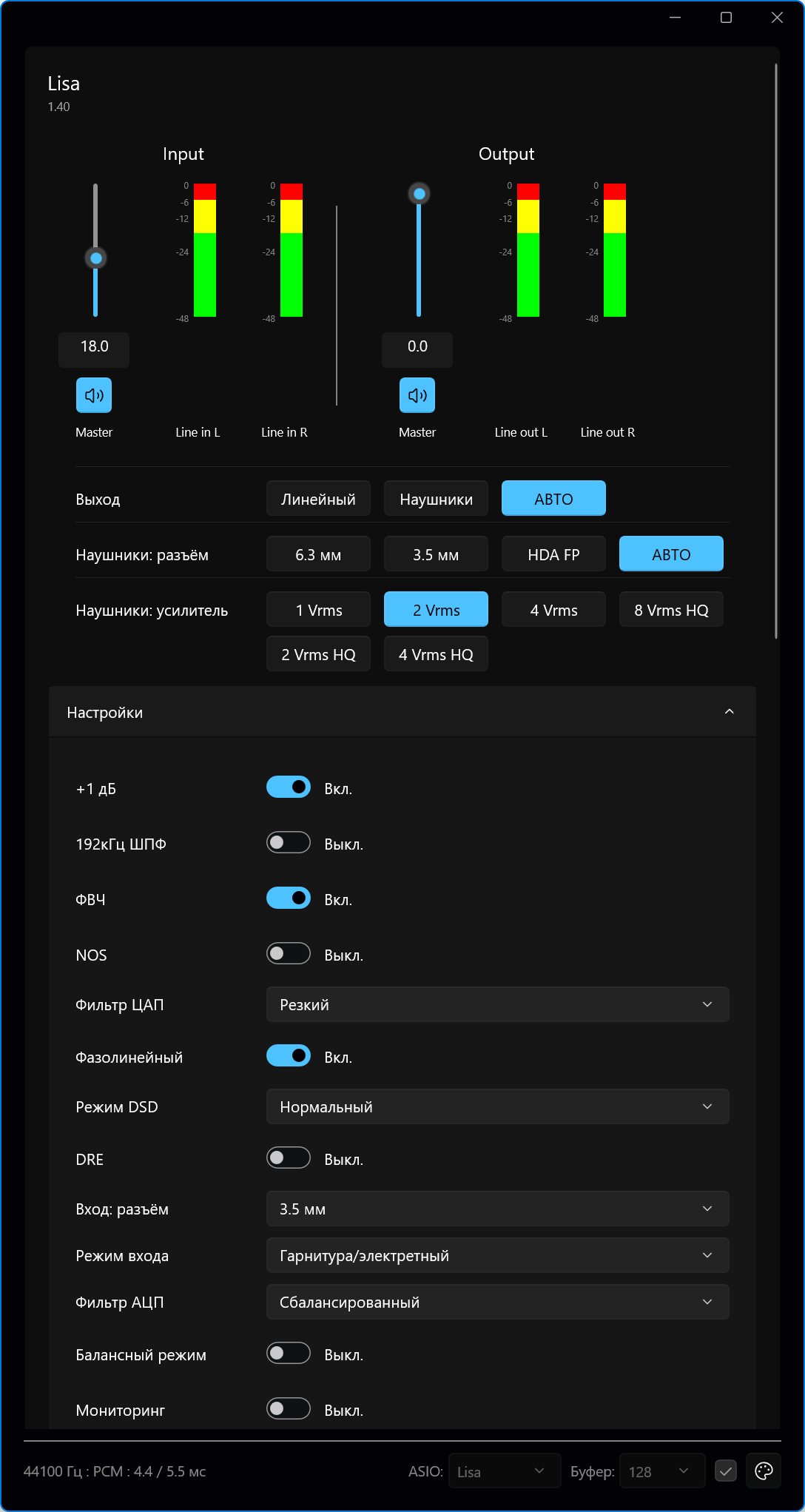
The main change is that recording and playback peak meters, volume controls and common device options are all in one window. There are no tabs or separate pop-up windows. Seeing the signal level helps during recording as well as playback. Users can check microphone or line-source levels before starting a recording.
The panel controls Lisa's hardware directly. Commands go to the DAC and ADC over the I2C service bus. Audio data is not changed. The device model and firmware determine which settings are available. This allows one control panel to support all Lisk Audio devices.
Select the ASIO buffer size in samples at the bottom of the window. A smaller buffer reduces latency in professional applications. However, a small buffer needs a faster processor and a computer optimised for audio. Normal music playback does not require changes to the buffer.
Frequently used modes are easy to access. Three options are particularly useful for Lisa:
OUTPUT = Line / Headphones / AUTO. Selects the RCA line output or headphone output. In AUTO mode, connecting headphones mutes RCA, and disconnecting them restores speaker playback. The desired output can also be selected manually.
HEADPHONES: CONNECTOR = 6.3 mm / 3.5 mm / HDA FP / AUTO. Selects the active connector, including the PC case's front headphone output. Automatic selection gives priority to HDA Front Panel, then 3.5 mm, then 6.3 mm.
HEADPHONES: AMPLIFIER Selects the hardware amplifier mode: 1 Vrms, 2 Vrms, 4 Vrms or an HQ option, including 8 Vrms HQ. Vrms means root-mean-square signal voltage. Choose the mode to match headphone sensitivity and the volume you need. Use a high output level only when needed. HQ identifies alternative hardware modes provided by the developer.
Other parameters appear in the expandable Settings section. These include microphone and line input mode, ADC and DAC filters, direct monitoring and other functions.
Global keyboard shortcuts work in any application. For example, a shortcut can switch between headphones and speakers or change the headphone amplifier's output level. The panel window does not need to be open. The server process must remain running, however. The server and graphical interface are separate, so closing the window does not stop keyboard control. When the panel is minimised, meter rendering stops to save resources.
The new panel is free for all Lisk Audio customers and is available from the official website. It runs on Windows 10 x64 version 1809 or later, including Windows 11. The panel needs Lisk Audio driver 6.20. Firmware 1.40 is needed to use all the new features. The latest drivers and firmware are in the Downloads section. Detailed hardware settings are described on the Lisk Audio Lisa.
ASIO RTL Latency

We normally test audio devices at 44 kHz with a 64-sample buffer. Lisa's measured latency was 8 ms. This is typical of many recording devices and works well for music creation and video editing in professional ASIO applications. A firmware update can reduce latency to about 5 ms. Lisa is therefore also suitable for playing virtual instruments from a MIDI keyboard. For recording, hardware Direct Monitoring lets you hear the input signal with zero latency. The option is in the card settings.
If the lowest possible round-trip latency (RTL) is essential in your digital audio workstation (DAW), consider a professional rackmount Thunderbolt interface. These devices can achieve latency below 1 ms. But the computer must process the audio fast enough for such a small buffer. Demanding DAW projects may need a dual-processor workstation. The cost can reach many thousands of dollars. Achieving this level of performance means spending much more money and effort. Yet Thunderbolt audio devices sell in very small numbers, despite advertising that highlights low latency. Perhaps these record figures are not essential for most users. A buffer of a few milliseconds still allows normal audio work. In our view, claims that the lowest possible latency is essential often lead to forum arguments rather than practical benefits.
Features:
Input channels: 2
Output channels: 2
Input latency: 322
Output latency: 375
Min buffer size: 8
Max buffer size: 2048
Preferred buffer size: 256
Granularity: -1
ASIOOutputReady — not supported
Sample rate:
8000 Hz — not supported
11025 Hz — not supported
16000 Hz — not supported
22050 Hz — not supported
32000 Hz — not supported
44100 Hz — supported
48000 Hz — supported
88200 Hz — supported
96000 Hz — supported
176400 Hz — supported
192000 Hz — supported
352800 Hz — supported
384000 Hz — supported
Input channels:
channel: 0 (Line in L) — Int32LSB
channel: 1 (Line in R) — Int32LSB
Output channels:
channel: 0 (Line out L) — Int32LSB
channel: 1 (Line out R) — Int32LSB
The ASIO driver supports modes up to 384 kHz. There are two recording and two playback channels, matching the physical inputs and outputs. Select Loopback in the card settings for online broadcasting. Loopback can also check that data is sent bit-perfect and that the 32-bit mode is genuine. The extra eight bits add 20 log (2 ^ 8 bits) = 48 dB to the dynamic range.
RMAA measurements
We tested Lisa's line output with the Russian RMAA measurement software. A MUX2 USB interface recorded the signal. MUX2 has 124 dBA dynamic range and 0.00003% distortion. Lisa was installed in a high-performance PC with an eight-core Core i7 11700K processor and an RTX 3060 Ti graphics card.

| Device under test | [ASIO] Lisk Audio ASIO |
| Operating mode | 32-bit/44 kHz |
| Audio interface | ASIO |
| Signal path | Line output |
| RMAA version | 6.4.5 PRO |
| 20 Hz–20 kHz filter | YES |
| Signal normalisation | YES |
| Level change | -1.3 dB / -1.3 dB |
| MONO mode | NO |
| Calibration signal frequency, Hz | 1000 |
| Polarity | Correct/correct |
| Frequency response (40 Hz–15 kHz), dB | +0.03, -0.01 |
Excellent |
| Noise level, dB(A) | -119.8 |
Excellent |
| Dynamic range, dB(A) | 119.8 |
Excellent |
| Total harmonic distortion, % | 0.00011 |
Excellent |
| Total harmonic distortion + noise, dB(A) | -92.4 |
Excellent |
| Intermodulation distortion + noise, % | 0.00161 |
Excellent |
| Stereo crosstalk, dB | -92.5 |
Excellent |
| Intermodulation at 10 kHz, % | 0.00043 |
Excellent |
| Overall assessment | Excellent |
Detailed line-output measurements at 24-bit/44 kHz in the RMAA report
These figures are difficult to reach even with an external USB DAC and a separate power supply. Lisa produced excellent results while installed inside a PC and powered from PCIe. Figures may differ on other computers or with other power supplies. We also measured higher dynamic range that confirmed the published specifications. Turning off the +1 dB option can lower distortion further, to 0.00008%. But record figures are not the goal by themselves. The musical performance and sound character deserve attention too. Graphs are unlikely to show all of this soon. Sound quality is more complex than a value in percent, decibels, centimetres or kilograms. Treat measurements as reference information. These results also help answer concerns that clean audio is impossible inside a PC.
Sound quality
Lisa has distinctive hardware and impressive sound. The card gives excellent results in any PC configuration. Sound is clean and detailed without special settings or unusual components to fix source problems. Lisa sounds good immediately in any setup and needs no warm-up.

I would like to describe a listening session at the Aris showroom. The practical comparison is more useful here than a poetic description of a Shostakovich symphony. Aris is a major distributor of professional audio equipment. Aris also develops the Russian T.H.E. (True High End) valve amplifier range, based on Matyushin's circuit. These amplifiers are expensive and designed for high-end speakers. Their valves serve a real audio purpose. The amplifier sounded linear and uncoloured, without the constant warm tone often heard in low-cost valve models. To demonstrate its full quality, Aris needed a high-quality DAC. Our colleagues chose Germany's RME, known for professional products and studio sound. They suggested a comparison between Lisk Audio Lisa at 50,000 roubles and the latest RME Babyface PRO FS external USB interface at 80,000 roubles. We compared the line outputs only. We did not compare microphone inputs or headphone outputs. The group included audiophiles and engineers who doubted that audio sources could sound different.
The playback system was impressive. The three-way Klipsh Cornwall floorstanders cost 1.2 million roubles and use 15-inch woofers and horns. The amplifier was the top T.H.E. 50 at 500,000 roubles. It operates in Class AB with classic KT88 pentodes in an ultralinear circuit. Expensive audiophile interconnects were available, but we chose not to use them. This reduced the number of variables and kept attention on the audio sources. RME was connected with a pair of German balanced Klotz MC5000 cables and Neutrik connectors. Lisa used Cordial CFU RCA cables with REAN connectors. Neutrik also owns the REAN brand. The T.H.E. amplifier had balanced and unbalanced inputs. Its remote made switching sources easy. Before listening, we took time to match the levels carefully. Even a few tenths of a decibel can give one high-quality device an advantage. The system made source differences easy to hear. The listeners were experienced and had no reason to favour a particular brand. Their aim was to find sound that would appeal to many people and help sell amplifiers. The showroom's open days attract many visitors who come to hear equipment. Many visitors then buy products. The large room had been acoustically treated by Aris specialists. The showroom is in the basement of a shopping centre, so we could use any playback volume we needed.
The group listened to rock, classical, electronic and jazz music. A computer running foobar played through ASIO and each device's own driver. All recordings were uncompressed FLAC files at standard and high resolutions. The amplifier and Klipsh speakers worked very well together. The speakers' high sensitivity allowed comfortable listening from three metres away. This was impressive in a large room with sound-absorbing materials. The amplifier manufacturer explained that its power rating, although below a hundred watts, was honest. The amplifier usually plays louder than competitors that claim more power. We liked the system very much. The price and space needed for these large speakers were the only reasons not to buy it. The speakers need to be placed far apart. This would be difficult in an average home.
RME produced good, fairly even sound with a professional studio character. The sound was suitable for editing, mixing and other audio work. Switching the amplifier to Lisa made a clear difference. The soundstage became much wider. The sound felt more spacious and open, and music held our attention more strongly. Our colleagues immediately asked to use Lisa for amplifier demonstrations. RME would be used for professional audio work and recording with professional microphones. In this comparison, RME was also not a strong choice as a headphone source. Its OPA1688-based amplifier was far behind Lisa in power and performance, with only 50 mW output. The size of the audible difference surprised everyone. Participants asked how a source could make such a difference when even $100 devices now give similar sine-wave measurements. The group tried other music genres, reset driver settings, tested options and checked the cables again. The result was hard to accept at first. Listeners wanted to know which parts of Lisa's hardware could explain such a clear advantage. After disbelief, frustration and more tests, the group accepted the result. With Lisa connected, listeners stayed to replay their favourite tracks. Lisa remained at the showroom. The card is now used regularly and is also taken to off-site events. The combination of a Russian source and a Russian power amplifier worked especially well. Lisa can improve more affordable systems too. But top-quality equipment and carefully chosen recordings are best for a serious assessment.
Conclusions
Lisk Audio Lisa shows that good PC sound is possible and accessible. Internal sound cards remain popular with people who build computers for their own needs. Many want high performance without compromises. An internal card can also outperform an external USB device. The manufacturer saves on an enclosure and power supply and can spend more on parts that affect the sound. Lisa suits audiophiles, gamers and people who create music or video. Often one person does all these things and wants high quality in each.
Lisa has been produced in small batches since 2024. Customers can order a card or buy one from stock. Collection from the manufacturer's warehouse and delivery within Russia are available. The more expensive Lisa Pro arrived in 2026. Lisa Pro uses dual-mono CS43198 converters and professional balanced 6.3 mm TRS inputs and outputs. It also has a condenser microphone input with +48 V phantom power.
The company's Russian-language website answers most questions and links to drivers and firmware. Lisk Audio talks actively with customers and answers questions. Technical support and a warranty are also available.
Note. This is an adapted machine translation into English. It follows the “In simple terms” approach. Read the original article at https://prosound.ixbt.com/interfaces/liskaudio-lisa.shtml.