
ROXTON AA-40M — a compact PA amplifier with a wide range of features
Alexander Ivanov
ROXTON is a Russian developer and manufacturer of public address equipment and announcement systems with more than 20 years of experience. The company started by supplying loudspeakers. It now develops and produces its own emergency announcement, background music and public address systems.
In this review, we look at an entry-level solution: the 40 W ROXTON AA-40M PA mixer-amplifier for speech and music distribution.
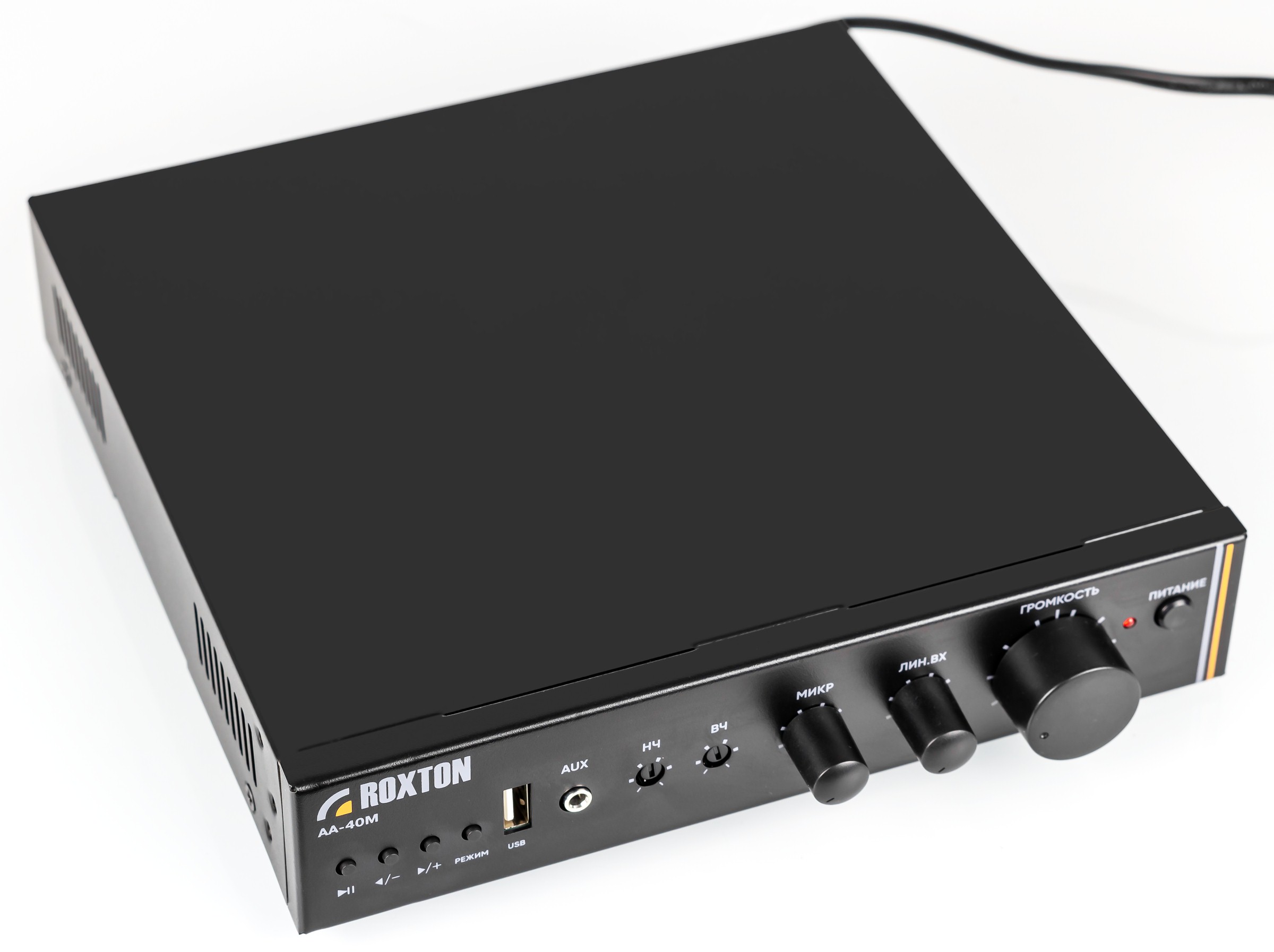
The small size and simple controls make this amplifier suitable for smaller spaces, including offices, food service premises, shops, cafés, bars and restaurants. The built-in MP3 player can provide background music from a USB drive or over Bluetooth, without extra playback equipment.
Specifications ROXTON AA-40M
- Output power: 40 W
- Frequency response: 150 Hz–15 kHz
- Total harmonic distortion: < 0.5%
- Amplifier class: D
- Audio inputs: line inputs on 2 × RCA and 1 × 3.5 mm TRS; microphone input on 1 × 6.35 mm TRS
- Audio outputs: line output on 2 × RCA (PRE OUT); low-impedance 4-ohm output; 100 V line output
- Supported external playback sources: USB, Bluetooth
- Supported audio formats: MP3
- Power supply: 230 V AC, 50 Hz
- Power consumption: 5 W with no signal; 75 W at full load
- Amplifier protection: overheating, short circuit, overload
- Dimensions (W × H × D): 215 × 44 × 220 mm
- Net weight: 1.8 kg
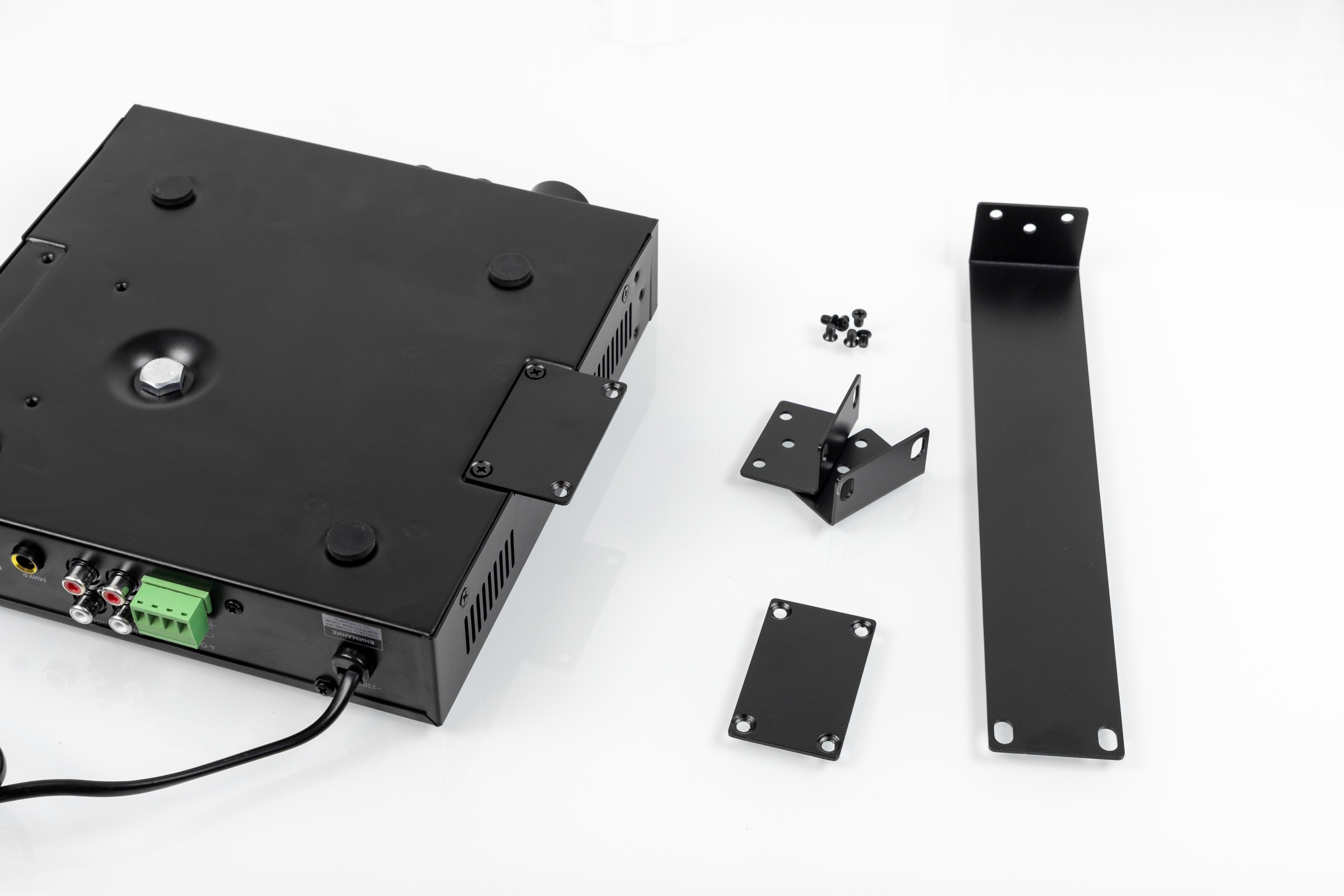
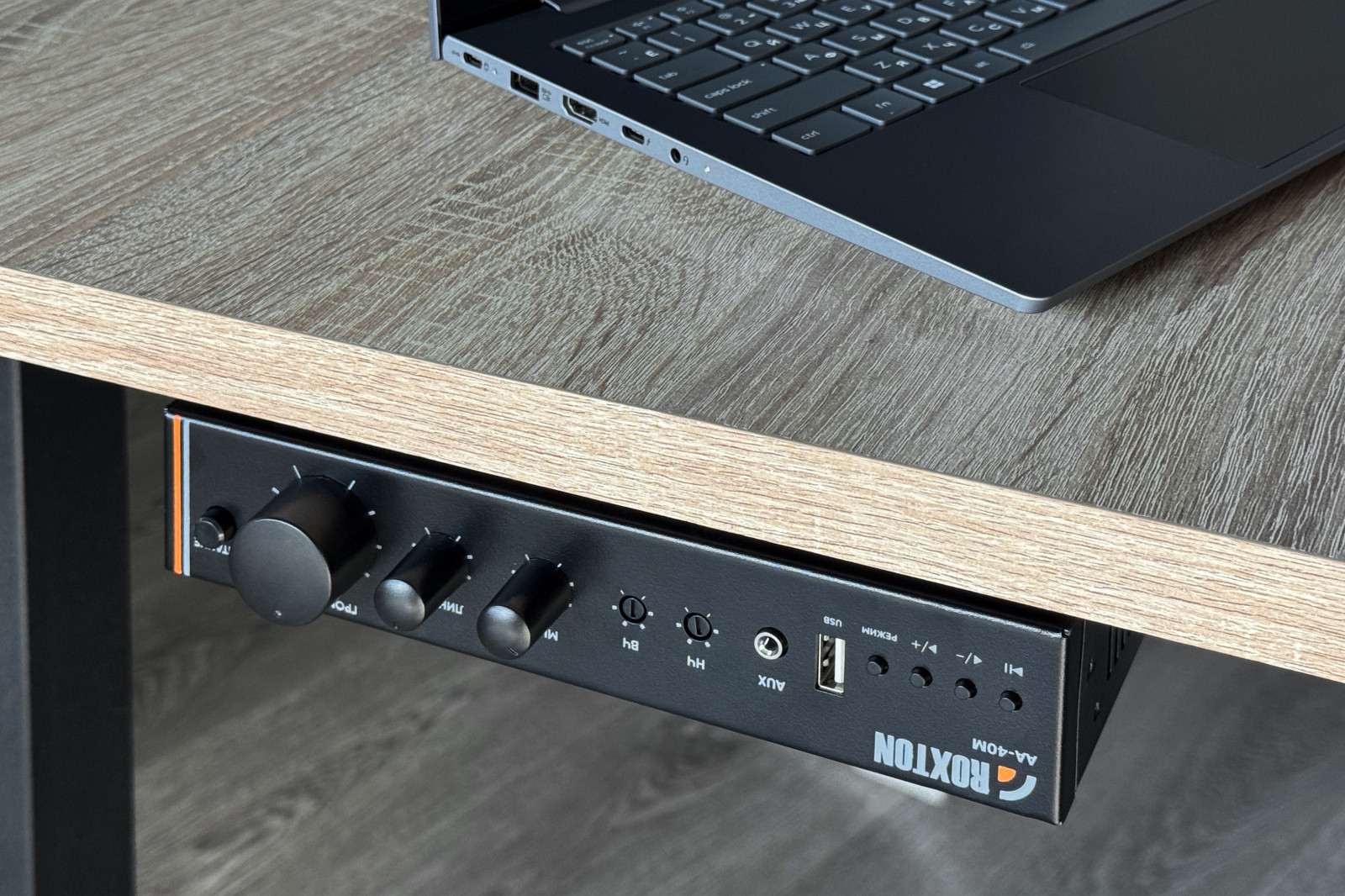
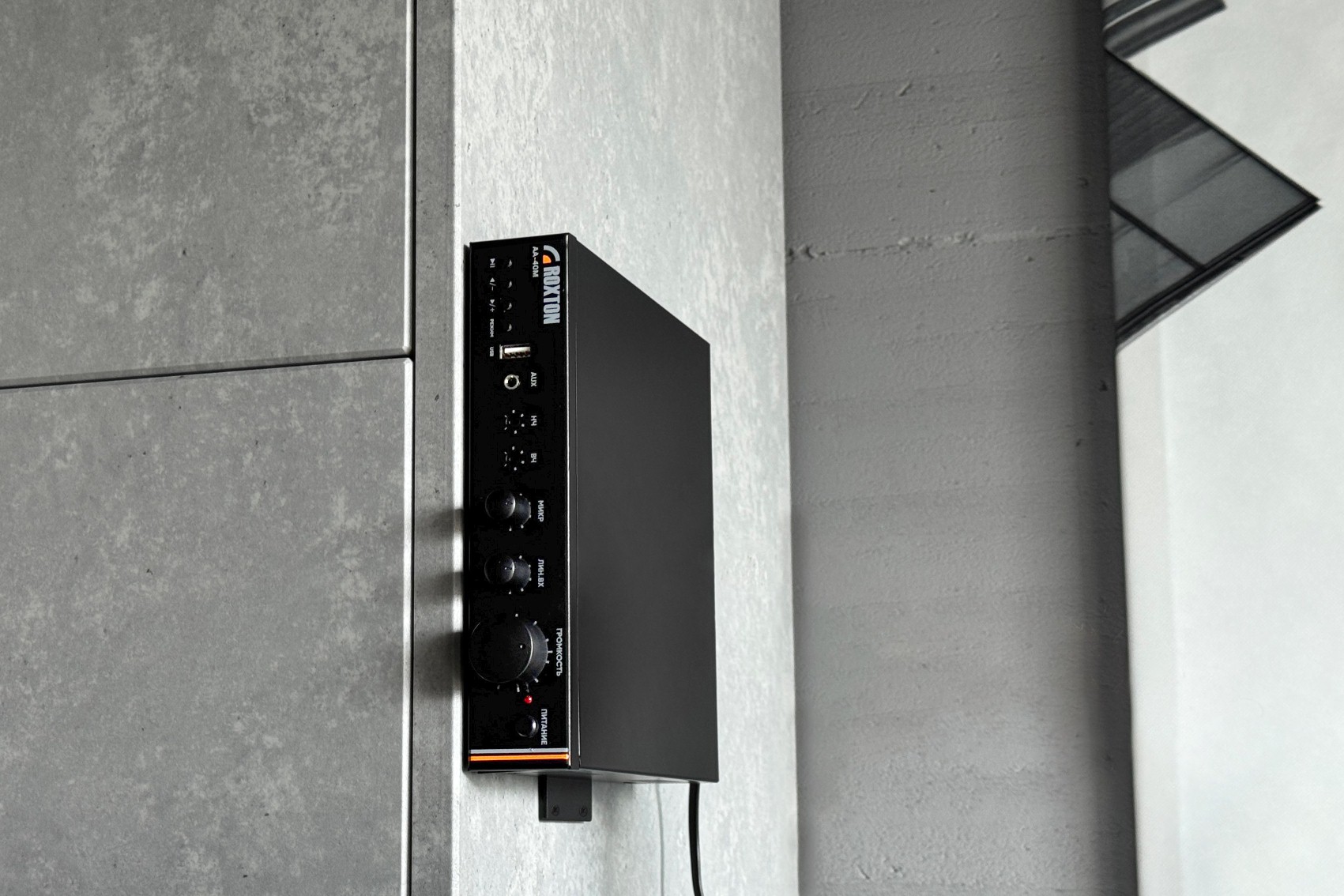
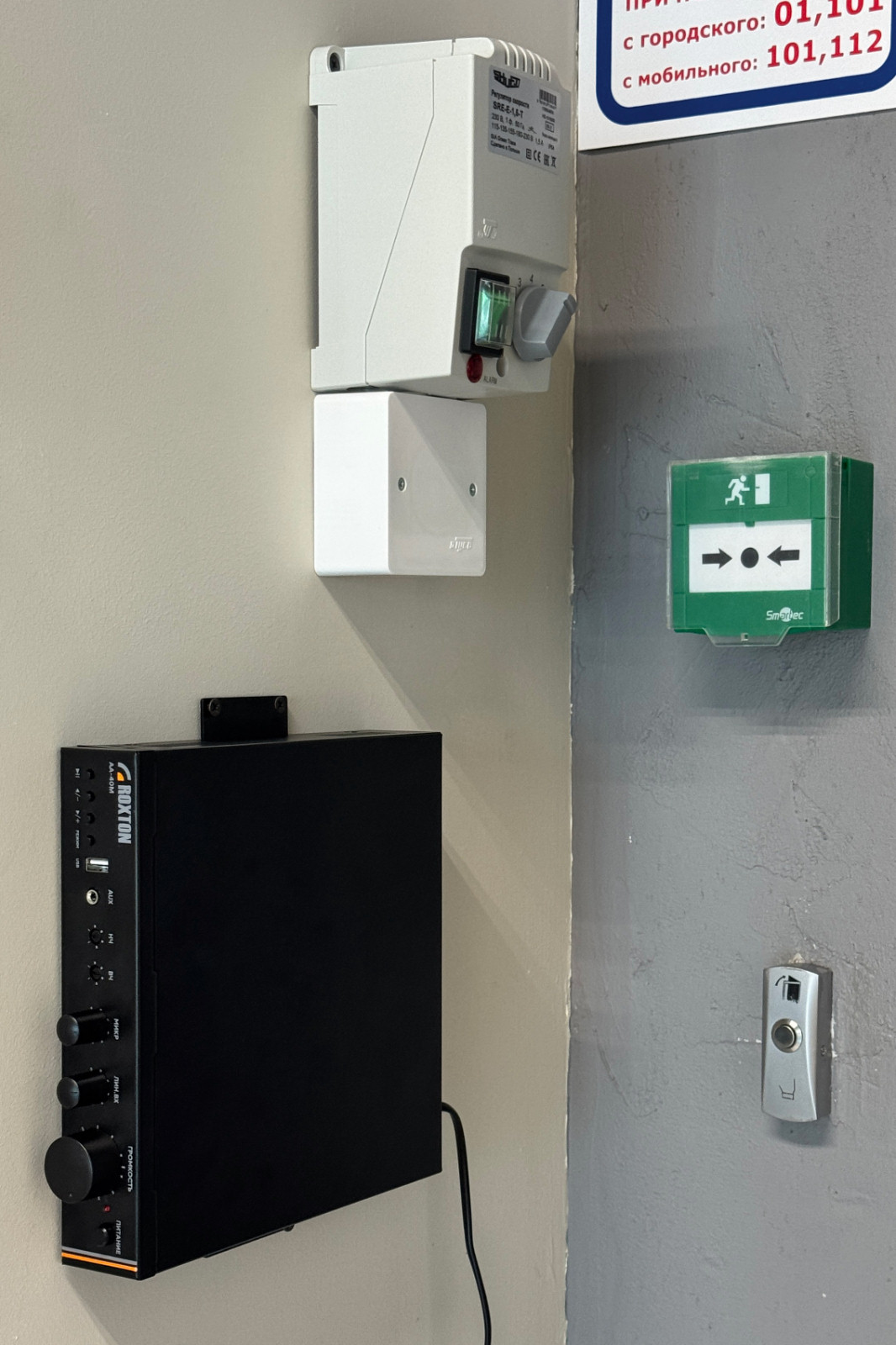
The package includes mounting parts for installing one or two amplifiers in a standard 19-inch equipment rack, using 1U of space. Soft feet also allow the amplifier to stand on any horizontal surface. Other mounting arrangements are possible. The photographs below show several examples.
The printed manual deserves special mention. It is supplied as a well-produced A4 booklet. The manual is detailed and answers almost every question about operating the unit.
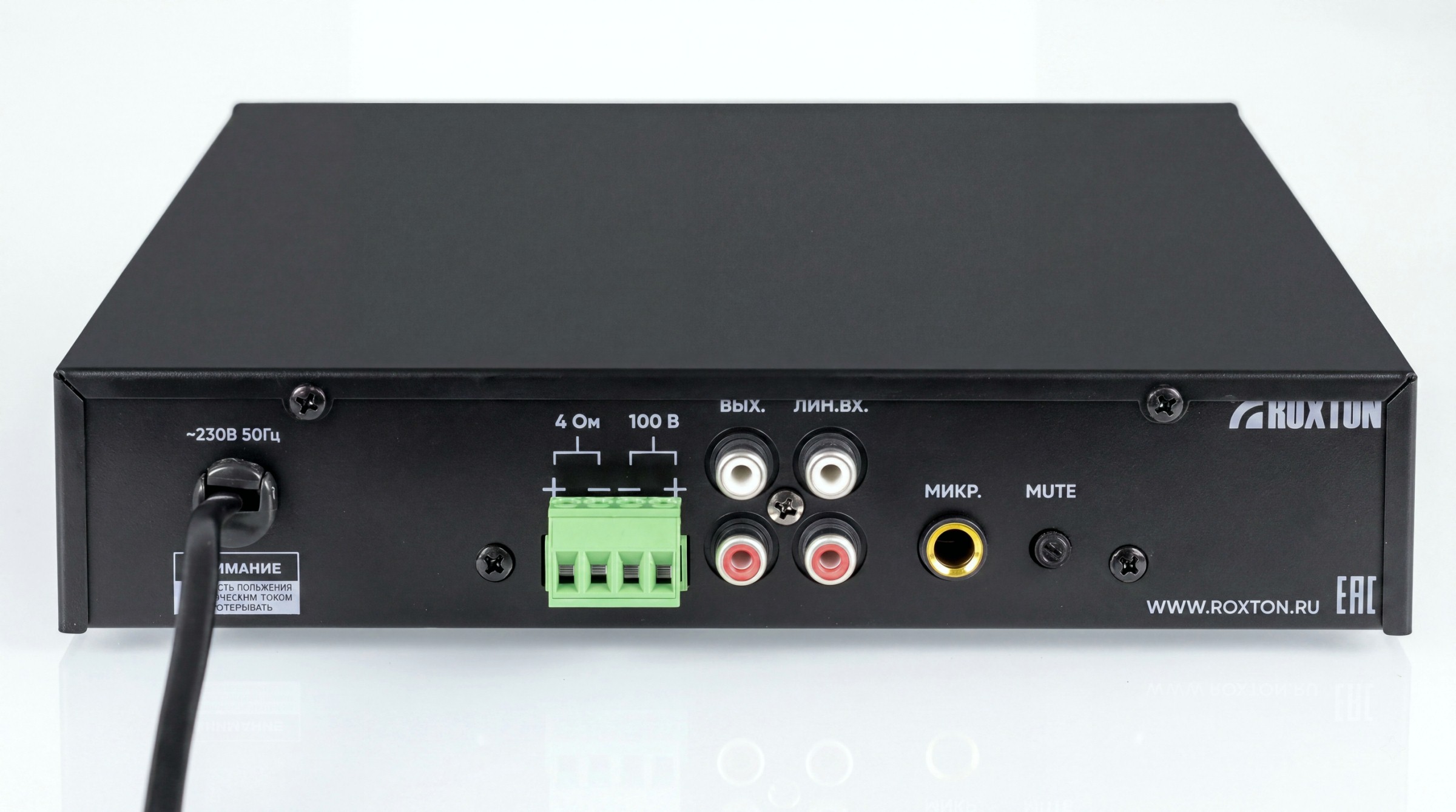
The amplifier can drive low-impedance speakers rated at 4, 8 or 16 ohms, or PA loudspeakers designed for a 100 V line. Remember that low-impedance speakers and 100 V loudspeakers must not be connected to the amplifier at the same time.
External line-level audio sources connect through the RCA inputs and the front-panel 3.5 mm TRS minijack. The amplifier mixes the signals from the line inputs. Their combined level is adjusted with the front-panel line-input knob. The front minijack is intended specifically for mobile audio sources.
For speech announcements, the amplifier has a microphone input on a 6.3 mm TRS jack. This input has priority. When a microphone signal appears, the line inputs and built-in player are automatically reduced in level. Announcements can therefore be heard clearly over the music. The MUTE control next to the microphone input adjusts the amount of attenuation, from minimum to maximum. The microphone input does not provide phantom power. You need an externally powered microphone, such as the ROXTON RM-01 recommended by the manufacturer, or a dynamic microphone.
The amplifier connects to the 230 V AC supply through a fixed 135 cm mains cable with a standard plug.
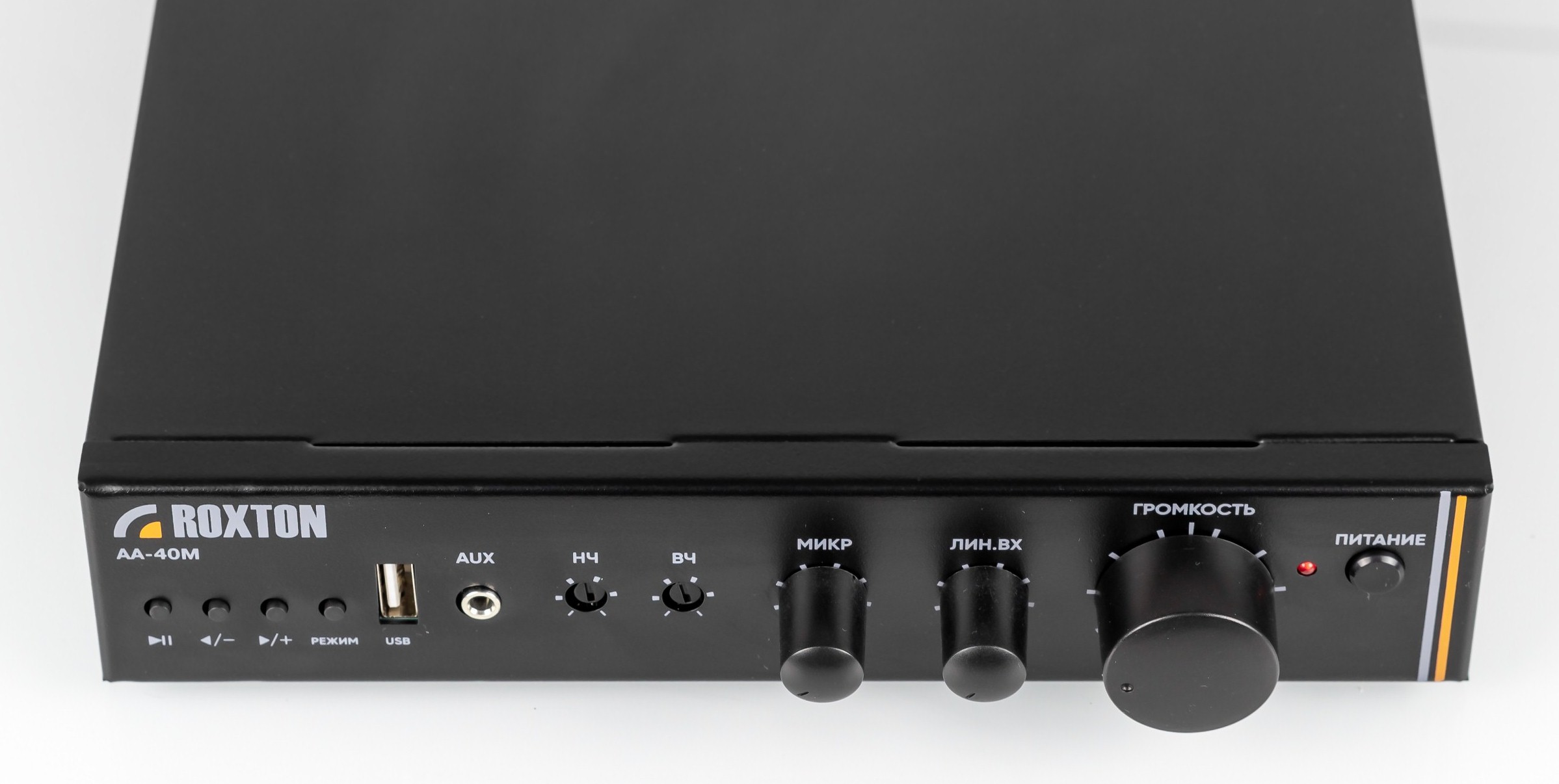
In addition to the microphone and line-input level knobs, the front panel has a master volume control and recessed tone controls adjusted with a flat-blade screwdriver.
The built-in MP3/Bluetooth player uses standard playback buttons. Pressing Mode cycles through line input, Bluetooth and USB. A voice message announces the current mode through the speakers connected to the amplifier.
When a USB drive containing music is inserted, the amplifier automatically switches to USB playback. Playback also starts automatically when the amplifier is powered on with a USB drive already connected. This reduces the work needed from staff: inserting a drive or switching on the power is enough to start the music. The player remembers its position when you change sources, even after an unexpected power loss. When USB mode is selected again or power returns, playback resumes from the same point. The player also supports uncompressed WAV files without loss of quality, although this is not documented.In Bluetooth mode, the amplifier appears and pairs as a standard audio device or headset named BT.

Changing playback mode and returning to Bluetooth does not require pairing again. We had no problems playing music from a phone. Although the Bluetooth antenna is mounted on the circuit board inside the metal case, reception is good. Playback did not break up within a range of 5 metres from the amplifier.
During Bluetooth playback, we heard low-level interference in the pauses, in the form of a quiet, periodic whistle. Its level did not depend on the volume controls. The likely cause is interference from the antenna reaching the power amplifier IC. The noise is low and should not be audible in normal installed use. Moving the Bluetooth antenna outside the case might have helped. In any case, we do not consider Bluetooth a high-quality, reliable audio connection. It is more suitable as a temporary option.
We heard no interference in any other playback mode.
The amplifier has RCA line outputs for expanding the sound system with additional amplifiers. The line-output signal is not affected by the master volume knob, but it is affected by the microphone and line-input knobs. Additional amplifiers therefore receive the same microphone-to-music balance as the main amplifier. Each amplifier can still have its own overall volume setting.
The paired RCA line-input and output sockets provide a through connection. This allows a system to be expanded to any number of amplifiers using standard RCA cables, without distribution boxes.
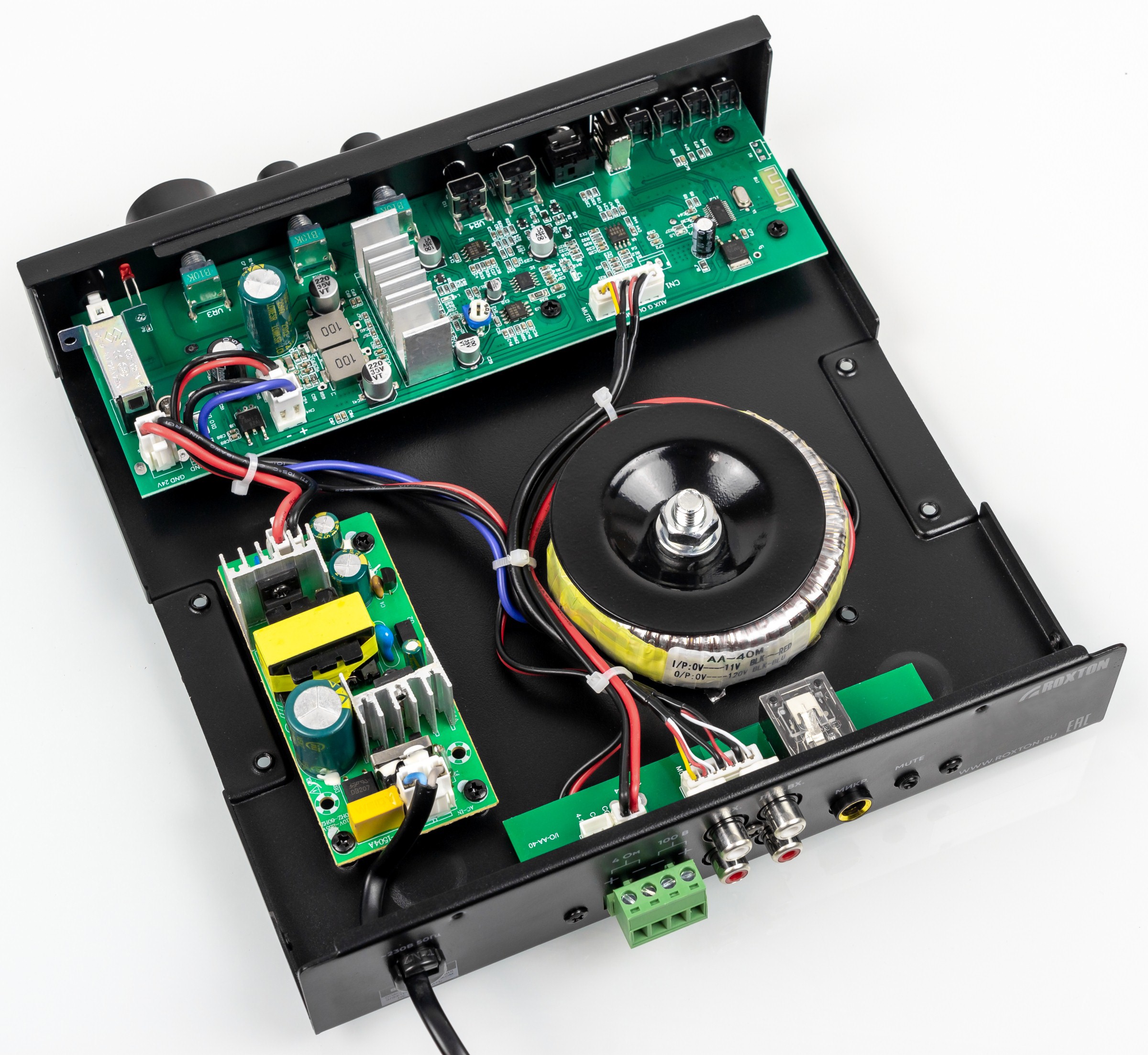
We opened the amplifier to examine its technical design in more detail.
Older PA amplifiers usually used class AB circuits. These needed large heatsinks, had low efficiency and lost around half their power as heat. The ROXTON AA-40M instead uses a modern, efficient class D power amplifier IC with a small heatsink.
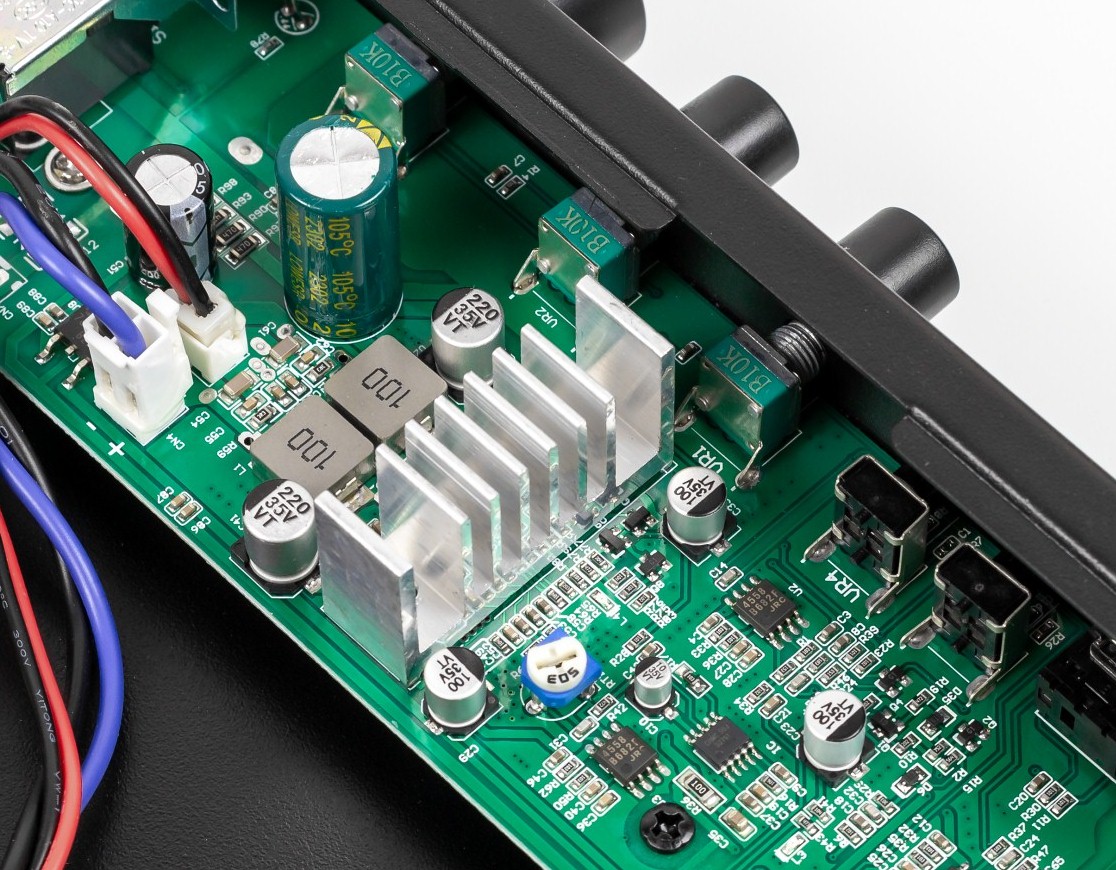
Power comes from an efficient switched-mode power supply. This helps reduce case size, power consumption and heat during operation. Note that the front-panel power button disconnects the amplifier circuit from the supply. The switched-mode supply itself remains connected to the 230 V mains.
The 100 V loudspeaker output uses a conventional step-up toroidal transformer. The transformer provides galvanic isolation between the 100 V loudspeaker line and the main amplifier circuit. This improves staff safety and system reliability during faults, such as a short circuit on the line or external high voltage reaching the line through a mains fault or lightning strike.
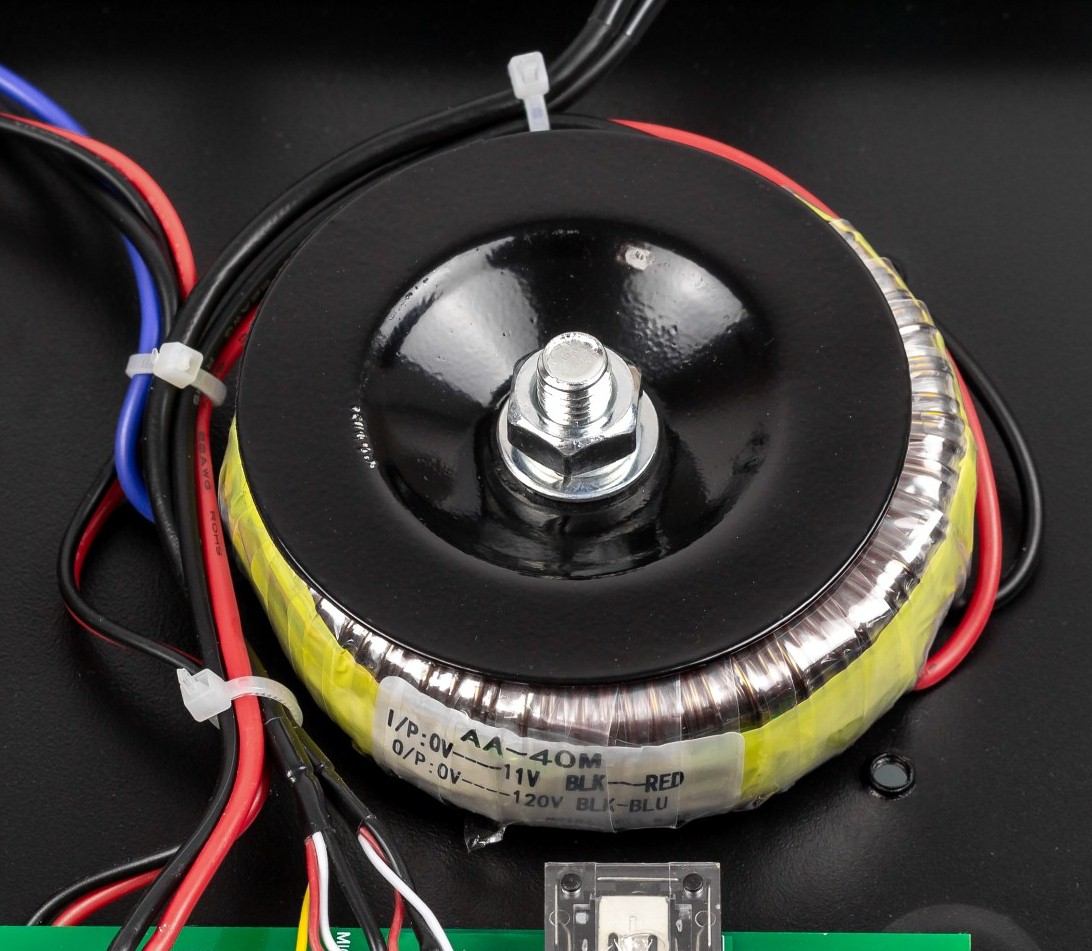
The manual's block diagram shows the 4-ohm speaker output connected through a separate transformer winding, with galvanic isolation. However, in our amplifier, the low-impedance output is connected directly to the class D amplifier IC. This is not a problem for the intended use. It can even improve sound quality with Hi-Fi speakers by removing the transformer, which causes high-frequency roll-off, from the signal path. However, the 4-ohm outputs have a 12 V DC offset relative to the case and signal ground. Nothing other than passive speakers may be connected to the 4-ohm output.
The manufacturer prohibits connecting low-impedance speakers and a 100 V line at the same time. The system designer must choose which type of loudspeaker to use.
For background music within one room, where sound quality matters, the low-impedance output and low-impedance speakers are the better choice. The ROXTON MS-40TB is one example. If the announcement line runs for tens of metres and is used for fire announcements, certified 100 V PA loudspeakers and fire-system cable are needed. A 100 V system reduces cable power losses and keeps loudspeaker levels consistent along the line.
We measured input sensitivity with the level controls at maximum. The input voltages below produce 100 V at the high-voltage output.
- 6.3 mm TRS microphone input: 10 mV
- RCA line input: 500 mV
- Front-panel 3.5 mm TRS AUX input: 330 mV
- RCA line output: 330 mV
- 4-ohm output: 9.3 V
- 100 V output: 100 V
Maximum output voltage with no load
- 4-ohm output: 11 V
- 100 V output: 120 V
Our tests showed that the amplifier has an output-voltage limiter, although the manufacturer does not mention this in the documentation. When the input signal exceeds the maximum level, the output voltage stops rising. There is no hard clipping: the waveform is maintained and no unpleasant distortion appears. This is an important feature that improves the reliability and performance of an announcement system. Staff cannot simply turn the volume above its limit and damage the equipment.
We ran a long stress test at maximum output power using a sine-wave signal. The case became only slightly warm, and the internal heatsinks stayed below 75 degrees. With music in normal use, heat will be much lower.
The amplifier has protection against overheating and output short circuits.
We simulated a line fault by shorting the low-voltage and high-voltage outputs with a jumper while the amplifier was operating at maximum output voltage. The amplifier passed the test, shutting off the output signal. After the short circuit was removed, normal operation resumed.
Measurements
We used the RightMark™ Audio Analyzer PRO hardware and software system to measure the amplifier's technical performance.
Measurements were made at maximum output voltage. A 4-ohm resistive load was connected to the low-impedance output, and a 250-ohm load to the high-voltage output.
The measurements confirm the manufacturer's published specifications.
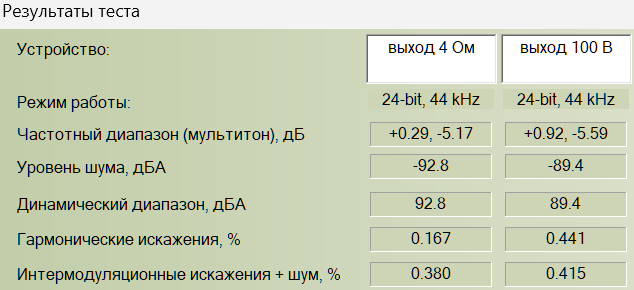
Output frequency response.
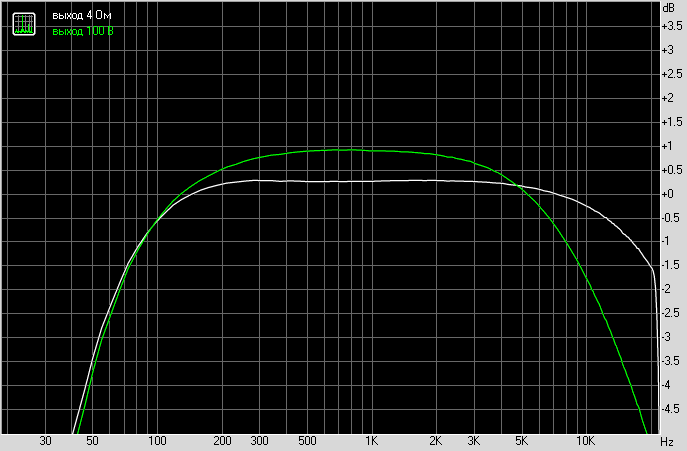
The roll-off below 100 Hz is typical of PA amplifiers with step-up output transformers. The step-down transformers in 100 V loudspeakers will also affect bass response. For most tasks in this amplifier's price range, this is not a serious issue. If stronger low-frequency output is needed for background music, an active subwoofer connected to the line output is a better solution. Note that the low-impedance output provides a wider frequency range and lower distortion than the published specifications. This makes the low-impedance output preferable for background music.
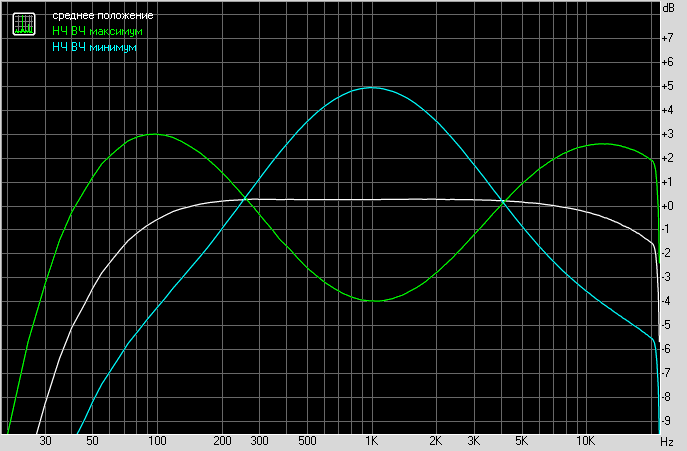
The amplifier has tone controls for adjusting the sound. The graphs below show frequency response with the controls at their centre, maximum and minimum positions.
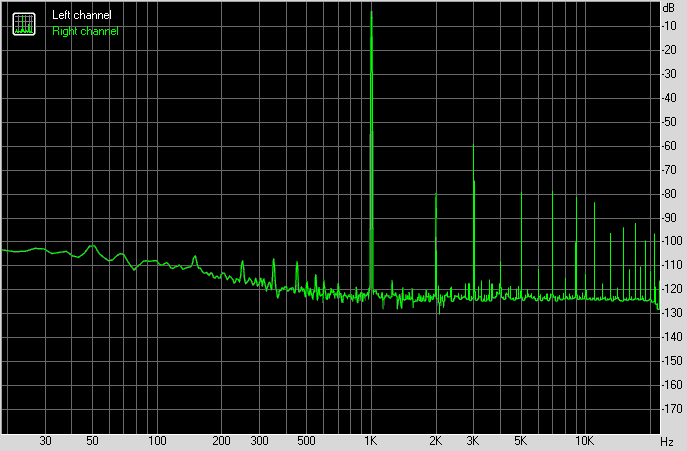
The distortion spectrum at maximum output power is typical of most class D amplifiers.
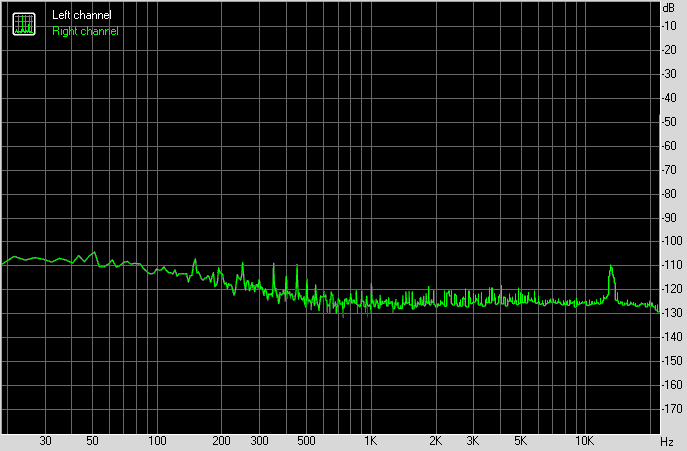
With no input signal, the amplifier produces a clean spectrum. There is no interference or low-frequency hum.
Sound
We listened to the ROXTON AA-40M with a low-impedance speaker and a 100 V PA loudspeaker. Sound quality was suitable for background music and speech announcements. The amplifier did not noticeably change the tonal character of the signal, and speech intelligibility was excellent. With music, treble reproduction was noticeably better than with traditional transformer-coupled class AB PA amplifiers. The microphone input remained quiet even at maximum gain. The tone controls allow further adjustment to taste.
Conclusions
The ROXTON AA-40M PA mixer-amplifier is a modern, practical and reliable device for providing good-quality sound in an office or café at low cost.
The range of audio inputs and the microphone input for announcements cover the needs of small business premises. The system can also be expanded to a larger area simply by buying and connecting more amplifiers.
Note. This is an adapted machine translation into English. It follows the “In simple terms” approach. Read the original article at https://prosound.ixbt.com/interfaces/roxton-aa40m.shtml.