
Radiotehnika S-20M — 5-inch active nearfield monitors
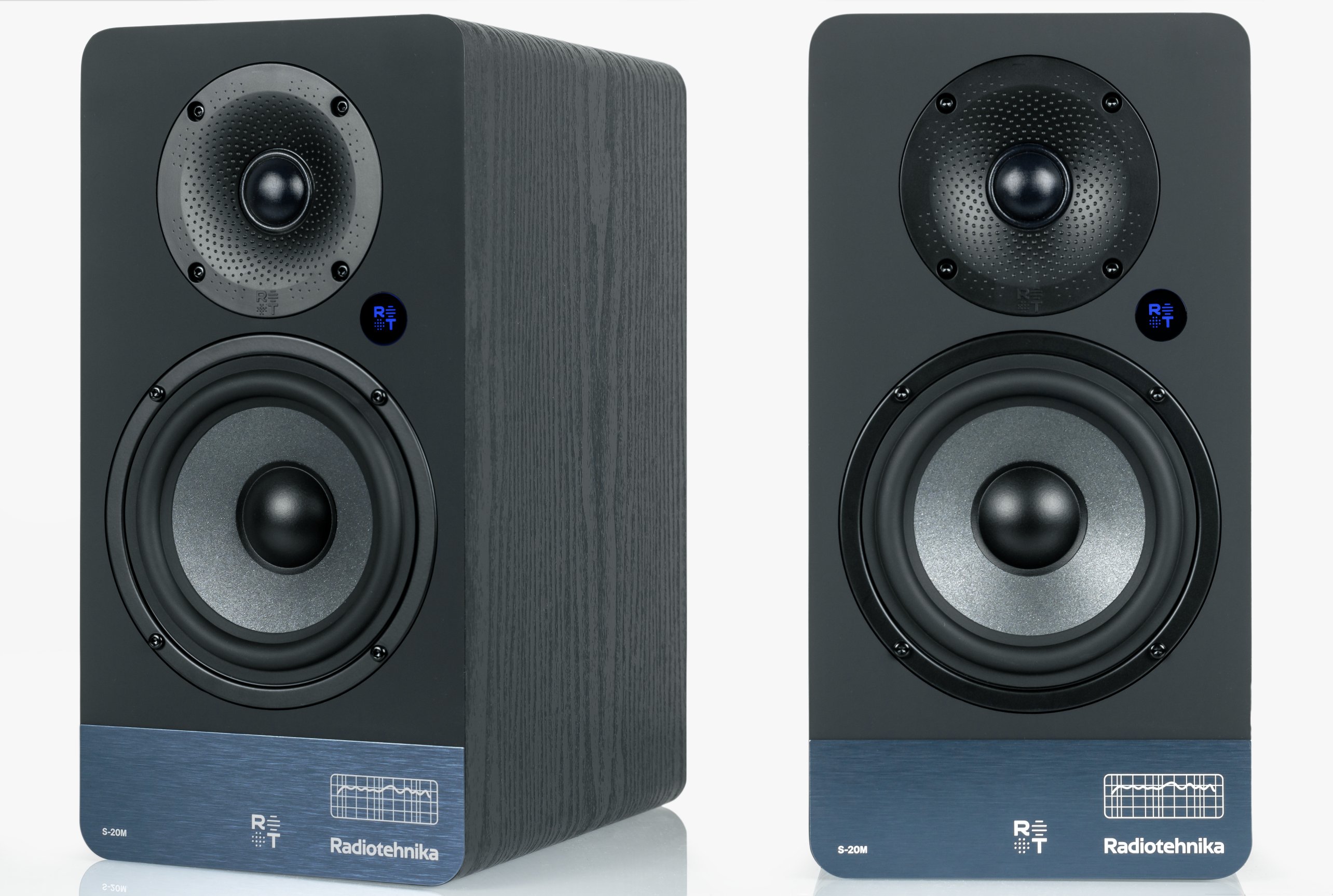
The Radiotehnika brand, relaunched in Russia with a new technical platform, has introduced its first studio monitors. The company chose the market's most popular format: active two-way nearfield speakers with 5-inch woofers. The new model is called the Radiotehnika S-20M, following the existing S-20 active Hi-Fi speakers. However, this is not simply a consumer speaker with an XLR input added, as sometimes happens with low-cost monitors. The S-20M has completely different electronics and different sound tuning.
Who is the Radiotehnika S-20M for? The main audience is a broad group of bloggers, musicians and computer users. This includes anyone who works with audio in professional software or wants active speakers with an even response and little colouration.
| Feature | Radiotehnika S-20NA MKII | Radiotehnika S-20M |
|---|---|---|
| Category | Hi-Fi bookshelf speaker | Studio monitor |
| Intended use | Music listening, TV, vinyl | Audio production, home studio |
| Connections | Bluetooth 5.0 (aptX HD), USB-C, optical, RCA (line/phono), minijack | XLR (balanced), RCA (unbalanced) |
| Frequency range | 55–20,000 Hz (±3 dB) | 50–20,000 Hz (±3 dB) |
| Amplification / power | Amplifier in one speaker, 2 × 50 W, class D | Separate bi-amp design: HF 20 W, LF 50 W, class D |
| Power supply | 24 V mains adapter | 220 V |
| Additional features | Subwoofer output, remote control | Adjustable HF/LF shelving filters |
| Sound profile | Forward sound with strong bass | Even, professional sound |
The two Radiotehnika models look similar and use similar cabinets, but the differences are significant. In the S-20 Hi-Fi pair, only one speaker contains an amplifier. The other, passive speaker connects through speaker cable. In the S-20M monitors, each driver has its own amplifier, as expected in a professional monitor. Amplifier power has increased, and the frequency range is wider.
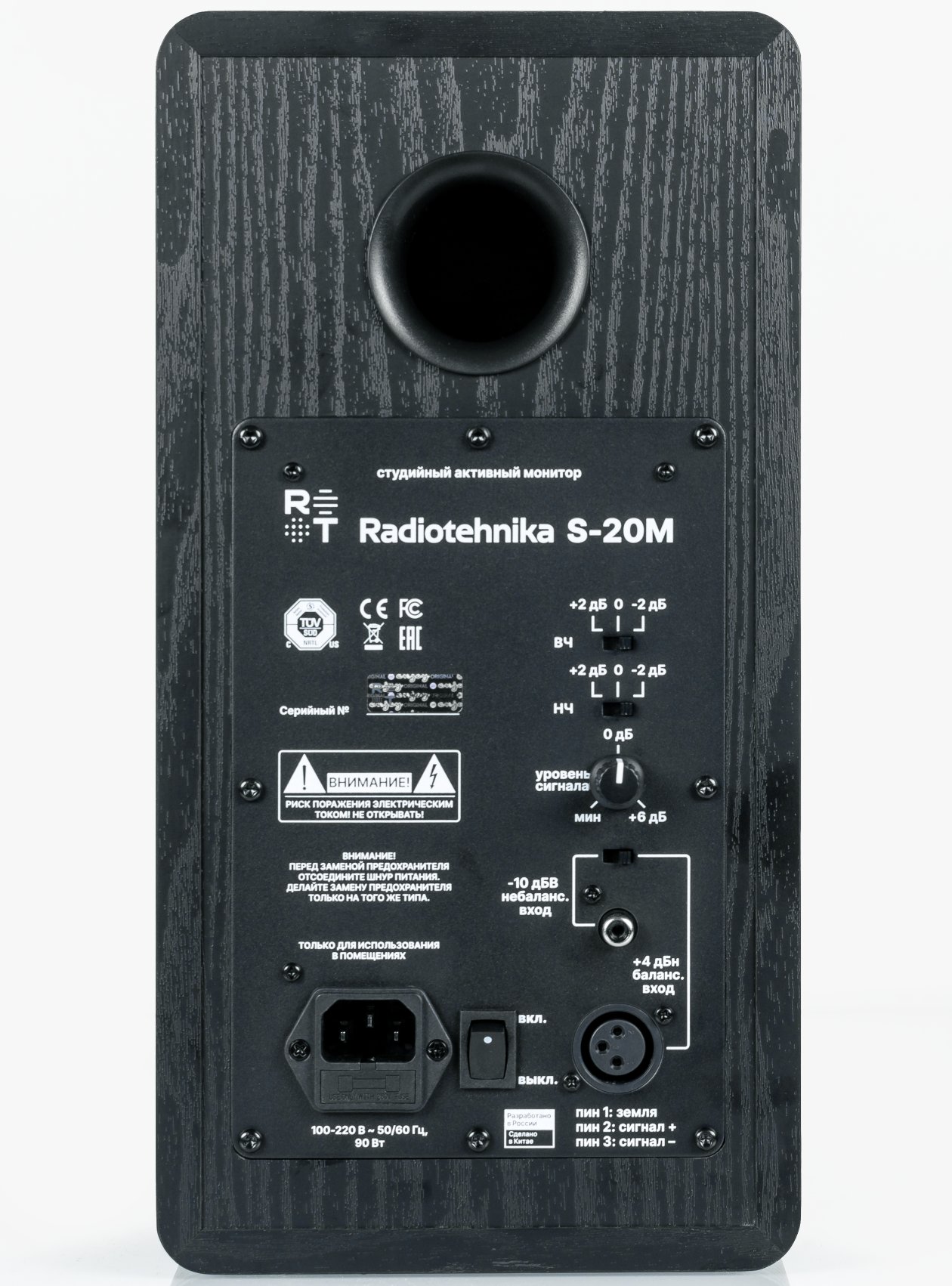
The connections are also very different from those of the Hi-Fi model. Digital inputs, Bluetooth and the remote control have been removed. The budget has instead been used for bi-amp amplification and a processor that handles the crossover and response correction. Radiotehnika's engineers have added proper balanced XLR inputs for professional recording interfaces. RCA inputs still allow consumer audio sources to be connected. Audio cables are not included, but suitable cables are widely available at different prices.
Users who want to save on the cost of power amplification can consider the similar-looking passive Radiotehnika Alfa 1.01 speakers. Each approach has advantages. Active Hi-Fi speakers offer many inputs, wireless connectivity and remote-controlled tone adjustment. Bi-amplified active monitors provide better matching between the amplifiers and drivers. Their digital crossover can align the frequency bands accurately, which is harder to achieve with passive analogue filters. Despite the more advanced amplification, the monitors cost almost the same as Radiotehnika's consumer Hi-Fi speakers.
The rear panel says: Designed in Russia, Made in China. Why not manufacture the speakers in Russia? The apparent reason is the lack of factories that can produce large quantities at an acceptable retail price. This problem is not unique to Russia.
Radiotehnika S-20M specifications
| Parameter | Value |
|---|---|
| System type | Active two-way nearfield monitor |
| Woofer | 5-inch (127 mm) Polyglass cone, butyl surround |
| Tweeter | 1-inch (25.4 mm) silk dome, neodymium magnet |
| Amplifier design | Bi-amping with separate class D amplifiers |
| RMS power | 70 W per monitor (50 W LF + 20 W HF) |
| Frequency range | 50 Hz–20 kHz (±3 dB); 46 Hz–22 kHz (−6 dB) |
| THD | ≤0.5% (>80 Hz) |
| Crossover frequency | 2.3 kHz |
| Adjustment range | HF: >4 kHz (0 dB ±2 dB); LF: <200 Hz (0 dB ±2 dB) |
| Maximum sound pressure level | 108 dB for a pair at 1 m |
| Built-in DSP | 24-bit / 192 kHz crossover and phase alignment |
| Cabinet material | High-density MDF with vinyl covering |
| Dimensions and weight | 334 × 170 × 258 mm, 4.8 kg per monitor |
The cabinet uses high-density MDF, with walls several centimetres thick. The structure is strong and designed to handle high sound pressure levels.
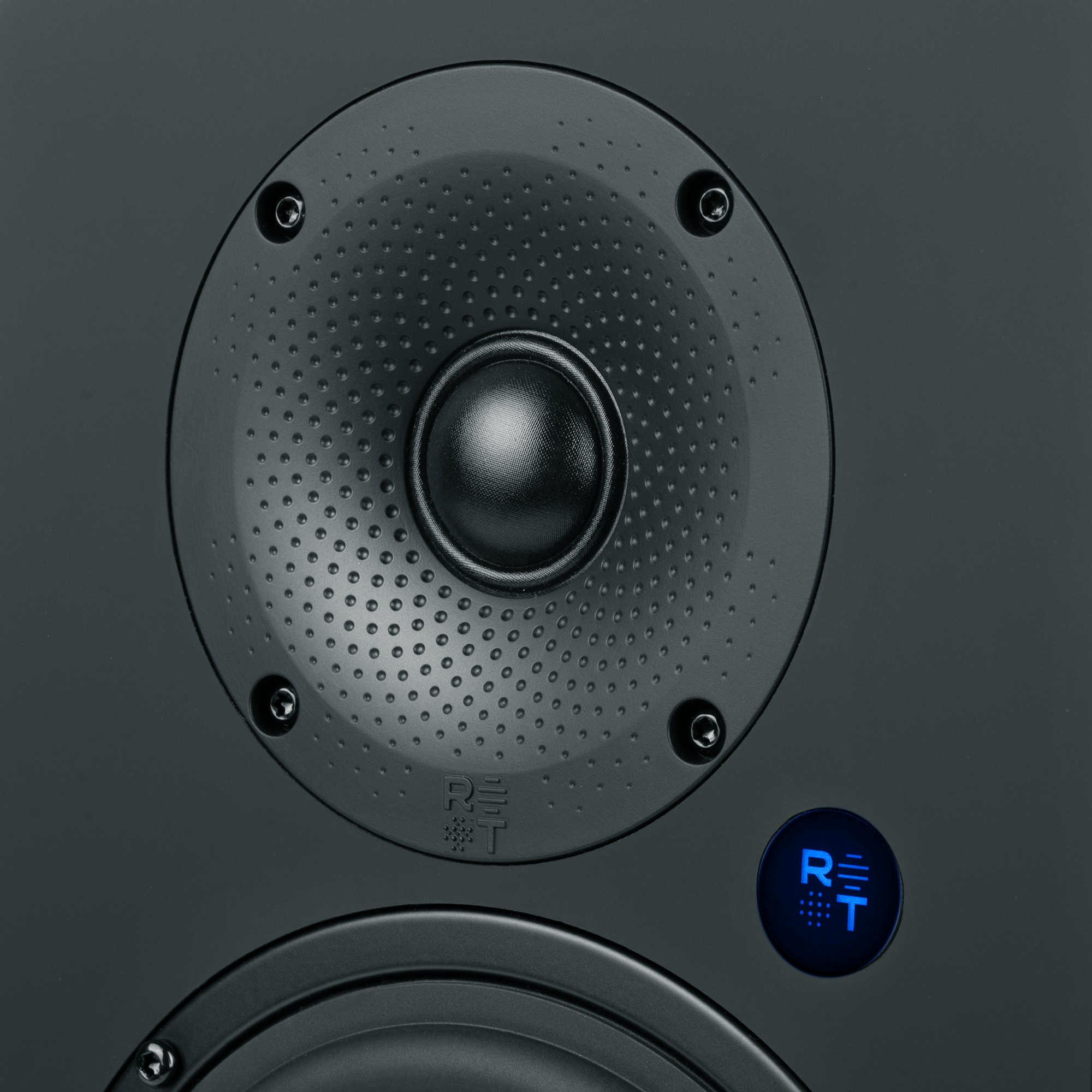
The 1-inch (25.4 mm) tweeter uses a conventional silk dome in a waveguide. A powerful neodymium magnet is fitted inside.
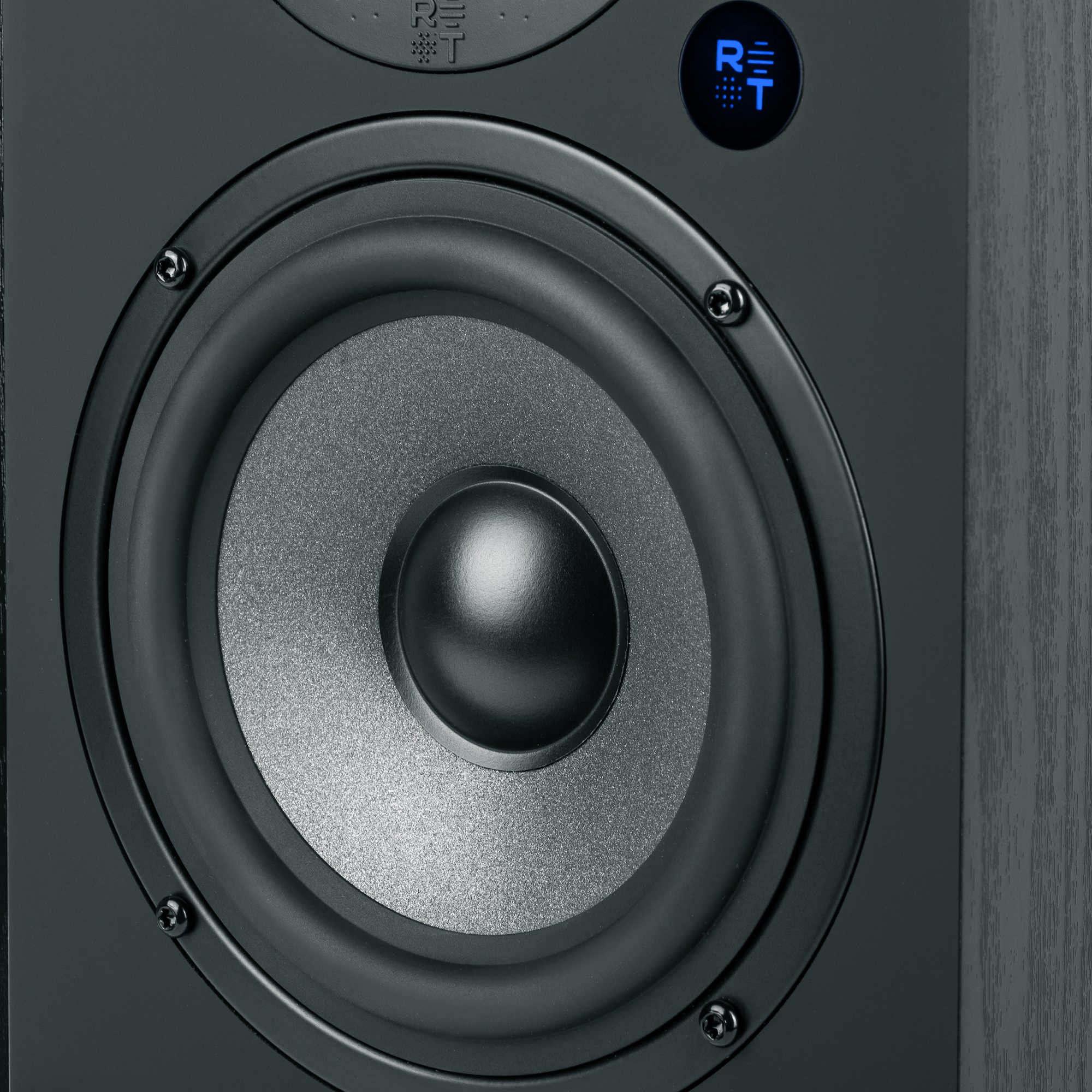
The drivers use materials normally associated with more expensive products. The Polyglass woofer cone combines cellulose with glass microspheres, providing stiffness and a fast response. Competitors at this price more often use ordinary polypropylene. The butyl surround is also worth noting: it resists moisture, cracking and decay, helping the driver last longer.
Let us compare the S-20M directly with leading international competitors in the same price range:
| Parameter | Radiotehnika S-20M | ADAM Audio T5V | KRK Rokit 5 G5 | JBL 305P MkII |
|---|---|---|---|---|
| LF / HF drivers | 5-inch Polyglass / 1-inch silk | 5-inch polypropylene / ART ribbon | 5-inch Kevlar / 1-inch silk | 5-inch polypropylene / 1-inch silk |
| RMS power (LF + HF) | 70 W (50 + 20) | 70 W (50 + 20) | 55 W (35 + 20) | 82 W (41 + 41) |
| Frequency range | 50 Hz–20 kHz (±3 dB) | 50 Hz –20 kHz (±3 dB) | 54 Hz–30 kHz (±3 dB) | 49 Hz–20 kHz (±3 dB) |
| Maximum SPL (peak, pair) | 108 dB | 106 dB | 104 dB | 108 dB |
| Bass-reflex port | Round, rear-facing | Round, rear-facing | Slot, front-facing | Round, rear-facing |
| DSP adjustments | 3 LF / 3 HF positions | 3 LF / 3 HF positions | 30 combinations | 3 LF / 3 HF positions |
| Average price | RUB 22,000 | RUB 25,000 | RUB 22,000 | RUB 22,000 |
The published specifications show that the Radiotehnika S-20M can match established market leaders in maximum sound pressure, amplifier power and frequency range.
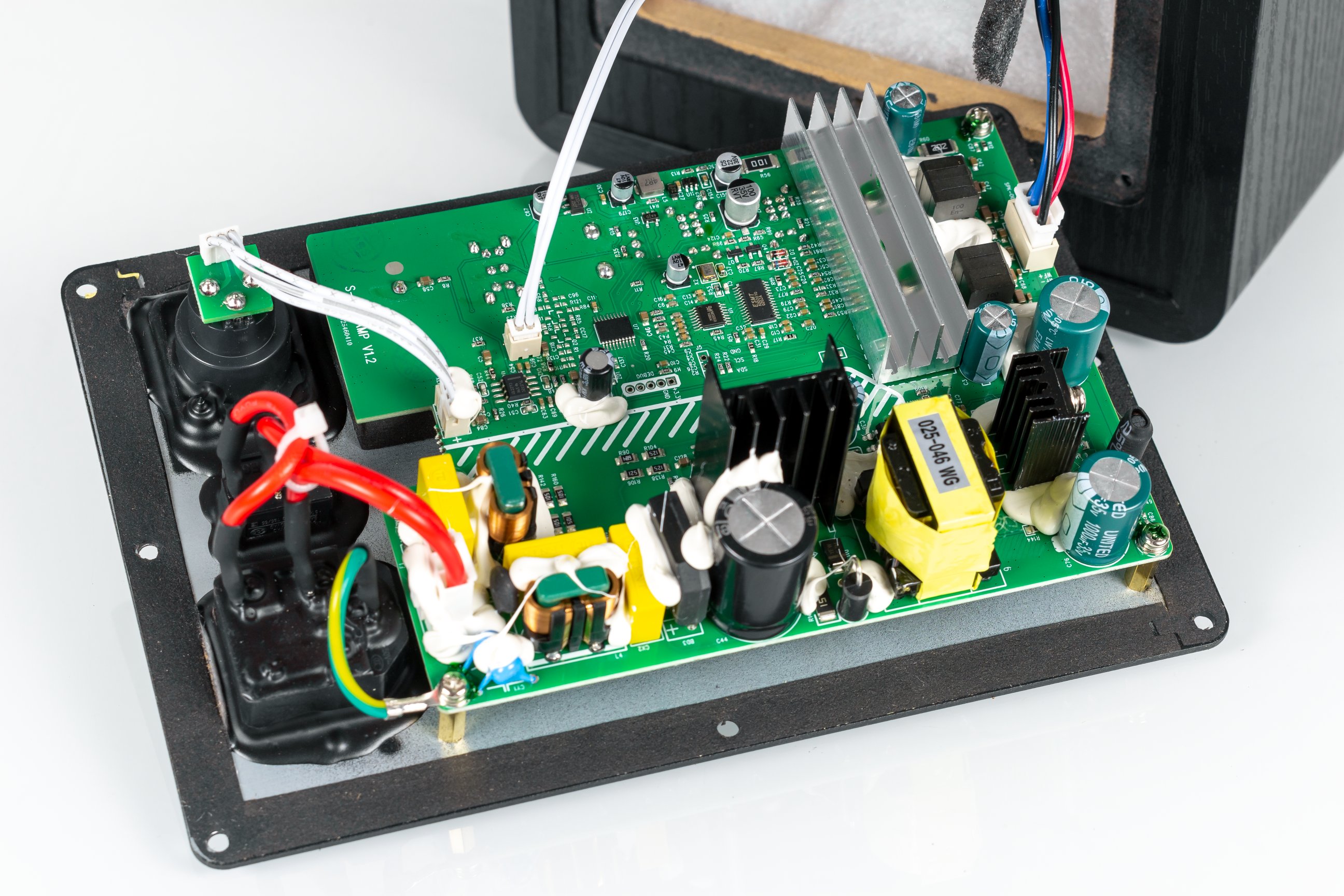
We opened the monitors and examined the electronics. The amplifier board is marked revision 1.2. The power supply is switched-mode, and the amplifiers operate in class D. Each driver has its own amplifier IC. The circuit design is modern, and build quality is very high. Glue secures all connectors and large components against vibration at high volume. The rear-panel openings are sealed. A thick layer of synthetic damping material fills the cabinet, and all wires are covered with foam tubes.
Measurements
For our measurements, we use the hardware and software test system RightMark™ Audio Analyzer PRO. We also use the measurement microphone Earthworks M50.
We measured the monitors in an acoustically treated room, 50 cm from the wall. The microphone was also 50 cm from the speaker under test.
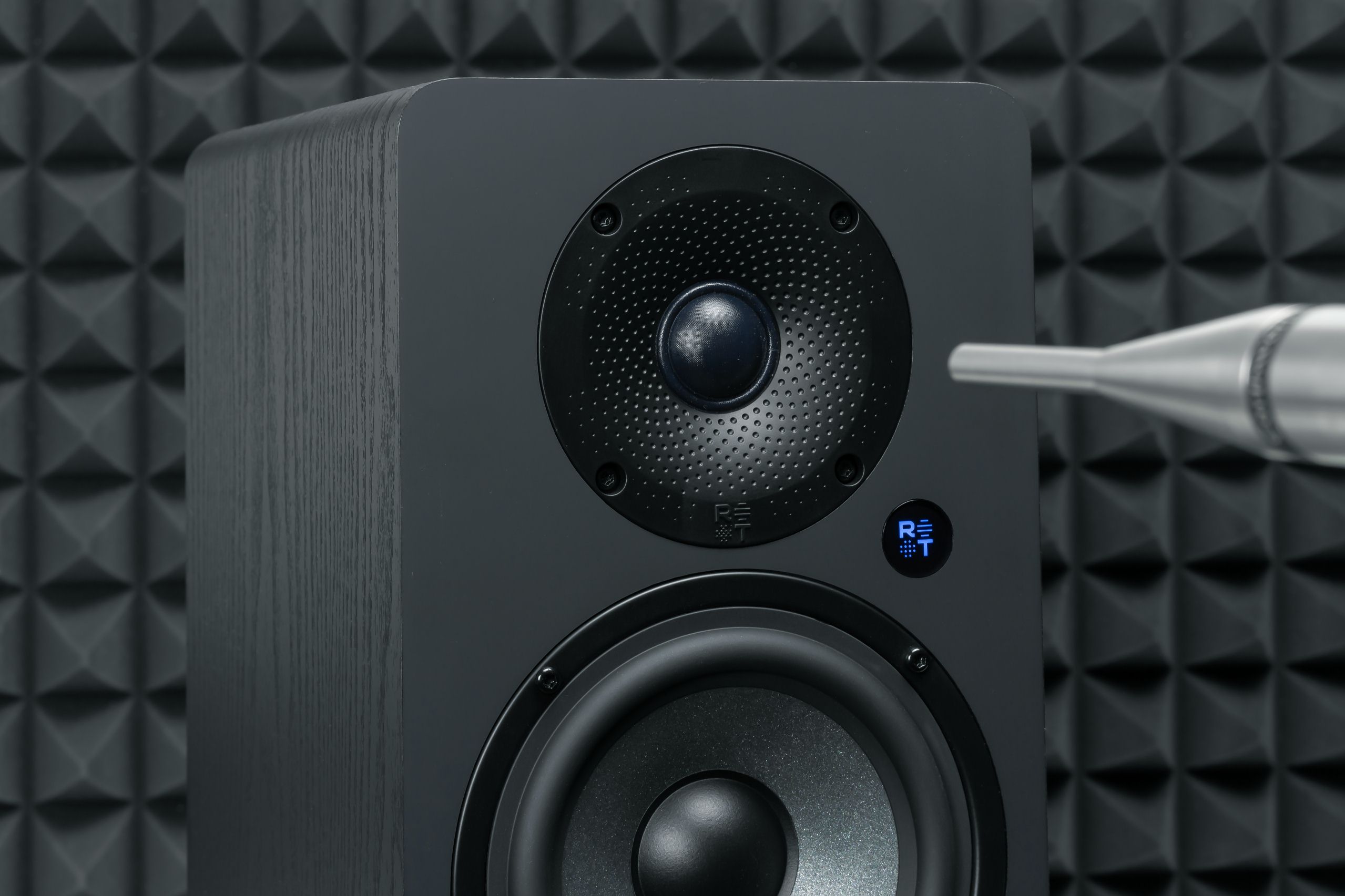
Our measurements confirm the published specifications. The frequency response is even. Variation across the operating range stays within ±3 dB, with no sharp peaks or dips. This is an excellent result. Bass extends confidently to 50 Hz.
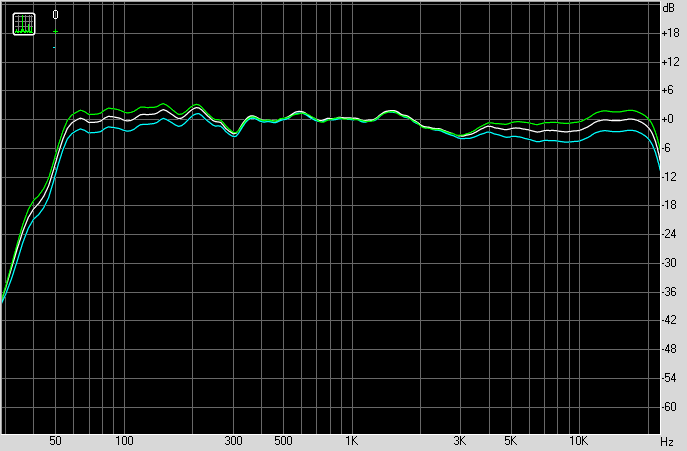
Frequency response with different ±2 dB filter settings
The graphs show the small response adjustments available through the built-in shelving-filter switches. If one speaker is closer to a corner, reducing that speaker's bass can help. The Russian-language manual gives useful advice on monitor placement, stands and isolation pads. The tweeters should also be aimed towards the listener.
Listening test
We connected the Russian Radiotehnika S-20M monitors to several professional audio interfaces with balanced outputs, including the Russian professional audio interface Lisk Audio Lisa Pro (RUB 75,000), using the manufacturer's balanced XLR cables. We played high-quality recordings at standard and high resolution to assess musical performance. Our room has bass traps and acoustic panels to reduce room effects. The treatment absorbs much of the acoustic energy, so it places higher demands on the monitors' sound pressure capability.
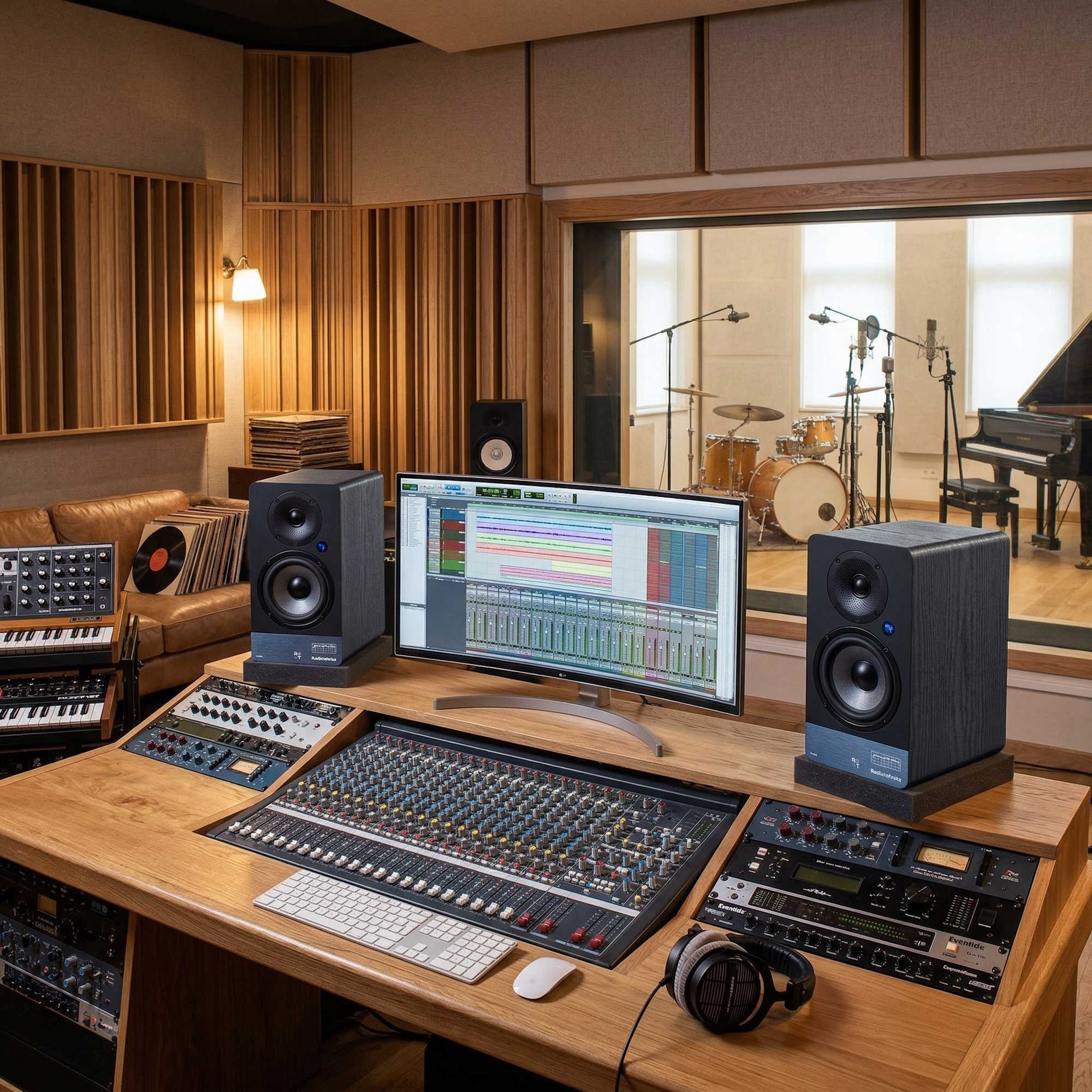
The Radiotehnika S-20M sounds as we would expect from a good, affordable mass-market monitor. The first point to note is the balanced, even sound, with no obvious audible problems. The bass does not boom, and there are no unwanted noises. We heard no distortion or resonances. A swept sine wave often reveals port noise, rattling internal wires or driver resonances in inexpensive monitors. We have become used to this. The Radiotehnika monitors showed none of these problems. Even a very loud sweep passed smoothly through the full range. Music also sounded consistently even.
To test studio work, we processed audio recorded with a Neumann TLM102 condenser microphone. Using the S-20M, we applied equalisation, de-essing, compression, excitation and limiting, then mixed the audio tracks with the rest of the project. The work caused no difficulties. For comparison, we connected our regular, more expensive ADAM A5X monitors. The difference was audible: the A5X offered clearer midrange detail and brighter treble. Even in this comparison, the Radiotehnika S-20M made a good impression. For a budget monitor, we found no obvious faults. Of course, audio equipment can always improve further, and prices can rise accordingly.
The Radiotehnika S-20M does not produce irritating background noise. The monitors remained completely silent even with the volume control at maximum.
Conclusions
Overall, we liked the Radiotehnika S-20M active monitors. Our tests showed that these are more than inexpensive computer speakers with a balanced connector added. The S-20M can compete with international brands at the same price. The model was designed as a professional monitor from the start and performs at the expected level. Its main strengths are a wide frequency range and an even sound without audible distortion. These qualities are useful both for audio production and for listening to music with natural tone. General users can also consider Radiotehnika's similar S-20NA MKII active Hi-Fi speakers, which offer tone controls, a remote and other consumer features, or the Alfa 1.01 passive bookshelf speakers.
Note. This is an adapted machine translation into English. It follows the “In simple terms” approach. Read the original article at https://prosound.ixbt.com/monitors/radiotehnika-s20m.shtml.