
Antelope Zenith 2 — a USB audio interface with built-in effects
Maxim Liadov
Antelope offers a large range of professional products. We recently reviewed the flagship Antelope Orion 32+ Gen4 Thunderbolt / MADI / USB audio interface with 128 channels and Atmos support. It is a serious, expensive product for high-end post-production studios. Today, we look at the much more affordable Zenith 2 USB interface, aimed at a broad audience including bloggers and streamers. Musicians are also well served: the interface includes the essential tools, even guitar cabinet simulations.
The Zenith 2 changes the usual idea of an Antelope product. It works as soon as it is connected, without installing software. There is no complex software mixer. A selected set of hardware effects is built into the interface and controlled from its small display. The processing is designed to be simple and easy to understand. The menus support Russian, English, Japanese and Chinese.
The manufacturer intends this approach to give users a quick start. Some users are put off by extensive options that require extra setup, separate plug-in purchases and a long manual. The Zenith 2's official slogan is plug-in-and-go. Despite the affordable price, Antelope promises a wide range of functions and professional sound.
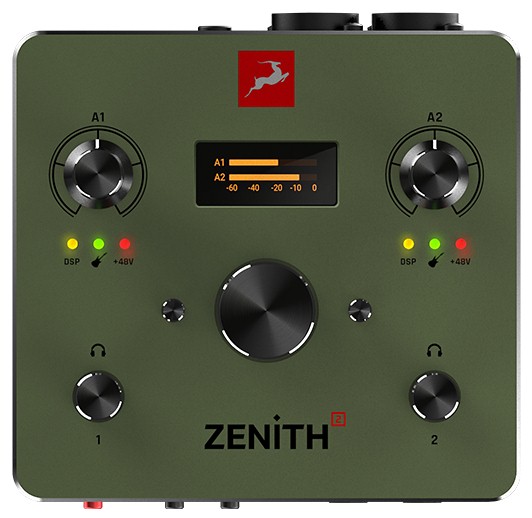
Antelope Zenith 2 key features
- Built-in DSP with selected effects: Tube-Opto Comp, Sky EQ, De-esser and Guitar Amp
- Easy-to-use presets and zero-latency monitoring for recording and streaming
- Class-leading A/D and D/A conversion with dynamic range up to 123 dB
- 2 fully discrete, six-transistor preamps with 75 dB gain, based on Antelope's professional interfaces
- +48 V phantom power, high-impedance instrument mode and line mode for both input channels
- Stereo output on two TRS channels
- 2 independent TRS headphone outputs capable of driving high-impedance headphones
- MIDI input/output for keyboards and controllers
- Loopback for streaming
- Works immediately with Mac/PC/iOS/Android without driver installation
- USB-C bus power
- Strong metal case
- Assembled in the EU
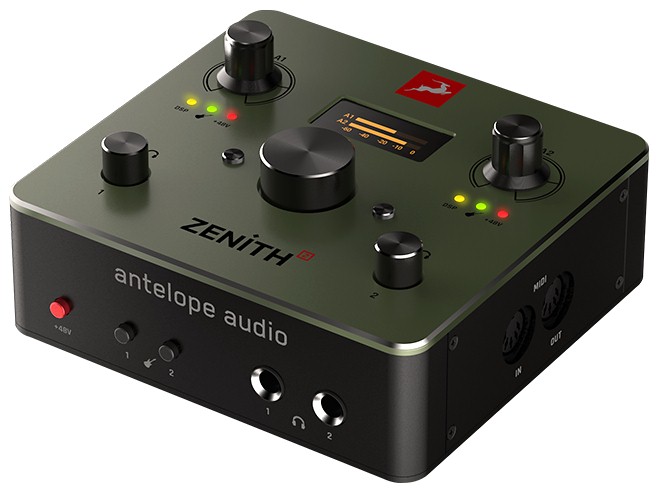
The Zenith 2 case is metal on all sides. Build quality can match more expensive interfaces, such as the Antelope Zen Quadro. The colour and square shape suggest a military-style design and give an impression of reliability.
The interface has a 2 × 2 channel configuration. Both inputs can accept guitar, line or microphone signals. Some low-cost interfaces dedicate the first input to microphones and the second to guitar. There is no such restriction here.
Analogue inputs
2 combo sockets for microphone, line or guitar input
+48 V phantom power and independent gain adjustment for each input
Analogue outputs
2 impedance-balanced TRS monitor outputs, maximum +20 dB
2 stereo headphone outputs
Analogue-to-digital converter (ADC)
Dynamic range: 123 dB, A-weighted
THD: −98 dB
Microphone gain: 0–55 dB
Maximum input level: +20 dB
Digital-to-analogue converter (DAC)
Dynamic range: 122 dB, A-weighted
THD+N: −108 dB
Maximum output level: +20 dB
Headphone outputs
Dynamic range: 120 dB, A-weighted
Output impedance: 20 ohms
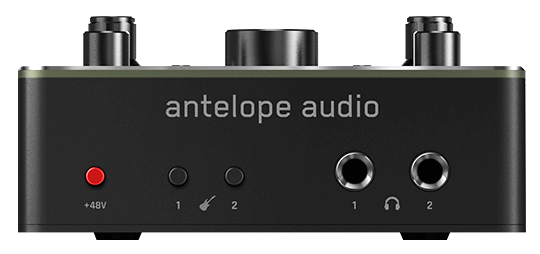
Line or guitar mode is selected independently for each input. Phantom power switches on for both inputs together. An unusual but very useful feature is the pair of headphone outputs. One pair of headphones can provide backing tracks to a performer, while the other pair is used to monitor the recording.
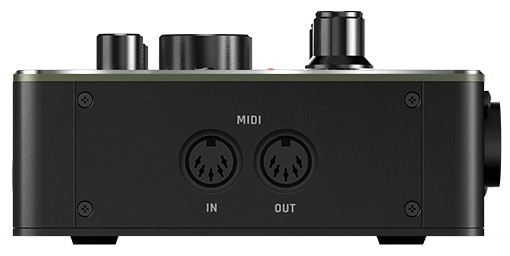
The MIDI inputs and outputs support synthesizers and keyboards made before USB connections became common.
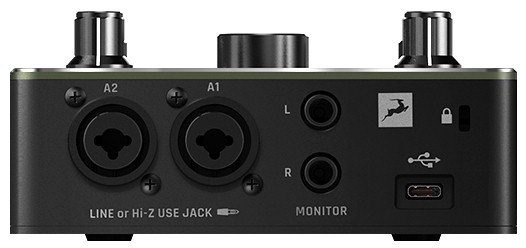
The interface is powered over USB. There is no separate power connector.
Inside, the familiar red circuit board carries an NXP MIMXRT1052 ARM processor, which handles I/O and data processing. The relatively new 8-channel ESS ES9081 DAC has integrated line buffers. The headphone amplifiers use 4565 operational amplifiers. This circuit is the same as in the ZEN Quadro. The manufacturer has indeed used discrete transistor circuits at the microphone inputs, which is very welcome. These are followed by a 4-channel TI PCM1840 ADC.
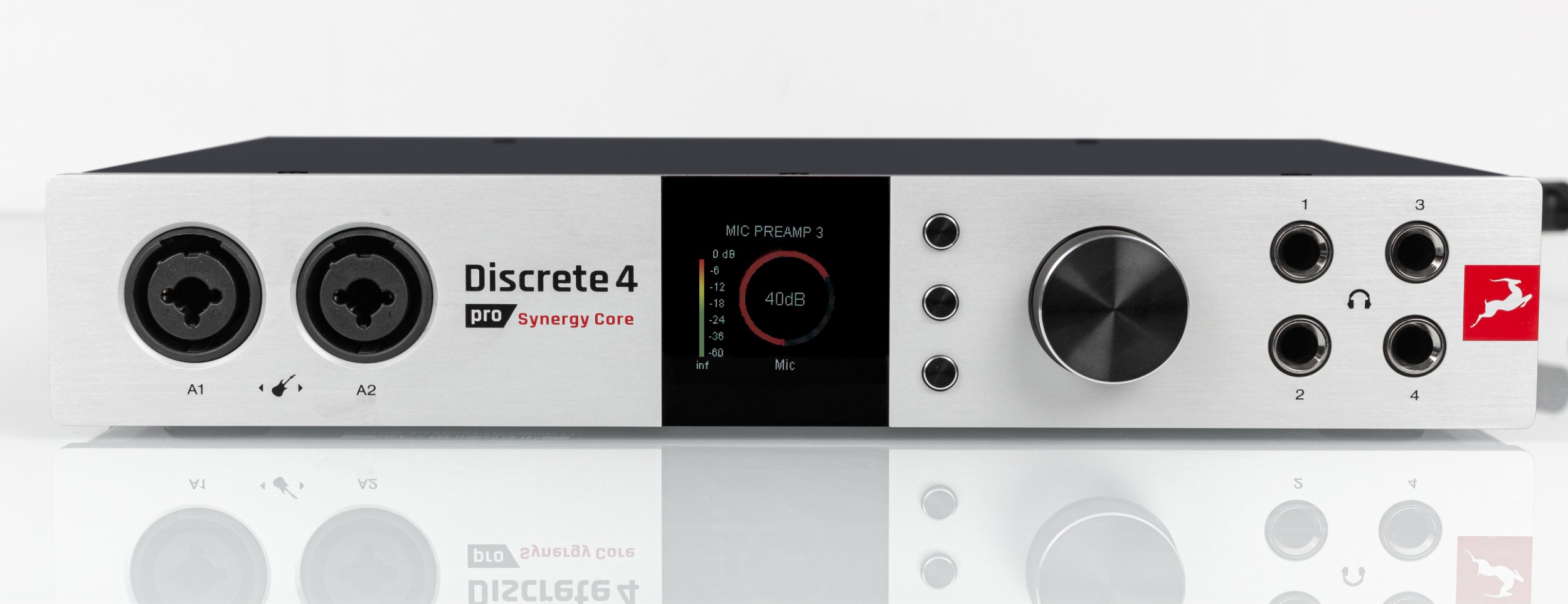

Round-trip latency is very low: just 5 ms with a 64-sample buffer at 44 kHz.
Features:
Input channels: 4
Output channels: 4
Input latency: 315
Output latency: 367
Min buffer size: 8
Max buffer size: 2048
Preferred buffer size: 256
Granularity: -1
ASIOOutputReady - not supported
Sample rate:
8000 Hz - not supported
11025 Hz - not supported
16000 Hz - not supported
22050 Hz - not supported
32000 Hz - not supported
44100 Hz - supported
48000 Hz - supported
88200 Hz - supported
96000 Hz - supported
176400 Hz - supported
192000 Hz - supported
352800 Hz - not supported
384000 Hz - not supported
Input channels:
channel: 0 (IN 1) - Int32LSB
channel: 1 (IN 2) - Int32LSB
channel: 2 (IN 3) - Int32LSB
channel: 3 (IN 4) - Int32LSB
Output channels:
channel: 0 (OUT 1) - Int32LSB
channel: 1 (OUT 2) - Int32LSB
channel: 2 (OUT 3) - Int32LSB
channel: 3 (OUT 4) - Int32LSB
The ASIO driver provides 4 channels and supports sample rates up to 192 kHz.
RMAA testing
We measured the line output separately to show playback performance:
| Device under test | Zenith 2 |
| Operating mode | 24-bit / 44 kHz |
| Audio interface | ASIO |
| Signal path | Output only |
| Frequency response, 40 Hz–15 kHz, dB | +0.04, -0.32 |
Very good |
| Noise level, dB(A) | -120.6 |
Excellent |
| Dynamic range, dB(A) | 120.4 |
Excellent |
| Total harmonic distortion, % | 0.00073 |
Excellent |
| THD + noise, dB(A) | -99.2 |
Excellent |
| Intermodulation distortion + noise, % | 0.00086 |
Excellent |
| Stereo crosstalk, dB | -59.4 |
Excellent |
| Intermodulation at 10 kHz, % | 0.00100 |
Excellent |
| Overall result | Excellent |
Detailed RMAA input measurements at 24-bit / 44 kHz
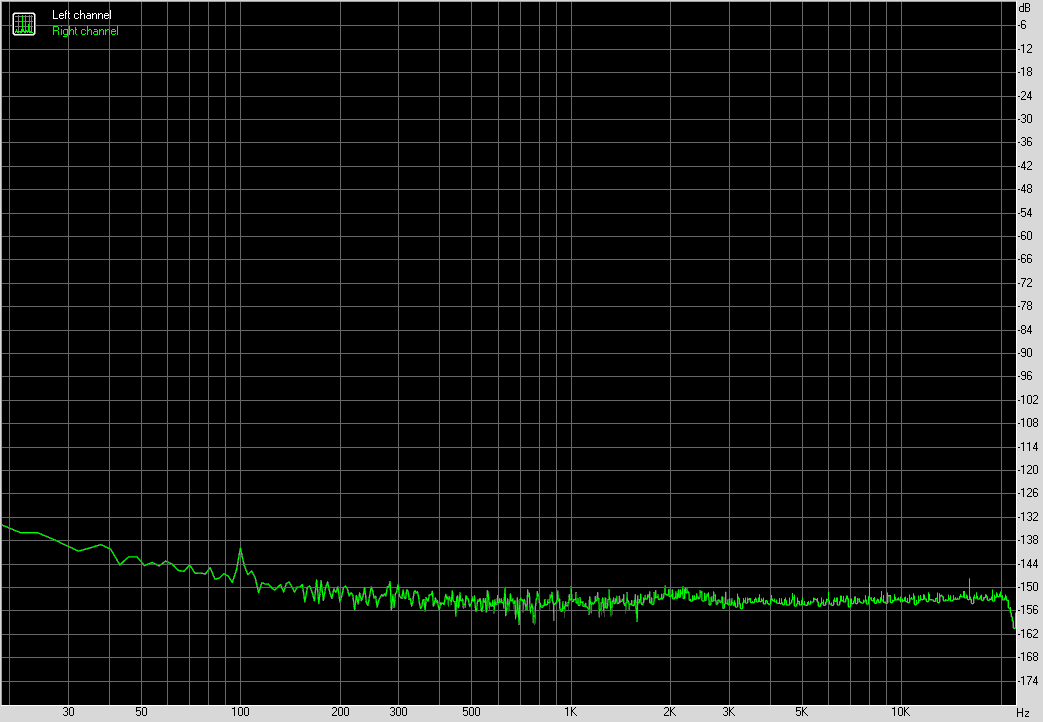
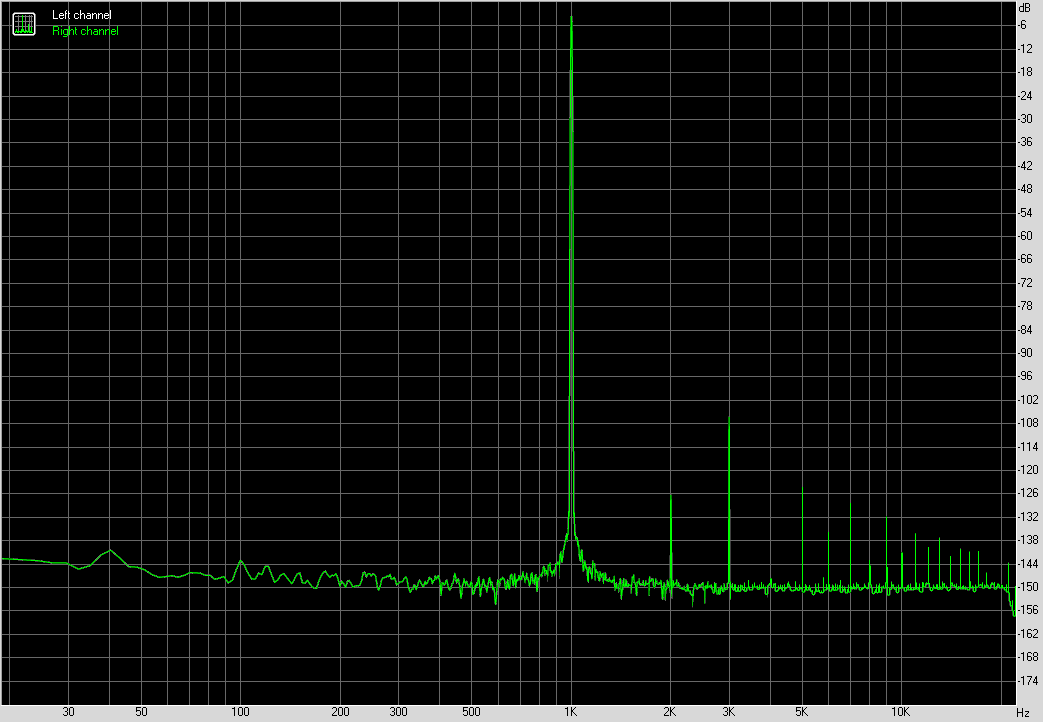
The overall test rating is Excellent. Noise is very low, below −120 dB. The spectra show no interference.
We compared the Zenith 2 with direct competitors: the MOTU M2 and Audient ID14 MKII. Before listening, we used an oscilloscope to match output levels exactly. The reference was the Audient ID14 MKII's maximum line output, the lowest in this test at just 3 Vrms. The Zenith 2 can provide twice that voltage. The MOTU has a fully differential output circuit, with opposite-polarity signals on the positive and negative terminals. The other interfaces use impedance-balanced outputs. All these designs reject interference, but in different ways.
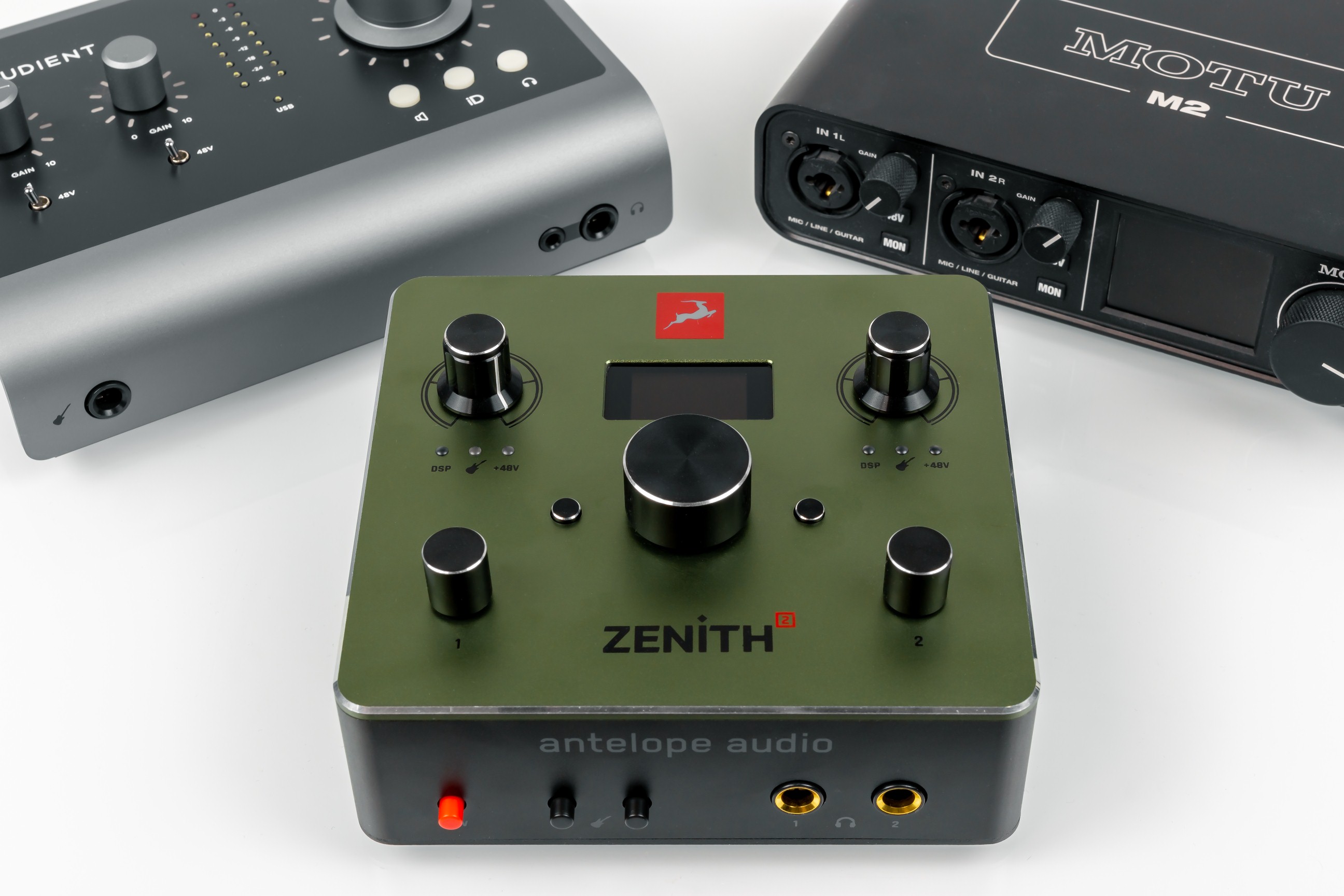
We compared the interfaces through ADAM Audio active monitors. Many users would like one clear winner so the choice is easy. In practice, the differences in sound are very small and are better described as matters of taste. More importantly, every interface in the comparison is suitable for professional audio work.
Our measurements showed that the Audient ID14 MKII has the most powerful headphone output, at 100 mW into 32 ohms. The Zenith 2 follows with 40 mW into 32 ohms. The MOTU M2 comes last in this group with 25 mW into 32 ohms, although some USB interfaces provide much less. We liked that the Zenith 2 uses the same DAC for its headphone and line outputs.
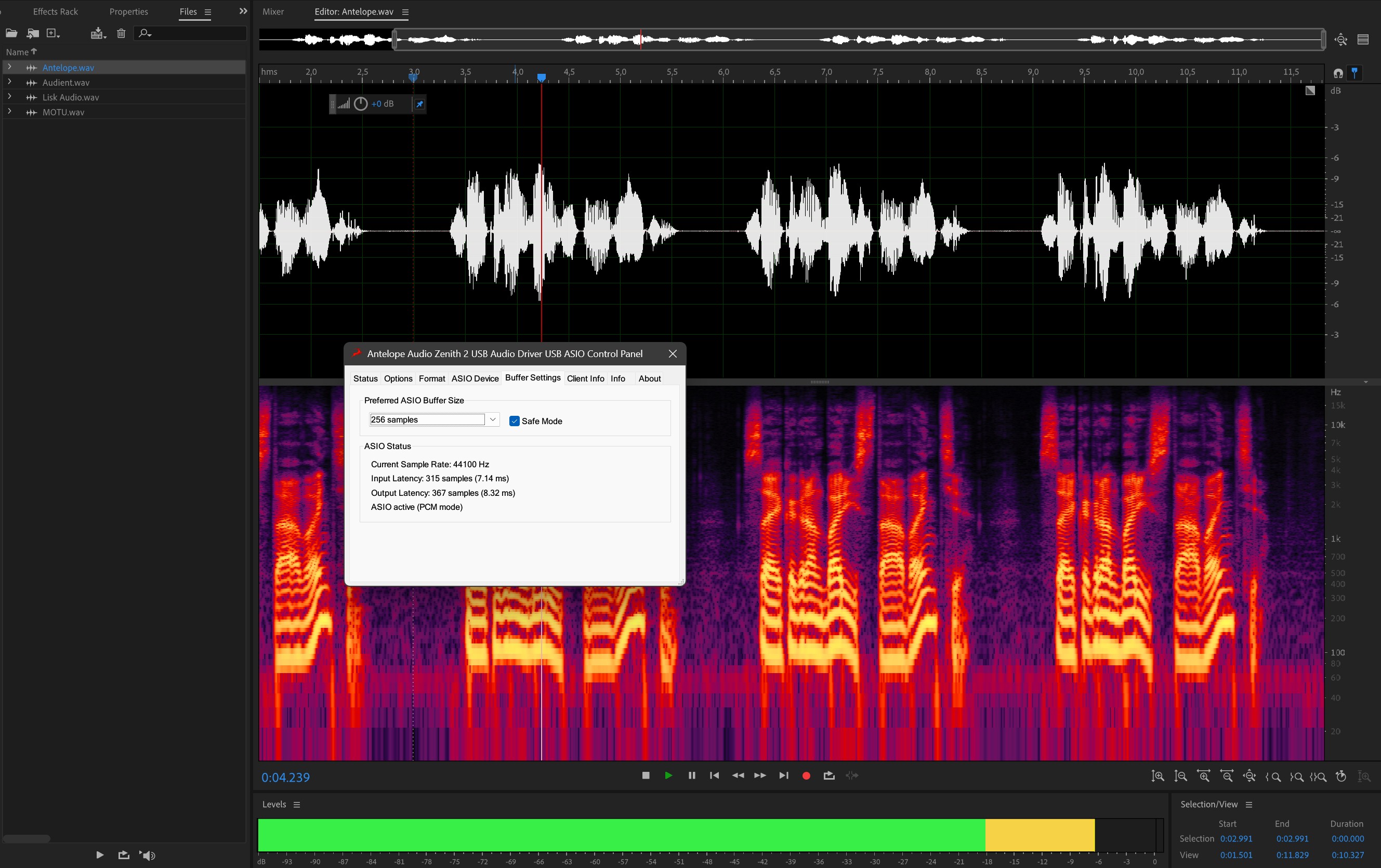
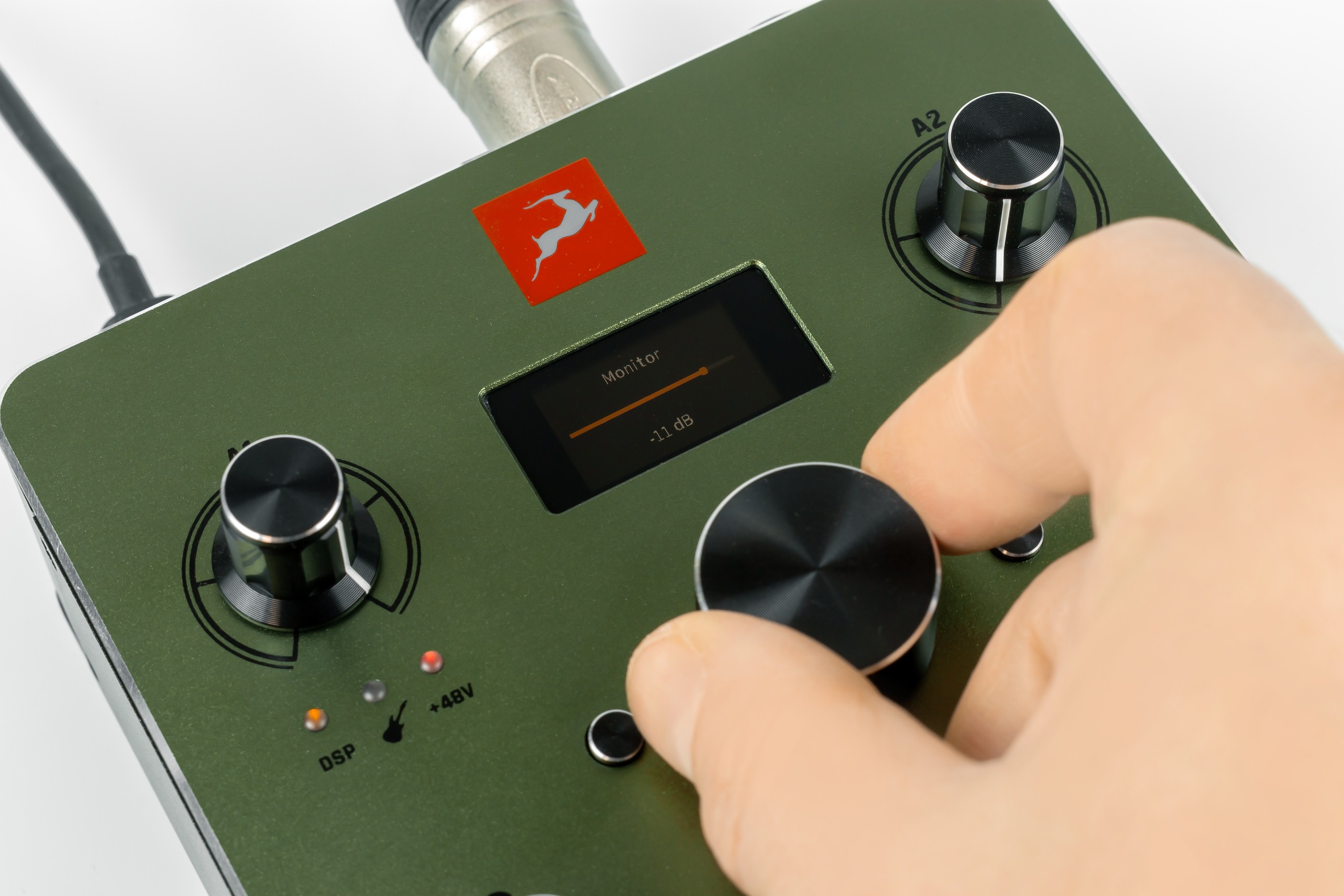
We tested the microphone preamps with a Neumann TLM102 condenser microphone. The Zenith 2 has two stages of gain adjustment. The top-panel knobs provide up to 55 dB, and the display menu adds 0–20 dB of digital gain. Some users find the gain controls unusual because much of the useful adjustment is near the fully counterclockwise position. Antelope support says this is expected and results from the control's logarithmic response.
We liked the inputs. Microphone recording quality is high, and voices sound natural, without colouration. The result reflects the discrete first preamp stage and the high-quality ADC.
Among these direct competitors, only the Zenith 2 has built-in processing. Hardware DSP is a major advantage for online broadcasting. Users do not have to rely on software plug-ins or deal with monitoring delay. All effects are applied immediately. Processing quality is at studio level and much better than in inexpensive mixers. In addition to EQ and dynamics processing, noise reduction is available and should be useful for bloggers.
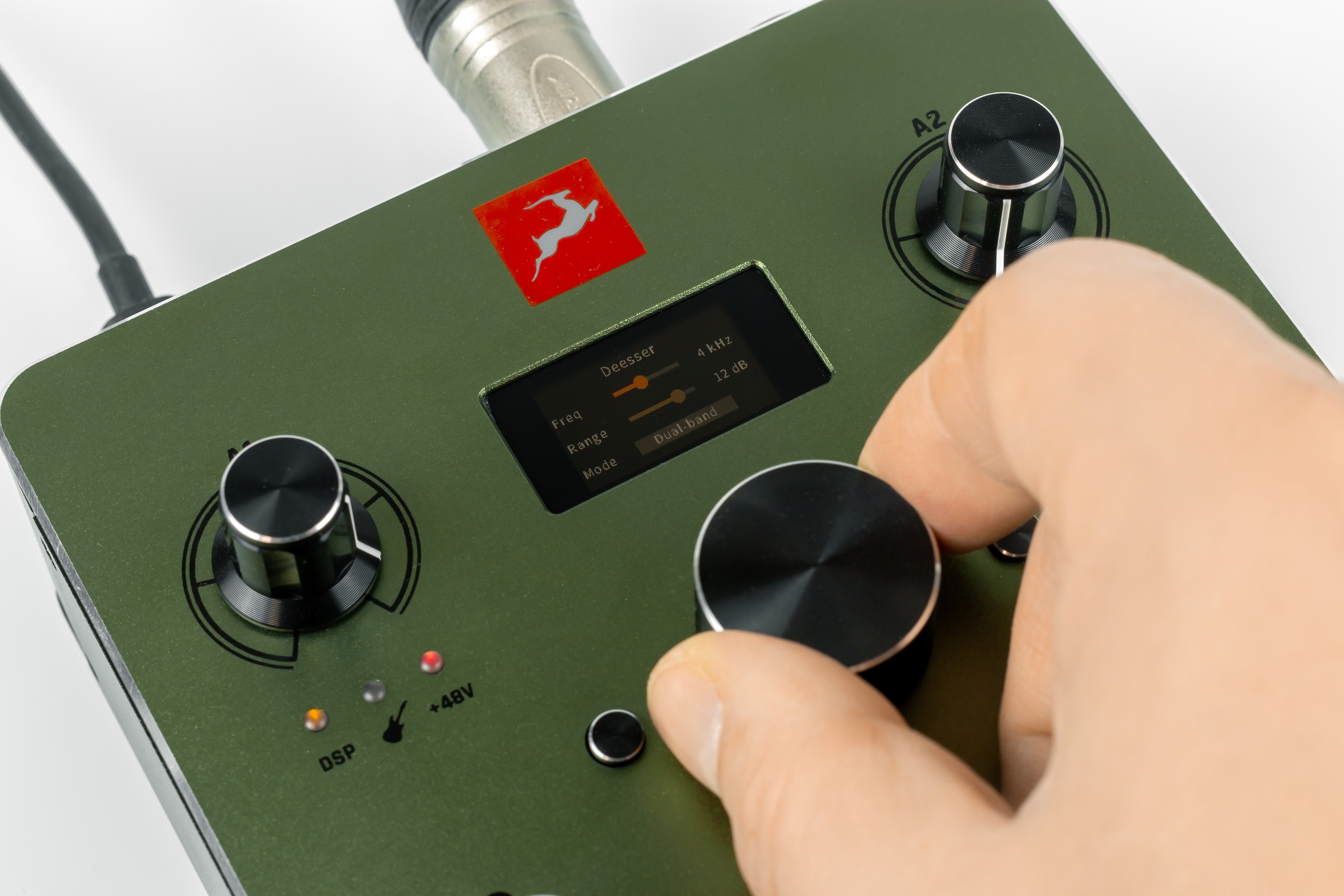
We did not find parameter adjustment on the small display very comfortable. The text requires close attention, and editing involves many steps. Control uses one knob and three buttons. The interface is simple and difficult to get lost in; the main problem is the very small text. Guitar effects include three different cabinet simulations, which is interesting. Users have asked the manufacturer to add a simple reverb to make monitoring more comfortable for musicians.
Some users complained that there were too few effects and that the selection was fixed. The manufacturer has since added processing in a firmware update. We tested firmware 2.11 and found the selection sufficient. The first 1,000 Zenith 2 buyers receive a one-year licence for a large collection of native software effects to use in music applications.
Conclusions
The Antelope Zenith 2 offers what many bloggers and home musicians have wanted for a long time. It works with Mac, Windows, iOS or Android as soon as it is connected, without extra software, complex control panels or drivers. Studio-quality DSP effects, including EQ, compression, de-essing and noise reduction, are useful for live streaming. Guitarists also get dedicated effects. On Windows, a low-latency ASIO driver supports popular DAWs. The total 75 dB gain is enough even for dynamic microphones. Sound quality has not been sacrificed: the discrete preamps and high-quality converters, with dynamic range up to 123 dB, can match similarly priced competitors. Users who need more features can consider the higher-end Antelope Quadro and Discrete Pro models.
Note. This is an adapted machine translation into English. It follows the “In simple terms” approach. Read the original article at https://prosound.ixbt.com/interfaces/antelope-zenith-2.shtml.