
Creative Sound Blaster AE-X review and test — a two-channel PCIe sound card with an Xamp headphone amplifier
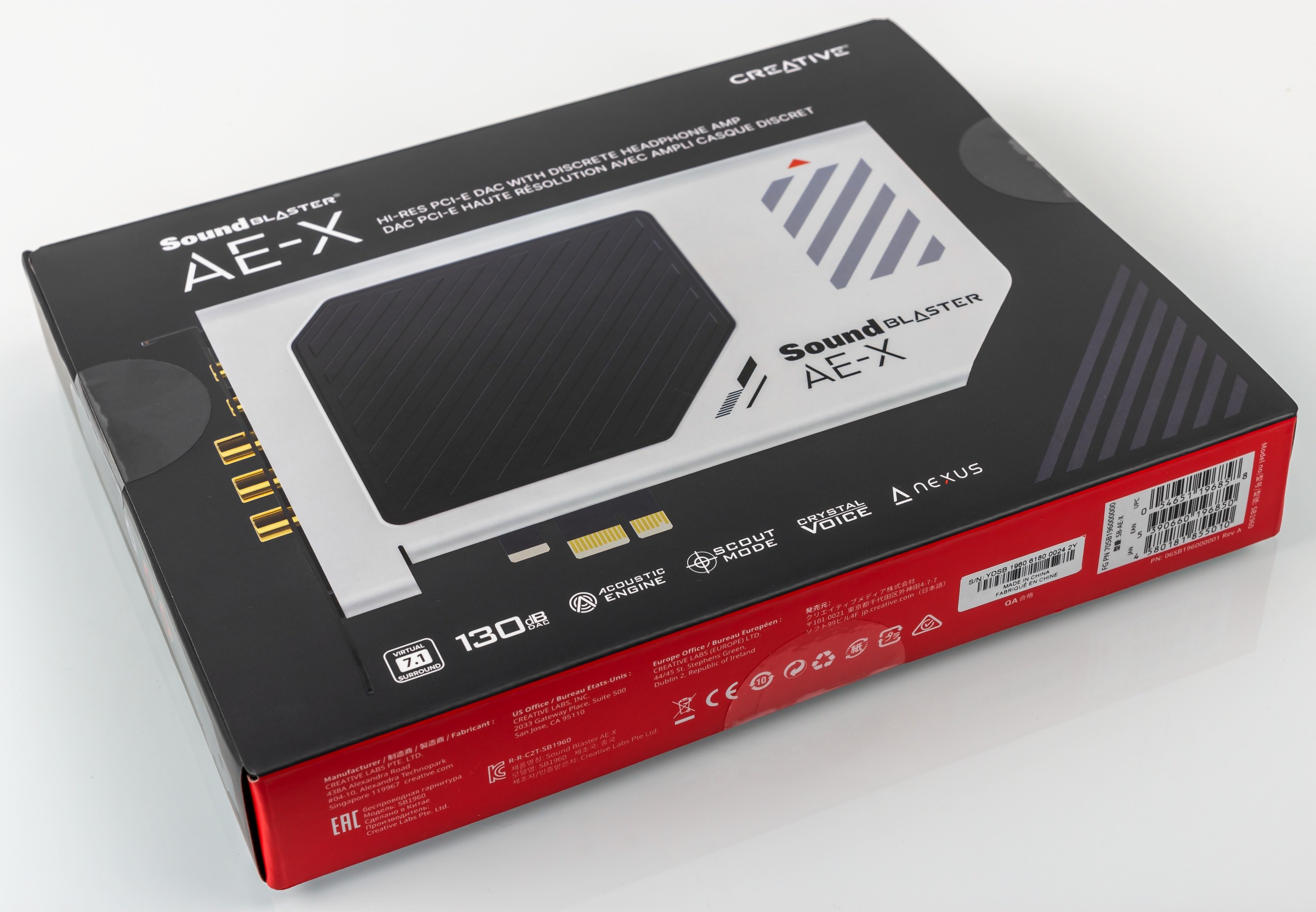
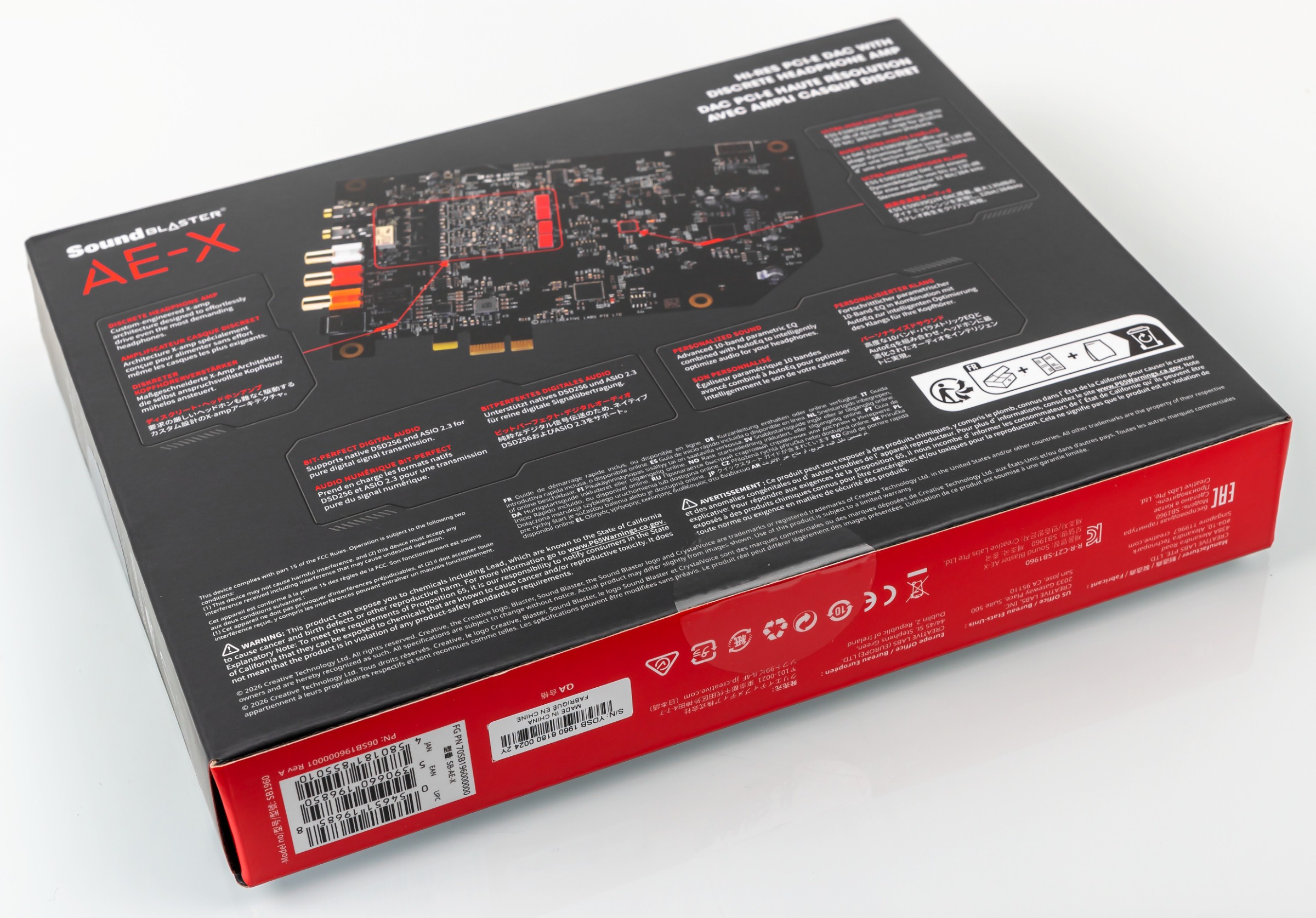
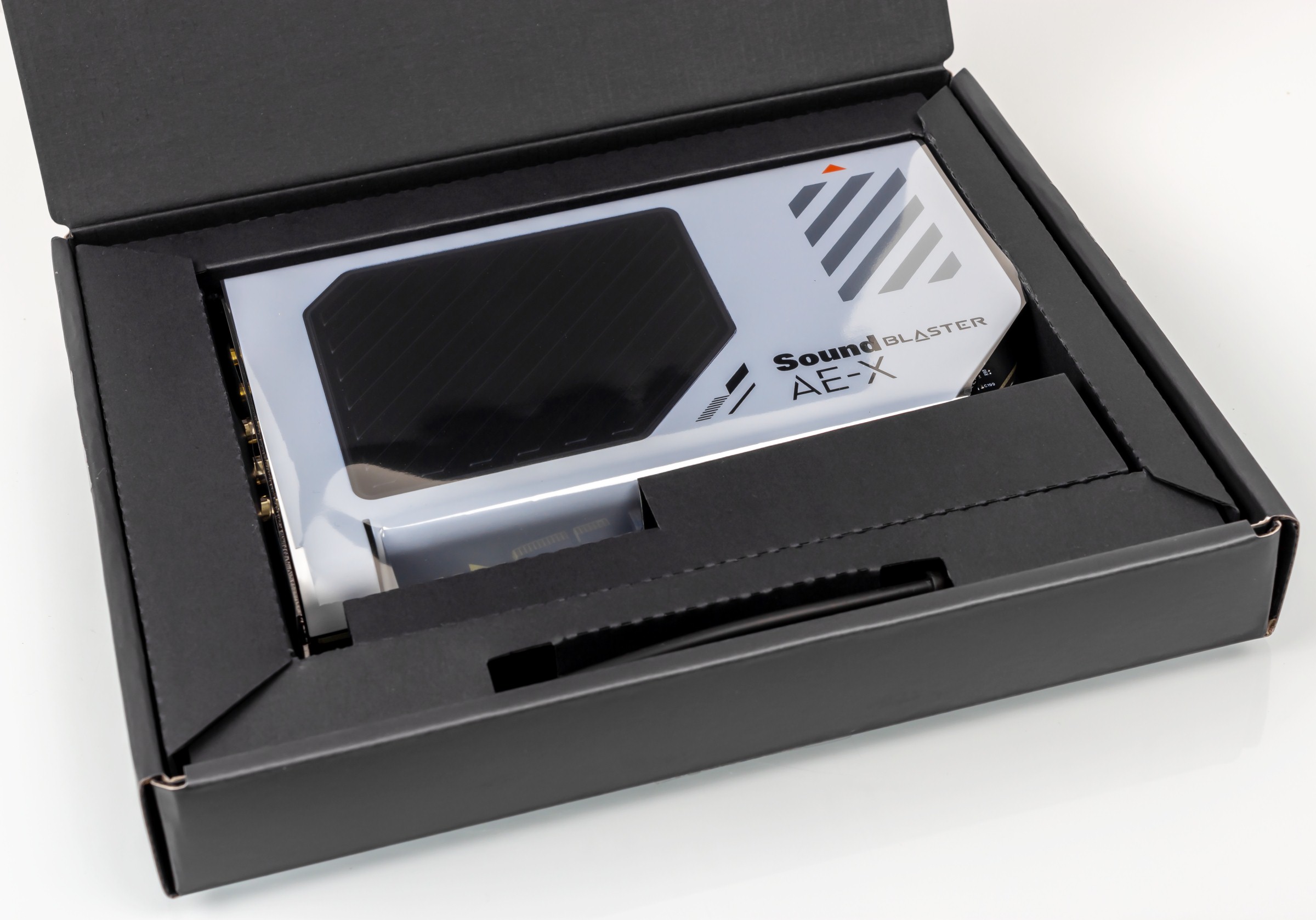
In 2026, Singapore-based Creative introduced the Sound Blaster AE-X internal sound card. It is not a direct upgrade to the AE-5/7/9 models. Instead, it continues the same product line with updated electronics.
The earlier models remain on the company's website, but their production life cannot last forever. Older components are eventually discontinued and replaced. Manufacturers then have to update products that use those parts. The Sound Blaster AE-X addresses this need. Inside, it combines familiar components with entirely new ones.
To understand the limits of the old electronics, we need some history. Since 2011, Creative products have used the company's highly integrated Sound Core 3D chip. It was originally an HDA codec with 5.1 analogue outputs, a microphone preamp and a built-in quad-core DSP. The plan was to put the chip on motherboards and challenge Realtek's dominant position. Creative did not succeed in entering this huge market. According to our information, the company was effectively denied access. The few motherboards released with the codec attracted little interest.
Creative then tried another approach: sell an attractive control panel and software effects to users of Realtek integrated audio. The idea had potential, with hundreds of millions of possible users. However, many of those users do not use their integrated audio at all and never connect anything to it.
These changes in direction, together with weak promotion, did not produce the desired result.
Creative management then decided to make headphones, smart speakers and separate sound cards based on the Sound Core 3D codec. The cards used an additional PCIe bridge. The first card, the Recon3D, was not successful because of its high price. In practice, users were being offered an integrated HDA codec with a signal-to-noise ratio of around 100 dB, similar to the Realtek codec already on their motherboard.
Although Sound Core 3D added hardware effects, input and output sound quality was effectively the same as integrated audio. This disappointed users familiar with Audigy and X-Fi cards.
As ASUS STX audiophile sound cards became popular, Creative took the next step. The Sound Blaster Z/Zx/ZxR family kept Sound Core 3D but added high-end DAC and ADC chips and a dedicated headphone amplifier IC. The cards became much more complex and expensive to make, yet they entered the same price range as the Recon3D. The positive market response was therefore understandable.
The AE-5/7/9 family continued that development. The main change was the move to the market-leading ESS Sabre 32 DAC family, adding 32-bit / 384 kHz and DSD support. Creative also introduced a genuinely discrete Xamp headphone amplifier instead of an integrated amplifier chip.
The cards still supported multiple channels. In the AE-5/7, the Sound Core 3D's integrated codec drove the rear channels. However, the old chip's limits were becoming clear. Processing was limited to 96 kHz. At higher sample rates, the DSP lacked the required power and was disabled. To play 32-bit / 384 kHz or DSD, users had to select stereo Direct Mode, which disabled the rear channels.
At the same time, inexpensive stereo USB DACs from China became very popular. This raises a question: do users really need 5.1 or 7.1 channels enough to pay much more for a high-quality implementation? In practice, multi-channel home cinema attracts a limited audience. Only a small group of enthusiasts want speaker stands and cables throughout a living room, with films and games played loudly. Most people prefer a smaller setup: stereo speakers or, more often, a soundbar. PC users commonly choose headphones, which block outside noise and avoid disturbing neighbours.
A stereo-only Sound Blaster AE-X therefore makes sense, as does removing the integrated 5.1 codec. Losing the hardware DSP should not affect most users because Creative has gradually moved processing and effects into its drivers. Software processing also removes the old DSP's performance limits, allowing more functions to be added later.
Creative still needed a new main chip to feed digital signals to high-quality external DACs and ADCs. To reduce cost, the company chose the feature-rich Realtek ALC4082. This chip supports 32-bit / 384 kHz, includes a DAC rated at 120 dB signal-to-noise, a microphone input with gain control and a headphone amplifier. Most importantly, it provides I2S for connecting external DACs and ADCs directly. The ALC4082 connects only over USB, so the card also uses an ASMedia PCIe-to-USB bridge.
Before testing, our main question was whether the Sound Blaster AE-X could compete with the AE-5/7/9. Let us look at the comparison table:
| Main specifications | Sound Blaster AE-X | Sound Blaster AE-9 | Sound Blaster AE-7 | Sound Blaster AE-5 Plus |
| Hardware DSP | Replaced by driver-based processing | Sound Core3D | Sound Core3D | Sound Core3D |
| DAC chip dynamic range | 130 dB | 129 dB | 127 dB | 122 dB |
| DAC | ESS ES9039Q2M | ESS ES9038Q2M | ESS ES9018K2M | ESS ES9016K2M |
| Supported speaker configuration | Stereo (2.0) | Up to 5.1 | Up to 5.1 | Up to 5.1 |
| Maximum playback resolution | 32-bit / 384 kHz PCM DSD256 |
PCM: 32-bit / 384 kHz DSD64 |
PCM: 32-bit / 384 kHz DSD64 |
PCM: 32-bit / 384 kHz |
| Maximum recording resolution | 2 channels, 24-bit / 192 kHz | 24-bit / 192 kHz | 24-bit / 96 kHz | 24-bit / 96 kHz |
| DAC chip THD+N | 0.0001% | 0.0001% | 0.0001% | 0.00032% |
| Discrete headphone amplifier | Yes, X-amp | Yes, X-amp | Yes, X-amp | Yes, X-amp |
| Replaceable operational amplifiers | None | Yes, 4 op-amps | None | None |
| ACM | None | Yes | Yes | None |
| RGB | None | None | None | Yes |
| ASIO support | Yes | Yes | Yes | Yes |
| Front-panel header support | Yes | None | None | Yes |
| 5.1 encoding for digital output | None | Yes | Yes | Yes |
| +48 V phantom power | None | Yes | None | None |
| Scout Mode | Yes | Yes | Yes | Yes |
| Two independent playback devices | Yes | None | None | Yes |
| Two independent recording devices | Yes | None | None | None |
| Software | Creative Nexus | Sound Blaster Command | Sound Blaster Command | Sound Blaster Command |
| What U Hear | None | Yes | Yes | Yes |
Keeping the same headphone amplifier and updating the DAC was the right decision. The new DAC does not set records, but its specifications are slightly better than those of its predecessors. The other cards also use different versions of a two-channel ESS Sabre 32 DAC. The ES9039Q2M is the newest of these and has a slightly higher rated dynamic range of 130 dB.
All the cards use the Xamp headphone amplifier. It has moved to the new model without changes.
The case audio header returns on the AE-X, labelled HDA_FP. The card can send different signals to its rear outputs and the case headphone socket. We could not immediately identify a practical use for this feature; it seems mainly intended as a marketing point.
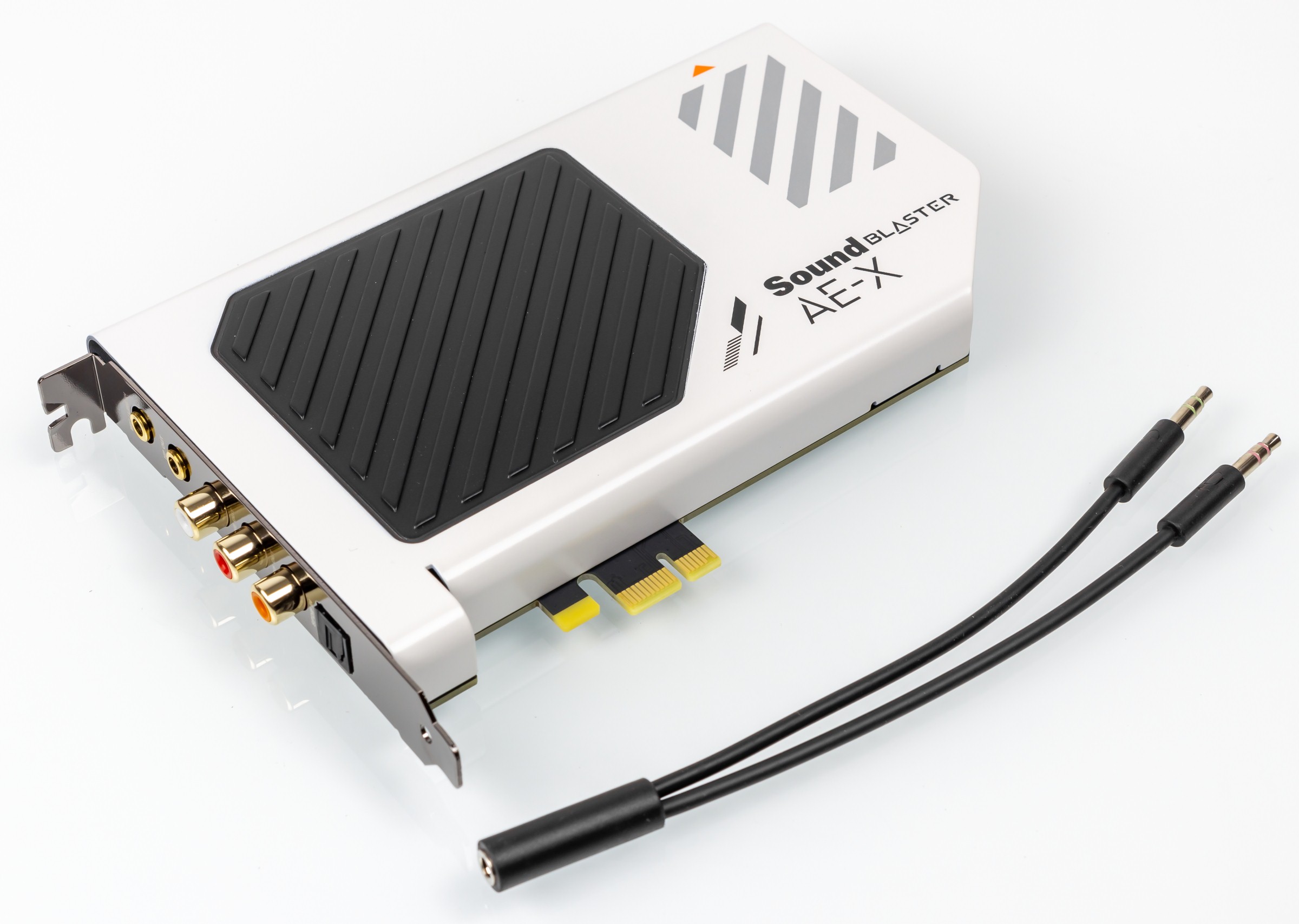
Like the AE-9, the AE-X has proper stereo RCA sockets. Owners of active speakers will welcome this. The only supplied audio cable is a four-pole minijack to two three-pole minijack adapter for headsets.
The manufacturer claims the AE-X can operate without drivers. With the current firmware, however, the card initially sends audio only to the HDA_FP header.
To get sound from the line output, something must be inserted into the headphone socket. This behaviour makes little sense and should be easy to fix in an update. A more serious issue is poor sound quality in driverless operation. For normal sound, users need to install Nexus from the manufacturer's website. Nexus then finds and offers the current drivers. An internet connection is required because the driver is not available as a separate installer.
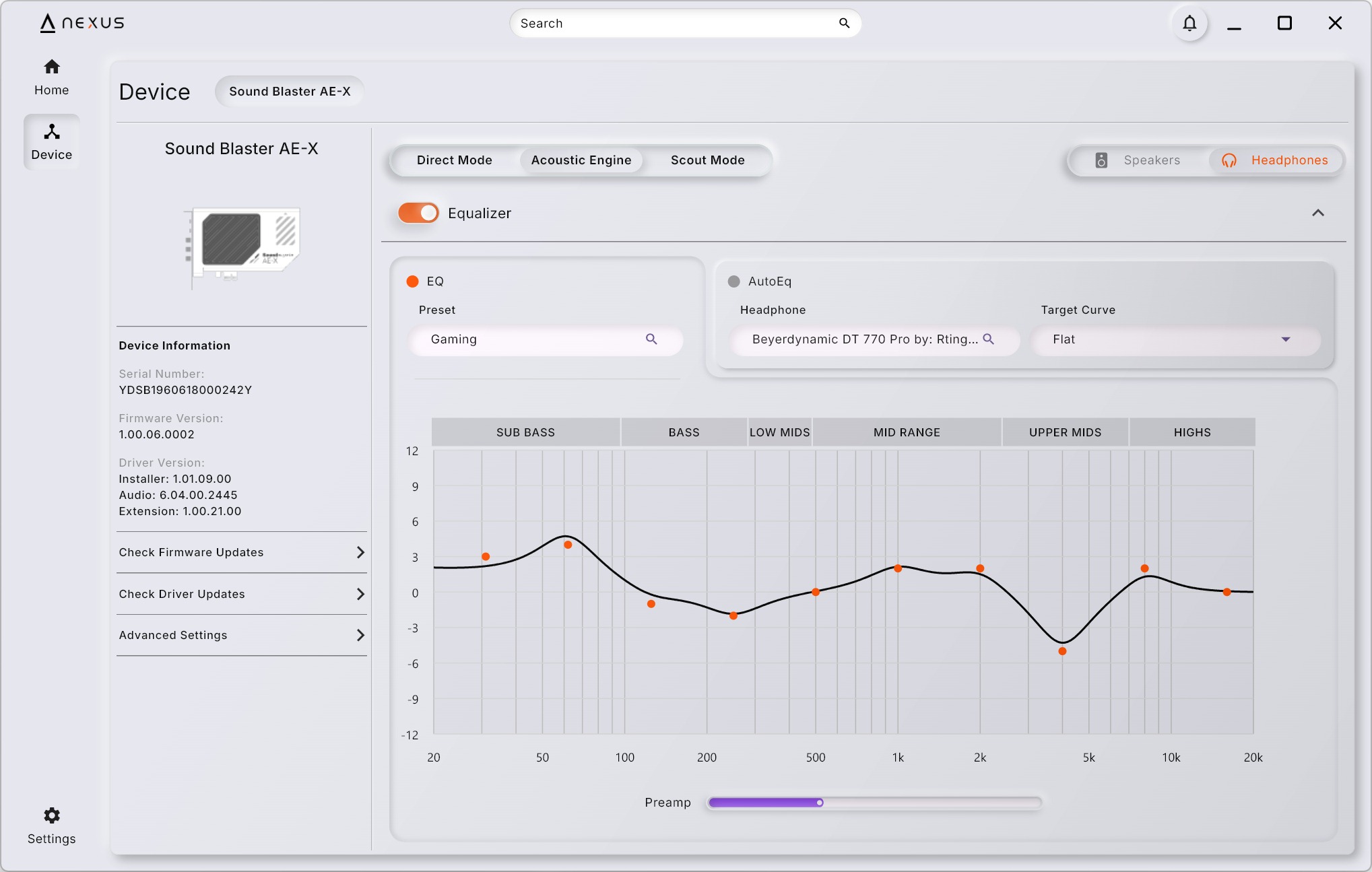
Nexus is completely different from the previous control panel. The game-specific SBX Profile tab has been removed. We considered that feature of limited value, so we support its removal.
A sound-card control panel should not be overloaded with settings that add little value. Nexus is not particularly convenient or intuitive. The design looks more modern, but small text and low contrast make it difficult to read. There is no dark theme or Russian-language support.
The operating mode is selected at the top: Direct Mode, Acoustic Engine or Scout Mode. Changes take effect immediately. Unlike the AE-5/7/9, there is no delay because no hardware switching takes place.
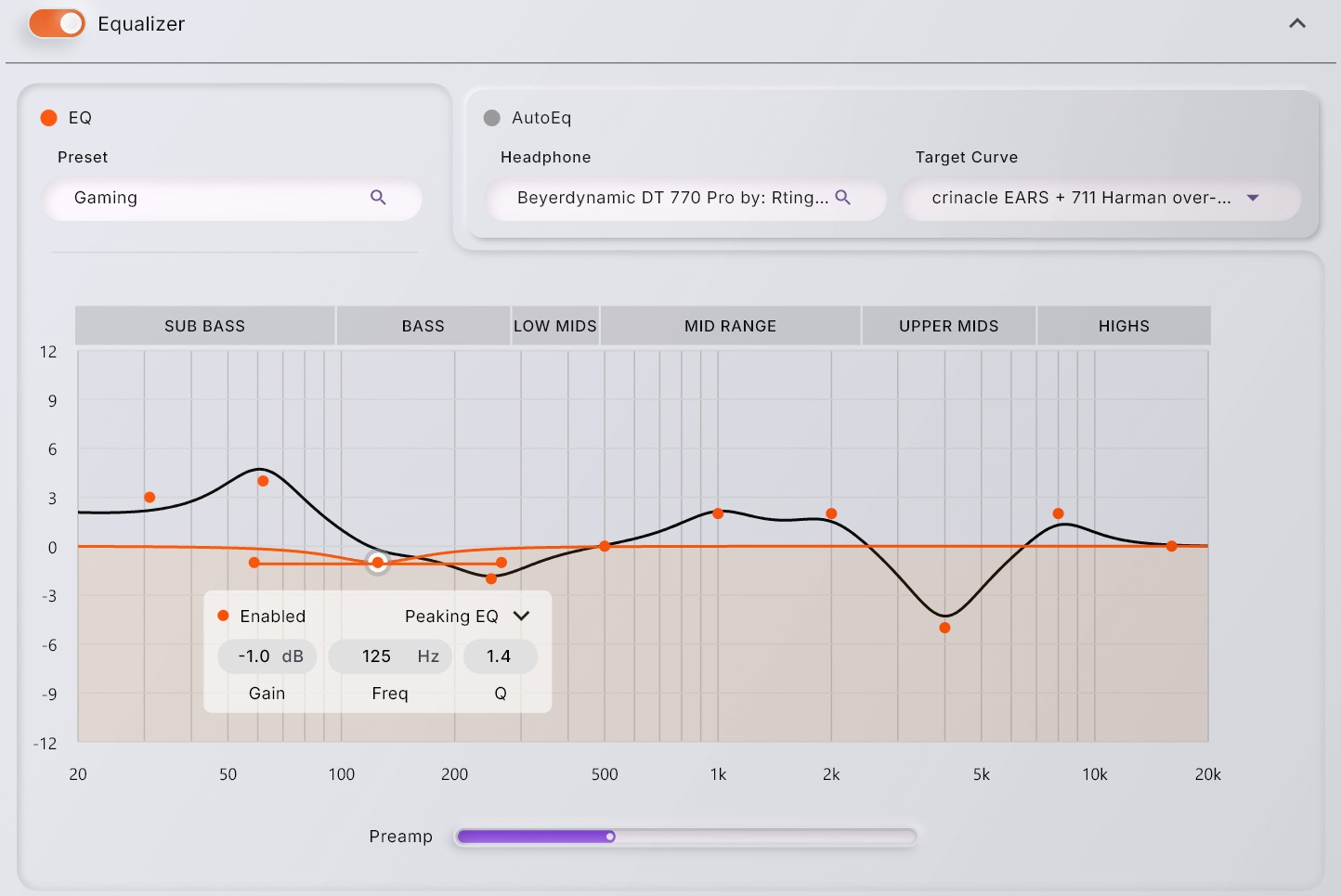
Below this is a parametric equaliser, much improved over the EQ in earlier Creative cards.
With software processing, users have great freedom in the number and configuration of EQ bands. Each point is a parametric filter with a selectable type, including high-pass, low-pass and shelving, and an adjustable Q factor.
Gain, frequency and Q can be adjusted with the mouse or entered as numbers. Gaming and Music presets demonstrate the features. Users can create their own presets or turn off the entire EQ with the Equalizer switch.
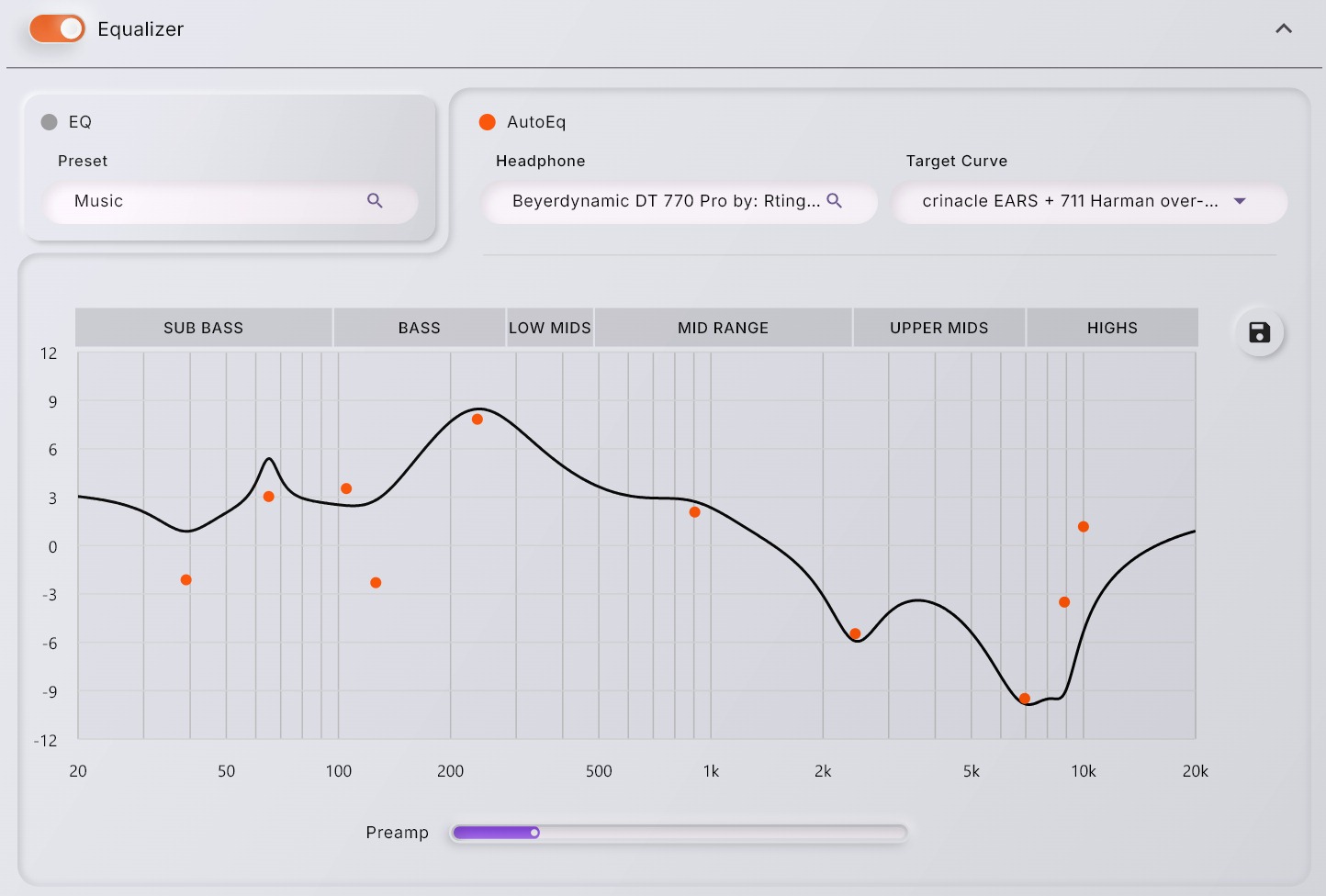
The main new feature is AutoEq. Creative has taken an approach that makes headphone equalisation much easier. Start typing a manufacturer and model in Headphones, and the software queries an online database. It lists frequency response measurements from review sites and independent enthusiasts. A target curve is then selected on the right. Flat aims to flatten the response. Other options include the B&K 5128 diffuse-field curve, which simulates speakers in a reverberant room, and Harman targets for in-ear and full-size headphones. These curves are similar, with small differences in the treble.
The resulting headphone EQ can also be adjusted manually as needed.
We tried correcting the Beyerdynamic DT 770 Pro, Neumann NDH20 and Grado SR325. Subjectively, the sound became more even.
For a fair comparison with AutoEq switched on and off, we had to match the original and equalised levels manually using the Preamp slider at the bottom. Without level matching, the comparison is misleading because the louder version will usually seem better. In 99% of cases, users who enjoy adjusting EQ and tone controls are responding to the increase in level as the sliders are raised. A louder signal is perceived as clearer and higher in quality.
All processing in the panel, including EQ, works only through the standard playback path: WASAPI Shared or DirectSound. WASAPI Exclusive and ASIO always bypass processing. The AE-X performs all effects in software within the standard Windows audio pipeline. This is an important difference from the AE-5/7/9, where the DSP applied the panel's effects regardless of the playback path.
There is another issue: in Russia, online profiles load only through a VPN. A normal connection shows the profile names but does not load the curves. Fortunately, saving a configured preset under a new name with the disk icon stores all settings locally. AutoEq can then be used without an internet connection.
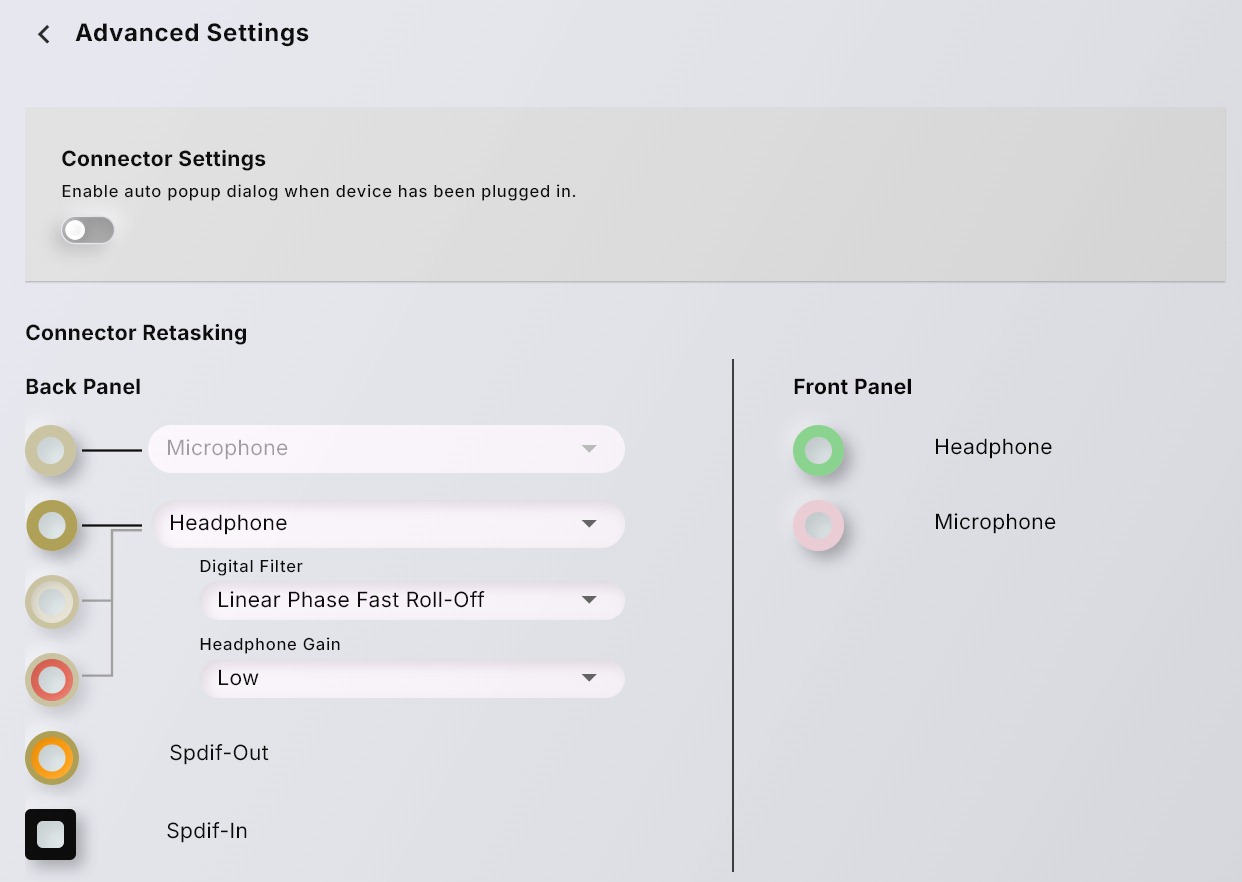
In the Nexus version we tested, the Speakers / Headphones switch had no effect. Its purpose was therefore unclear.
The actual hardware controls are in Advanced Settings. Manual speaker/headphone selection operates a relay that enables headphones and turns off the speaker signal.
This tab also selects the DAC reconstruction filter and one of four maximum output levels. Limiting output helps protect sensitive headphones from excessive volume.
Automatic switching is incorrect in the current firmware. Plugging in headphones changes the output from Headphones to Line Out, when the opposite is needed. Unplugging headphones does not restore Line Out. Users must open this tab and select the right output manually. We expect this issue to be fixed in a future version.
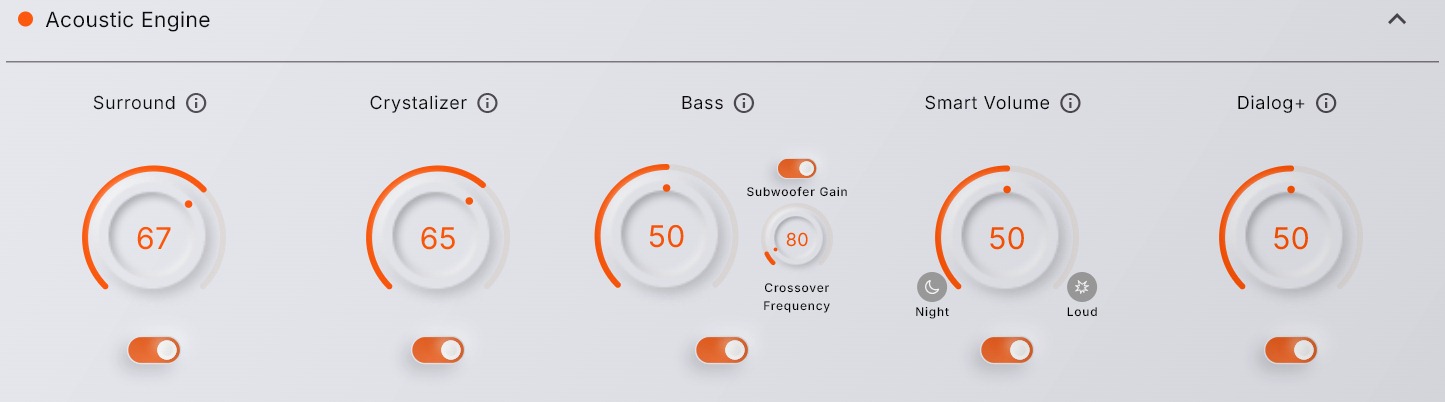
Acoustic Engine is unchanged from earlier cards. It has the familiar Surround, Crystalizer, Bass, Smart Volume and Dialog+ controls. Unneeded sections can be hidden with the arrow on the right.
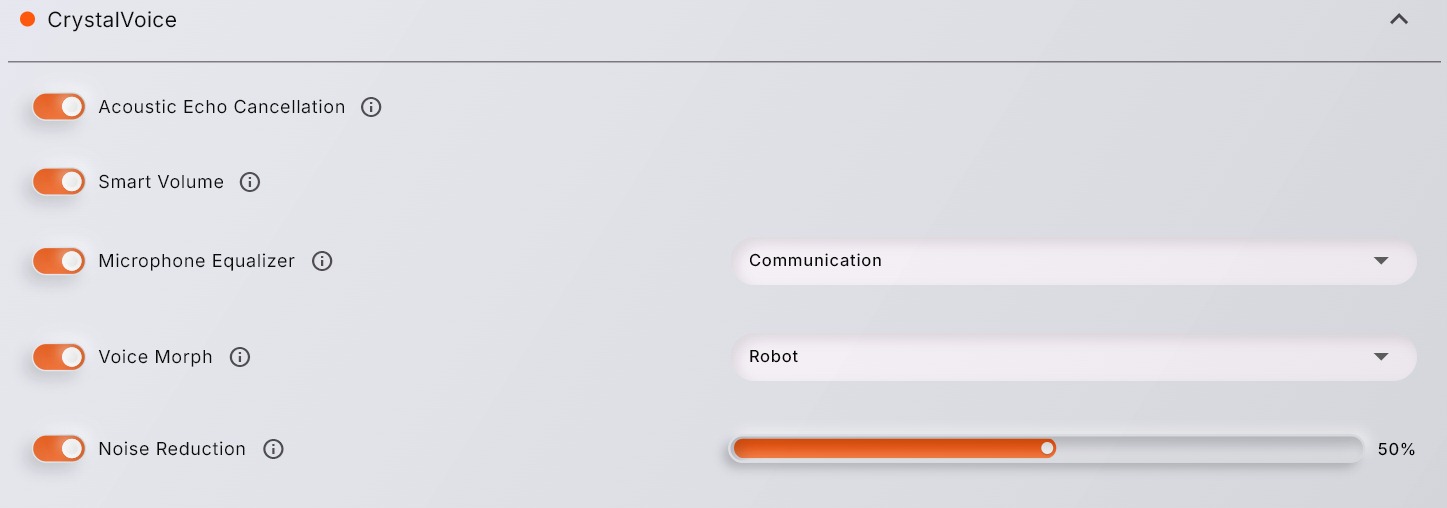
Connecting a microphone adds the CrystalVoice tab, with noise reduction and other useful settings.
The AE-X microphone input is more sensitive than the AE-5 input, but also noisier.
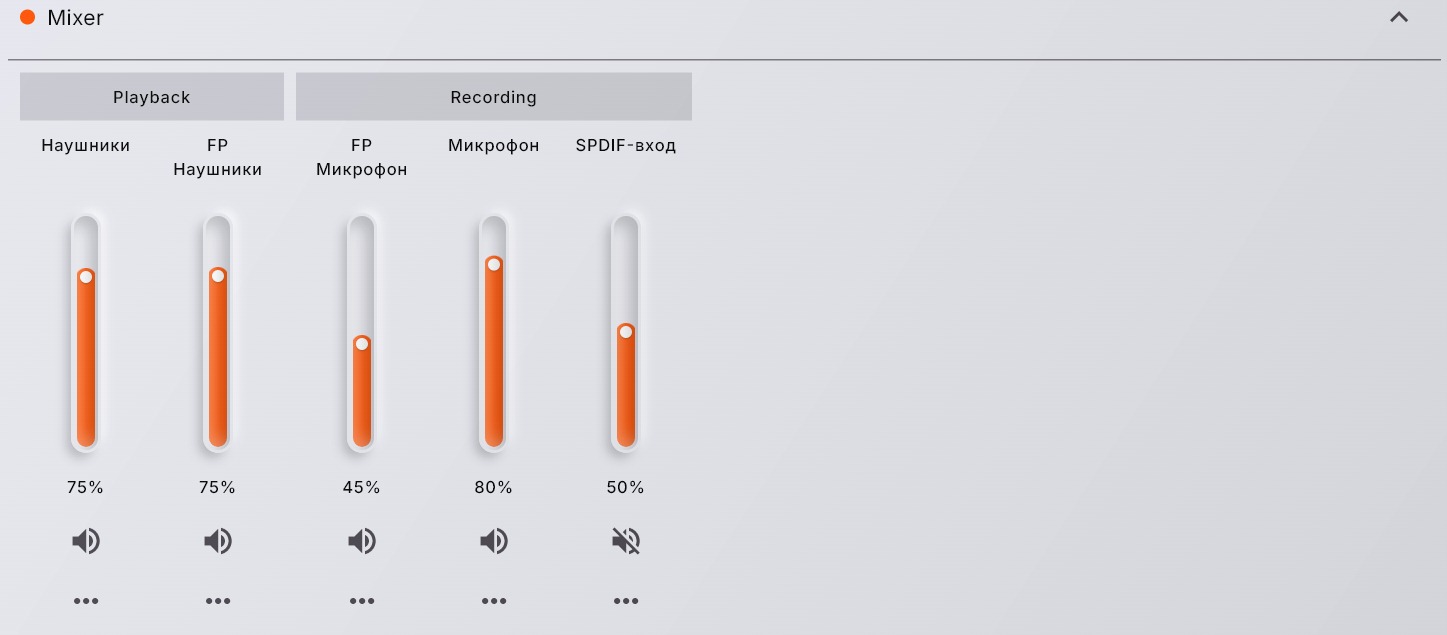
The AE-X mixer enables inputs and outputs and selects +10, +20 or +30 dB digital gain for the microphone inputs.
When an input or output is disconnected, its slider disappears from the mixer and the device disappears from Windows. This is a questionable design because not every application handles devices appearing and disappearing smoothly.
In a player such as foobar2000, selecting Primary Sound Device instead of Speakers (Sound Blaster AE-X) avoids errors when Speakers disappears and is replaced by Headphones. Selecting the ASIO driver also allows smooth switching.
The AE-X driver is named Realtek ASIO because both the digital chip and drivers come from Taiwan-based Realtek.
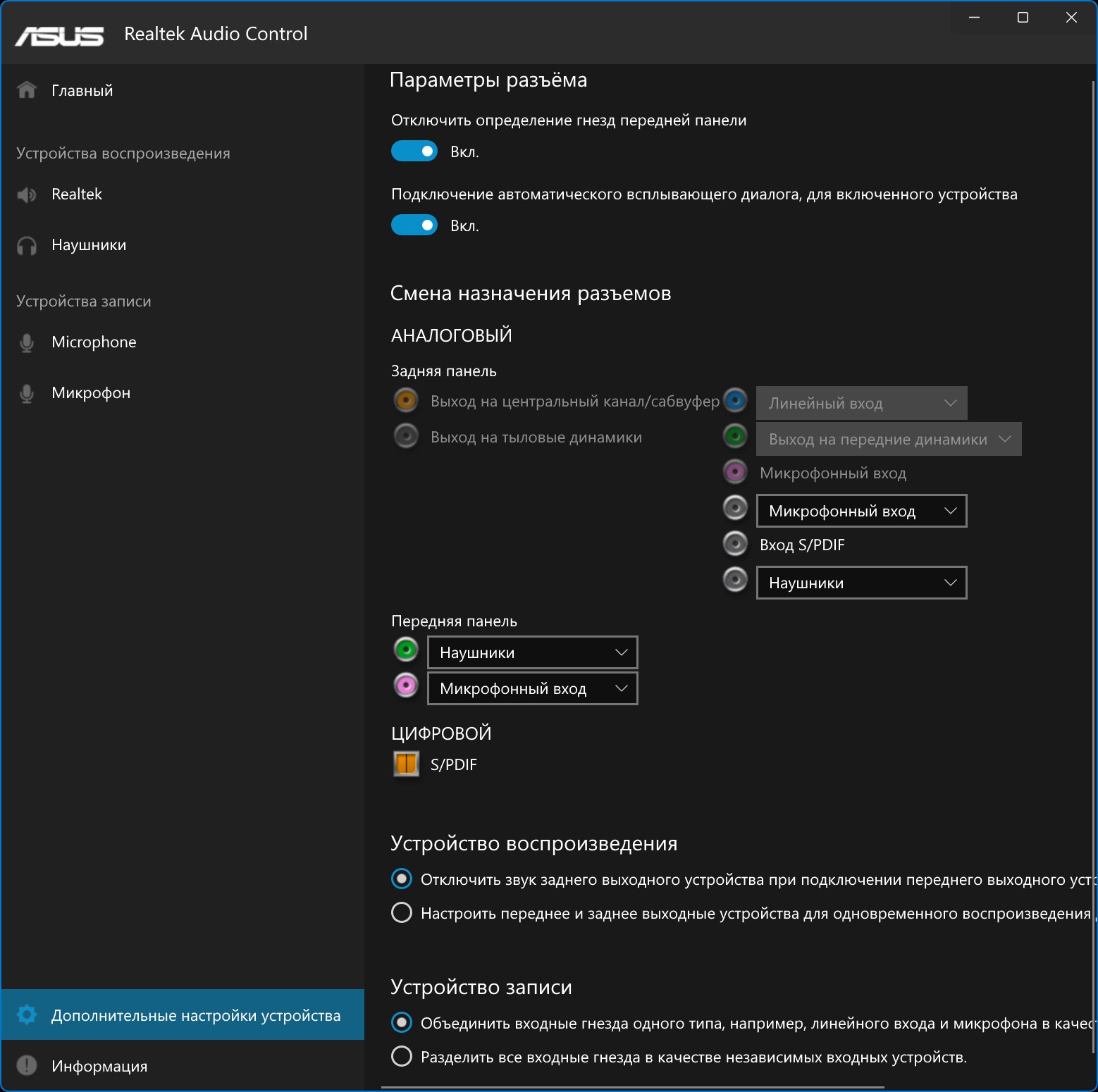
Interestingly, the AE-X also appears in the standard Realtek Audio Control panel. It has separate tabs alongside the Realtek ALC897 integrated audio in our test computer. This panel adjusts basic functions associated with the AE-X's internal Realtek chip.
7.1 virtualisation in headphones
The claimed virtualisation support raised many questions. Some users considered it only a marketing claim and believed the function was absent. The manufacturer provides no instructions and only briefly mentions the feature on its website.
Earlier models clearly provided virtualisation through their control panel. Under Windows 7/8, a 5.1 device was usually required. Games and media players could see those channels and send multi-channel audio to them. Windows 10/11 makes this less clear: multi-channel handling is inside WASAPI, and driver processing uses audio processing objects, or APOs. As a result, even Creative's own staff can struggle to explain how the sound card works.
In large companies, staff often fall into two groups:
1) Development engineers who understand the product but cannot discuss technical details freely because of confidentiality rules.
2) Staff in other departments who can speak publicly but may have little direct experience of the product or specialist audio knowledge.
This makes useful communication difficult. Users often receive general support replies rather than clear technical answers.
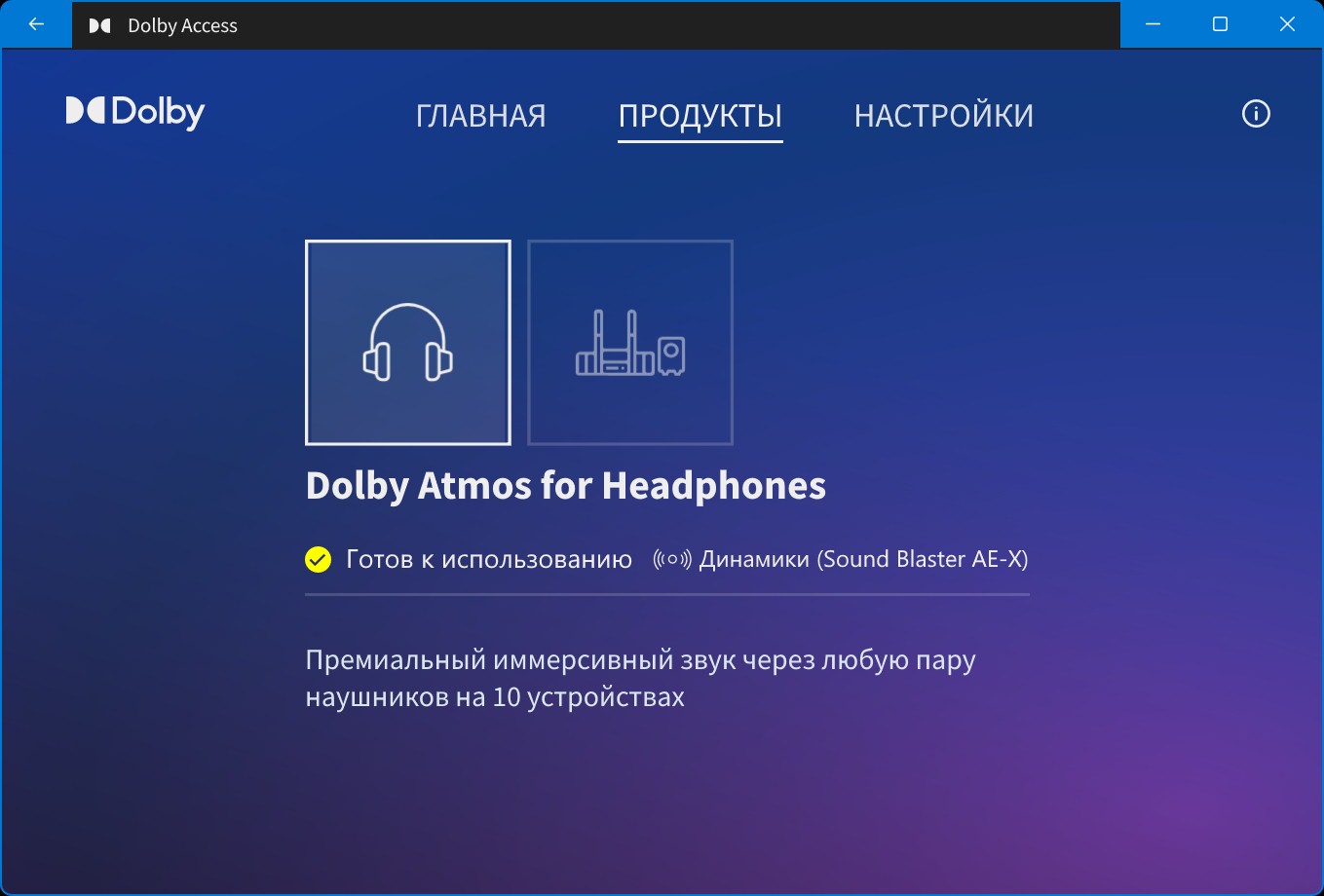
We therefore decided to investigate ourselves. We developed a small utility that calls the internal Windows 10/11 APIs in the same way as a game. This lets us test software and hardware virtualisation directly.
The playback code was developed through trial and error. According to user feedback, it works across their systems. The utility runs from the command line. It has no graphical interface, but is small and very fast.
- Download: test_51_71_WASAPI.zip ZIP archive, 5 MB
The test uses a ready-made WAV file included with the executable. Put both files in the same folder. A different test WAV can be specified as the first command-line argument. The file must be 5.1 or 7.1, 24-bit, at any sample rate.
If no virtualisation is active, the file plays in ordinary stereo without a surround effect. When virtualisation is enabled, the difference is immediately audible.
The effect is intended for headphones, although users can also try listening through speakers. If there is a problem or no sound card is available, diagnostic information appears on screen.
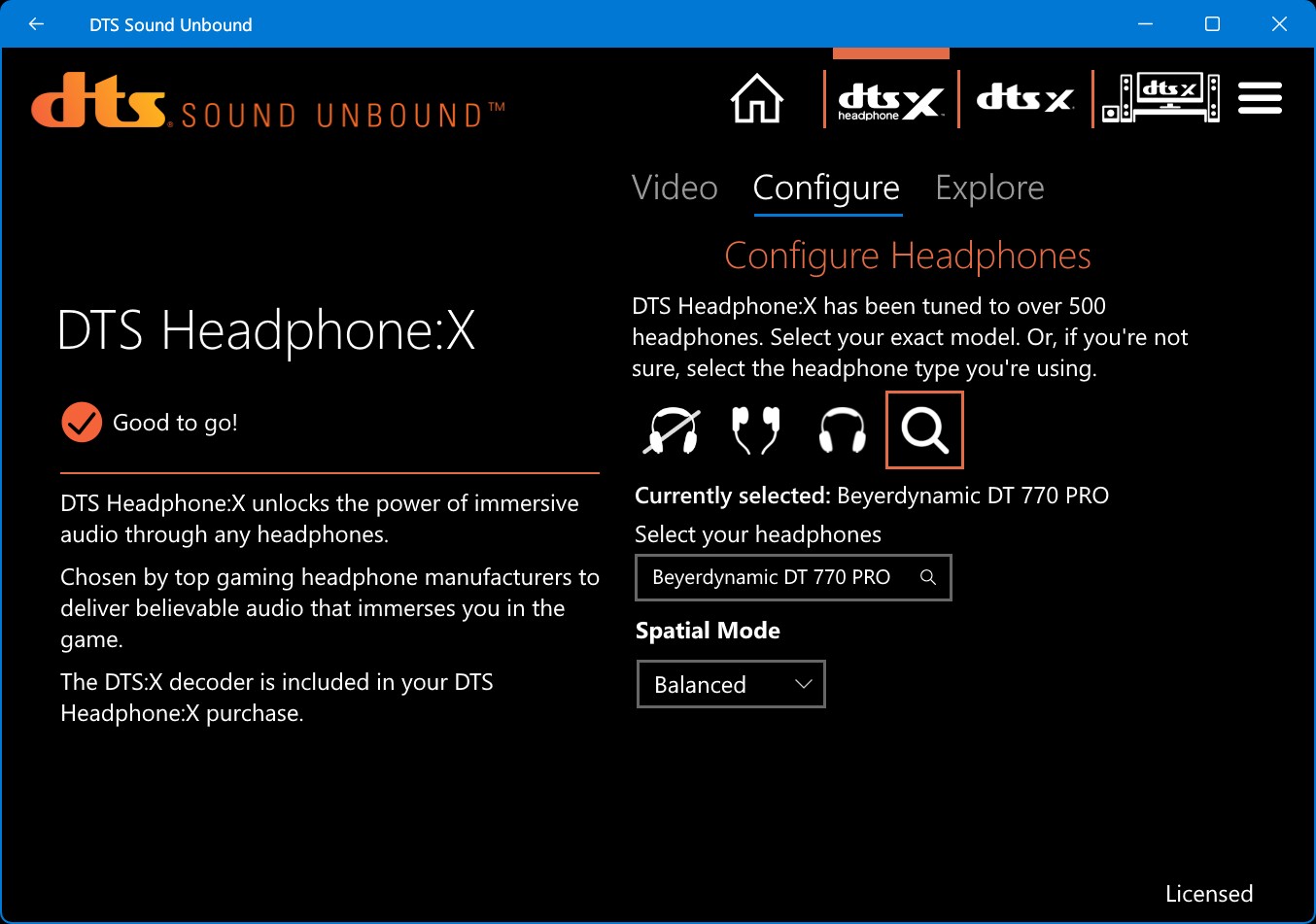
On our computer, the test works very well with the Sound Blaster AE-5 and demonstrates the strong spatial effect of Sound Core 3D. It also reveals a very different 3D presentation from Windows Sonic and the paid Dolby Atmos and DTS:X software. The differences are large and easy to hear.
Windows Sonic is the simplest and least interesting virtualiser, but it is free.
Dolby Atmos is usually the loudest and most forward, although its settings allow full adjustment. DTS:X is the gentlest and adds strong room reverberation.
In our opinion, Creative SBX places sources most accurately in space and sounds the most realistic. Other listeners may prefer a different approach.
Through testing, we found how to enable virtualisation on the AE-X. The card must be the Windows default playback device, used by applications such as the browser. Effects must be enabled in the control panel, with Surround selected. Without these settings, virtualisation will not work.
The Surround slider appears to control the width of the virtual soundstage. Other software virtualisers should be disabled by setting Spatial Sound to Off in Windows. The AE-X driver has its own software implementation. It does work, and works very well.
After correspondence and discussion with Creative, its head office responded very positively to our initiative and planned to add a similar test to the control panel. At least, that was the verbal promise.
Internal electronics
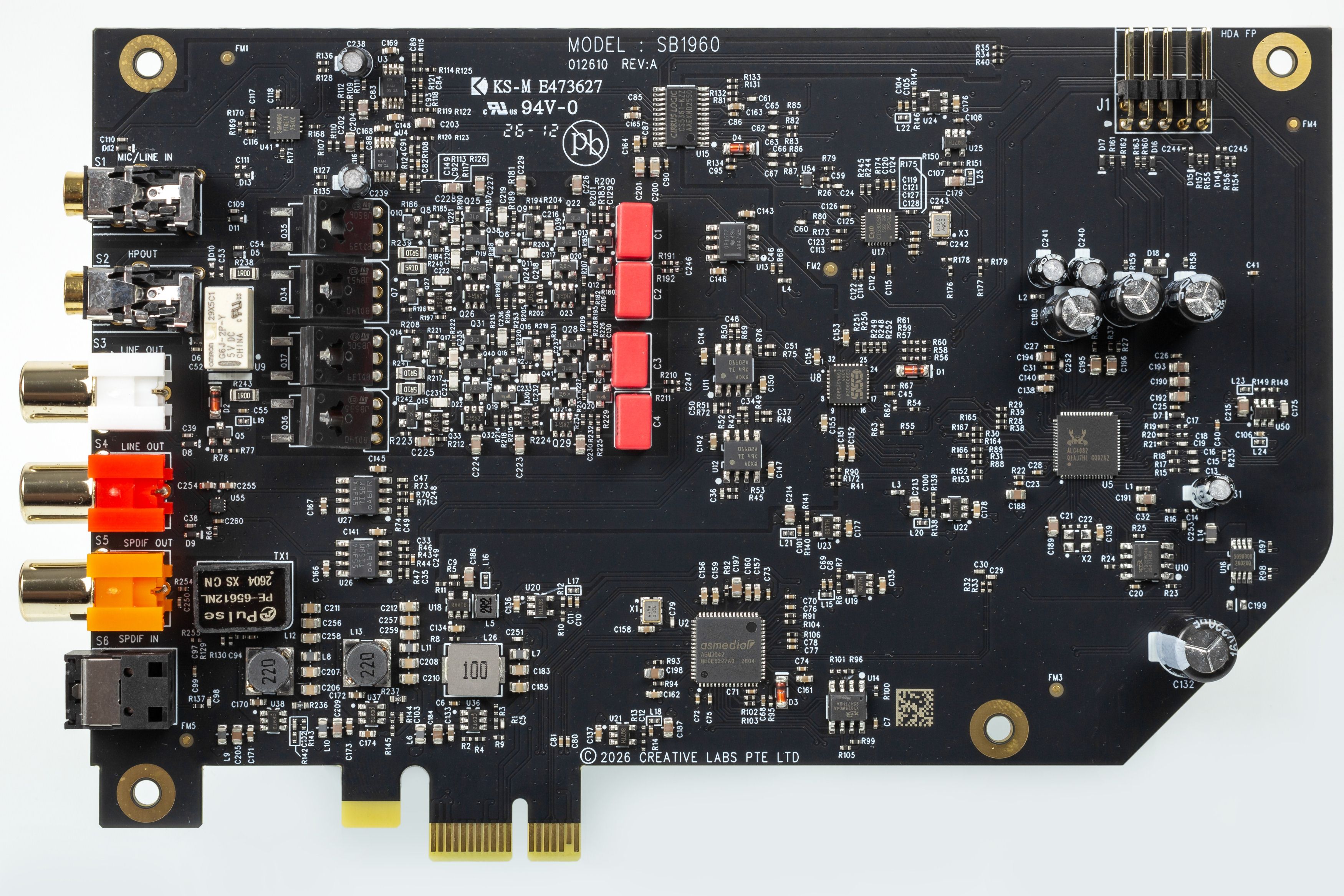
With the protective cover removed, the AE-X components are easy to see. The ASMedia bridge connects the PCIe bus to USB2.0.
The next component is the highly integrated Realtek ALC4082. It reduces the bill of materials, or BOM, and therefore manufacturing cost. This matters greatly for mass-market products such as motherboards and portable devices. A separate sound card has more room for additional components, so this benefit is less important here.
We criticised the digital section of the AE-5/7/9 for lacking direct support for 44.1 kHz. The AE-X uses a completely different digital design.
Clear advantages include 32-bit / 384 kHz and DSD support, plus a stereo output rated at 120 dB, while the codec's other channels provide 98 dB. The AE-X uses this higher-quality Realtek output for the case HD AUDIO headphone connection. The card's rear outputs always use the higher-grade ESS DAC rated at 130 dB.
However, cost reduction has consequences. There are no separate audio clock oscillators because the Realtek chip neither needs nor supports them. Realtek generates the required clocks internally. According to its specification, the chip uses USB transfer timing as a reference and reconstructs the audio clock through an internal phase-locked loop, or PLL.
The quality of that PLL is not specified. The chip's S/PDIF output jitter is known to be 4 ns at 48 kHz, which is relatively high. Perhaps this explains the additional asynchronous sample-rate converter, or ASRC, for I2S/S/PDIF signals on the board.
We were surprised to find a separate Cirrus Logic CS5361 ADC, specified at 114 dB dynamic range and −105 dB THD+N.
The card can unusually use its input as a stereo line input for digitising external sources. The AE-5/7 did not provide this; only the AE-9 did. The AE-X clearly combines features from different models in the family.
Texas Instruments NE5532 and OPA1602 operational amplifiers are soldered to the board and are not intended for user replacement. These are not low-quality parts, and we see little reason to replace them. Improving the card would first require addressing other limitations in the design.
Why criticise these choices if users have no alternative? Is Creative the only company still making PCIe sound cards? Not quite. Apart from expensive professional cards for musicians, there is a similarly designed consumer product: the Lisk Audio Lisa, developed and made in Russia. Our detailed review is available here: Lisk Audio Lisa — a Russian 32-bit / 384 kHz sound card with a powerful headphone amplifier
| Parameter | Lisk Audio Lisa | Creative AE-X |
| Channel count | 2 | 2 |
| DAC chip | Cirrus Logic CS43198 | ESS ES9039Q2M |
| Chip dynamic range | 130 dB | 130 dB |
| ADC chip | Texas Instruments TLV320ADC6120 | Cirrus Logic CS5361 |
| 32-bit / 384 kHz playback | Yes | Yes |
| 32-bit / 384 kHz recording | Yes | No |
| DSD playback | Yes, native and DoP | Yes, native and DoP |
| Hardware DSP | No | No |
| Audio processing | No | Software |
| 3.5 mm headphone output | Yes | Yes |
| 6.3 mm headphone output | Yes | No |
| 3.5 mm microphone input | Yes | Yes |
| Stereo RCA line output | Yes | Yes |
| HD_AUDIO, PC case audio connectors | Yes | Yes |
| Line input | Yes | Yes |
| Headphone output power | 2,000 mW into 32 ohms 2,000 mW into 32 ohms, HD_AUDIO |
350 mW into 32 ohms 40 mW into 32 ohms, HD_AUDIO |
| Headphone amplifier gain switching | Yes, 4 positions | Yes, 4 positions |
| Digital inputs/outputs | No | Toslink/SPDIF |
| Display | 128 × 32 pixel matrix | No |
| Peak meter | Yes | No |
| Volume control | Hardware | Hardware |
| Driverless operation | Yes | Yes |
| Linux compatibility | Yes | Yes |
| ASIO driver | Yes | Yes |
The two cards are similar enough for a fair comparison. The Lisa costs more, at RUB 50,000, because it is made in small batches in Russia rather than mass-produced in China. This approach has advantages and disadvantages. It allows complex circuits and expensive components, better service and support in the user's language. However, contractor services and logistics cost more, and production takes longer.
Headphone amplifier
Before listening, we measured headphone amplifier power precisely into 32 ohms. We use high-power ceramic resistors rated at 10 W because headphones may not survive such high levels.
- Lisk Audio Lisa: 2,000 mW
- Sound Blaster AE-5: 450 mW
- Sound Blaster AE-X: 350 mW
All three amplifiers provide enough power for common headphones. However, the AE-5 and AE-X show power-supply voltage drop as their volume controls approach maximum. Above the stated 350 mW level, the power circuit produces a whistle, and the waveform changes from a sine wave towards a square wave with depressed peaks. It is better never to drive these cards to maximum volume, to avoid damaging headphones or hearing.
By contrast, the Lisa operates stably even at 100% volume and delivers its rated 2,000 mW.
All three amplifiers drove our headphones well, from high-impedance, low-sensitivity dynamic models to low-impedance, low-sensitivity planar models.
Before listening, we matched levels with a digital oscilloscope to within 0.1 dB so that no card had a loudness advantage.
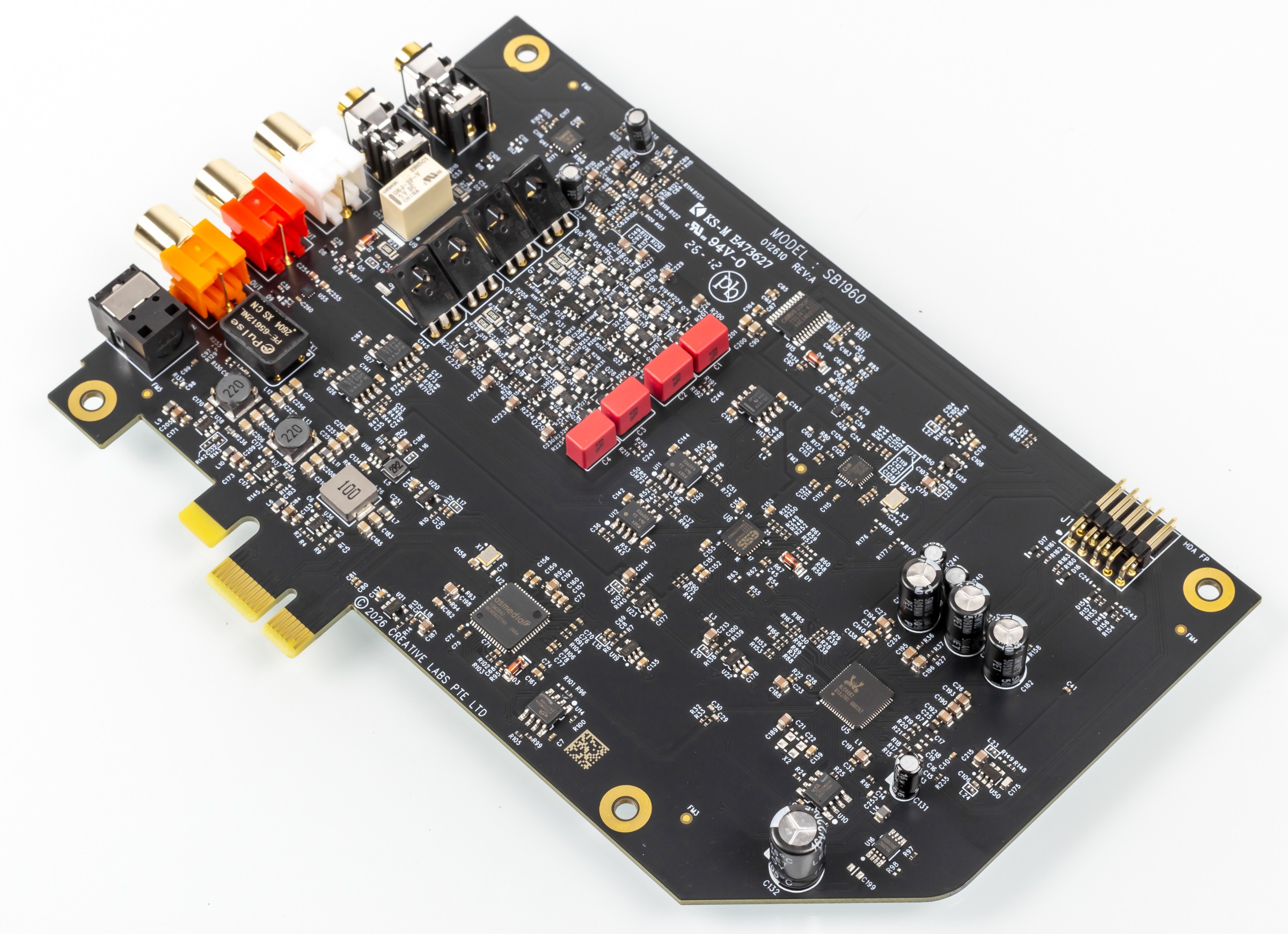
We tested the Sound Blaster AE-X with music, directly against the Sound Blaster AE-5 and Lisk Audio Lisa. The headphones were the Beyerdynamic DT 770 Pro (250 ohms), Neumann NDH20 (150 ohms), Grado SR325 (32 ohms) and Snorry Radius (25 ohms). We used high-resolution recordings from Qobuz and a local FLAC collection. Listening continued over several days to reduce the chance of a mistaken judgement.
The Sound Blaster AE-5 initially sounds bright and impressive, and many listeners may like it. After a while, however, a sensitive listener may tire of the exaggerated snare attack and strong sibilance. Together with the overly smooth midrange we associate with Sabre 32, this makes lead instruments and vocals harder to enjoy.
A high-quality audio device should first reproduce the midrange well, followed by bass and then treble. That is our order of priorities. The AE-5 seems to reverse it. The midrange is recessed and not fully clear. Bass sounds better by comparison but has too much emphasis on attack. Treble is very strong, making EQ tempting. Even a Realtek integrated codec can sound more balanced, although its sound is flatter and simpler and its output has less volume available.
The Sound Blaster AE-X sounds more interesting and musical than the AE-5. Its presentation reminded us of the AE-9, whose more mature sound contrasted with the AE-5 and AE-7 and was better suited to more expensive audio systems.
The AE-X does add colouration to vocals and drums. Some listeners may like this, but we prefer a natural sound without the slight extra breathiness and sibilance.
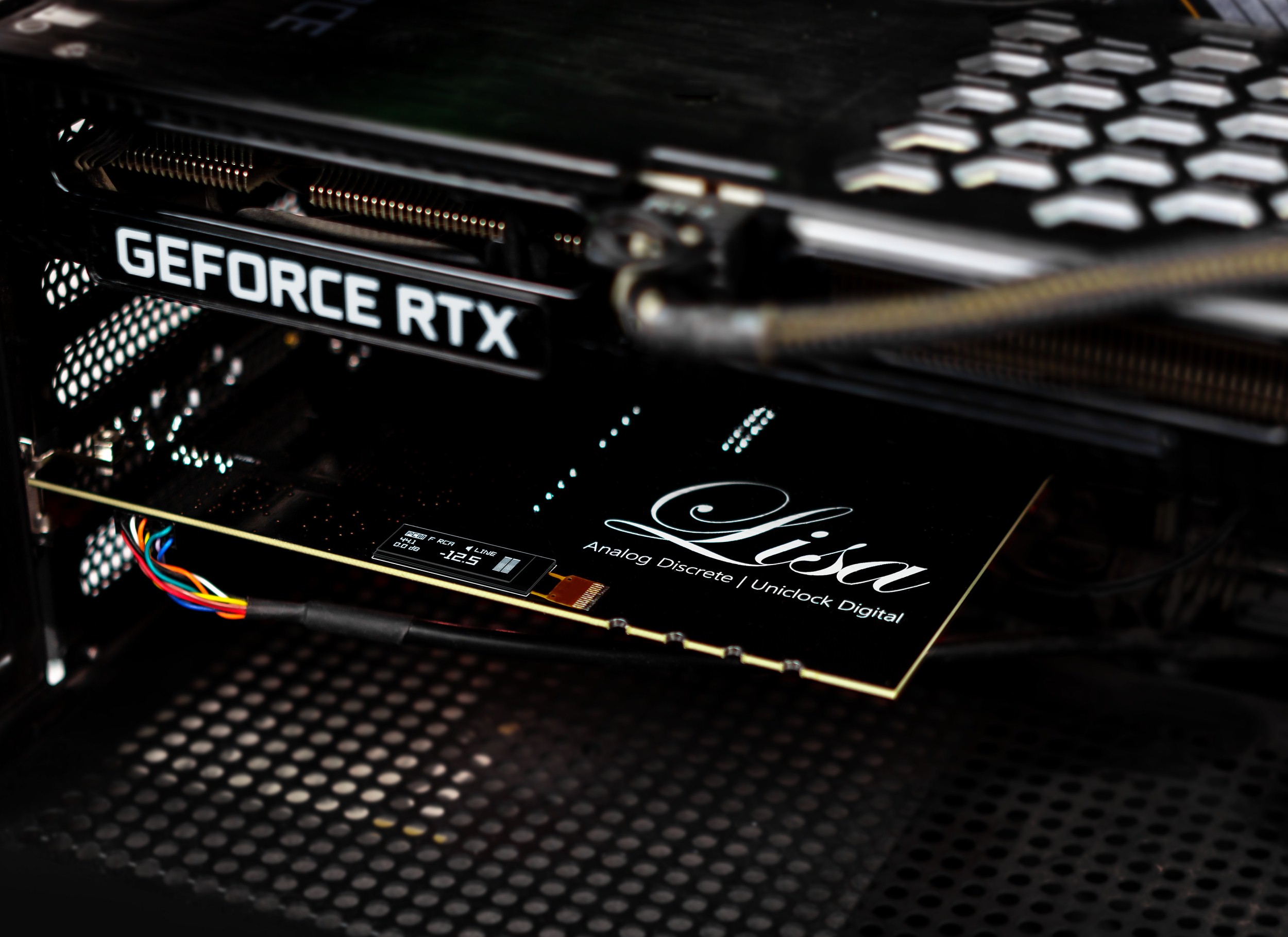
The Lisk Audio Lisa presents the music naturally rather than emphasising individual effects. Everything sounds in place, with nothing distracting from the recording.
Creative's metal covers are intended to reduce interference inside a computer. Interestingly, the Lisa has a cleaner spectrum without such a cover.
Why? The Lisa uses a modern four-layer circuit board, with two layers almost fully covered by ground planes. These provide effective shielding, more useful than an external metal cover that is not connected to ground. We could neither see nor hear interference from the powerful graphics card in the same PC. Internal cards can have cleaner signals than many external USB devices because the main noise paths are often the power supply and ground connections, rather than airborne interference.
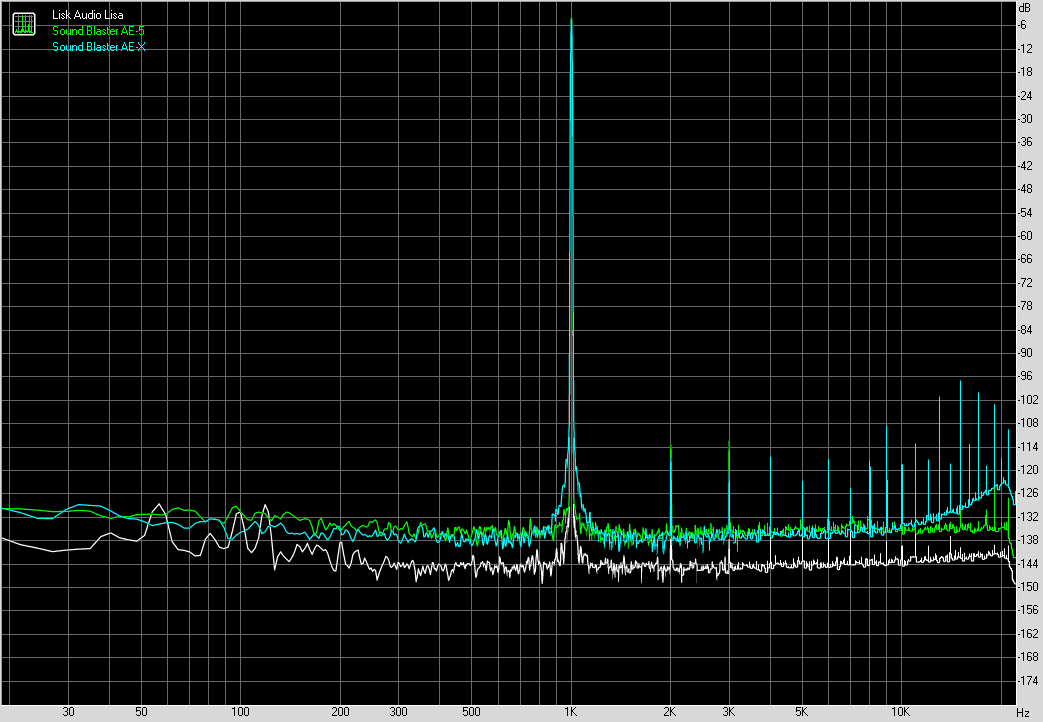
The graphs show the headphone amplifiers driving 32 ohms at a modest output level of 1 V. This is a realistic listening condition because around 30 mW gives enough volume for many common headphones.
All three cards were installed in the same computer under identical conditions. Moving a card outside the case through a PCIe extension did not change the graphs. Numerical results changed only in the last significant digit. The spectra therefore show the cards' own behaviour rather than an effect of the test computer.
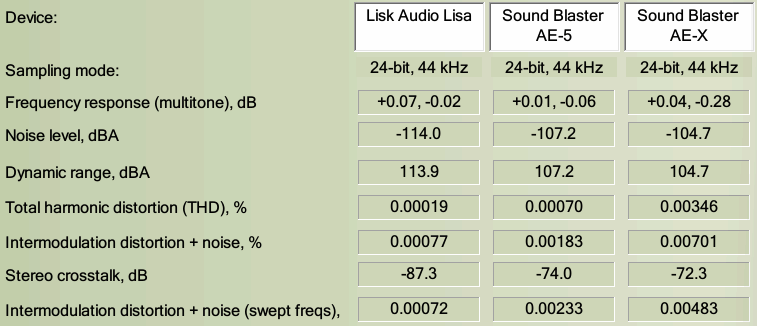
The Lisa, shown in white, has a less noisy spectrum and roughly an order of magnitude less distortion. The table confirms this.
A common online opinion is that all modern audio devices already have perfect performance beyond human hearing. This may be true in a single-sine test, but people normally listen to music. If one sine wave produces many harmonics, a more complex signal can create greater distortion problems. Compare THD and IMD tests. IMD uses two tones rather than one and shows how distortion increases. Intermodulation products spread throughout the spectrum, rather than remaining only at high frequencies.
Why did we test the AE-X's rear output? In both the AE-5 and AE-X, the HD_AUDIO case output is fed by the HDA codec inside the digital chip. It is limited to 1 V into 32 ohms and sounds flatter than the rear output. Its specifications are also worse: maximum power is 40 mW, and output impedance is a high 10 ohms. This reduces headphone damping and can make bass sound boomy.
For some reason, the expensive ESS DAC is not used for the case headphone socket. This is not true of every card. The Lisk Audio Lisa has no integrated HDA codec, and its HD_AUDIO output is fully featured, powerful and of the same quality as its rear output.
ASIO diagnostics
Here are the results from ASIOdiag, the diagnostic utility we developed to test sound-card capabilities.
Creative AE-5
The Creative AE-5 exposes two ASIO devices: Creative SB/SBX AE DSD ASIO and Creative SB/SBX AE series ASIO.
ASIO Driver Version: 2
Buffer Size Limits: Min=19200 | Max=19200 | Preferred=19200 | Granularity=0
Hardware Latency: Input=19200 samples | Output=19200 samples
Channel Layout: Total Inputs=4 | Total Outputs=6
--- Input Channel Details ---
In 0: [Line In L/R] | Audio Type: Int32 LSB
In 1: [Line In L/R] | Audio Type: Int32 LSB
In 2: [Mic L/R] | Audio Type: Int32 LSB
In 3: [Mic L/R] | Audio Type: Int32 LSB
--- Output Channel Details ---
Out 0: [Front L/R] | Audio Type: Int32 LSB
Out 1: [Front L/R] | Audio Type: Int32 LSB
Out 2: [Rear L/R] | Audio Type: Int32 LSB
Out 3: [Rear L/R] | Audio Type: Int32 LSB
Out 4: [Center/Sub] | Audio Type: Int32 LSB
Out 5: [Center/Sub] | Audio Type: Int32 LSB
Supported Hardware PCM Sample Rates:
* 44100 Hz (PCM)
* 48000 Hz (PCM)
* 88200 Hz (PCM)
* 96000 Hz (PCM)
* 192000 Hz (PCM)
* 384000 Hz (PCM)
Direct Stream Digital (DSD) Capabilities:
* Native DSD mode switch rejected by driver.
* Native DSD & DoP wrappers appear unsupported on this interface profile.
This is unusual for a sound card. Buffer size is adjusted in the ASIO panel, with a minimum of 2 ms. For a reason we could not explain, 176400 Hz is not supported.
ASIO Driver Version: 2
Buffer Size Limits: Min=2208 | Max=2208 | Preferred=2208 | Granularity=0
Hardware Latency: Input=2208 samples | Output=2208 samples
Channel Layout: Total Inputs=0 | Total Outputs=6
--- Input Channel Details ---
--- Output Channel Details ---
Out 0: [Front L/R] | Audio Type: Int32 LSB
Out 1: [Front L/R] | Audio Type: Int32 LSB
Out 2: [Rear L/R] | Audio Type: Int32 LSB
Out 3: [Rear L/R] | Audio Type: Int32 LSB
Out 4: [Center/Sub] | Audio Type: Int32 LSB
Out 5: [Center/Sub] | Audio Type: Int32 LSB
Supported Hardware PCM Sample Rates:
* 44100 Hz (PCM)
* 48000 Hz (PCM)
* 88200 Hz (PCM)
* 96000 Hz (PCM)
* 192000 Hz (PCM)
* 384000 Hz (PCM)
Direct Stream Digital (DSD) Capabilities:
* [SUCCESS] Native DSD Mode Switch: SUPPORTED
* Active Channels in DSD Mode: In=0 | Out=6
* Native DSD Packing Type: Int32 LSB
* Clock Support Verified: DSD64 (2.82 MHz)
The driver's Direct Stream Digital support is limited to DSD64. The AE-5 does not officially support DSD playback; that feature is reserved for higher models. Attempting DSD playback on the AE-5 caused foobar2000 to crash.
Creative AE-X
Diagnostics of the AE-X's Realtek ASIO driver show no 384 kHz support. Driver data depth is 16-bit for recording and 24-bit for playback. However, Direct Stream Digital formats up to DSD256 (11.28 MHz) are supported. foobar2000 correctly plays native DSD through the ASIO+DSD plug-in.
ASIO Driver Version: 3
Buffer Size Limits: Min=265 | Max=265 | Preferred=265 | Granularity=0
Channel Layout: Total Inputs=2 | Total Outputs=2
--- Input Channel Details ---
In 0: [HD Audio input 1] | Audio Type: Int16 LSB
In 1: [HD Audio input 2] | Audio Type: Int16 LSB
--- Output Channel Details ---
Out 0: [HD Audio output 1] | Audio Type: Int24 LSB (or 20-bit)
Out 1: [HD Audio output 2] | Audio Type: Int24 LSB (or 20-bit)
Supported Hardware PCM Sample Rates:
* 44100 Hz (PCM)
* 48000 Hz (PCM)
* 88200 Hz (PCM)
* 96000 Hz (PCM)
* 176400 Hz (PCM)
* 192000 Hz (PCM)
Direct Stream Digital (DSD) Capabilities:
* [SUCCESS] Native DSD Mode Switch: SUPPORTED
* Active Channels in DSD Mode: In=2 | Out=2
* Native DSD Packing Type: DSD 1-bit (8 samples/byte, MSB first)
* Clock Support Verified: DSD64 (2.82 MHz)
* Clock Support Verified: DSD128 (5.64 MHz)
* Clock Support Verified: DSD256 (11.28 MHz)
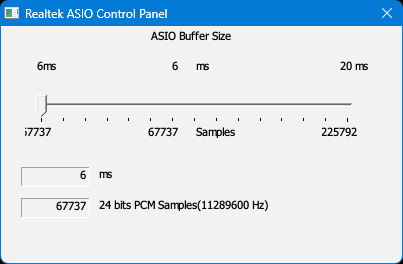
Buffer size is adjusted in the ASIO panel, with a minimum of 6 ms. The panel looks like this:
Lisk Audio Lisa
The Lisk Audio Lisa supports all PCM and DSD formats correctly. Recording and playback both support 32-bit audio, and Direct Stream Digital is available up to DSD256. foobar2000 correctly plays native DSD through the ASIO+DSD plug-in.
ASIO Driver Version: 1536
Buffer Size Limits: Min=64 | Max=16384 | Preferred=4096 | Granularity=-1
Hardware Latency: Input=4672 samples | Output=5568 samples
Channel Layout: Total Inputs=2 | Total Outputs=2
--- Input Channel Details ---
In 0: [Line in L] | Audio Type: Int32 LSB
In 1: [Line in R] | Audio Type: Int32 LSB
--- Output Channel Details ---
Out 0: [Line out L] | Audio Type: Int32 LSB
Out 1: [Line out R] | Audio Type: Int32 LSB
Supported Hardware PCM Sample Rates:
* 44100 Hz (PCM)
* 48000 Hz (PCM)
* 88200 Hz (PCM)
* 96000 Hz (PCM)
* 176400 Hz (PCM)
* 192000 Hz (PCM)
* 352800 Hz (PCM)
* 384000 Hz (PCM)
Direct Stream Digital (DSD) Capabilities:
* [SUCCESS] Native DSD Mode Switch: SUPPORTED
* Active Channels in DSD Mode: In=0 | Out=2
* Native DSD Packing Type: DSD 1-bit (8 samples/byte, MSB first)
* Clock Support Verified: DSD64 (2.82 MHz)
* Clock Support Verified: DSD128 (5.64 MHz)
* Clock Support Verified: DSD256 (11.28 MHz)
RMAA testing
We measured the line output separately. The card's own input cannot show the output's full performance, so we recorded the signal through a galvanically isolated Lisk Audio MUX2 interface.
| Device under test | Creative Sound Blaster AE-X |
| Operating mode | 32-bit / 44 kHz |
| Audio interface | MME |
| Signal path | Line out |
| RMAA version | 6.4.5 PRO |
| 20 Hz–20 kHz filter | YES |
| Signal normalisation | YES |
| Level change | −0.9 dB / −1.0 dB |
| Mono mode | NO |
| Calibration signal frequency, Hz | 1000 |
| Polarity | Correct/correct |
| Frequency response, 40 Hz–15 kHz, dB | +0.04, -0.28 |
Very good |
| Noise level, dB(A) | -115.3 |
Excellent |
| Dynamic range, dB(A) | 115.3 |
Excellent |
| Total harmonic distortion, % | 0.00058 |
Excellent |
| THD + noise, dB(A) | -93.9 |
Very good |
| Intermodulation distortion + noise, % | 0.00552 |
Excellent |
| Stereo crosstalk, dB | -97.8 |
Excellent |
| Intermodulation at 10 kHz, % | 0.00107 |
Excellent |
| Overall result | Excellent |
Detailed RMAA input measurements at 24-bit / 44 kHz
The overall Excellent rating is welcome. However, the measurements revealed several small technical problems.
Fortunately, the first problem does not affect the rear headphone output. The line output and FP_HDA headphone connection produce quiet but sharp clicks, around −30 dB, in both channels when playback starts or stops. Windows' sound test makes this easy to hear because it plays short samples. Continuous music does not click. A gap longer than 1.5 seconds between tracks produces a pair of clicks. The issue is related to a DAC dynamic-range extension feature that switches off the output below a certain level. This lowers background noise in pauses and improves measured results by around 10 dB. What is unclear is why the switching produces an audible click. It should not.
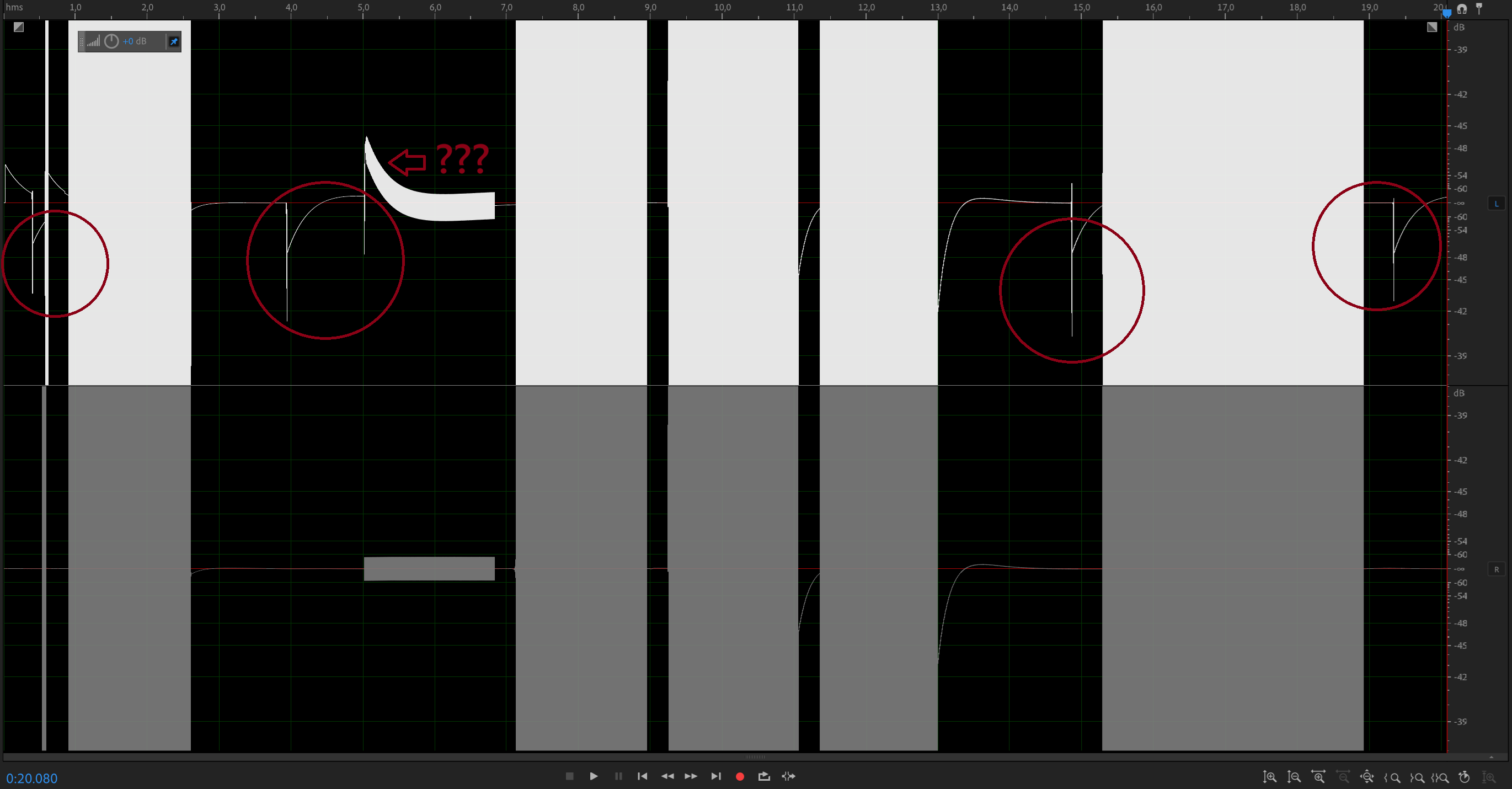
The upper image shows the waveform of an RMAA recording from the AE-X line output. Clicks occur at the start and end of the signal, together with a DC offset marked ???. The lower Lisa result shows how this should work: no clicks and no unusual bend in the dynamic-range test signal (Lisa line-output RMAA report).
We have informed the AE-X manufacturer. We hope the problem will be removed in a firmware or driver update, or that users will at least be able to disable this specification-enhancing feature. Besides being unpleasant, the clicks interfere with measurements. A loud switching click occurs during the noise test, the second test after frequency response. RMAA then reports −87 dB noise and a Poor rating, but that figure is misleading. After the switching event, noise remains stably at −115 dB for as long as required.
To show the actual noise performance, we opened the test WAV and manually replaced each click with a short section of valid data from a click-free part of the same file.
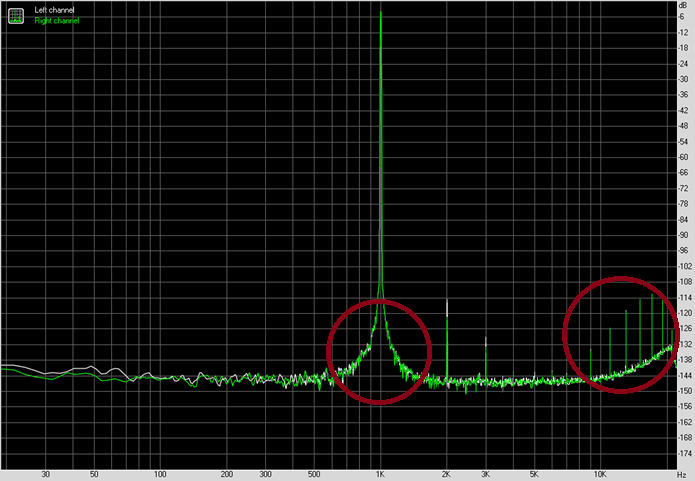
The second problem is an increase in harmonics above 10 kHz, as shown in the image. The higher the volume, the stronger the extra components. Reducing signal amplitude reduces the problem. The graph uses a signal level of −3 dBFS.
Without these extra spectral components, the distortion test would rate Excellent rather than Very good, because the rest of the spectrum is clean. Subjectively, the high-frequency harmonics add colouration to sibilants and cymbals.
The third issue is a wide skirt around the main tone, indicating increased low-frequency jitter. This skirt appears on every AE-X output, including the case socket driven by the Realtek codec. The cause is PLL timing inaccuracy. The significance should not be overstated: hearing is relatively insensitive to low-frequency jitter. Put simply, this low-frequency jitter is not audible. The absence of high-frequency jitter matters more because sensitivity to it is around three orders of magnitude higher, or thousands of times greater. The AE-X shows no high-frequency jitter.
Our card was neither a prototype nor a pre-production sample. We bought a normal retail unit from an ordinary shop, just as a customer would.
Here is the comparison of all three line outputs in RMAA.
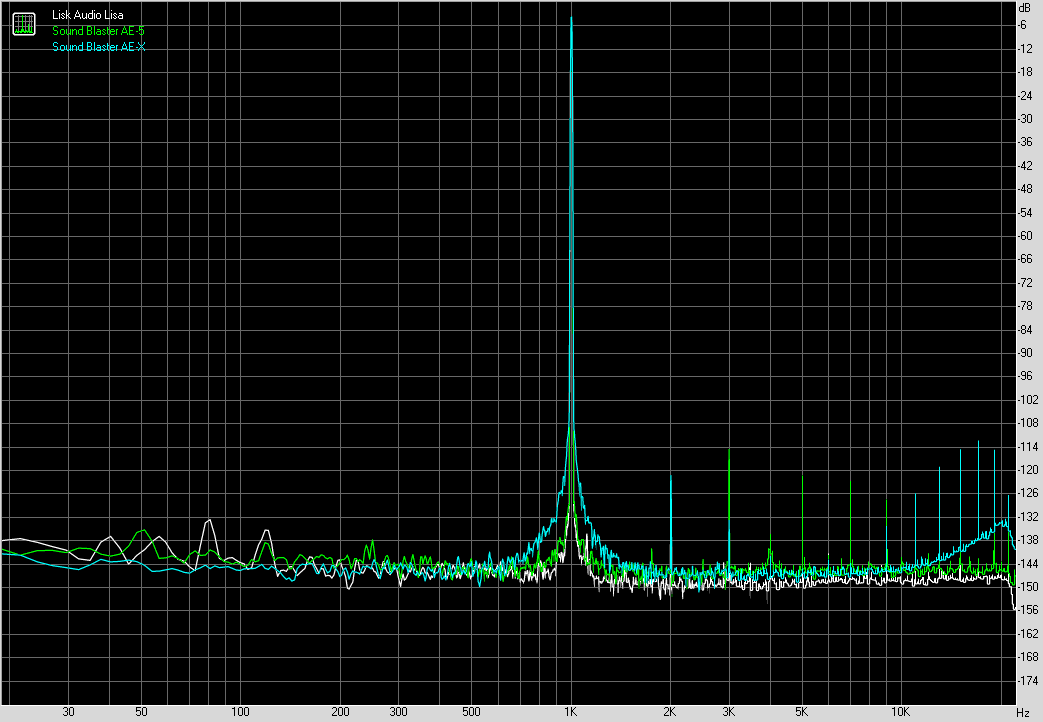
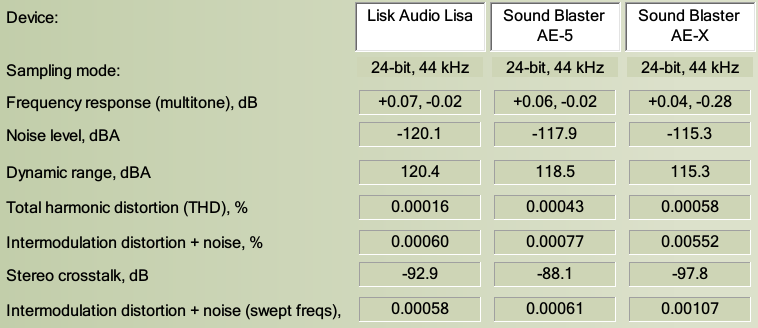
Without the extra high-frequency component, the AE-X would easily beat the AE-5 in both graphs and figures. The AE-5 has much higher 3rd, 5th, 7th and 9th harmonics. As tested, however, the AE-X only approaches the AE-5's measured performance.
Conclusions
We welcome Creative's return to developing internal sound cards after a long pause. The AE-X, released in 2026, has a completely redesigned digital section and software. The scale of those changes may explain why some functions do not yet work as intended. We found stability problems, including the card disappearing from the control panel.
However, we are not ready to make a final judgement. The card is new, and enthusiast users will provide feedback. Some time is needed for new firmware, drivers and Nexus updates.
Software processing is already proving useful for an internal card. It offers room for further improvements without the old hardware limits. At the same time, a mass-market price inevitably requires compromises, and the manufacturer has not yet fully resolved the behaviour of the new chips. Despite its potential, the AE-X only approaches the AE-5 in measurements. Musically, however, it comes close to the AE-9.
The AE-X is relatively affordable, with a recommended European price of EUR 200.
The more expensive Lisa remains beyond the AE family's reach in both technical performance and sound quality. The price difference reflects that difference in performance.
We welcome competition because it gives users more choice and encourages technical progress. We hope users will recognise Creative's efforts and that the company will continue developing this product line.
Note. This is an adapted machine translation into English. It follows the “In simple terms” approach. Read the original article at https://prosound.ixbt.com/multimedia/creative-aex.shtml.