
MOTU 10pre — a Thunderbolt 4 / USB4 audio interface with 10 microphone inputs
Maxim Liadov
Among the MOTU 16A, 848 and 10pre rackmount studio interfaces, the model under test offers the largest number of microphone preamps. As its name suggests, the 10pre has ten inputs. This is enough to record a small group of performers, including separate microphones for a drum kit. The main change from the MOTU 8pre-es is Thunderbolt 4 / USB4, with speeds up to 40 Gbit/s and a very low round-trip latency of 1.8 ms. The previous model supported only USB 2.0 and Thunderbolt 2. Standard USB2 and USB3 connections are still supported. A strength of the whole range is built-in DSP for audio processing, controlled from a computer or an iPad. The table shows the differences between models.
| Feature | MOTU 16A | MOTU 848 | MOTU 10pre |
|---|---|---|---|
| Form factor | Rackmount, 1U | Rackmount, 1U | Rackmount, 1U |
| Main focus | Line-level channels | Microphone and line inputs | Microphone preamps |
| Total I/O channels | 32 x 34 | 28 x 32 | 26 x 28 |
| Microphone inputs (XLR) | None | 4 | 10 |
| Instrument inputs (Hi-Z) | None | 2 | 10 |
| Analogue line inputs | 16 TRS | 8 TRS inputs, plus 2 Return inputs | 10 (Combo XLR/TRS) |
| Analogue line outputs | 16 TRS | 8 TRS + 2 XLR (Main) | 8 TRS |
| Preamp gain | — | Up to +74 dB | Up to +74 dB |
| Headphone outputs | 1 | 2 independent outputs | 2 independent outputs |
| Optical digital I/O | 2 ADAT / S/MUX banks | 2 ADAT / S/MUX banks | 2 ADAT / S/MUX banks |
| DAC dynamic range | 125 dB (ESS Sabre32) | 125 dB (ESS Sabre32) | 125 dB (ESS Sabre32) |
| Host connection | Thunderbolt 4 / USB4 | Thunderbolt 4 / USB4 | Thunderbolt 4 / USB4 |
| Network protocol | Milan AVB, 2 ports | Milan AVB, 2 ports | Milan AVB, 2 ports |
| Built-in DSP mixer | 64 channels | 64 channels | 64 channels |
If more inputs and outputs are needed, several interfaces can be connected through an AVB network on Apple systems. Recent firmware adds support for the open Milan protocol, which is important news for current and future MOTU owners. Windows does not support this connection directly. However, the interface can connect to a Windows PC over Thunderbolt 4 / USB4 and act as a bridged endstation for the Milan network. The devices have official certification, confirming compatibility with these networks.
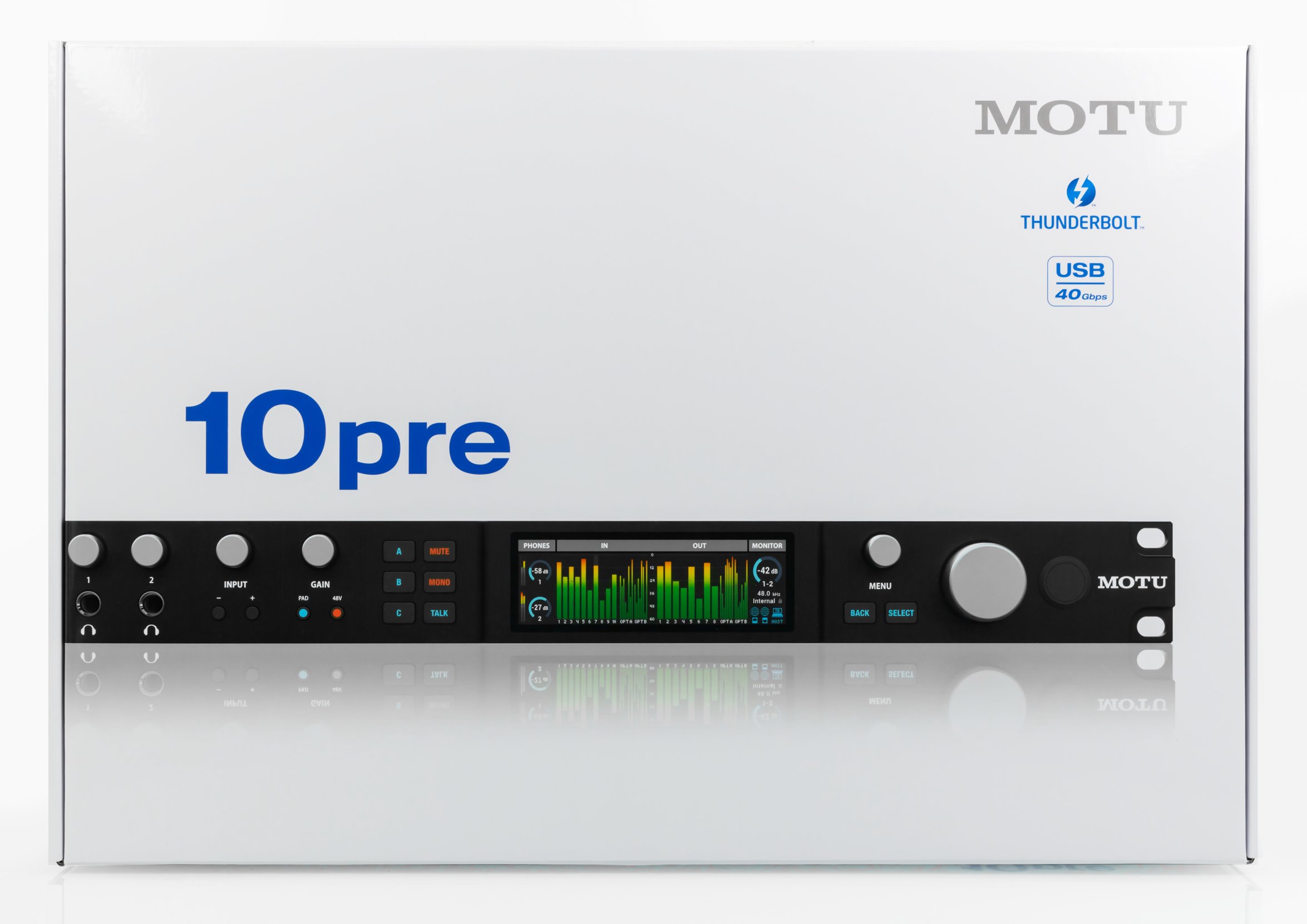

MOTU 10pre key features
- Advanced computer connections: AVB Ethernet, Thunderbolt 4 / USB4
- 54 simultaneous channels: 26 inputs and 28 outputs
- 10 microphone/line/instrument inputs on XLR/TRS combo sockets
- 3.9-inch, 24-bit RGB LCD, 480 × 128 pixels, with accurate peak meters
- High audio performance using ESS Sabre32 DACs
- High-performance MOTU drivers with very low latency: 1.8 ms round-trip latency (RTL) at 96 kHz with a 32-sample buffer
- Flexible connection through the supplied 40 Gbit/s USB-C cable, compatible with USB4, USB3 and USB2
- DSP-based digital mixer with 64 inputs, 32 buses and DSP effects: reverb, 4-band EQ, gate, compressor and high-pass filter, operating at sample rates up to 96 kHz
- Advanced microphone channels with high-quality components: THD+N below −114 dB, 118 dBA dynamic range and −129 dBu equivalent input noise (EIN). Each microphone channel has individual gain up to +74 dB, a −20 dB pad, +48 V phantom power and polarity inversion. All settings can be controlled remotely from a computer or an iOS device. Microphone inputs 3–4 have send/return inserts for external processing.
- A clear Patchbay interface with virtual patch cables for routing any source to any destination
- 2 Gigabit Ethernet ports with AVB support
- Wi-Fi control from CueMix Pro on several mobile devices
- Precise analogue input/output level adjustment in 1 dB steps
- Control-room functions on the front panel: Talkback, A/B/C monitor selection, Mute and mono compatibility check
- 2 flexible headphone outputs with independent volume controls. Each can monitor the other headphone output, the main outputs, any other analogue output pair, any mixer bus or any computer playback channels. Independent submixes and reverb are supported.
- Two optical I/O banks provide 16 ADAT channels at 44.1/48 kHz or 8 S/MUX channels at 88.2/96 kHz. Bank A can alternatively provide stereo TOSLink I/O at up to 96 kHz.
- Word clock input, output and thru at up to 192 kHz
- DC-coupled TRS outputs can send control voltage (CV) from the DAW to modular synthesizers
- Guitar reamping: connect a guitar to the front input and route the signal through CueMix to any output with virtually no latency. Use a reamping adapter if needed. Record both the clean guitar signal and a microphone in front of the guitar amplifier at the same time.
- Loopback for live streaming and podcasts
- Advanced front-panel metering with selectable views for analogue I/O, digital I/O and other channel combinations
- CueMix Pro mixer and hardware control from Mac, PC or iOS
- Milan™ certification through a firmware update
- Performer Lite DAW software with more than 100 instruments, dozens of effects and 6 GB of loops for music production
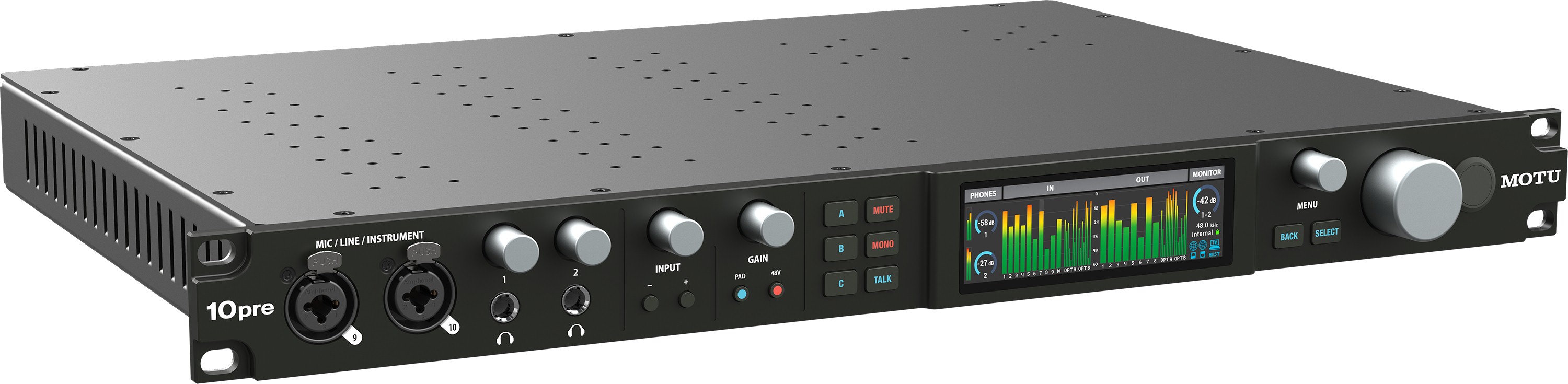
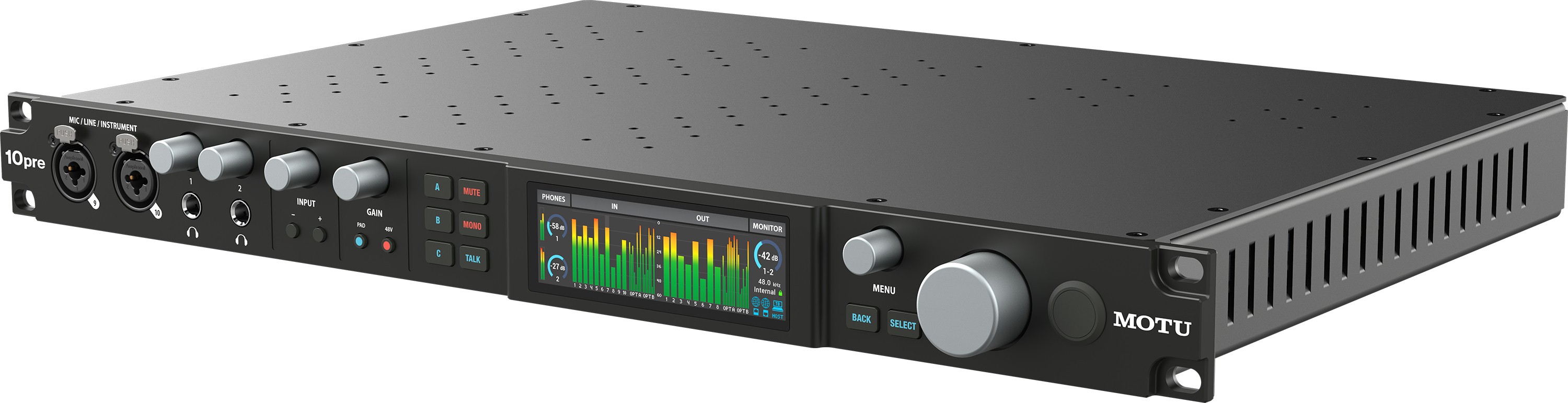
All current MOTU interfaces in this range use a strong aluminium case with metal knobs. The bright colour metering display has several viewing modes. Rack ears are provided, and the case is 1U high.
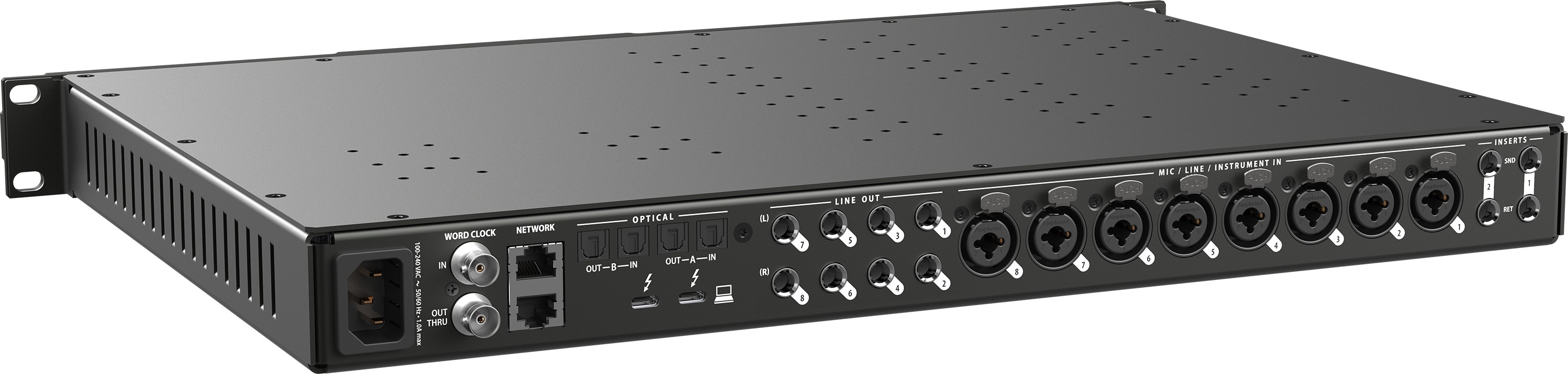
The MOTU connects to a Mac, PC or iOS device through the supplied high-quality USB4 cable, which is compatible with Thunderbolt 3/4. Full backward compatibility with USB3 and USB2 is provided. Two Thunderbolt 4/USB4 Type-C ports allow up to 6 devices to be connected in a chain.
The total digital channel count is 256: 128 inputs and 128 outputs. Round-trip latency is 1.8 ms at 96 kHz with a 32-sample buffer. There are 10 balanced analogue inputs, all with microphone capability, and 10 TRS line outputs. Two banks of 8-channel ADAT optical I/O are available. BNC word clock input and output, with optional Thru, provide external synchronisation.
These figures are the same across MOTU's 2025 models because they use the same electronics:
| Connector | Dynamic range | THD+N | Signal level | |
|---|---|---|---|---|
| Line inputs | 1/4-inch TRS, balanced | 120 dBA | −114 dB (0.0002%) | +21dBu |
| Line outputs | 1/4-inch TRS, balanced | 125 dBA | −114 dB (0.0002%) | +21dBu |
| Microphone inputs | 1/4-inch TRS, balanced | 118 dBA | −114 dB (0.0002%) EIN: -129 dBu |
Gain +74 dB |
| Headphone output | 1/4-inch stereo TRS | 118 dBA | −110 dB (0.0003%) | +13.3 dBu 1-ohm impedance |
The analogue outputs use ESS Sabre32 DACs and achieve a measured dynamic range of 125 dB with THD+N of −114 dB. All input and output levels are adjustable in 1 dB steps.
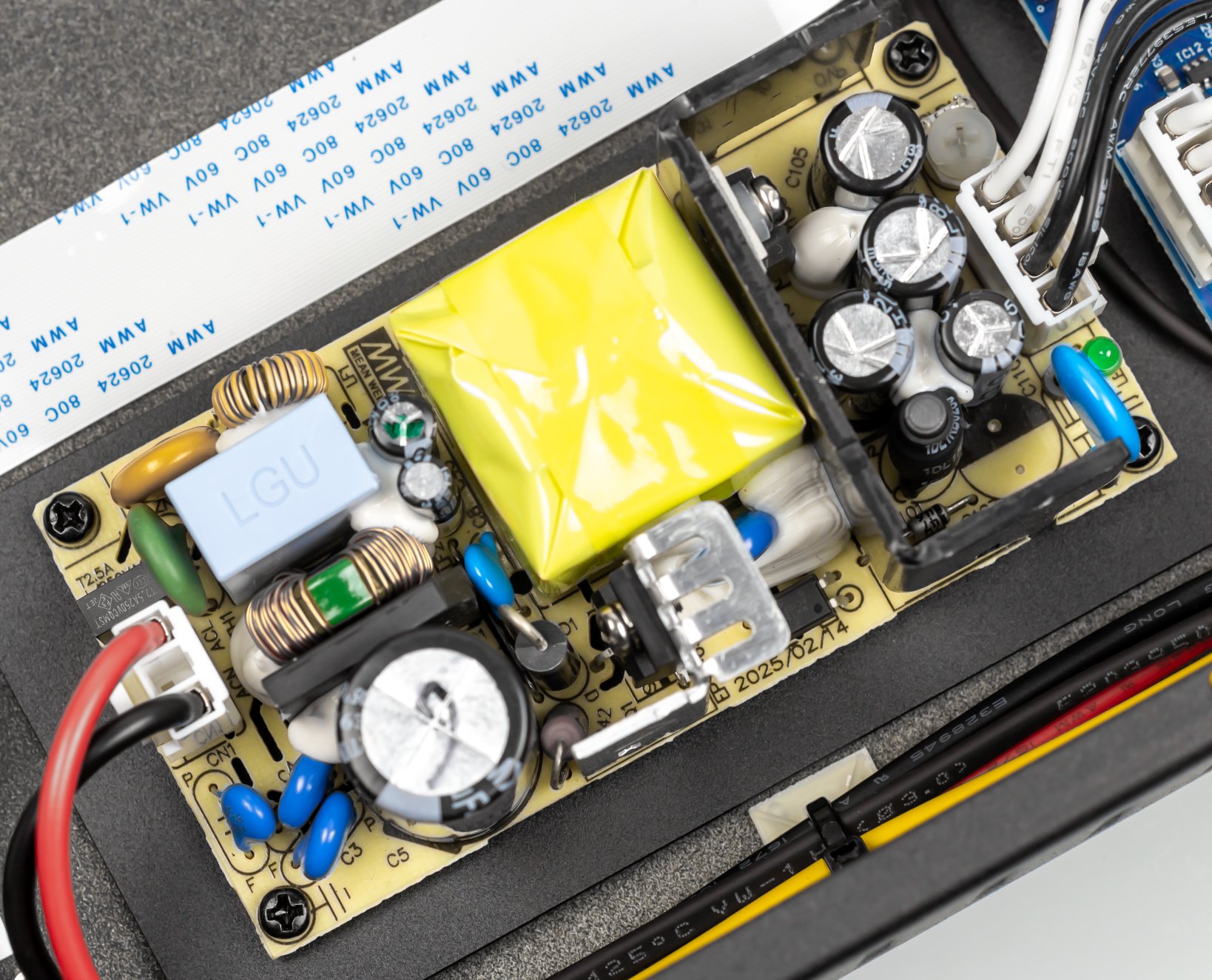
The well-made switched-mode power supply from Taiwanese manufacturer Mean Well sits on a separate board and accepts a wide input range of 100–240 V.
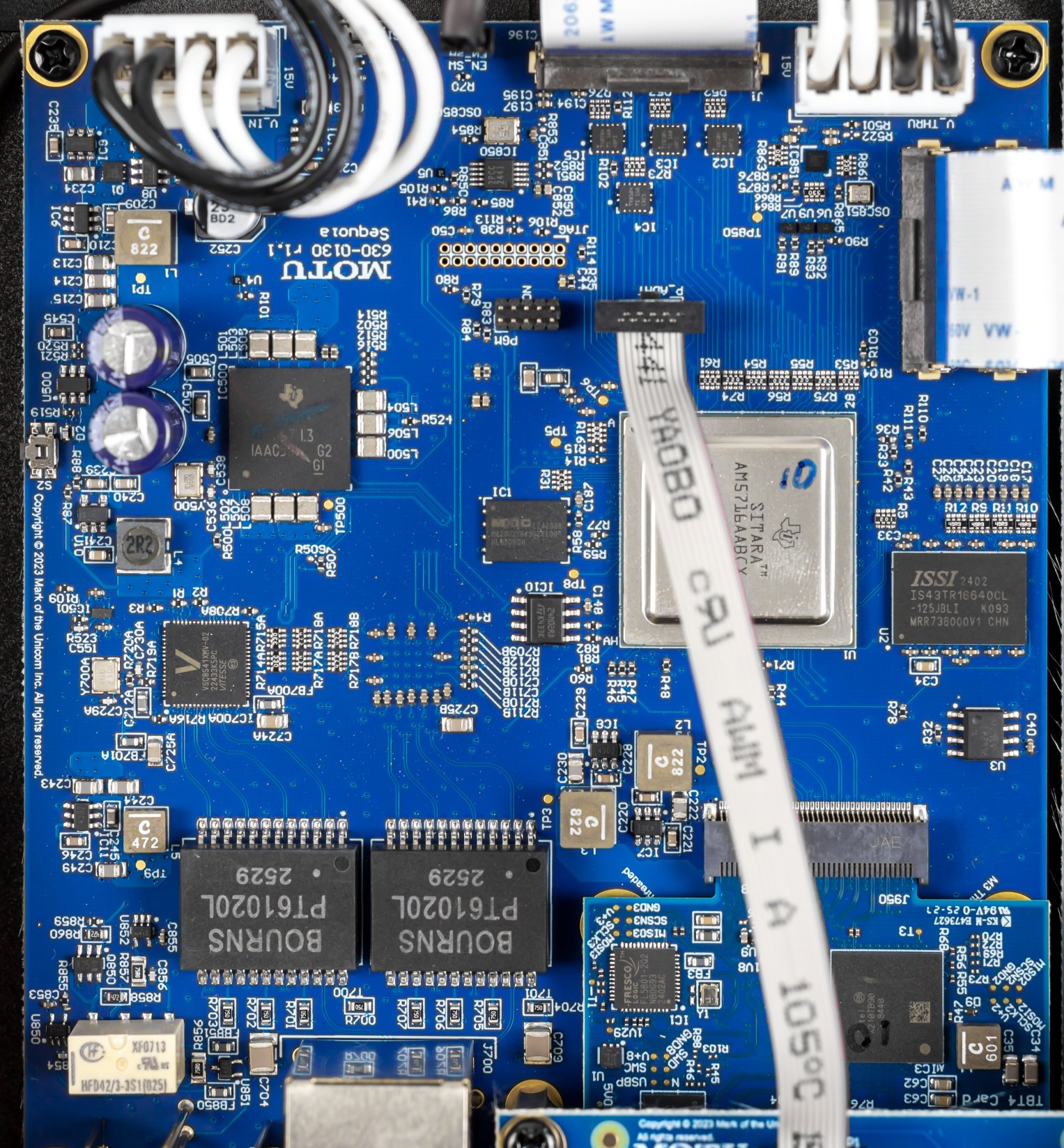
The TI Sitara 5716 ARM Cortex-A15 processor handles audio processing using its TI C66x DSP and VLIW floating-point operations.
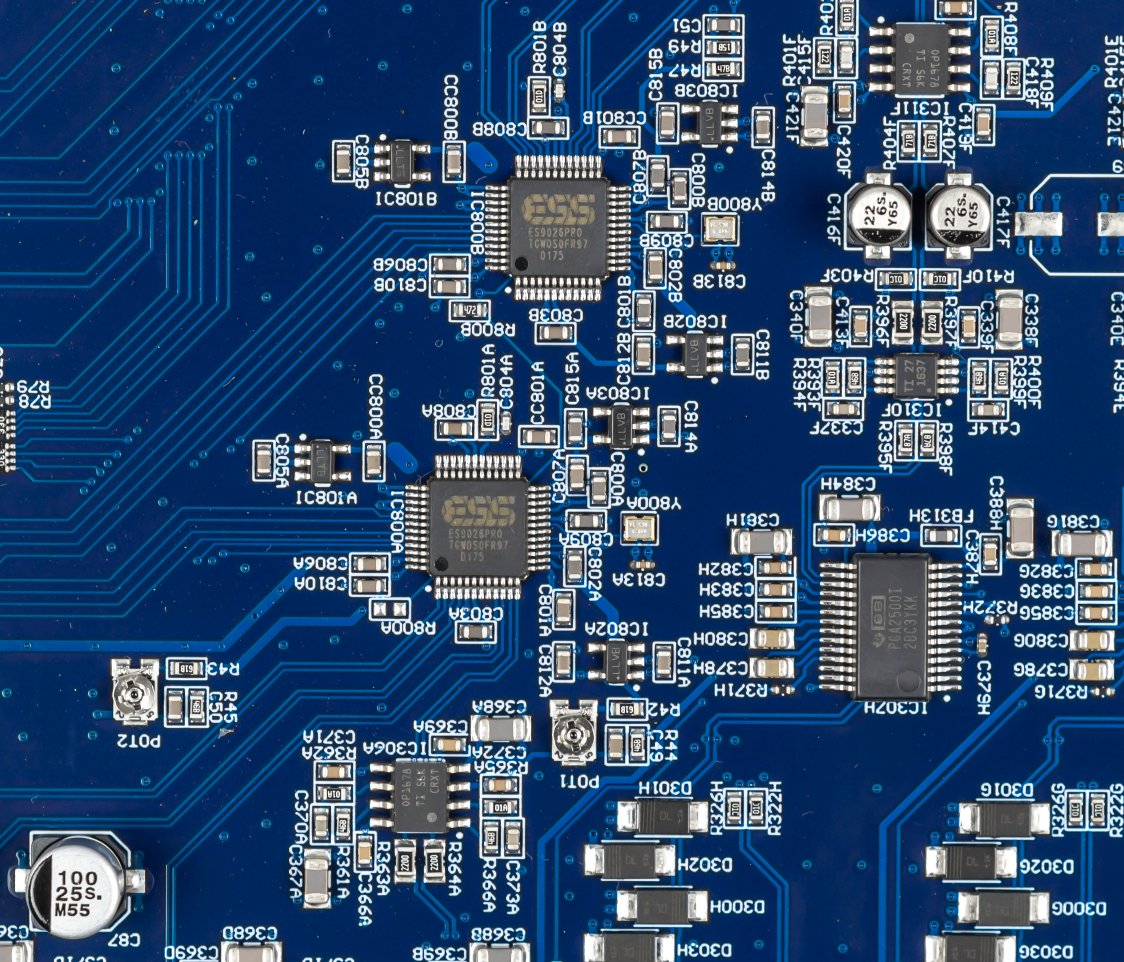
Eight-channel ESS ES9026PRO DACs serve the outputs. Some other products use a separate, cheaper DAC for headphones. Here, two ESS ES9026PRO chips serve both the line and headphone outputs. The chip specifications are 124 dBA dynamic range and −110 dB THD+N. TI OP1678 dual operational amplifiers are used at the inputs and outputs.
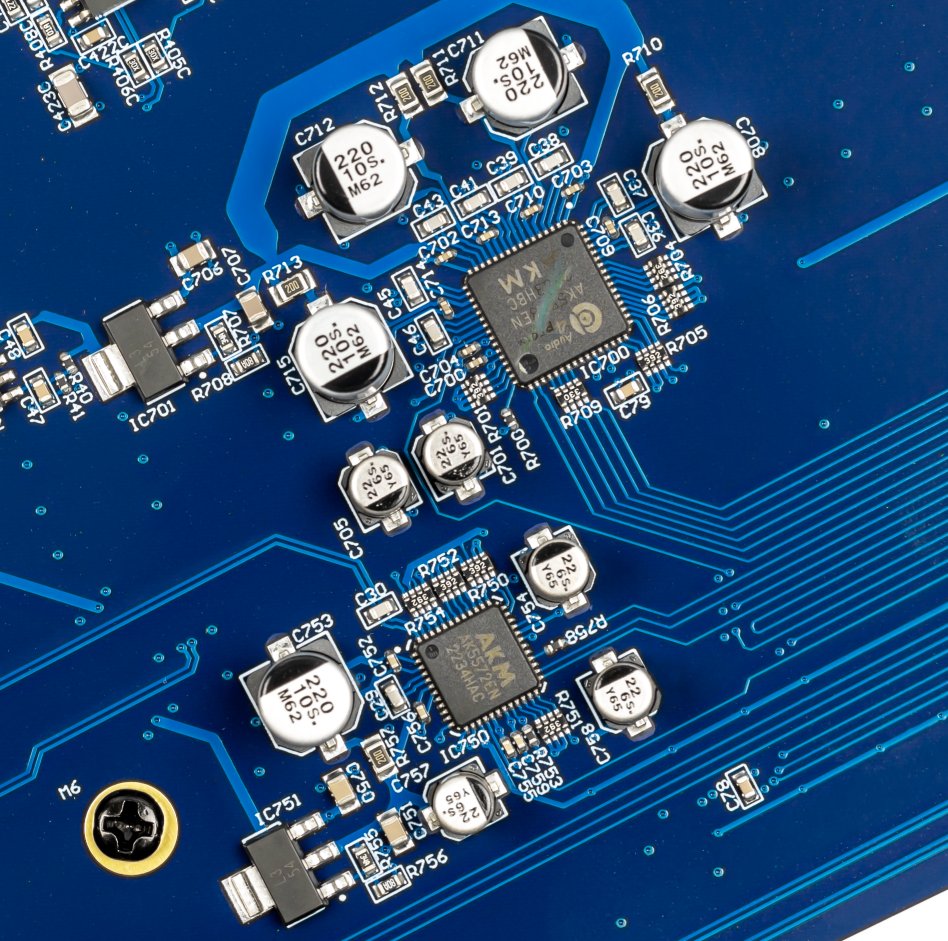
Two ADC chips are used: an 8-channel AKM AK5578 and a 2-channel AKM AK5572. Both have the same specifications: 121 dBA dynamic range and THD+N below −112 dB.
An OPA1688A integrated amplifier drives the headphones. Additional circuitry raises the output level to +13.3 dBu and reduces output impedance to 1 ohm.
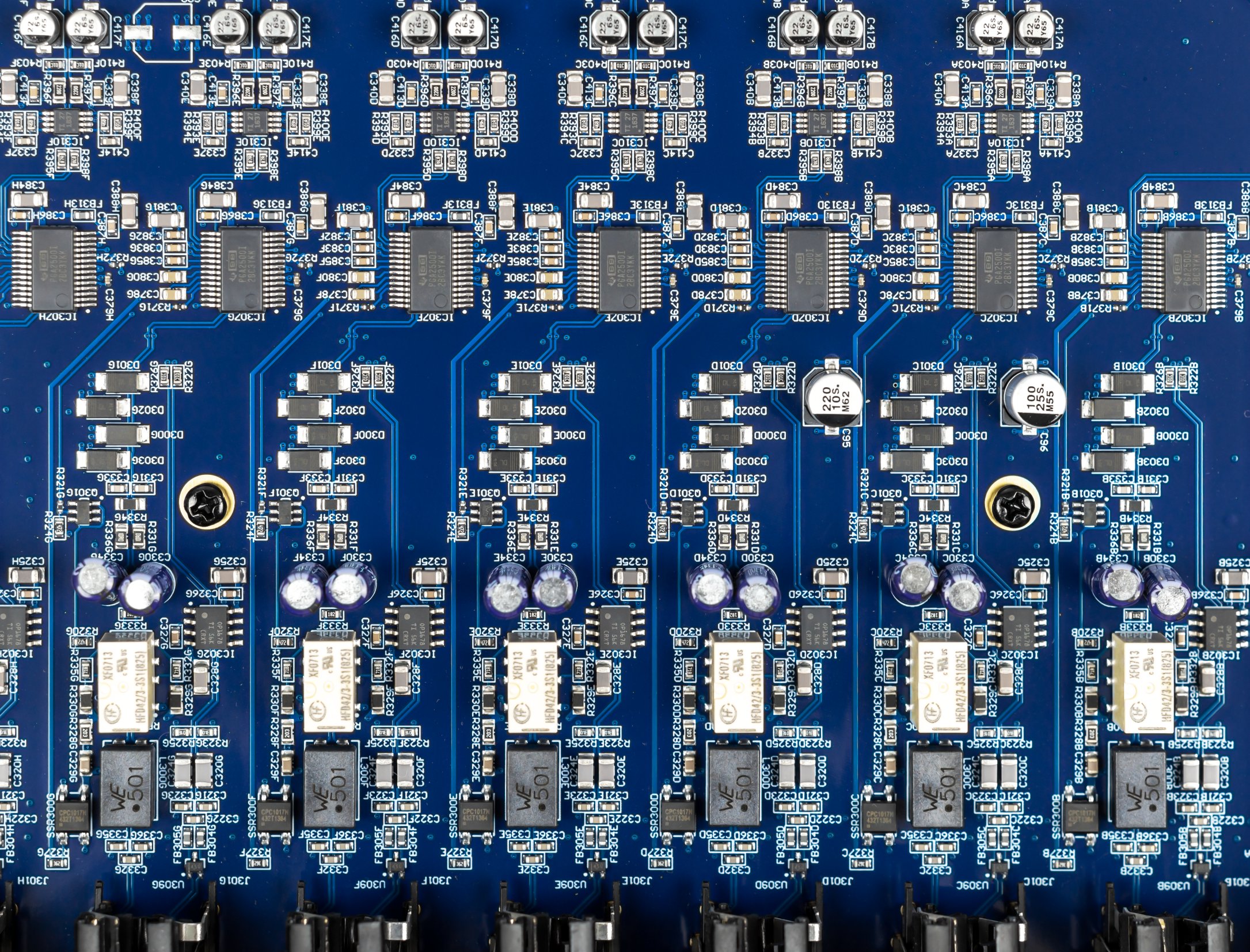
As usual, the microphone preamps use the analogue PGA2500 with digitally controlled input gain. Equivalent input noise is −128 dBu. THD+N at 30 dB gain is only 0.0004%. Gain up to +74 dB allows even very low-sensitivity microphones to be used.
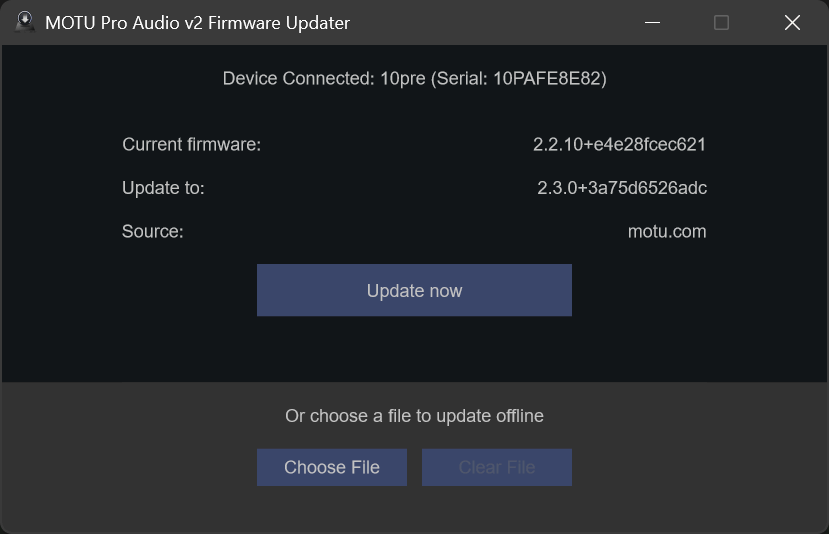
New firmware versions are released regularly.
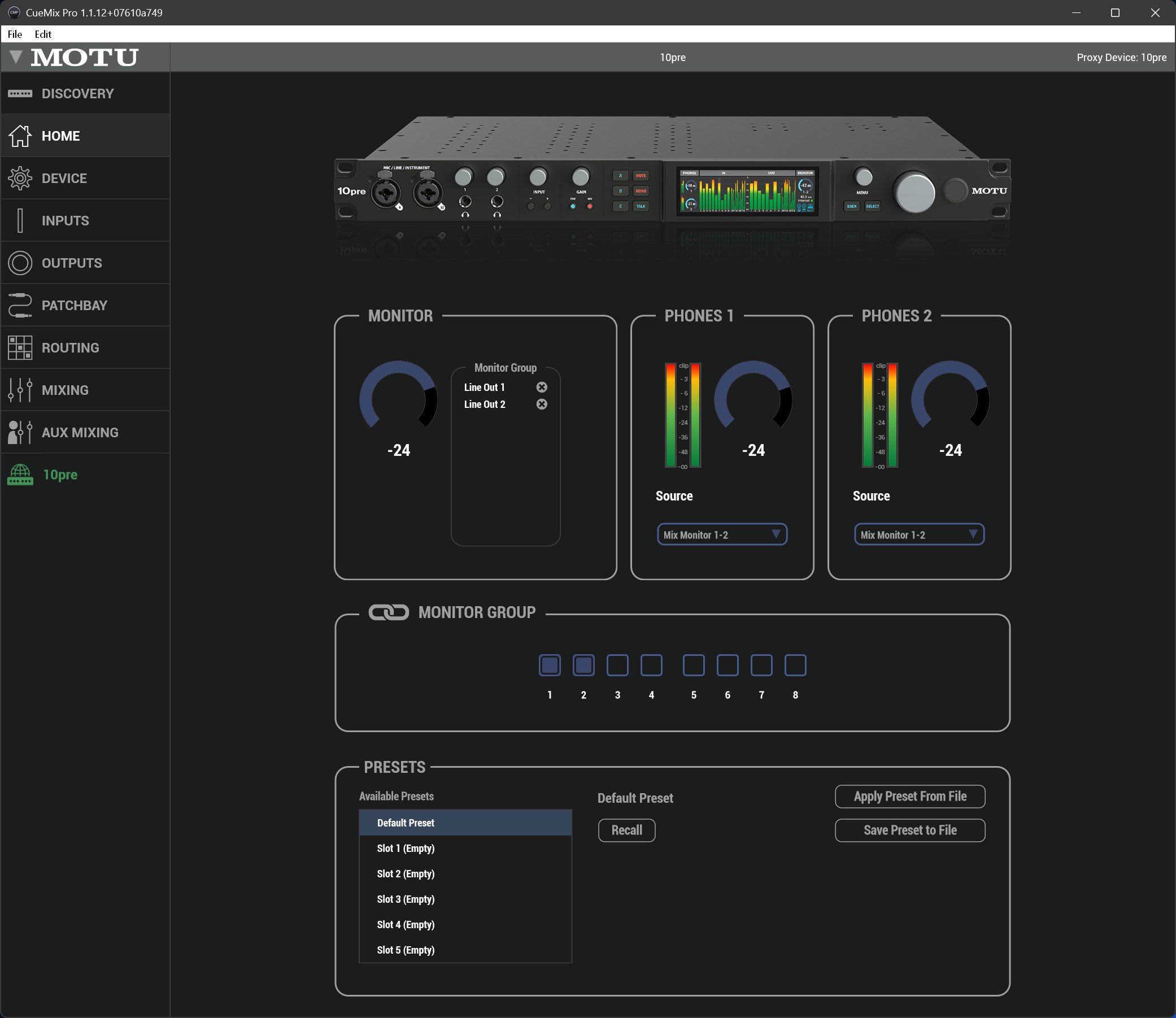
CueMix Pro provides the same clear user interface for all MOTU devices.
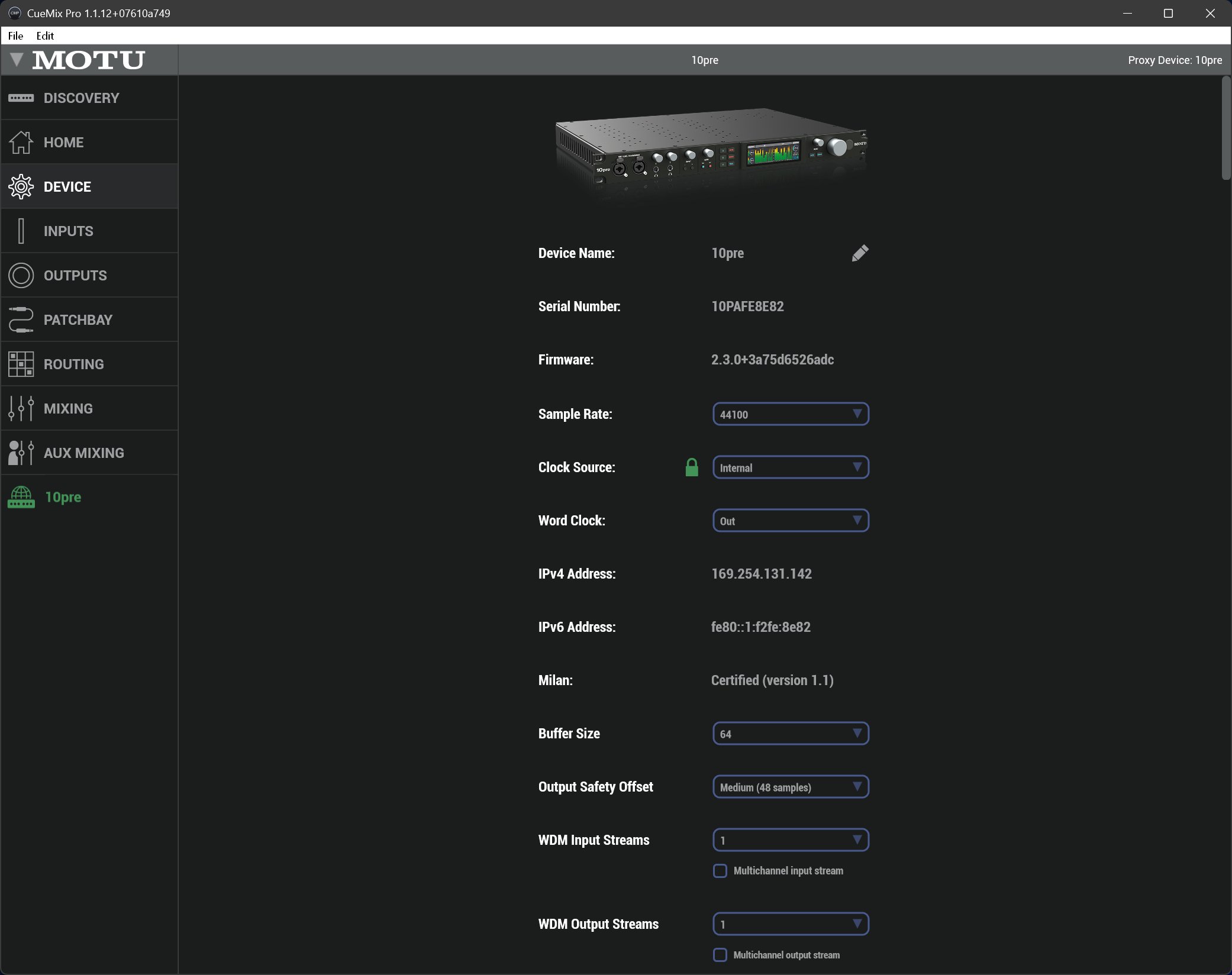
Hardware settings for the selected device include clock source and mixer sample rate. Effects can be used at sample rates up to 96 kHz.
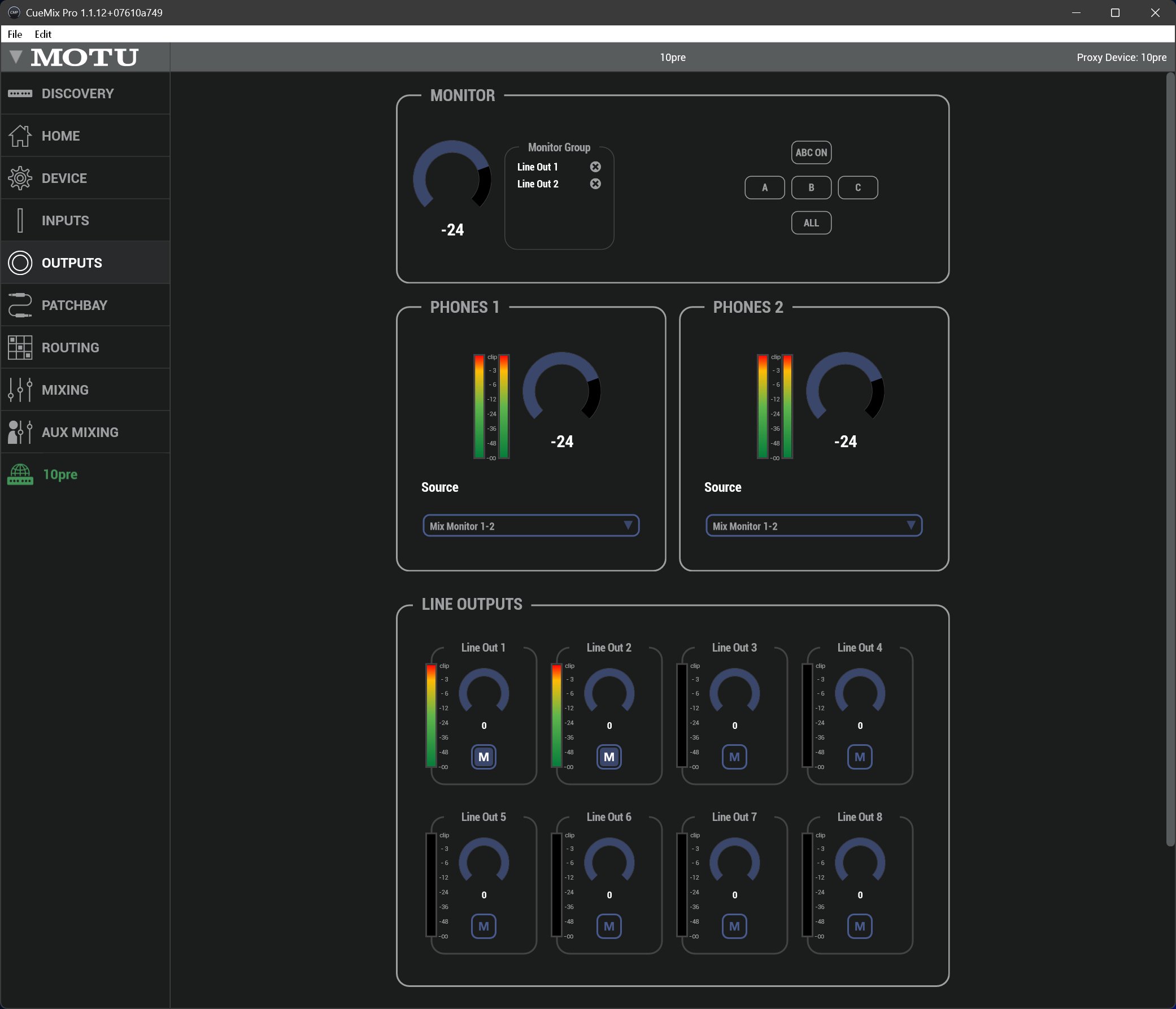
Settings can be changed in CueMix Pro or with the physical knobs on the front panel.
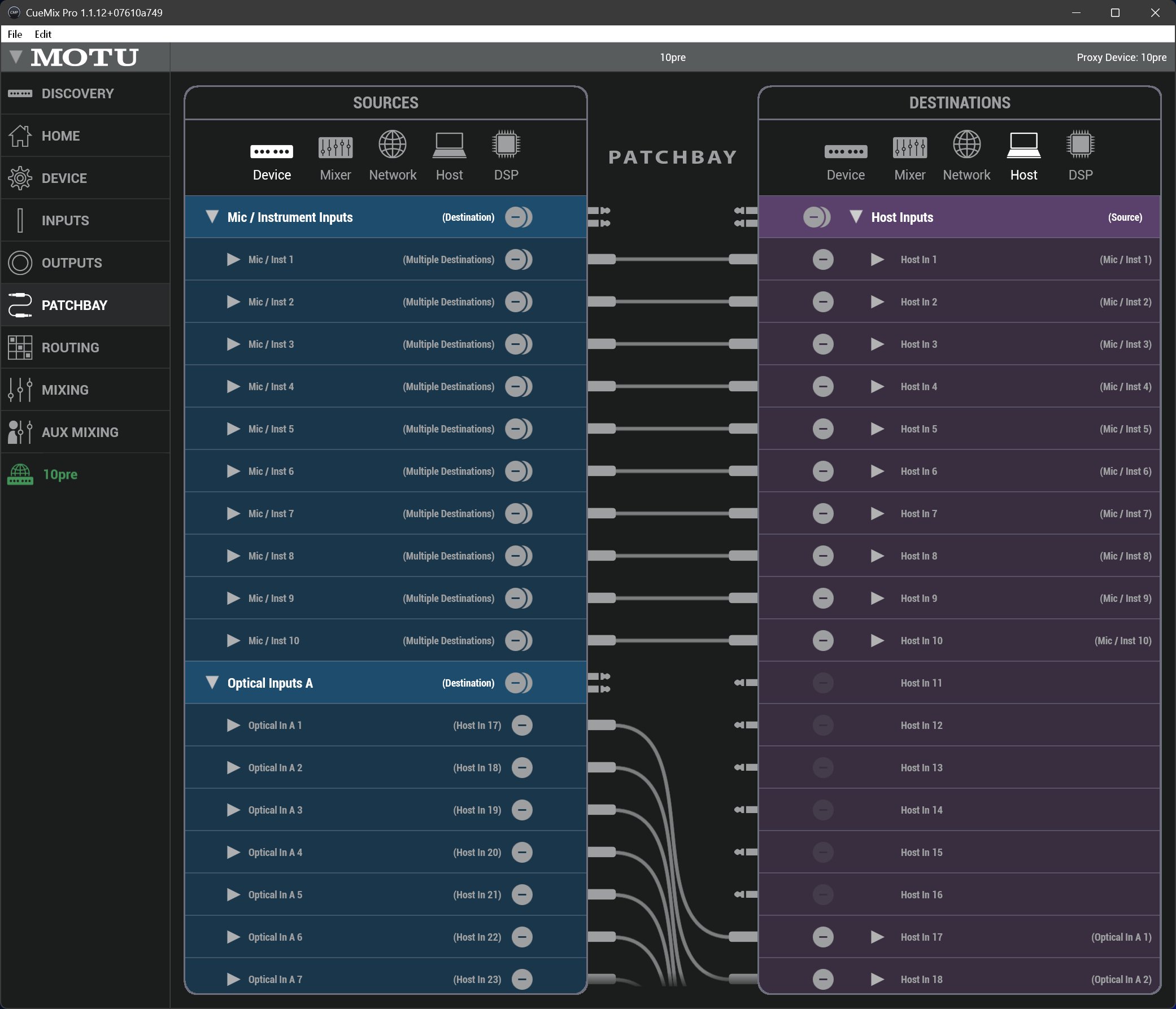
Patchbay provides a visual way to connect physical sources and virtual DAW channels.
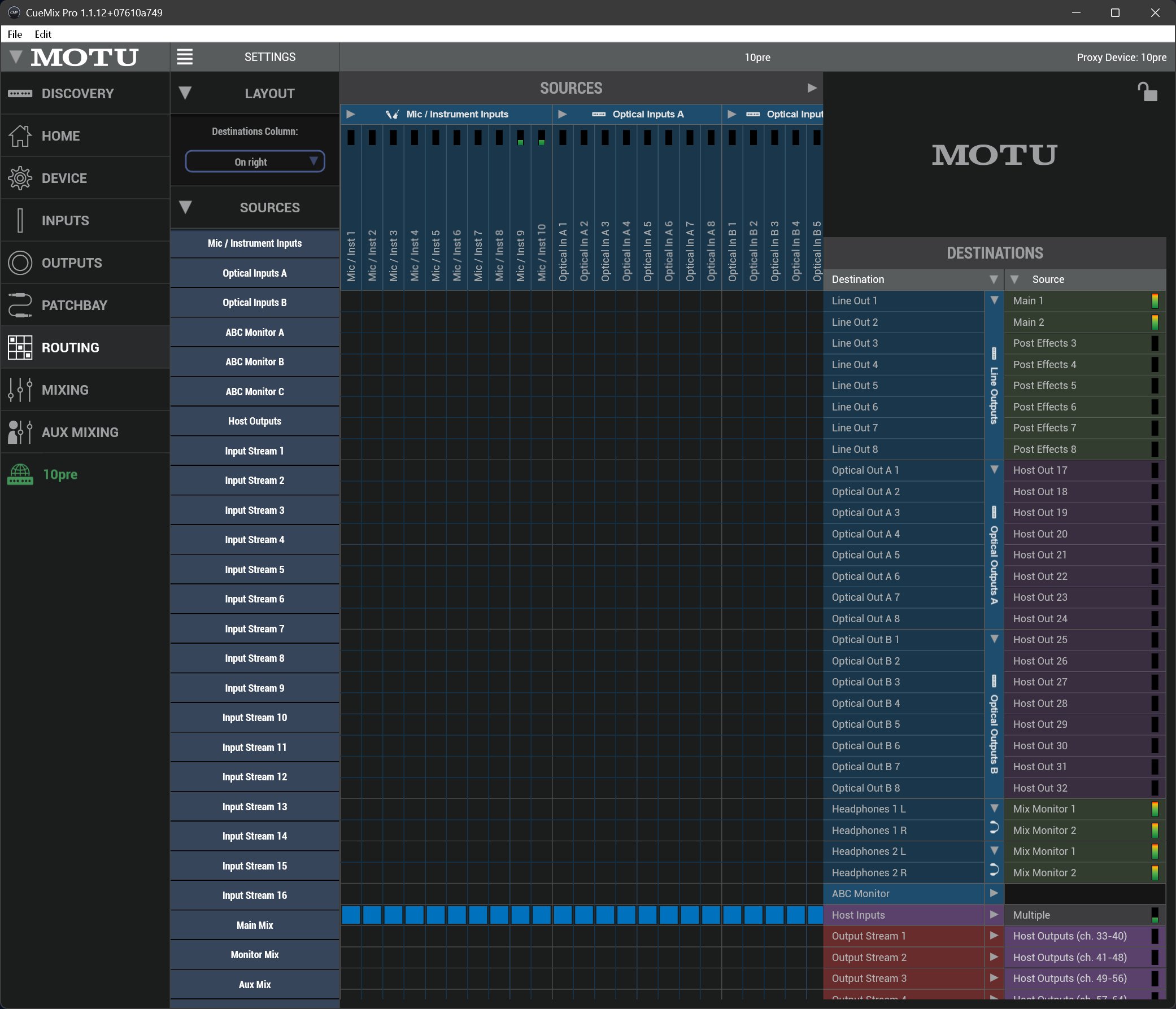
The Routing view shows a conventional routing matrix.
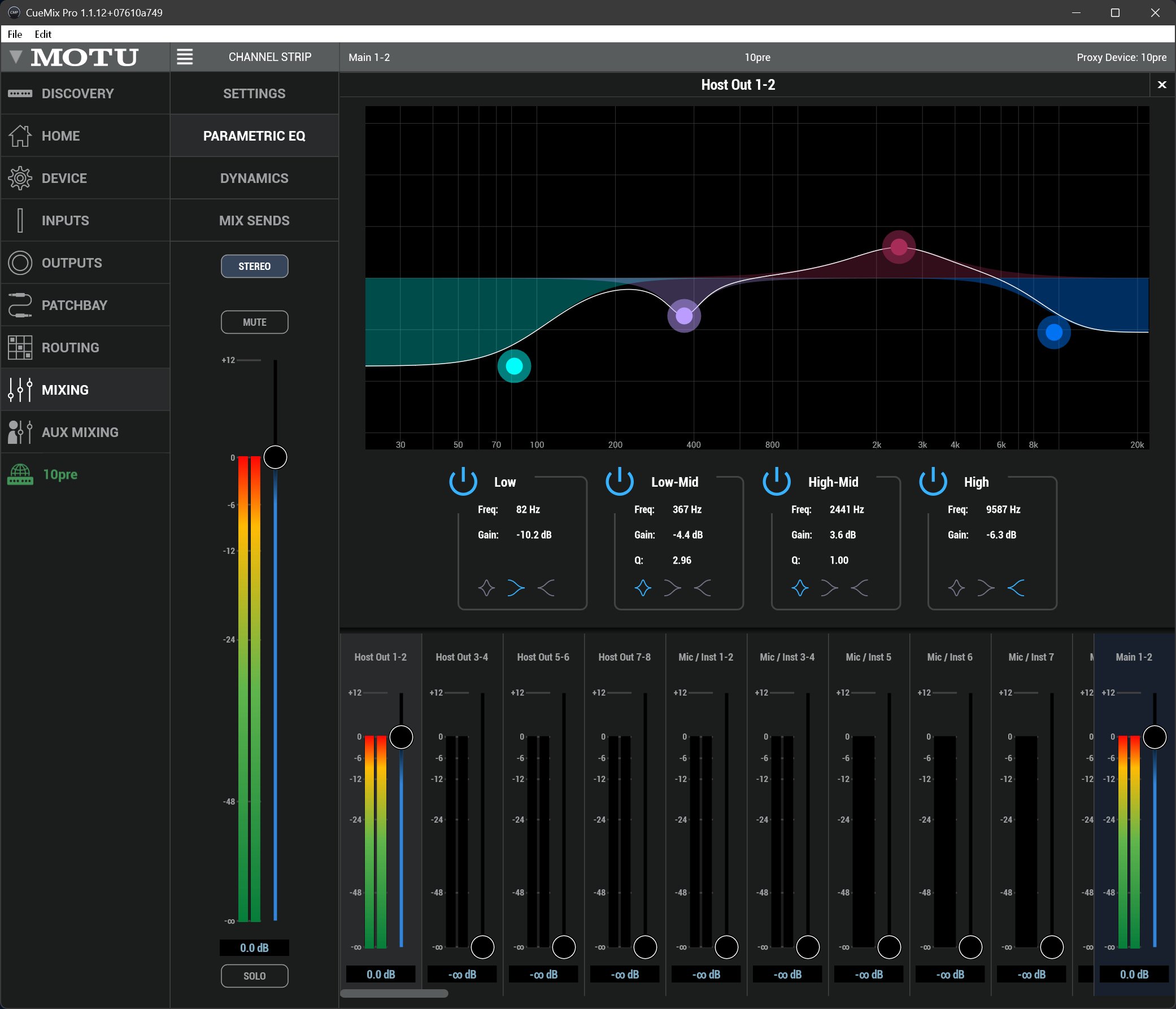
Each channel in the built-in mixer has its own EQ and dynamics settings. All effects are good enough for practical use.
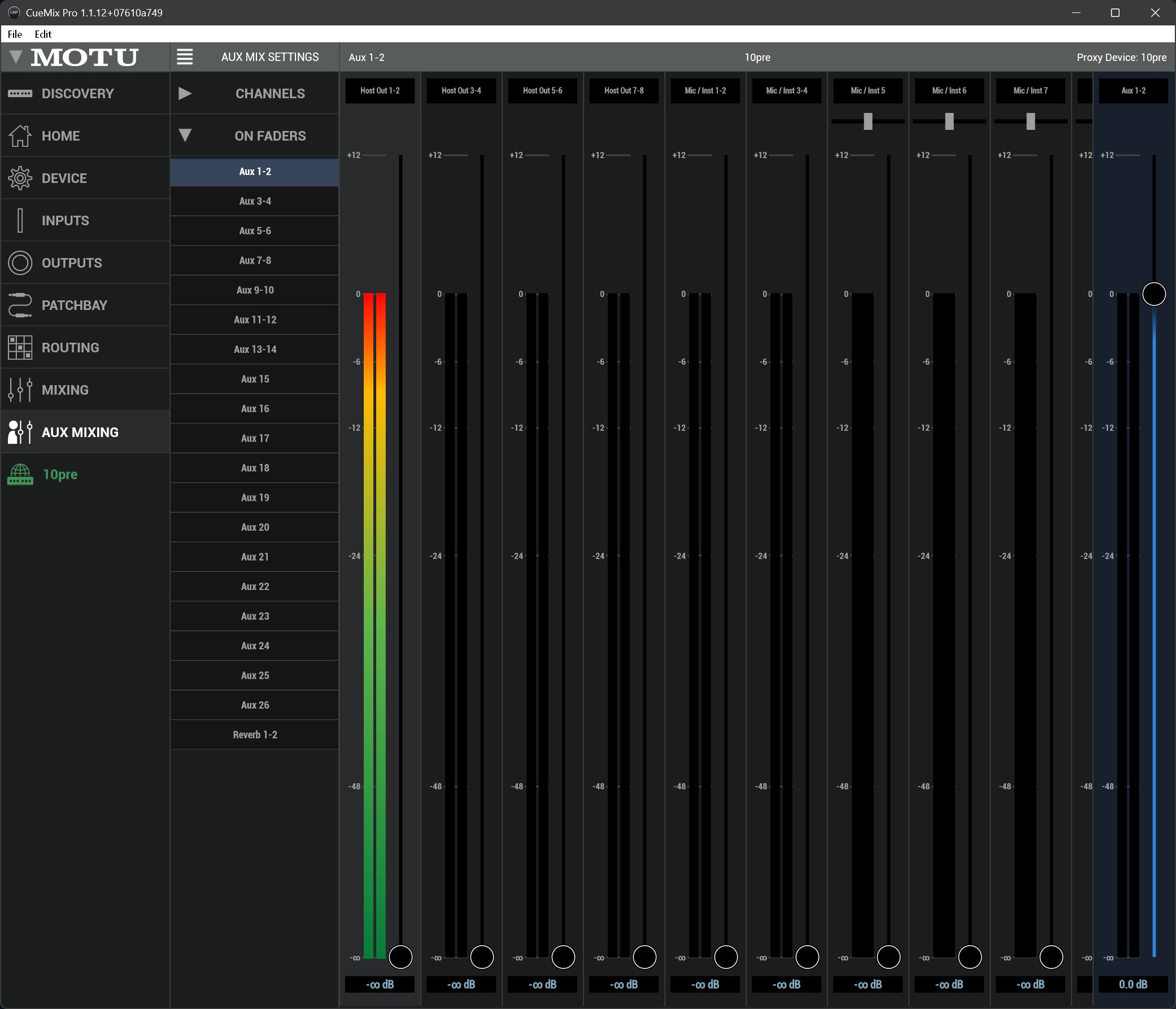
AUX MIXING creates submixes from physical and software channels and assigns the submixes to separate buses.
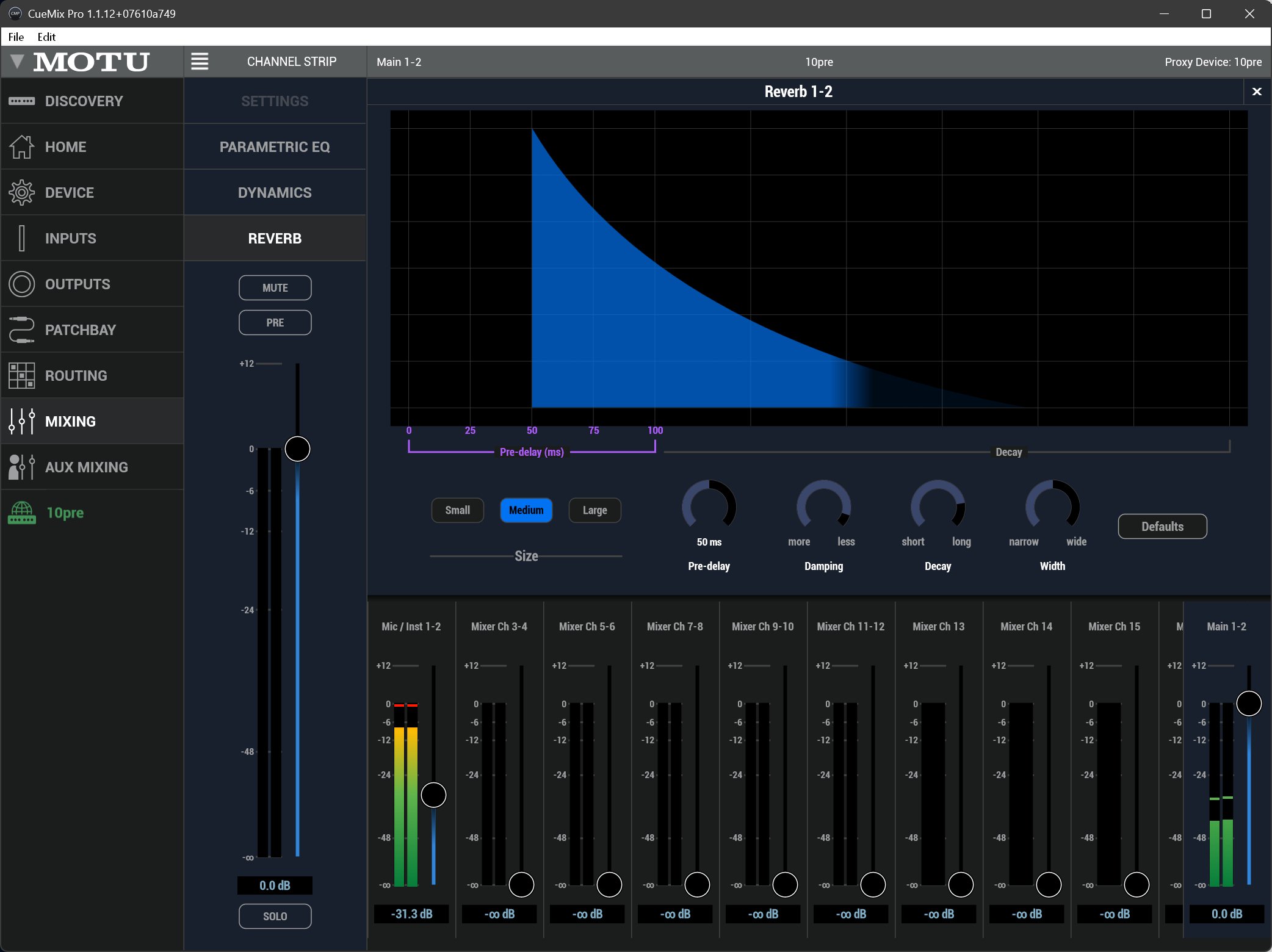
Reverb settings are shared by all channels. The dry/wet balance is adjusted in the usual way, using sends to the Reverb 1–2 bus.
The manufacturer includes a Thunderbolt 4 / USB4 cable marked 40 Gbps 240W. We decided to test that connection. We installed an ASUS ThunderboltEX 4 expansion card in a Windows 11 desktop computer and enabled the required Thunderbolt option in the BIOS.
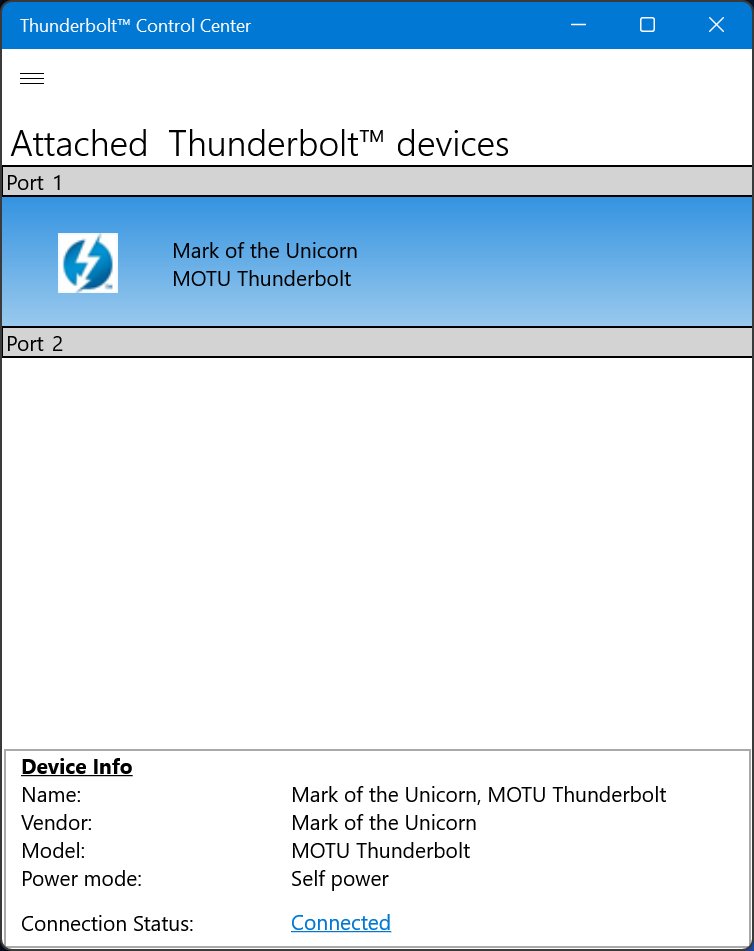
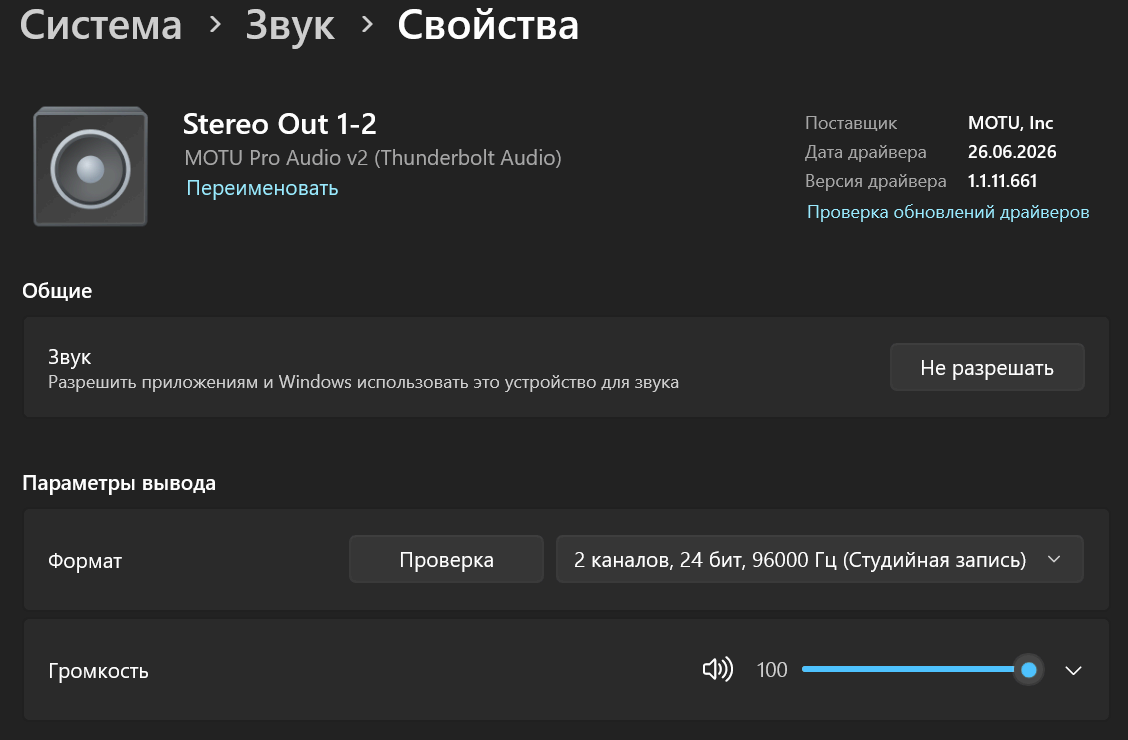
Thunderbolt Control Center in Windows detected the MOTU Thunderbolt device. The operating system listed MOTU Pro Audio v2 (Thunderbolt Audio), and a TB icon appeared on the interface display. This confirmed that we had a real Thunderbolt 4 connection rather than USB compatibility mode.
CueMix Pro started and worked normally, exactly as it does with a standard USB connection.
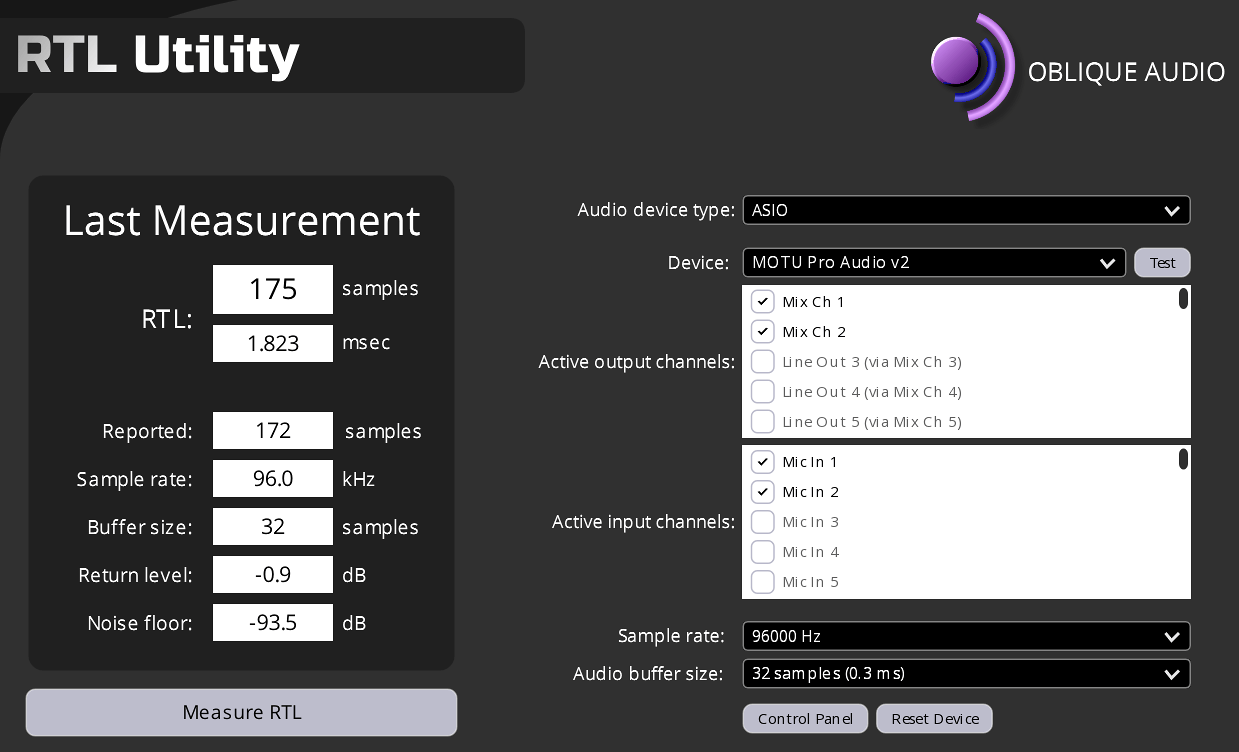
We measured RTL and obtained the manufacturer's advertised 1.8 ms. But would professional ASIO software work at those settings without clicks? In our tests, both recording and playback worked perfectly. Our test system has a powerful Intel Core i7 CPU and is optimised for audio. We disabled hardware power-saving features that can slow real-time operation, including C-states and core parking.
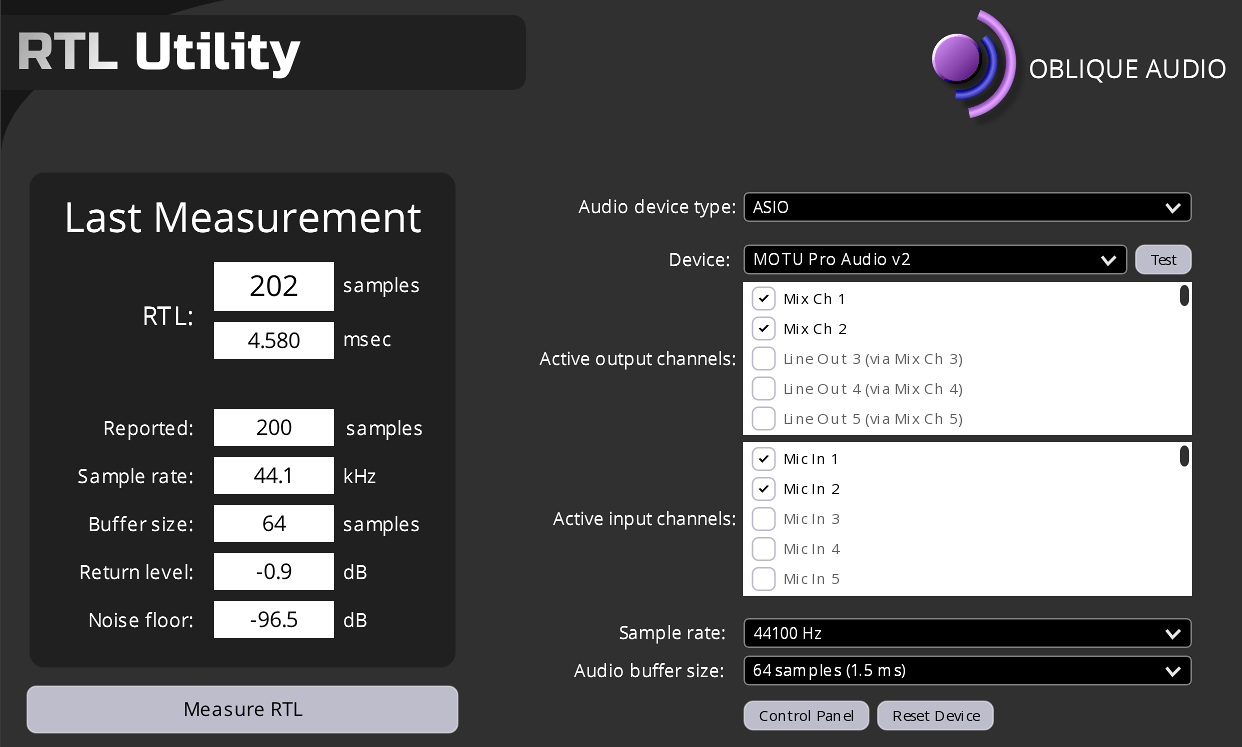
However, 1.8 ms is possible only at the demanding setting of 96 kHz with a 32-sample buffer. At the more usual 44 kHz and 64 samples, latency rises to 4.5 ms, as expected.
ASIO diagnostics
Features:
Input channels: 32
Output channels: 32
Input latency: 159
Output latency: 367
Min buffer size: 64
Max buffer size: 4096
Preferred buffer size: 64
Granularity: -1
ASIOOutputReady - not supported
Sample rate:
44100 Hz - supported
48000 Hz - supported
88200 Hz - supported
96000 Hz - supported
176400 Hz - supported
192000 Hz - supported
352800 Hz - not supported
384000 Hz - not supported
Input channels:
channel: 0 (Mic In 1) - Int32LSB
channel: 1 (Mic In 2) - Int32LSB
channel: 2 (Mic In 3) - Int32LSB
channel: 3 (Mic In 4) - Int32LSB
channel: 4 (Mic In 5) - Int32LSB
channel: 5 (Mic In 6) - Int32LSB
channel: 6 (Mic In 7) - Int32LSB
channel: 7 (Mic In 8) - Int32LSB
channel: 8 (Mic In 9) - Int32LSB
channel: 9 (Mic In 10) - Int32LSB
channel: 10 (Line In 11) - Int32LSB
channel: 11 (Line In 12) - Int32LSB
channel: 12 (Host In 13) - Int32LSB
channel: 13 (Host In 14) - Int32LSB
channel: 14 (Host In 15) - Int32LSB
channel: 15 (Host In 16) - Int32LSB
channel: 16 (Optical In A 1) - Int32LSB
channel: 17 (Optical In A 2) - Int32LSB
channel: 18 (Optical In A 3) - Int32LSB
channel: 19 (Optical In A 4) - Int32LSB
channel: 20 (Optical In A 5) - Int32LSB
channel: 21 (Optical In A 6) - Int32LSB
channel: 22 (Optical In A 7) - Int32LSB
channel: 23 (Optical In A 8) - Int32LSB
channel: 24 (Optical In B 1) - Int32LSB
channel: 25 (Optical In B 2) - Int32LSB
channel: 26 (Optical In B 3) - Int32LSB
channel: 27 (Optical In B 4) - Int32LSB
channel: 28 (Optical In B 5) - Int32LSB
channel: 29 (Optical In B 6) - Int32LSB
channel: 30 (Optical In B 7) - Int32LSB
channel: 31 (Optical In B 8) - Int32LSB
Output channels:
channel: 0 (Mix Ch 1) - Int32LSB
channel: 1 (Mix Ch 2) - Int32LSB
channel: 2 (Line Out 3 (via Mix Ch 3)) - Int32LSB
channel: 3 (Line Out 4 (via Mix Ch 4)) - Int32LSB
channel: 4 (Line Out 5 (via Mix Ch 5)) - Int32LSB
channel: 5 (Line Out 6 (via Mix Ch 6)) - Int32LSB
channel: 6 (Line Out 7 (via Mix Ch 7)) - Int32LSB
channel: 7 (Line Out 8 (via Mix Ch 8)) - Int32LSB
channel: 8 (Host Out (via Mix Ch 9)) - Int32LSB
channel: 9 (Host Out 10 (via Mix Ch 10)) - Int32LSB
channel: 10 (Host Out 11 (via Mix Ch 11)) - Int32LSB
channel: 11 (Host Out 12 (via Mix Ch 12)) - Int32LSB
channel: 12 (Host Out 13) - Int32LSB
channel: 13 (Host Out 14) - Int32LSB
channel: 14 (Host Out 15) - Int32LSB
channel: 15 (Host Out 16) - Int32LSB
channel: 16 (Optical Out A 1) - Int32LSB
channel: 17 (Optical Out A 2) - Int32LSB
channel: 18 (Optical Out A 3) - Int32LSB
channel: 19 (Optical Out A 4) - Int32LSB
channel: 20 (Optical Out A 5) - Int32LSB
channel: 21 (Optical Out A 6) - Int32LSB
channel: 22 (Optical Out A 7) - Int32LSB
channel: 23 (Optical Out A 8) - Int32LSB
channel: 24 (Optical Out B 1) - Int32LSB
channel: 25 (Optical Out B 2) - Int32LSB
channel: 26 (Optical Out B 3) - Int32LSB
channel: 27 (Optical Out B 4) - Int32LSB
channel: 28 (Optical Out B 5) - Int32LSB
channel: 29 (Optical Out B 6) - Int32LSB
channel: 30 (Optical Out B 7) - Int32LSB
channel: 31 (Optical Out B 8) - Int32LSB
Over USB3.0, the device provides 12 analogue and 16 digital channels. Sample rates up to 192 kHz are supported.
Over Thunderbolt 4, the channel count rises to 128 inputs and 128 outputs. We have not included the Thunderbolt diagnostic screenshot because listing all 256 channels would add little useful information.
RMAA PRO measurements
We measured the interface with its outputs connected to its inputs.
| Device under test | MOTU Pro Audio v2 |
| Operating mode | 24-bit, 44 kHz |
| Audio interface | ASIO |
| Signal path | External loopback (line-out - line-in) |
| RMAA version | 6.4.5 PRO |
| 20 Hz–20 kHz filter | YES |
| Signal normalisation | YES |
| Level change | 0.1 dB / 0.3 dB |
| Mono mode | NO |
| Calibration signal frequency, Hz | 1000 |
| Polarity | Correct/correct |
| Frequency response, 40 Hz–15 kHz, dB | +0.22, +0.00 |
Excellent |
| Noise level, dB(A) | -117.3 |
Excellent |
| Dynamic range, dB(A) | 117.1 |
Excellent |
| Total harmonic distortion, % | 0.00019 |
Excellent |
| THD + noise, dB(A) | -107.1 |
Excellent |
| Intermodulation distortion + noise, % | 0.00058 |
Excellent |
| Stereo crosstalk, dB | -117.0 |
Excellent |
| Intermodulation at 10 kHz, % | 0.00095 |
Excellent |
| Overall result | Excellent |
24-bit / 44 kHz measurements are provided on a separate page.
All measurement results are excellent. The figures are slightly below those of the 16A and 848 because the 10PRE has no dedicated TRS line inputs: all inputs use XLR/TRS combo sockets. The line signal apparently passes through additional switching circuits. Fortunately, the difference is only a couple of decibels and has no practical effect. In 99% of cases, users will connect microphones to the XLR inputs rather than line sources to TRS. Users who need only dedicated line inputs can choose another model from the MOTU range.
Recording and playback quality is as high as on the other MOTU models. We listened through active monitors and headphones and were pleased with the natural tone and dynamics. The hardware input effects are very good and can match the standard processing in a DAW. Hardware processing adds no latency and does not use the computer's CPU.
Conclusions
The MOTU 10PRE feels like a flagship product, with high sound quality and a very wide range of technical features. It is well suited to setups that need to record up to 10 microphones at once. Thunderbolt 4 provides up to 256 simultaneous channels and latency as low as 1.8 ms. This makes it comfortable to record vocals while monitoring through plug-ins or the built-in hardware effects, including reverb. A computer without Thunderbolt can still use USB3, with low latency and 64 channels.
The MOTU 10PRE has the most microphone preamps in this range. If you need more dedicated line inputs, or no microphone inputs at all, consider the otherwise similar MOTU 848 and MOTU 16A. These offer different I/O configurations with the same electronics. According to the manufacturer, up to 6 devices can be connected in a Thunderbolt chain. The firmware update adding the open Milan standard is also important. Milan allows many remotely located interfaces to work in one system, including with the Windows platform.
Note. This is an adapted machine translation into English. It follows the “In simple terms” approach. Read the original article at https://prosound.ixbt.com/interfaces/motu-10pre.shtml.