
Arturia FX Collection 5 — the 2024 update to Arturia's effects collection
Arturia continues to expand its effects collection regularly. Four new effects were added in 2024: Bus EXCITER-104, an emulation of a classic exciter, the Bus PEAK limiter, and two creative Efx-series multieffects, Efx REFRACT and Efx MOTIONS. As usual, we take a detailed look at the new additions.
Arturia's effects use True Analog Emulation® (TAE®) and Physical Modeling® (Phi®) technologies to model hardware behaviour accurately, preserving subtle nuances and fine details. According to the manufacturer, developing FX Collection required substantial resources and years of careful analysis and research.
The effects are available as VST, AU and AAX plug-ins with full NKS support. FX Collection 5 contains 34 plug-ins and costs $499. Individual plug-ins are also available, though at a much higher combined cost: a single plug-in is priced at $99. Fully functional demo versions let you try all their features in your own projects before buying.
Bus EXCITER-104
Bus EXCITER-104 emulates the popular Aphex Aural Exciter 104 Type C2, introduced by Aphex in 1993. Distinctive features of the hardware included its analogue processing character and Big Bottom mode, which used parallel compression to enhance the low end. Such processing is common today, but thirty years ago the Aphex exciter was a secret weapon for many producers and recording engineers.
Unlike a conventional equaliser, an exciter can improve clarity and richness by adding harmonics rather than simply raising signal amplitude. Depending on the goal, Bus EXCITER-104 can be used on almost anything, from individual vocals and drum parts to a complete mix, producing anything from subtle tonal changes to pronounced, characterful saturation.
Bus EXCITER-104 reproduces the Aphex hardware's functions and likewise processes separate high- and low-frequency regions. It adds much more flexible modern controls and an attractive graphical interface that clearly shows the processing against the signal spectrum.

The interface can be divided into three processing modules.
Big Bass handles low-frequency parallel compression and reproduces the original unit's controls. Drive sets the amount of compression applied to the input. Freq sets the filter cutoff below which compression takes place. Mix controls the amount of processed signal blended with the dry signal. Big Bass also adds software-only settings: saturation for introducing nonlinear distortion, mono operation of the parallel processing, and adjustment of the filter's Q.
The Exciter module also includes three controls derived from the original, governing harmonic content, the frequency above which processing occurs, and the amount of processing. The hardware's Harmonics control had just two positions. Bus EXCITER-104 makes it continuously variable and extends it to extreme saturation settings unavailable on the original. The character of the harmonics can also be changed: one generation mode suits vocals and lead melodic instruments, while another is available for drums and percussion. Additional controls adjust filter resonance, created through different harmonic amplitudes, and widen the processed stereo signal.
The Output module includes a two-band shelving equaliser with a ±12 dB range. Its operating frequencies follow those set for the exciter and compressor, allowing compensation for level changes caused by processing.
Useful monitoring options let you audition only the processed signal or the Big Bass and Exciter modules individually. Two oversampling quality modes help balance performance and workflow. Studio is suitable for working alongside other plug-ins and virtual instruments, while Rendering offers higher quality at greater CPU cost for the final mix.
Twenty appropriately named presets provide typical starting points for experimentation immediately after installation. The controls are highly flexible and allow very fine adjustments. Processing quality is high enough for demanding projects and applications. Audio examples can be found on the manufacturer's website, where a fully functional demo is also available.
BUS Peak
Bus PEAK is an advanced limiter that also includes a clipper. Unlike the previous plug-in, it is an original Arturia design rather than an emulation of hardware. Arturia says its processing algorithms match the quality of expensive processors used in mastering and broadcasting. The interface remains simple and approachable, even for beginners.
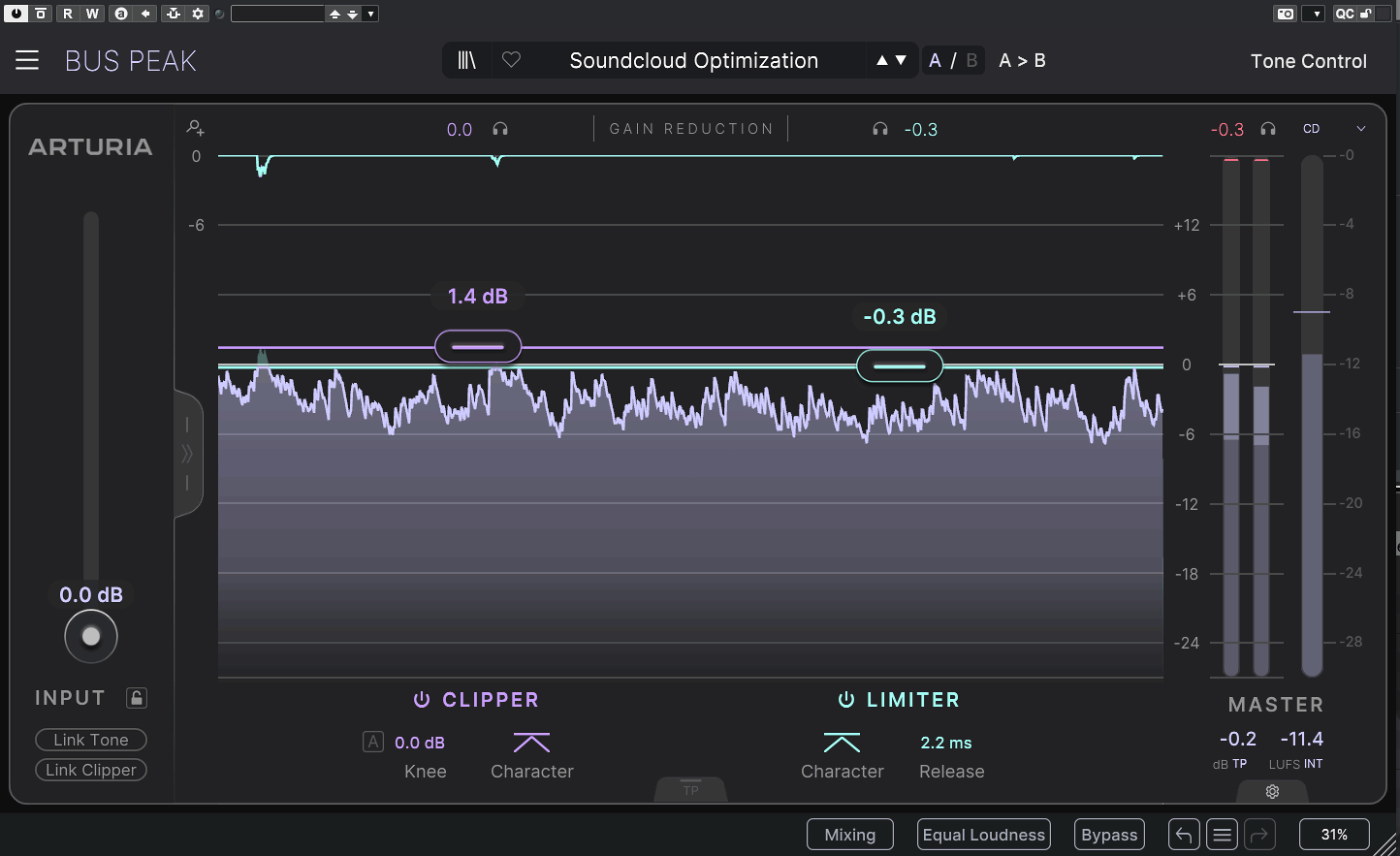
Bus PEAK offers useful additional settings and operating modes. A two-band limiter at the input acts rather like a dynamic equaliser, allowing tonal adjustment before the main limiter. It uses shelving filters affecting frequencies below the low-frequency setting and above the high-frequency setting. The visualiser shows signal level, threshold and gain reduction.
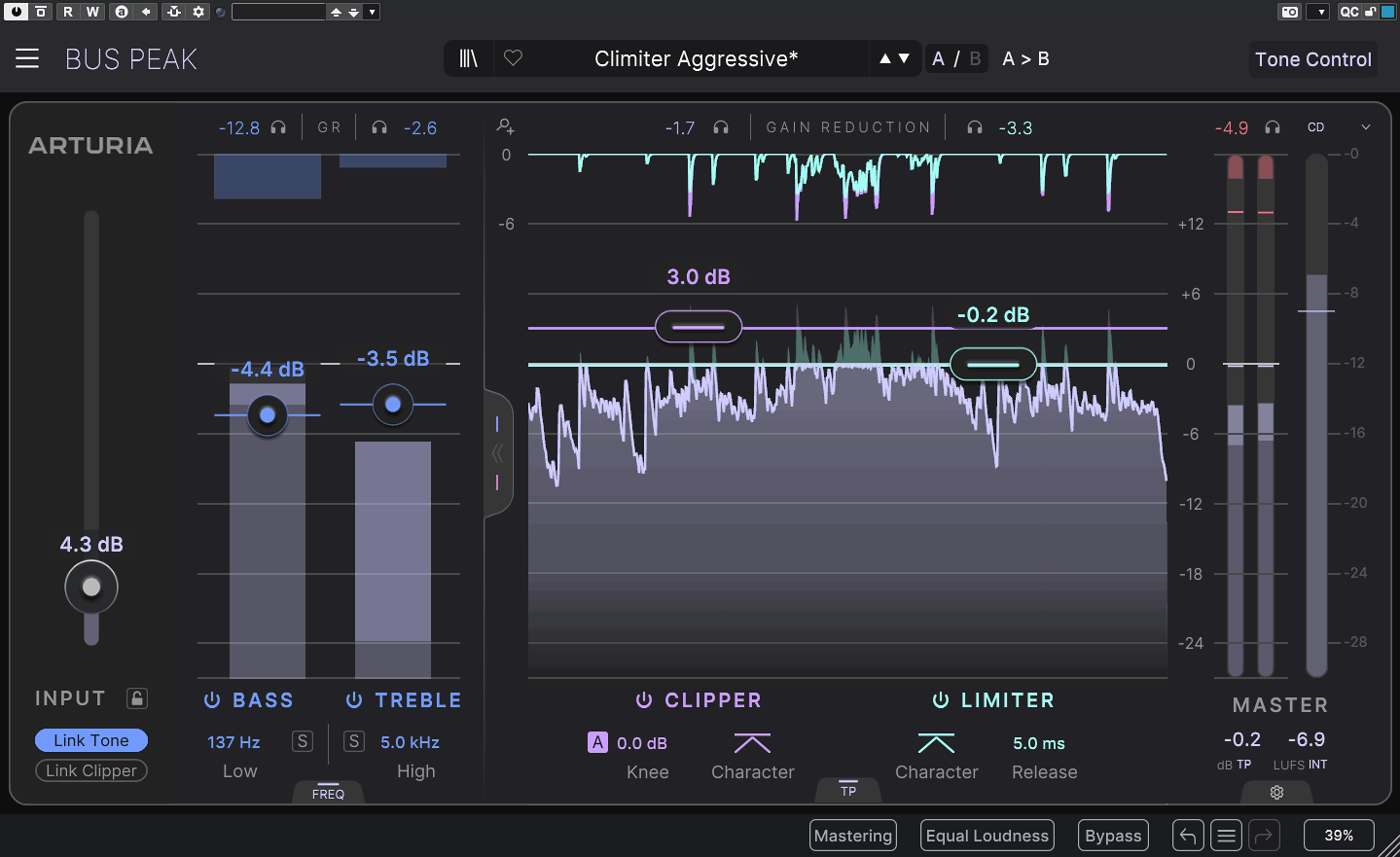
After the preliminary tonal adjustment, the signal reaches the clipper and limiter, which can operate separately or together. Controls are familiar and can be manipulated directly against the signal display. Lower dB values make the clipper limit more and the limiter attenuate peaks more strongly. Additional settings vary the knee width and the look-ahead/release behaviour, labelled Character, for softer or more aggressive processing.
Processing changes are clearly shown on the signal display. You can audition each processing block individually or listen only to the processed signal. Equal Loudness lets you compare dry and processed signals at the same loudness. Other useful features include True Peak operation, multiple quality modes for managing large projects, and LUFS metering.
In our view, FX Collection had long needed a full-featured limiter to match the quality of Arturia's other dynamics processors. This much-requested addition has turned out very well. You can judge for yourself by listening to the audio examples on the manufacturer's website or installing the demo.
Efx MOTIONS
Efx MOTIONS is a powerful sound-design tool combining several effects modules. It adds movement, development and variation by dynamically changing multiple parameters. The plug-in makes assigning key settings and creating different envelopes and automation curves particularly convenient.
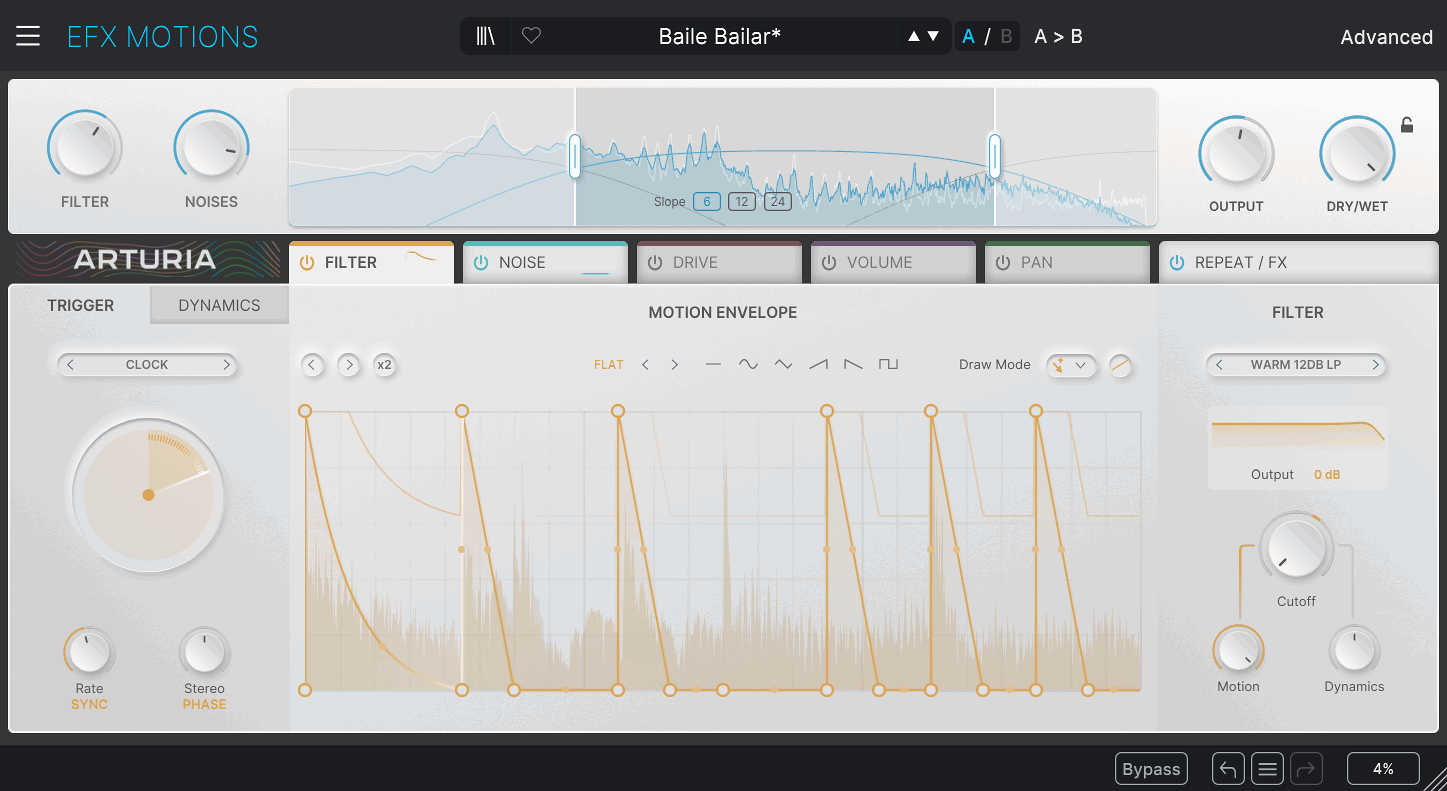
Its operating principle is straightforward. Five processing modules can be arranged in any order. The effects themselves are familiar: the emphasis is on automation rather than the basic processing.
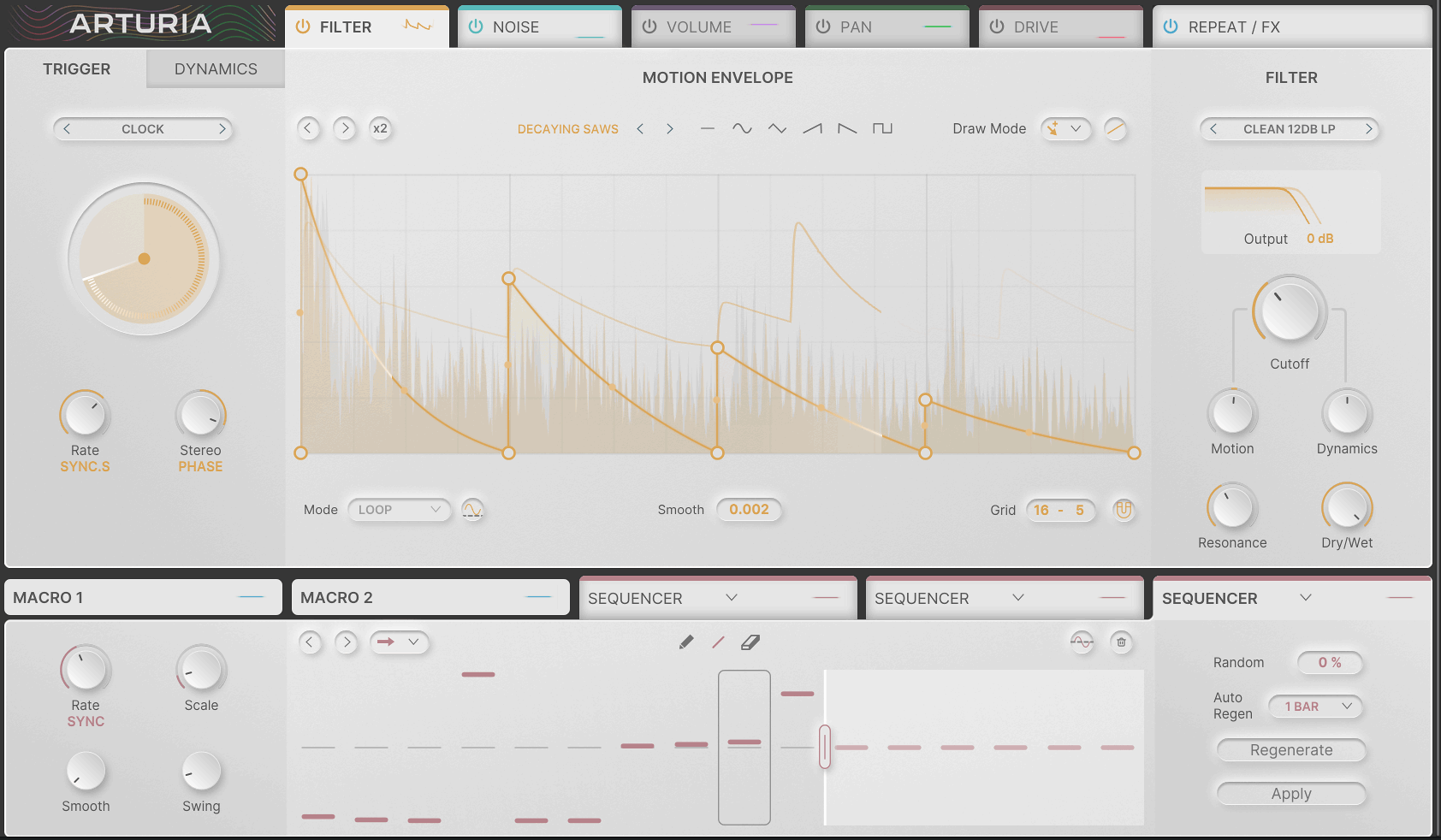
The FILTER module, for example, processes the signal through a filter whose cutoff can be modulated by a graphical envelope. In the centre of the screen, overlaid on the spectrum, you can select a preset envelope or draw any shape you like. Each effect module has its own independent envelope. Three additional blocks provide more flexible parameter control, with a choice of modulation envelope, step sequencer, envelope follower or randomiser. Each block can control several parameters simultaneously, producing more complex, varied modulation that changes the sound dynamically.
NOISE adds short samples lasting a few seconds, including natural sounds, noise, percussion and similar material. You can also import your own samples. DRIVE supplies overdrive and distortion. VOLUME creates tremolo or ducking effects, while PAN animates movement across the stereo field.
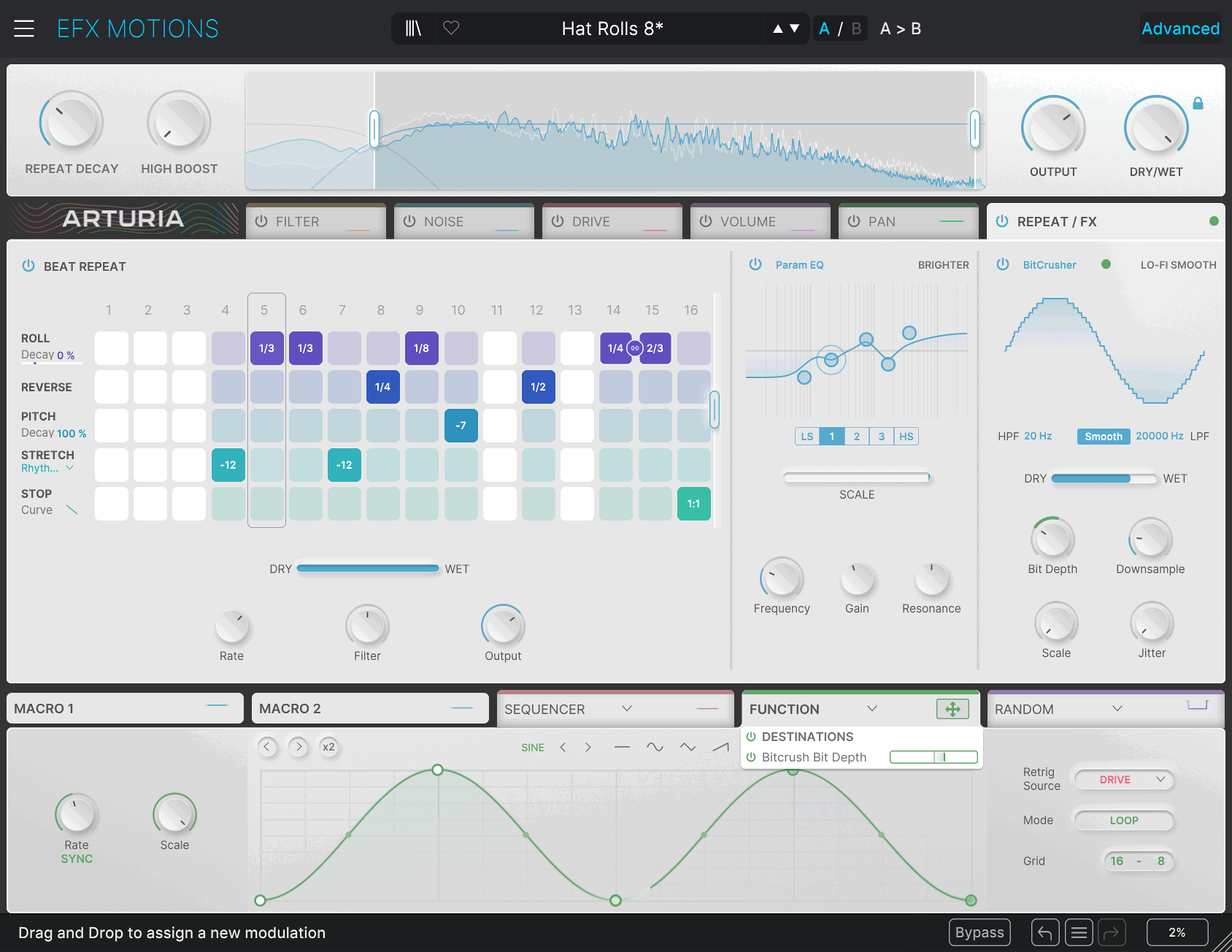
The plug-in also includes a sequencer-style Beat Repeat module. Each step can be processed individually with one of five built-in effects: Roll, Reverse, Pitch, Stretch or Stop. It is especially useful for rhythmic parts and loops, but can also work well on sustained sounds.
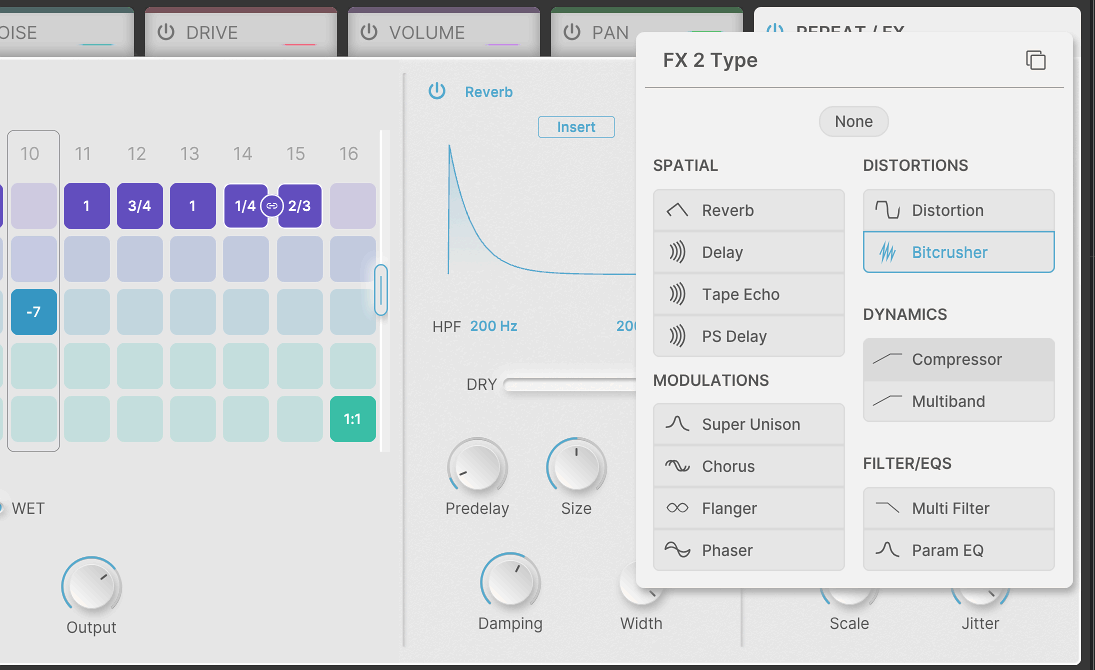
The same tab includes two further slots for final processing, offering 14 familiar effects commonly used in Arturia products.

The entire effect can also be restricted to a frequency range. Input cutoff filters define the band to be processed. Frequencies outside that band are retained in their original form rather than removed.
Overall, the plug-in's possibilities feel interesting and fresh. You can listen to Efx MOTIONS processing examples on the manufacturer's website, where a fully functional demo is also available.
Efx REFRACT
Efx REFRACT is another creative plug-in with a colourful interface and an inventive approach to processing. It duplicates the incoming signal into several voices, in the manner of a chorus, then applies creative effects. It works with almost any source, including synthesizers, vocals and drums. Depending on your aim, Efx REFRACT can add barely perceptible modulation or radically expand a sound with resonances and bitcrusher or distortion processing.
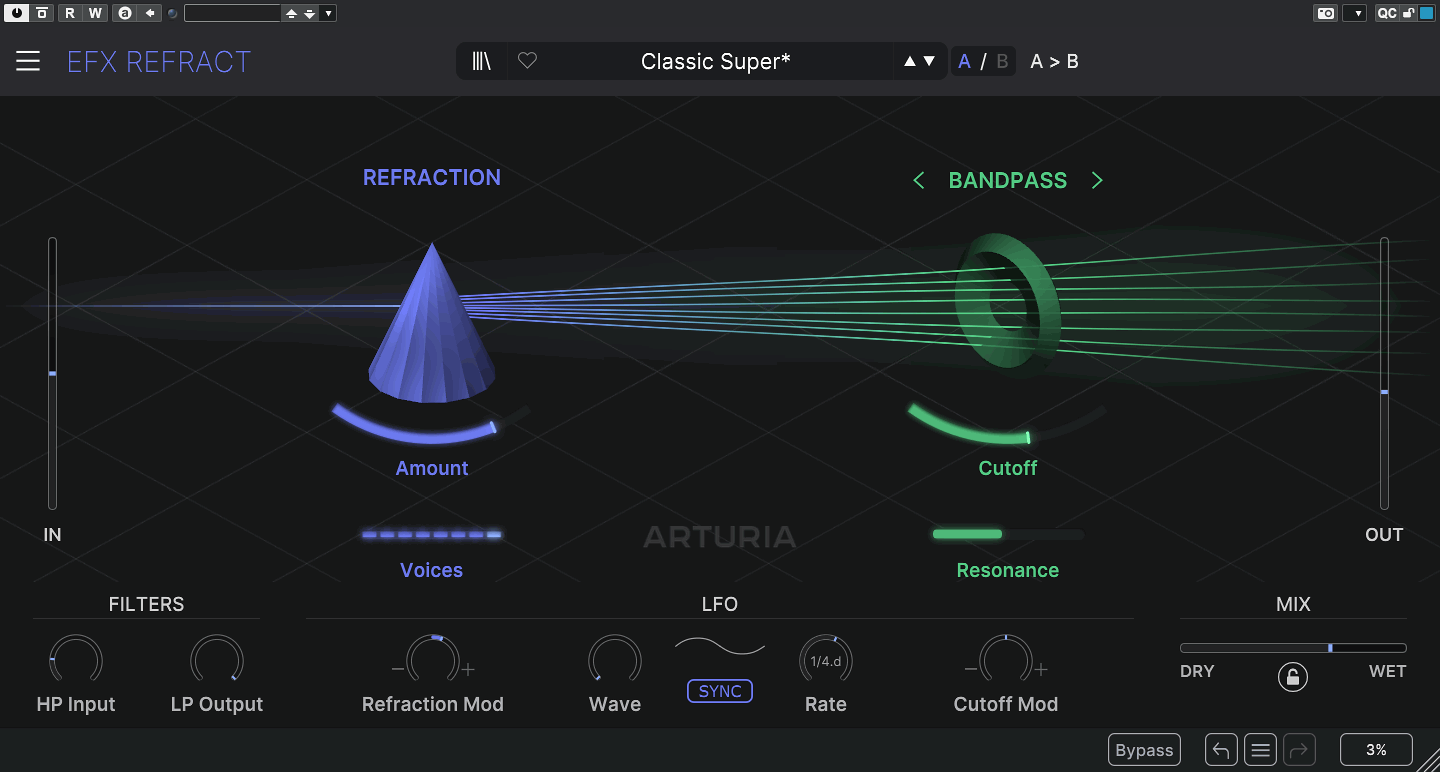
Processing can be divided into several stages. A two-band input equaliser selects the part of the spectrum to be affected. The signal then reaches REFRACTION, where it is duplicated into multiple voices. Available settings include the number of voices and their intensity, labelled Amount. To add movement, this parameter can be animated with an LFO.
After the chorus stage, the signal enters a creative effects section with five options: Bandpass Filter, Comb Filter, Distortion, Bitcrusher and Harmonizer.
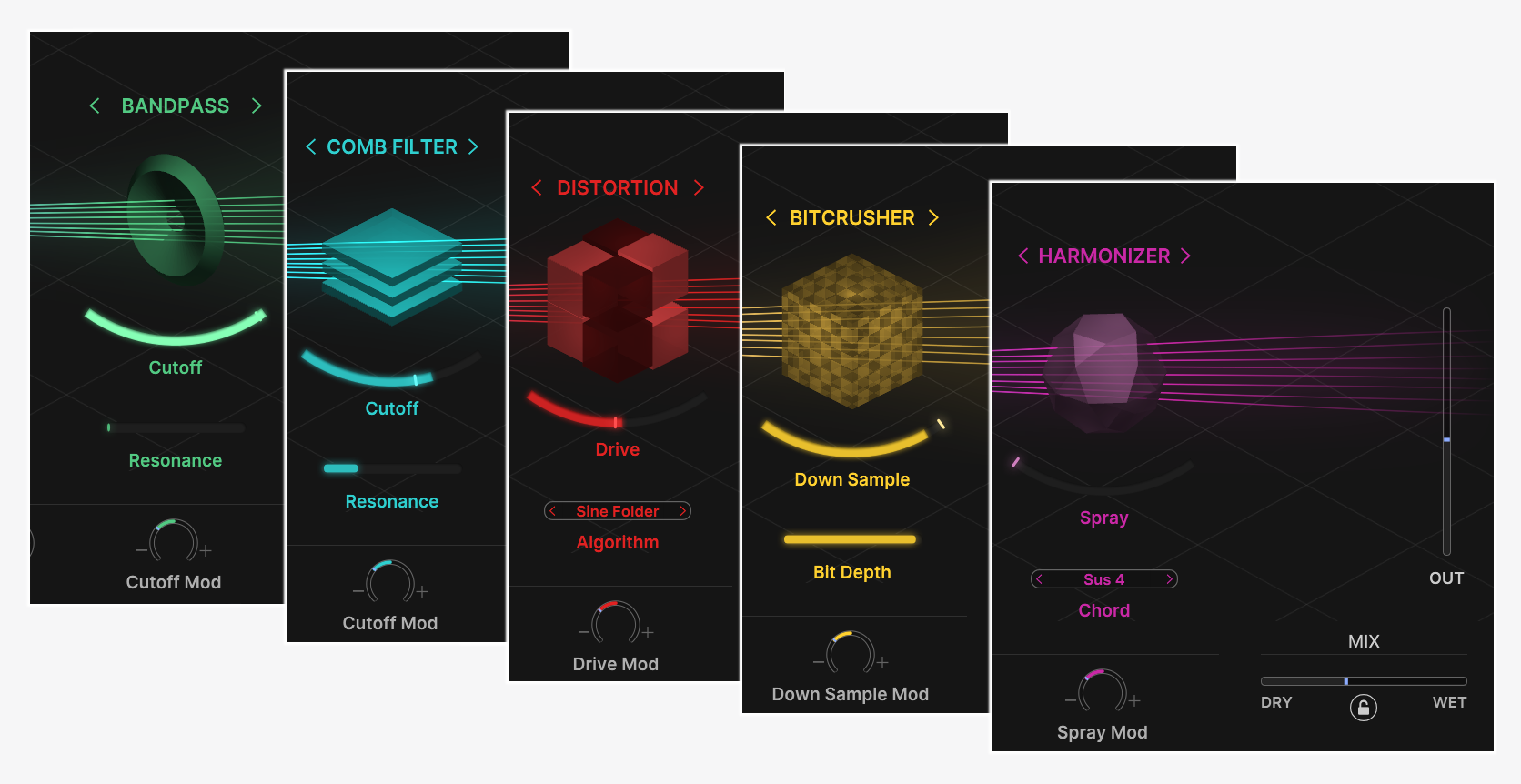
Each effect has two adjustable parameters: frequency and resonance for filtering, drive and saturation algorithm for distortion, amount and bit depth for the bitcrusher, and density and chord structure for the harmonizer. As with the chorus, the main parameter can be animated by the LFO. Unfortunately, both effects share the same modulation generator, which limits flexibility somewhat. Negative modulation values partly compensate by letting parameters move differently.
You can hear Efx REFRACT examples on the product page, where a fully functional demo can also be downloaded.
Conclusions
As usual, the Arturia FX Collection 5 update is both interesting and extremely useful. The new plug-ins should be in considerable demand, particularly Bus PEAK and Bus EXCITER-104. Efx MOTIONS and Efx REFRACT are also highly appealing. Their extensive capabilities and high-quality algorithms make them suitable for many tasks beyond sound design alone. As with other Arturia products, straightforward controls and attractive graphics make the plug-ins comfortable to use for experienced users and beginners alike.
Note. This is an adapted machine translation into English. It follows the “In simple terms” approach. Read the original article at https://prosound.ixbt.com/soft/arturia-fx-collection-5.shtml.