
Arturia MiniFuse OTG — a two-channel USB audio interface for streamers
Maxim Liadov
Introduced in 2025 by French manufacturer Arturia, the MiniFuse OTG targets the rapidly growing market for bloggers and streamers. It is a simple, affordable product for a broad audience, using the popular two-input/two-output configuration. What makes it special? As its name suggests, it has not one but two USB ports. The second, labelled OTG (on-the-go), connects to mobile devices. Arturia says the MiniFuse OTG turns a smartphone into a recording studio, allowing you to make music on the move. You can record high-quality content directly to a smartphone without a laptop. Connecting a computer also lets you route audio between the two devices. A laptop can therefore run your usual Ableton session while a smartphone app streams the live set online. The interface retains the advanced monitoring features of the Arturia MiniFuse range, including headphone or speaker monitoring with an adjustable balance between inputs and backing tracks. In effect, it offers everything found in the bestselling MiniFuse 2, plus an additional streaming input, several virtual audio devices and routing support in the well-designed MiniFuse Control Center application. For users concerned about getting started, Arturia provides detailed PDF instructions and YouTube tutorials.
The appearance closely matches the other MiniFuse models. The Direct Monitor button is gone: monitoring is always active and adjusted with the MIX knob. In its place is a USB source selector for OTG or COMPUTER. Although the enclosure may look like plastic in photographs, it is actually metal with a white painted finish, so durability should not be a concern.
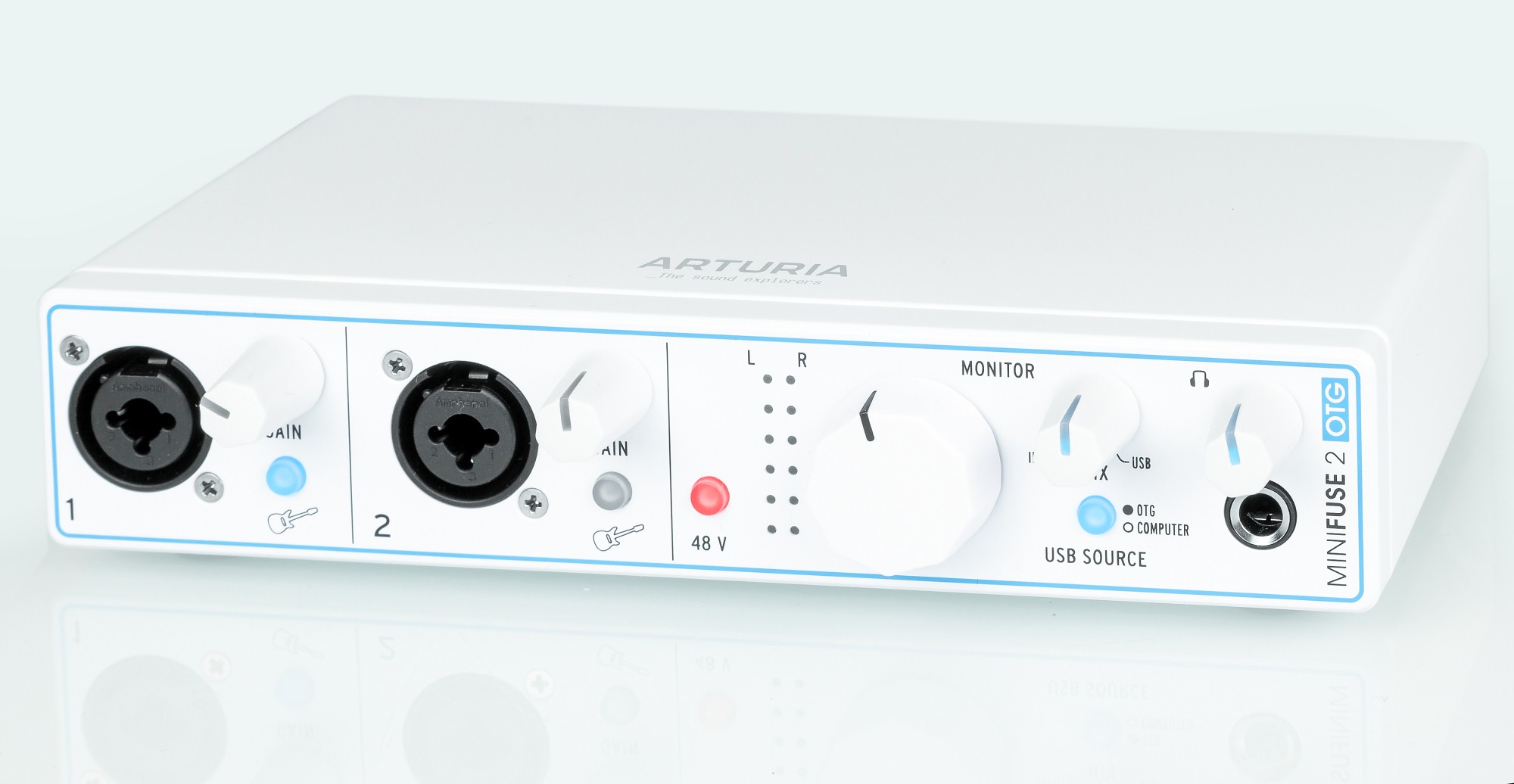
The XLR/TRS inputs are on the front. Phantom power is switched on for both inputs together. The knobs are illuminated: input signal presence is shown in blue, clipping in red. There is also a multisegment LED level meter. Separate speaker and headphone level controls are particularly welcome.
Arturia MiniFuse OTG specifications
- Line inputs 1–2 (balanced TRS):
- Impedance: 16 kΩ;
- Maximum level: +22 dBu;
- Gain: 56 dB;
- Frequency response: 20 Hz–20 kHz, ±0.05 dB;
- Dynamic range: 110 dBA;
- THD+N: -100 dB;
- Crosstalk: -116 dB;
- Microphone inputs 1–2 (balanced XLR):
- Impedance: 2.5 kΩ;
- Maximum level: +9 dBu;
- Gain: 56 dB;
- Equivalent input noise (EIN): -129 dBA;
- Frequency response: 20 Hz–20 kHz, ±0.06 dB;
- Dynamic range: 110 dBA;
- THD+N: -100 dB;
- Crosstalk: -116 dB;
- Instrument inputs 1–2 (unbalanced TS):
- Impedance: 1.1 MΩ;
- Maximum level: +11.5 dBu;
- Gain: 56 dB;
- Frequency response: 20 Hz–20 kHz, ±0.06 dB;
- Dynamic range: 110 dBA;
- THD+N: -100 dB;
- Line outputs (balanced TRS):
- Impedance: 94 Ω;
- Maximum level: +12 dBu;
- Frequency response: 20 Hz–20 kHz, ±0.09 dB;
- Dynamic range: 107.5 dBA;
- THD+N: -101 dB;
- Headphone output (TRS):
- Impedance: 10 Ω;
- Maximum level: +11.4 dBu;
- Frequency response: 20 Hz–20 kHz, ±0.09 dB;
- Dynamic range: 104 dBA;
- Output power: 137 mW.
The specifications match those of the Arturia MiniFuse 2, suggesting identical audio circuitry. The figures are very good, including 110 dBA dynamic range and low-noise inputs rated at 129 dBu. The interface is smaller than its main competitors at 43 × 200 × 100 mm and weighs 440 g.
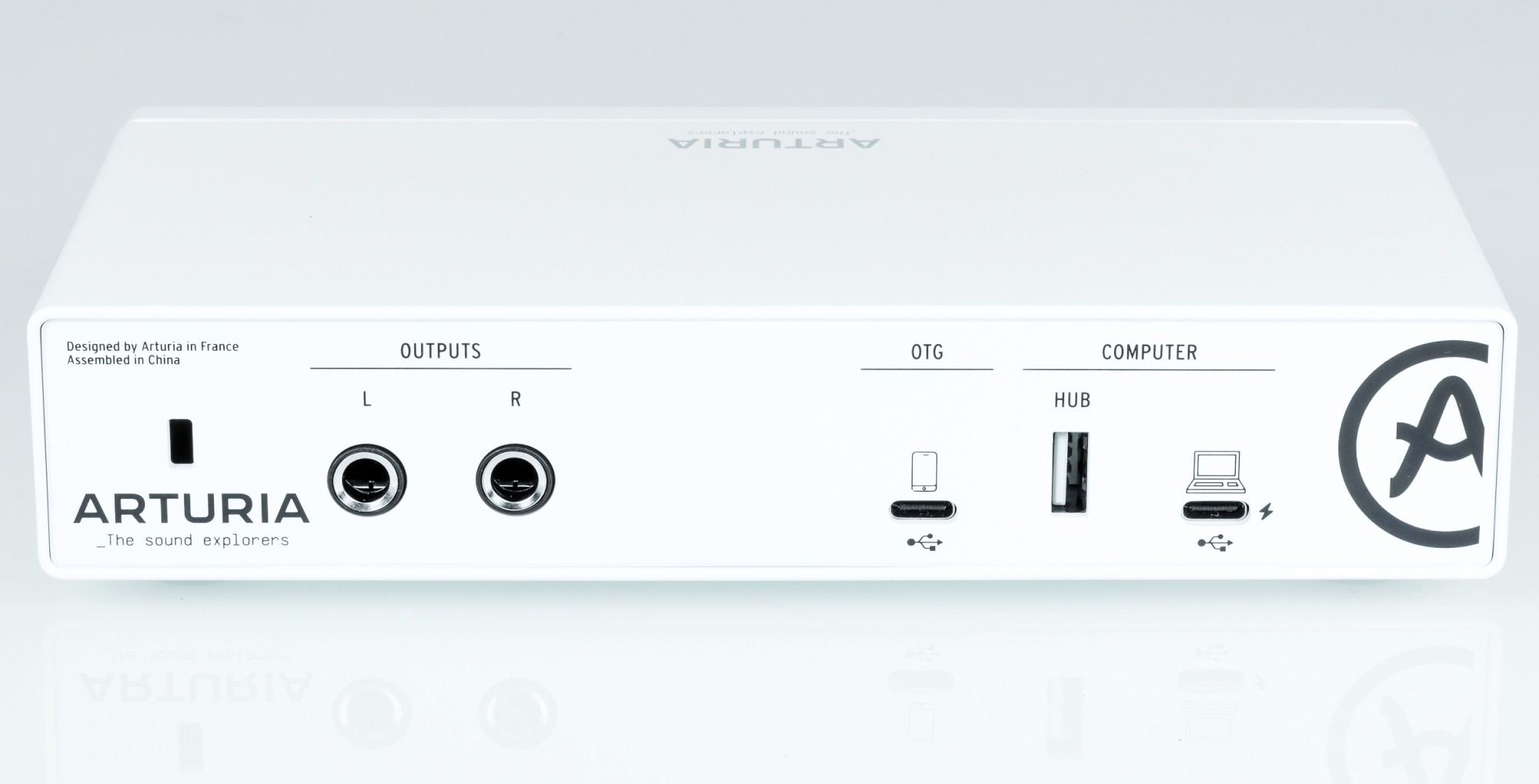
The rear panel has balanced TRS outputs and a USB hub port for a MIDI keyboard. The USB Type-C connectors provide power and connections to a computer and smartphone. Two matching white USB cables with braided sleeves are included.

As in the MiniFuse 2, conversion is handled by a Cirrus Logic CS4272 stereo codec, specified at 114 dB dynamic range and THD+N below -100 dB (below 0.001%).






The op-amps are JRC4580 devices.

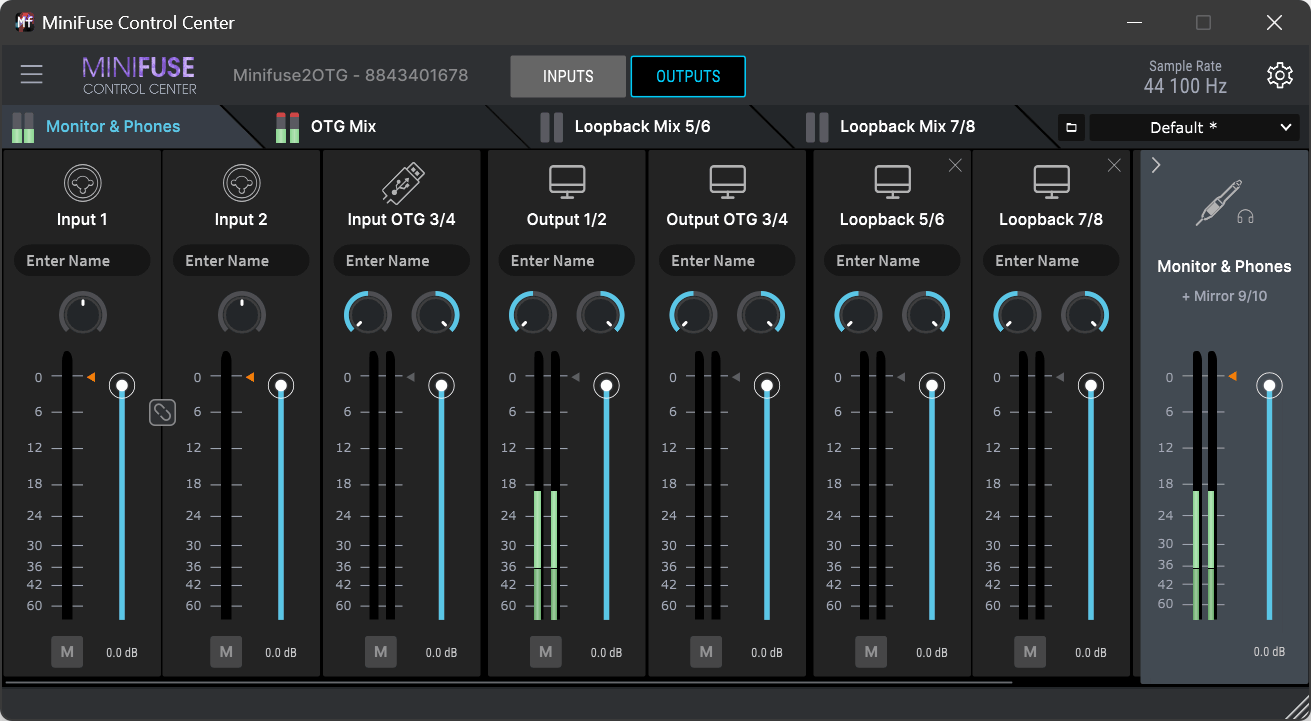
While the standard MiniFuse models had little in the way of a mixer, the MiniFuse OTG offers a wide range of options similar to the higher-end AudioFuse interfaces. Although there are only two physical inputs and outputs, additional submixes and controls are available for OTG and virtual channels. This lets you run several audio applications and combine them into the mixes you need for streaming and headphone or speaker monitoring.
The input tab lets you monitor signal levels and choose mono or stereo direct monitoring. The USB SOURCE button duplicates the physical selector on the front panel.
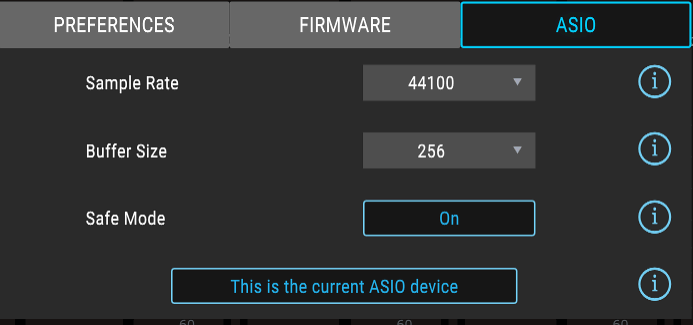
The ASIO control panel offers the usual settings, with buffer sizes from 8 to 2048 samples. Safe Mode adds USB buffering to help avoid clicks on less powerful computers.
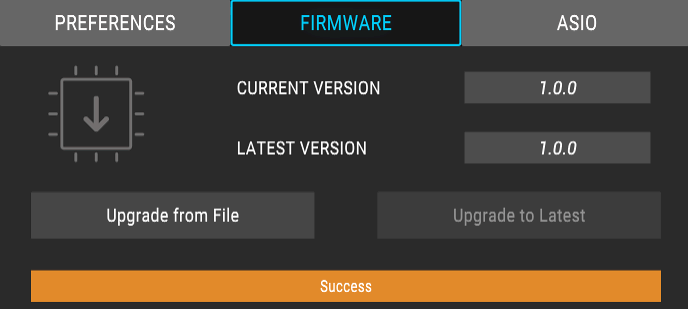
Firmware updates are available through the manufacturer's website. We encountered no glitches during use, so we hope there will be no pressing need for one.
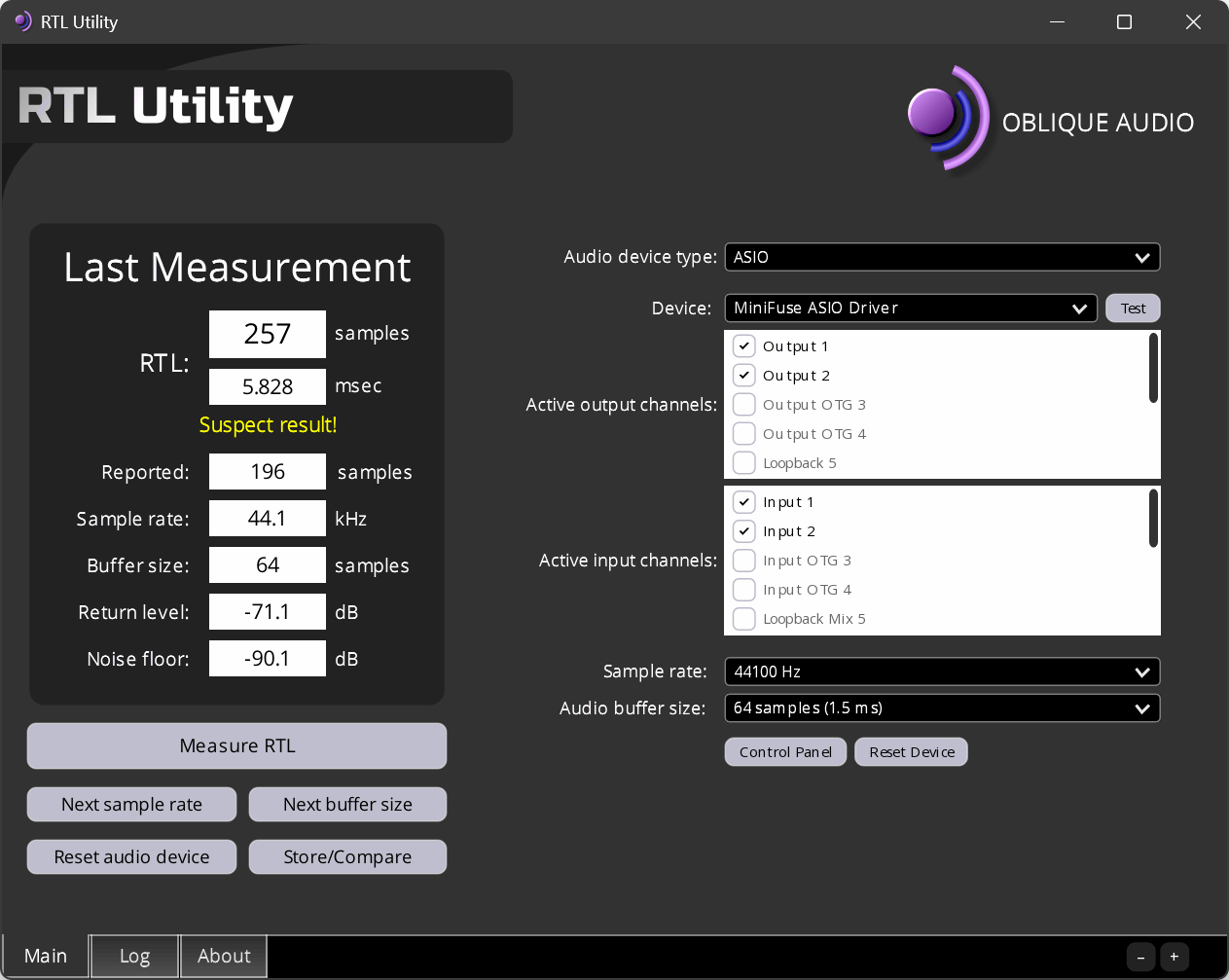
Latency is very low: 5.8 ms at a 64-sample buffer. Output-only latency is lower still.
Features:
Input channels: 12
Output channels: 10
Input latency: 322
Output latency: 375
Min buffer size: 8
Max buffer size: 2048
Preferred buffer size: 256
Granularity: -1
ASIOOutputReady - not supported
Sample rate:
8000 Hz - not supported
11025 Hz - not supported
16000 Hz - not supported
22050 Hz - not supported
32000 Hz - not supported
44100 Hz - supported
48000 Hz - supported
88200 Hz - supported
96000 Hz - supported
176400 Hz - supported
192000 Hz - supported
352800 Hz - not supported
384000 Hz - not supported
Input channels:
channel: 0 (Input 1) - Int32LSB
channel: 1 (Input 2) - Int32LSB
channel: 2 (Input OTG 3) - Int32LSB
channel: 3 (Input OTG 4) - Int32LSB
channel: 4 (Loopback Mix 5) - Int32LSB
channel: 5 (Loopback Mix 6) - Int32LSB
channel: 6 (Loopback Mix 7) - Int32LSB
channel: 7 (Loopback Mix 8) - Int32LSB
channel: 8 (Monitor Mirror 9) - Int32LSB
channel: 9 (Monitor Mirror 10) - Int32LSB
channel: 10 (OTG Mirror 11) - Int32LSB
channel: 11 (OTG Mirror 12) - Int32LSB
Output channels:
channel: 0 (Output 1) - Int32LSB
channel: 1 (Output 2) - Int32LSB
channel: 2 (Output OTG 3) - Int32LSB
channel: 3 (Output OTG 4) - Int32LSB
channel: 4 (Loopback 5) - Int32LSB
channel: 5 (Loopback 6) - Int32LSB
channel: 6 (Loopback 7) - Int32LSB
channel: 7 (Loopback 8) - Int32LSB
channel: 8 (Loopback 9) - Int32LSB
channel: 9 (Loopback 10) - Int32LSB
The Arturia MiniFuse OTG supports sample rates up to 192 kHz. Four virtual stereo devices appear in the system: MAIN 1/2, OTG 3/4, Virtual 5/6 and Virtual 7/8. The latter can be used as inputs in recording, broadcasting and streaming applications.
RMAA testing
| Device under test | [ASIO] MiniFuse ASIO Driver |
| Operating mode | 24-bit, 44 kHz |
| Audio interface | ASIO |
| Signal path | External loopback (line-out - line-in) |
| RMAA version | 6.4.5 PRO |
| 20 Hz–20 kHz filter | ON |
| Signal normalisation | ON |
| Level change | -0.2 dB / -0.1 dB |
| MONO mode | OFF |
| Calibration signal frequency, Hz | 1000 |
| Polarity | inverted/inverted |
| Frequency response (40 Hz–15 kHz), dB | +0.11, +0.00 |
Excellent |
| Noise level, dB(A) | -107.5 |
Excellent |
| Dynamic range, dB(A) | 107.5 |
Excellent |
| Total harmonic distortion, % | 0.00084 |
Excellent |
| Total harmonic distortion + noise, dB(A) | -93.9 |
Very good |
| Intermodulation distortion + noise, % | 0.00187 |
Excellent |
| Stereo crosstalk, dB | -95.3 |
Excellent |
| Intermodulation at 10 kHz, % | 0.00166 |
Excellent |
| Overall assessment | Excellent |
See the RMAA report for details
Overall, the measurements are very good and confirm the stereo codec's published specifications. The spectrum is clean and testing revealed no problems. These are respectable results for an inexpensive device.
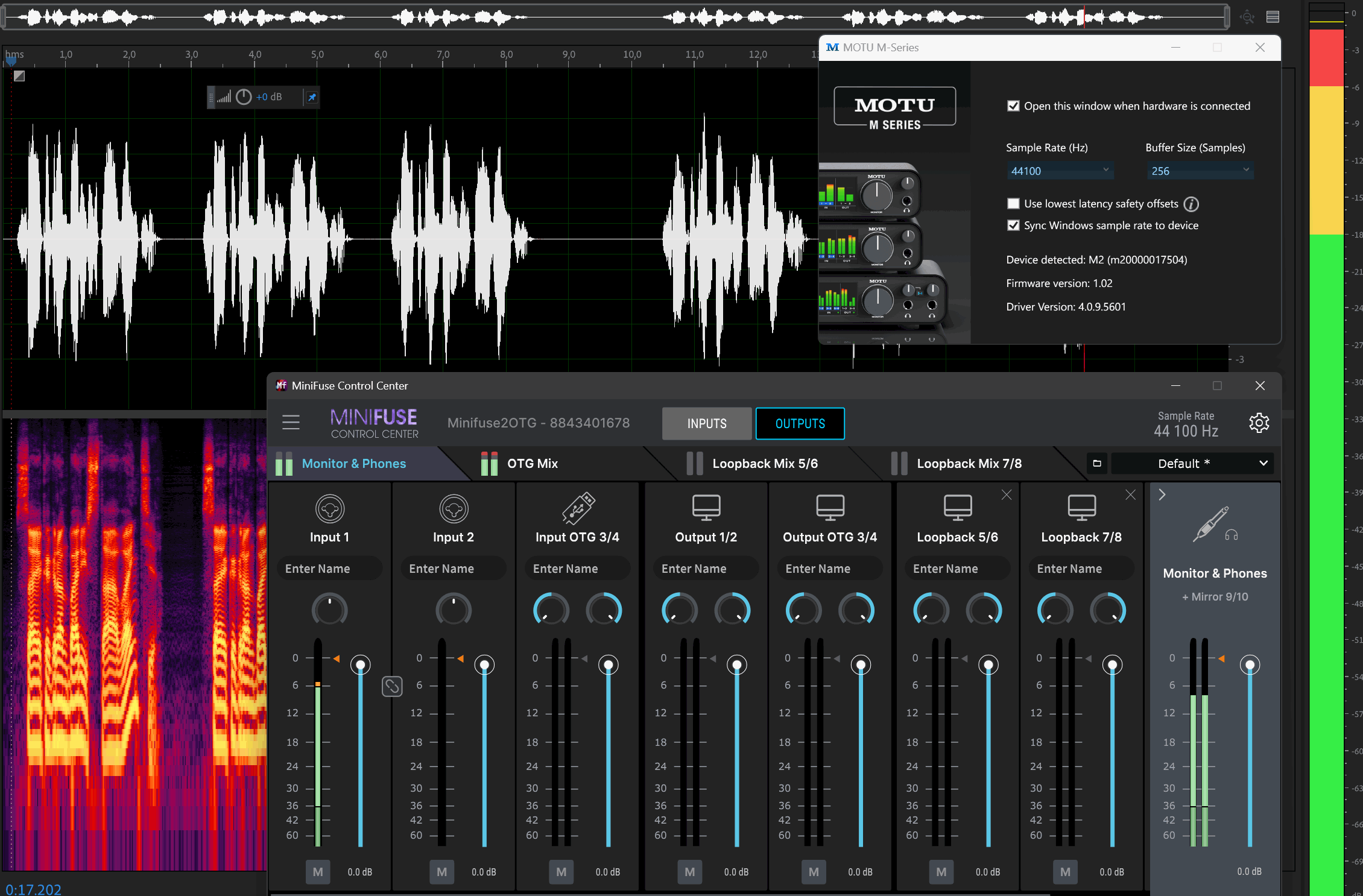
We recorded speech with a Neumann TLM 102 condenser microphone and compared it with a MOTU M2 recording made under identical conditions. The recordings were virtually identical in quality, with no differences in timbre or detail. This points to the professional standard of the Arturia MiniFuse OTG's audio circuitry. The interface was convenient to use and gave us no cause for complaint. Its software has been refined through extensive testing with bloggers, and the product is ready for practical use.
The software bundle is also worth mentioning: Ableton Live Lite, Analog Lab Intro virtual instruments, Arturia FX effects, Steinberg Cubase LE, Steinberg Cubasis for mobile devices, iZotope VEA (AI Voice Enhancement Assistant), Hindenburg PRO, Auto-Tune Unlimited and the Splice Creator Plan. Software licences can be obtained after registering on Arturia's official website.

Conclusions
The Arturia MiniFuse OTG is a further evolution of the MiniFuse range, now focusing on the large community of streamers and bloggers. Arturia has much to offer them. The proven MiniFuse 2 professional interface, with its high-quality preamps and reliable drivers, has been adapted to online broadcasters' needs. Even for a conventional musician, the MiniFuse OTG is an attractive choice thanks to its advanced professional mixer and richer, up-to-date software bundle.
Note. This is an adapted machine translation into English. It follows the “In simple terms” approach. Read the original article at https://prosound.ixbt.com/interfaces/arturia-minifuse-otg.shtml.