
Arturia FX Collection: Arturia's effects collection
Grigory Liadov
Arturia continues to surprise us with its products. Following the excellent Pigments 2 synthesizer, the company has introduced FX Collection, a collection of software effects.
The collection contains 15 high-quality audio processing plug-ins. They combine the character of classic studio hardware with modern features and controls. It also includes original Arturia effects that match the quality of the legendary devices.
As with Arturia's virtual instruments, FX Collection uses True Analog Emulation® (TAE®) and Physical Modeling® (Phi®). These technologies model hardware processes in detail, retaining their small variations and characteristics. Arturia says it invested significant resources and several years of analysis and research in the collection.

The result is 15 interesting frequency, dynamics, and spatial processors: 3 compressors, 3 delays, 3 reverbs, 3 preamps, and 3 filters. All run as VST, AU, or AAX plug-ins in a DAW. We will examine these effects and consider their usefulness in modern production.
Comp VCA-65
Comp VCA-65 models the famous dbx 165A VCA compressor. VCA compressors have a distinctive sound and many adjustable parameters. The dbx 165A was among the early compressors with an RMS detector. Arturia paid particular attention to accurately modeling its circuits. For greater flexibility, VCA-65 adds Auto Mode, Peak Limiter, and Soft Knee.
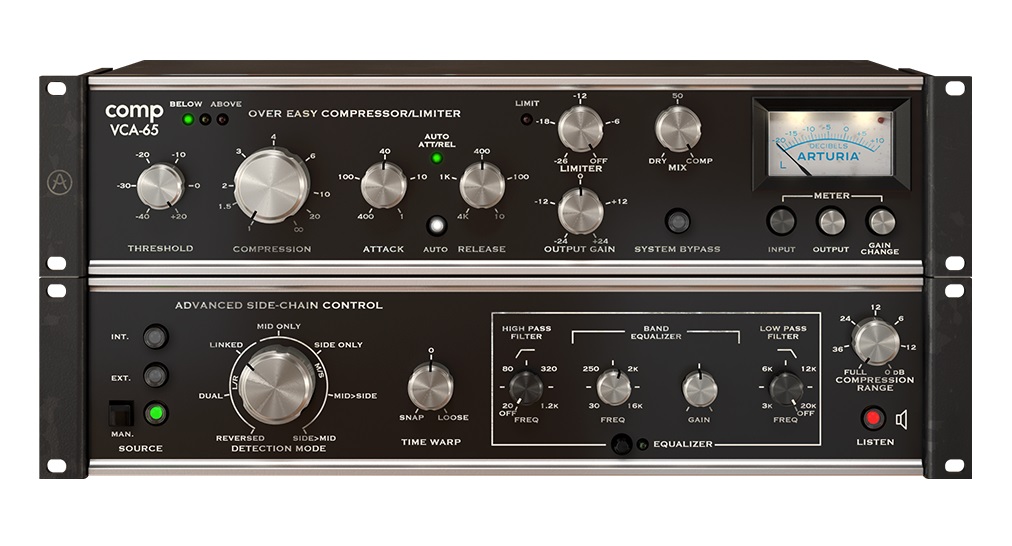
VCA-65 strongly resembles the dbx 165A, with a matching appearance and control layout. The upper section has conventional compressor controls: Threshold, Compression, Attack, Release, Limiter, and Output Gain. MIX, available only in software, balances processed and dry signals. This alone may be enough for parallel compression. An extra panel provides advanced sidechain settings. Different detection modes are particularly interesting. On stereo tracks, detection can switch from L/R to Mid/Side, greatly expanding processing options. The sidechain also has a single-band equalizer with cut filters. These shape the detector signal for more precise, predictable compression. They can emphasize vocal sibilance in the detector path, using the sidechain for de-essing.
Presets cover common signal types. Sound Design Tips also helps beginners: for each preset, it highlights useful controls and adjustment ranges to try first. This function first appeared in the fairly complex Pigments synthesizer and was welcomed by users.
Comp TUBE-STA
TUBE-STA models the Gates STA-Level tube compressor. The hardware was popular in the 60s and 70s for its warm character and gentle saturation, especially at low frequencies. Originally used in television and radio broadcasting, it later became popular in recording studios for its musical sound. Simplicity was part of its appeal. Despite adding modern functions, Arturia retains the original's very simple design.

Like most tube compressors, TUBE-STA has few controls. Input level, Mode, and Recovery Time are available. The latter settings work roughly like conventional Attack and Release, but with fixed response times. A needle meter can show input level, output level, or Gain Reduction. By default, the output control is linked to the input control, so both change together, avoiding excessive level increases. Link can separate the controls for independent adjustment. As on the previous plug-in, MIX supports parallel compression and an extra panel provides advanced sidechain settings.
Tube compressors can handle very large amounts of gain reduction without audible artifacts. They are slower than VCA compressors, but their warmth and coloration can transform a sound in a way other compressor types cannot.
Comp FET-76
FET-76 models the famous Universal Audio 1176 field-effect-transistor compressor. The 1176 has a very fast attack, down to 20 microseconds, and up to 45 dB of gain. Its input amplifier design gives it a distinctive sound. It was often used in rock music to add density and aggression. Heavy compression increases distortion, adding grain to guitars and bass. Strong vocal compression adds brightness and presence. On drums, compression can create a dense, explosive sound.
With FET-76, Arturia aims to recreate the 1176 processes and match the hardware's behavior as closely as possible.


The FET-76 controls follow the original. There are few controls, including input and output level. Link joins them to keep output level steady. Attack and Release use numbers: 1 is the longest time and 7 the shortest. Ratio selects a particular compression ratio, while All enables every ratio button together. The hardware had no dedicated All button, but several buttons could be pressed at once. This produced an unusually even response with extra distortion. Many users found the unexpected effect useful, so Arturia includes it. FET-76 also gains advanced sidechain settings, like the other compressors.
Delay TAPE-201
Delay Tape-201 models an iconic tape delay from the 1970s. The hardware used a tape loop and several playback heads arranged in sequence to create rhythmic echoes. Tape-201 recreates the original device and its detailed characteristics.

Although the appearance differs considerably, the main delay controls remain. Modern additions sit in the lower panel. Full stereo operation includes independent channel adjustment. An extra equalizer processes the signal before the delay. Flutter, motor inertia, and background noise controls recreate hardware behavior. A modulation section enables more unusual effects.
Delay MEMORY-BRIGADE
MEMORY-BRIGADE emulates a bucket-brigade delay pedal from the 1970s. It was among the early compact effects offering warm, tape-like echoes. Before bucket-brigade devices, echoes required large tape machines. These sounded excellent but needed maintenance and could be unstable. The pedal used a chain of capacitors instead of tape. This also allowed much shorter delays for chorus or flanging.
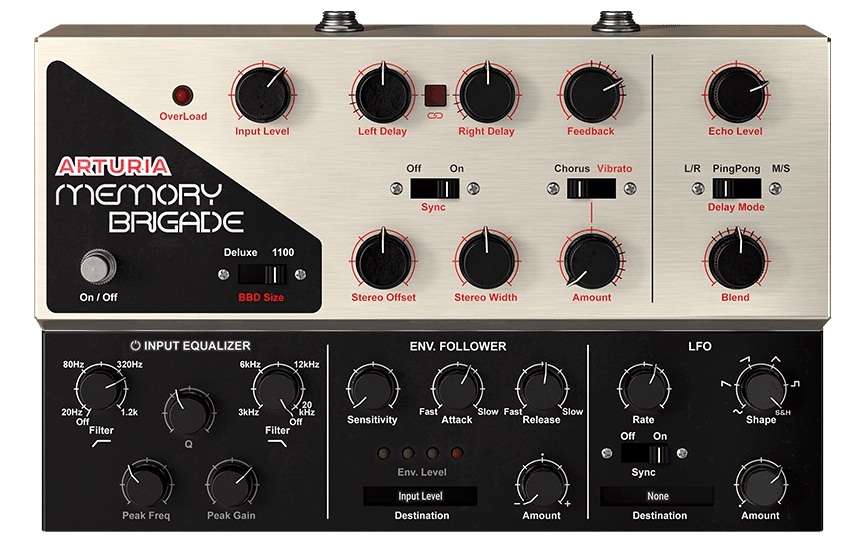
As on the other plug-ins, the upper panel contains controls matching the hardware. Modern additions sit below. Envelope and LFO modulation are especially interesting.
Delay ETERNITY
ETERNITY is another delay, this time designed entirely by Arturia. It combines simple operation with many settings. Its interface resembles hardware, with buttons and large knobs.

ETERNITY has five repeat modes, from simple delay to two independent delay lines for complex patterns. Bit Crusher adds characteristic distortion. Another filter processes the repeating signal separately. Advanced settings include input equalization and three modulation sources, offering extensive creative possibilities.
The next three plug-ins are reverbs.
Rev PLATE-140
PLATE-140 closely recreates the classic EMT 140 plate reverb and its tube preamp. Alongside EMT 140, there are 2 modes modeling other plate reverbs with different resonance characteristics. This helps choose a suitable character for the current requirements and tasks.

Controls include pre-delay and an input high-pass filter to reduce metallic coloration. A tube preamp control adds harmonics. Chorus makes the sound more diffuse. Output controls include a three-band equalizer and stereo width.
Like the other Arturia effects, PLATE-140 includes convenient presets.
Rev INTENSITY
Rev INTENSITY is another original Arturia design. It draws inspiration from late-1980s digital reverbs without modeling any particular unit. Its algorithms aim for an attractive musical sound rather than exact mathematical room simulation. Still, it includes the common types: Rooms, Chambers, Studios, Halls, Arenas, Concert Halls, and Cathedrals.

Rev INTENSITY looks simple. Main reverb parameters sit above, with advanced settings below. Modulation can target any parameter, providing considerable creative freedom.
Rev SPRING-636
Rev SPRING-636 models the famous Grampian 636 spring reverb. The interface closely resembles the hardware, but the plug-in includes other spring models alongside Grampian 636.

Rev SPRING-636 adjusts preamp coloration, reverb decay, stereo width, and the balance between preamp and reverb signals. Advanced options include pre-delay, a pre-reverb filter, spring model selection, and final equalization.
Pre 1973
Pre 1973 models the legendary Neve 1073 preamp. Arturia describes it as the result of more than a decade of experience recreating classic instruments. The company analyzed the Neve 1073 in detail and modeled its circuitry. Unlike the original console, Pre 1973 has continuously adjustable EQ frequencies.

Pre 1973 combines a preamp and equalizer. The signal first receives saturation and harmonic distortion in the preamp, then passes through the equalizer for further processing with the characteristic Neve sound. It works in mono or stereo, as shown, and also offers Mid/Side mode.
Pre 1973 sounds very interesting and could rank among the best Neve emulations.
Pre TridA
Pre TridA models the preamp and equalizer of the legendary Trident console, valued by many musicians for its musical EQ and preamp.

An unusual feature is the set of three cut filters: 18 dB/octave at high frequencies and 12 dB/octave at low frequencies. They can operate together, creating unusual response curves through different combinations. Four additional fixed-frequency bands provide continuously adjustable gain over ±15 dB.
Pre TridA recreates the console's features and character, whether using its unusual equalizer or just the preamp. Even with minimum input gain and EQ disabled, it adds the slight coloration of the original Trident console.
Pre V76
Pre V76 models the famous Telefunken V76 tube preamp used in REDD consoles. Arturia goes beyond preamp emulation, adding an equalizer designed in the style of the period and polarity inversion, absent from the original consoles.

The Telefunken preamp is valued for its bright tube saturation. Arturia aims to recreate that distinctive character in Pre V76, and this is the plug-in's main strength. The extra equalizer is also interesting and well implemented. It has two fixed-frequency bands: around 5 kHz and 100 Hz, with ±10 dB adjustment. A four-position low-cut filter is also available. Like the other plug-ins, Pre V76 supports stereo, Dual Mono, and Mid/Side modes.
Filter MINI, Filter M12, Filter SEM
The collection ends with filters from familiar vintage synthesizers in Arturia V COLLECTION, provided as separate effects. Filter MINI comes from MINI V, Filter M12 from Matrix-12 V, and Filter SEM from SEM V.

In our view, making these classic synthesizer filters available as signal processors is a sensible and long-overdue idea, especially given the quality of the instruments themselves. The filters are as interesting and useful as the other FX Collection effects. They add the character of older analog hardware, while modern additions provide many creative options.
Conclusions
FX Collection is very interesting and deserves close attention. The effects are easy to use yet capable of excellent results. The compressors and preamps particularly stand out. Arturia's website helpfully provides processing examples with different source signals. Demo versions also let users try the effects in real projects before deciding.
Every FX Collection plug-in is sold separately. The bundle costs much less overall, however. If three or four effects appeal to you, buying the whole collection makes more sense.
Note. This is an adapted machine translation into English. It follows the “In simple terms” approach. Read the original article at https://prosound.ixbt.com/soft/arturia-fx-collection.shtml.