
Native Instruments KOMPLETE Audio 6 MK2: six-channel USB audio interface
Maxim Liadov
Germany's Native Instruments expands its modern USB audio interface range with the KOMPLETE Audio 6 MK2.
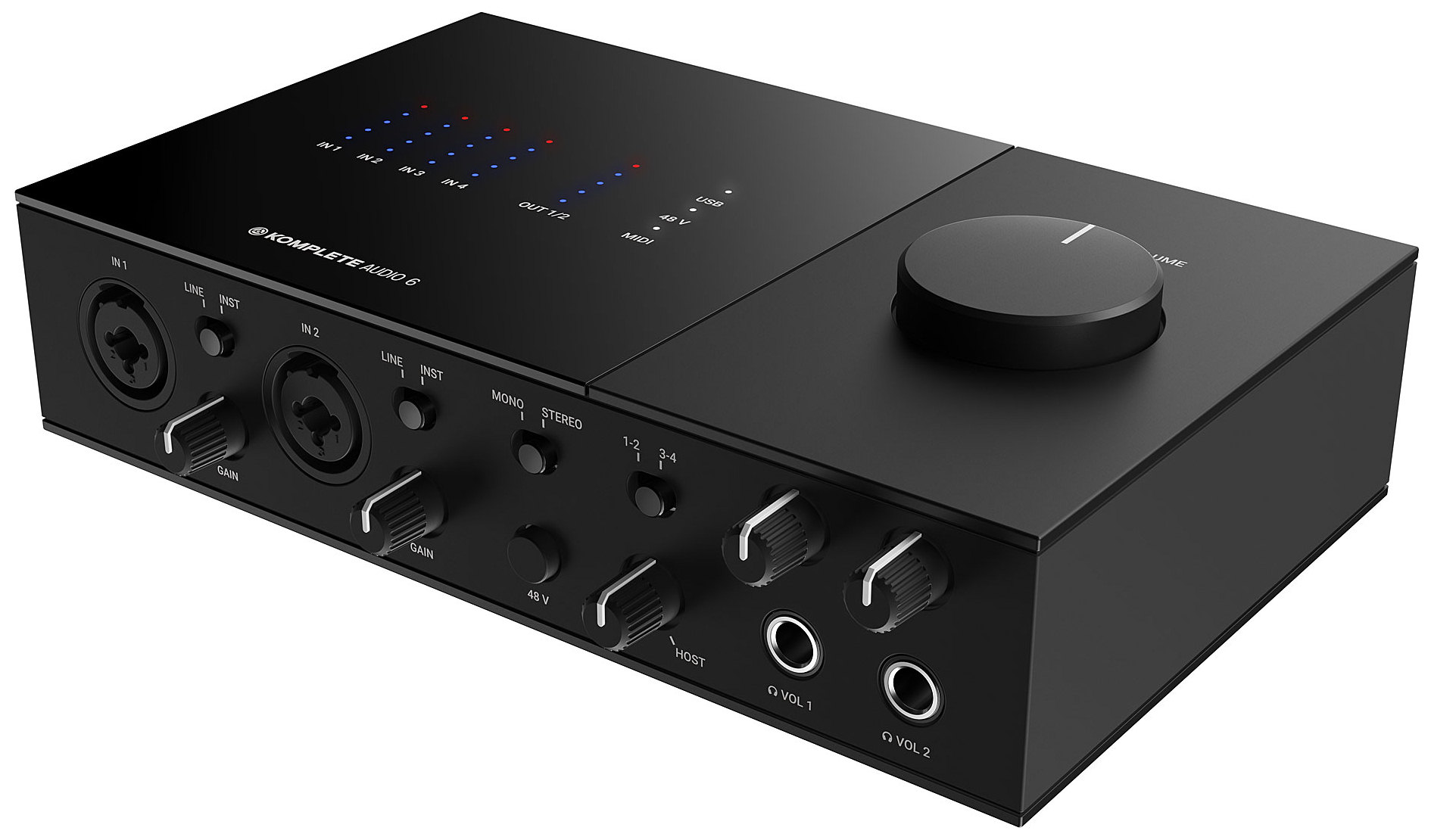
The earlier model without MK2 stayed on sale for a long time. The main change is a shift from DJ use to music production. Headphones can no longer receive channels 3/4. Instead, there are 2 headphone outputs, both following 1/2. Other visible and practical features largely match the predecessor.
It is more useful to see the KOMPLETE Audio 6 MK2 as the larger model in the new USB interface family. Our earlier KOMPLETE Audio 1 review left us very satisfied with its quality and functions.

The Audio 6 MK2 follows a similar design. Top-panel channel meters show levels sensibly and are useful. The large volume knob controls line outputs 1/2, independently of the dedicated headphone controls. Every knob is analogue.

Connections are the main difference from smaller models. Many rear inputs and outputs expand musical options. Extra I/O 3/4 can connect studio hardware effects. Despite plastic panels, metal covers and an internal frame give the unit weight. Four large rubber feet prevent sliding.
The electronics are unusual and new to us.

A general-purpose 500 MHz NXP i.MX RT1020 Arm Cortex-M7 controller includes USB PHY, S/PDIF, I2S, I2C and a PLL for audio converters. Many GPIO lines serve buttons and indicators.

The DACs are inexpensive two-channel WM8523 types, with 104 dB dynamic range and THD <-89 dB. This is surprising because smaller Native Instruments interfaces use the more capable CS4272 codec, with 114 dB dynamic range and THD+N <-100 dB.


The CS5341 ADC specifies 104 dB dynamic range and THD+N <-98 dB. Headphones similarly use JRC4556, with less volume reserve than the smaller models' 3414A buffer we praised. The designers seem to have added channels within a limited budget by simplifying electronics slightly.
Features:
Input channels: 6
Output channels: 6
Input latency: 130
Output latency: 66
Min buffer size: 8
Max buffer size: 2048
Preferred buffer size: 64
Granularity: -1
ASIOOutputReady - not supported
Sample rate:
8000 Hz - not supported
11025 Hz - not supported
16000 Hz - not supported
22050 Hz - not supported
32000 Hz - not supported
44100 Hz - supported
48000 Hz - supported
88200 Hz - supported
96000 Hz - supported
176400 Hz - supported
192000 Hz - supported
352800 Hz - not supported
384000 Hz - not supported
Input channels:
channel: 0 (Input 1) - Int32LSB
channel: 1 (Input 2) - Int32LSB
channel: 2 (Input 3) - Int32LSB
channel: 3 (Input 4) - Int32LSB
channel: 4 (S/PDIF Input5) - Int32LSB
channel: 5 (S/PDIF Input6) - Int32LSB
Output channels:
channel: 0 (Output 1) - Int32LSB
channel: 1 (Output 2) - Int32LSB
channel: 2 (Output 3) - Int32LSB
channel: 3 (Output 4) - Int32LSB
channel: 4 (S/PDIF Output5) - Int32LSB
channel: 5 (S/PDIF Output6) - Int32LSB
Rates up to 192 kHz are supported. All channels are independent: 4 analogue inputs, 4 outputs and expansion through S/PDIF.
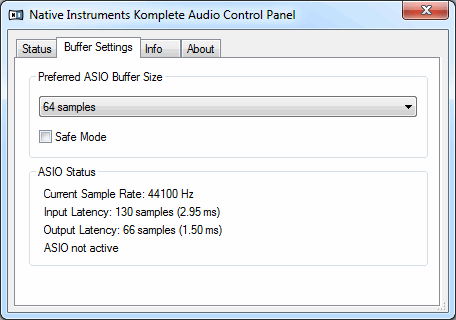
The new range uses Thesycon 4.59 drivers. ASIO buffers are selected in samples, down to 8. Safe Mode adds USB buffering.

We measure latency at 64 samples and 44.1 kHz. Round-trip latency here was just 5.7 ms, a positive result.
At 64 samples, our fast desktop worked without problems. Unless playing virtual instruments from a MIDI keyboard or applying live guitar effects, 256 samples or more is sensible. DAWs know and compensate recording-buffer timing. Chasing the smallest buffer offers little practical benefit without a real-time need.
RMAA measurements
We measured line output with our RMAA 6.4.5 PRO software.
| Device under test | [ASIO] Komplete Audio ASIO Driver |
| Operating mode | 24-bit, 44 kHz |
| Audio interface | ASIO |
| Signal path | Line output |
| RMAA version | 6.4.5 PRO |
| 20 Hz–20 kHz filter | YES |
| Signal normalization | YES |
| Level change | -0.2 dB / -0.1 dB |
| MONO mode | NO |
| Calibration signal frequency, Hz | 1000 |
| Polarity | Correct/correct |
| Frequency response variation (40 Hz–15 kHz), dB | +0.01, -0.04 |
Excellent |
| Noise level, dB(A) | -100.6 |
Excellent |
| Dynamic range, dB(A) | 100.5 |
Excellent |
| Harmonic distortion, % | 0.00404 |
Very good |
| Harmonic distortion + noise, dB(A) | -83.2 |
Good |
| Intermodulation distortion + noise, % | 0.00712 |
Excellent |
| Stereo crosstalk, dB | -98.6 |
Excellent |
| Intermodulation at 10 kHz, % | 0.012 |
Very good |
| Overall rating | Excellent |
Detailed RMAA results at 24-bit/44 kHz
Results are typical of an entry-level interface.
We recorded a Neumann TLM 102 and compared it with a recording from the smaller model, the KOMPLETE Audio 1.


Recording quality is very good: accurate tone, no unusual coloration and no audible distortion. We heard no meaningful recording difference between models. As with the smaller unit, gain needed about 90% of its range, but it was sufficient.
Input and clipping indicators work correctly. A hardware-monitoring knob is provided. Unlike smaller models, headphone monitoring can be mono or stereo, adding useful flexibility.

Headphone power is modest: 25 mW maximum versus the smaller model's 48 mW. Insensitive 32-ohm and 250-ohm headphones had just enough level, without reserve. For comparison, Steinberg UR12 provides only 6 mW per channel, noticeably insufficient in these conditions.
Conclusions
We liked the Audio 6 less than the smaller models. Audio 1 and Audio 2 were easy recommendations as excellent buys. Adding functions to Audio 6 has slightly reduced some strengths. Its clear benefits are extra TRS analogue I/O, S/PDIF and MIDI, especially useful for synthesizer users. We look forward to more Native Instruments products: the German engineers clearly have strong potential.
Note. This is an adapted machine translation into English. It follows the “In simple terms” approach. Read the original article at https://prosound.ixbt.com/interfaces/ni-komplete-audio6mk2.shtml.