
HEDD BASS 08 — an active 8-inch studio subwoofer with Lineariser and CoP
Maxim Liadov
Speaker principles have been known for decades, so what remains to develop? Much was already invented 50 years ago, but HEDD Audio's German team under Klaus Heinz continues finding new solutions. First came its own AMT tweeters, then original midrange and high-frequency drivers, followed by several processing technologies in a powerful internal DSP. HEDD targets demanding users who have outgrown cheap mainstream models but are not ready for the size and price of high-end speakers.
Second-generation HEDD MK2 monitors replaced fully analog models with several proprietary technologies. Our review explains them: HEDD Audio Type 07 MK2 — two-way 7-inch active studio monitors with Lineariser and CoP technologies.
The latest official HEDD MK2 video is available on the company's YouTube channel.
Users had long requested active subwoofers, and HEDD repeatedly promised them. Its engineers waited to release them on the same platform as the MK2 monitors.
The Russian presentation took place in March 2021 at Dr.Head on Moscow's Novy Arbat. The official distributor organized the event: ARIS. I attended as an invited expert: Maxim Liadov, ProSound founder and editor-in-chief.

The event again explained how HEDD differs from similar monitors. Every HEDD monitor is made at the company's Berlin factory and developed in-house. Experienced specialists who moved from ADAM with Klaus hand-build the tweeters. Assembly and instrument-based quality control happen there too. Having visited many factories, we see HEDD as a clear example of a leading European manufacturer. Its dedicated engineering department works under founder and chief designer Klaus Heinz.

The event included product introductions, questions, and an opportunity to speak online directly with Klaus Heinz and lead engineer Dmitry Grigoriev. Visitors also had time to hear all new models. Those who missed it can watch official Klaus Heinz videos with our Russian dubbingfor first-hand information about HEDD technology.

Dmitry and Klaus answered questions about differences from first-generation monitors. Cabinets now have a more practical finish, but the drivers and amplifiers are unchanged. The difference is the DSP board containing Lineariser and CoP.
The monitors can be heard in the sound-isolated studio at Dr.Head. Its large product selection also permits comparison with other manufacturers.

The shop also offers listening to the unusual high-end HEDDphone ONE AMT headphones.
Two subwoofers are now available, BASS 08 and BASS 12, with full DSP and proprietary technology support. Bass is secondary for 5–7-inch monitors but central to a subwoofer. Phase rotation from cabinet design can produce an even amplitude response yet blurred bass that is unpleasant with music. Cinema effects may hide this, but phase-response problems are undesirable in music and video production. Many users therefore prefer large multiway speakers over subwoofers. HEDD focused on solving this once-accepted limitation.
HEDD BASS 08 and BASS 12 specifications
| BASS 08 | BASS 12 | |
| Driver diameter (voice coil) | 8’’ (2’’) | 12’’ (2.5’’) |
| Frequency range (-3 dB) | 24–80 Hz | 20–80 Hz |
| Upper frequency limit (var.) | 40–120 Hz | 40–120 Hz |
| Lower limit (-3 dB): Normal / extended mode |
24 / 19 Hz | 20 / 16 Hz |
| Analog / AES digital input | 2x / 1x XLR | 2x / 1x XLR |
| Input level | ±12 dB | ±12 dB |
| Sensitivity: 0 dB = 90 dB SPL at 1 m | -10 / -4 / 0 / +4 dB | -10 / -4 / 0 / +4 dB |
| AES pass-through output | XLR | XLR |
| HEDD Lineariser hardware latency | 30 ms | 30 ms |
| Phase selector | 0 / 90 / 180 / 270° | 0 / 90 / 180 / 270° |
| Satellite offset (analog output) | ±2 m, 0.5 m steps | ±2 m, 0.5 m steps |
| Maximum SPL at 1 m | 105 dB | 115 dB |
| Power amplifier | 300 W ICEpower | 700 W ICEpower |
| ADC/DAC | 96 kHz / 32-bit | 96 kHz / 32-bit |
| Cabinet color | Black | Black |
| Dimensions (H × W × D) | 392 x 290 x 400 mm | 595 x 380 x 610 mm |
| Weight | 17 kg | 32.1 kg |
| Warranty | 2 years | 2 years |
The specifications show impressive bass extension. DSP can reach below 20 Hz by trading maximum output for lower-frequency coverage.
The drivers are new and unlike those in other HEDD models. Engineers designed them specifically for these subwoofers and had them made to order.
The BASS 08 is compact for a subwoofer and should fit even a small studio or listening room. Front ports are easy to reach with the supplied plugs for conversion to a sealed cabinet.

Time and frequency behavior are inseparable. Uneven phase response changes the signal's leading edge. Instead of a coherent kick drum or double-bass note, the listener may hear only low-frequency pressure. This makes bass difficult to judge and process in a studio and changes the intended listening experience.
Modern DSP and fast, high-quality filters offer solutions. First, a linear-phase digital crossover can minimize the overlap between drivers without losing amplifier power in passive filters. Second, processing can compensate speaker or room problems, including desk or console effects. Third, the whole system's measured phase response can be corrected. HEDD calls this Lineariser. First-generation monitors used a VST plugin or system-wide filter.

MK2 monitors and subwoofers store Lineariser in internal DSP. Any standalone source, not just a computer, can therefore be connected through analog or digital inputs. Digital is slightly preferable because it bypasses the ADC. Fully analog operation is impossible: the multichannel DAC and DSP crossover always supply the individual power amplifiers, even with optional processing disabled.
HEDD subwoofers offer an additional benefit. Their four-channel DAC feeds both the internal bass amplifier and analog outputs for any monitors, not only HEDD. The AKM 44-series DAC matches mainstream audio interfaces in quality. Many competing digital monitors use roughly 100 dB SNR DACs; HEDD uses 115 dB SNR conversion.
With HEDD MK2 monitors, the recommended AES chain feeds the subwoofer first, then the monitors. Select subwoofer integration mode on the monitors.

Control functions:
VOL (dB) Wide-range subwoofer volume adjustment
HEDD Lineariser Enables or disables Lineariser linear-phase processing; a third star-marked position is reserved by the manufacturer
CoP Selects sealed or ported cabinet operation and changes DSP filters accordingly
SAT. OFFSET (Satellite Offset) sets the difference in listening distance between satellites and subwoofer
X-OVER (Crossover Frequency) Crossover frequency from 40 to 200 Hz
LF RANGE (Low frequency range) Extends bass by equalizing the lowest-frequency roll-off, reducing maximum SPL
ANALOG/AES Selects MONO / ANALOG / LEFT / RIGHT for analog or digital input
INP. SENS. (Input sensitivity) adjusts analog input sensitivity: -10 / -4 / 0 / +4
Phase Manual phase selection: 0 / 90 / 180 / 270
HEDD has included enough advanced technology and controls in the MK2 monitors and subwoofers for several product updates.
The electronics confirm this.

As in all HEDD monitors, the Class D amplifier is an ICEpower module from Denmark's B&O. It provides 300 W with little heat because most energy becomes sound rather than heat, particularly useful at high power.
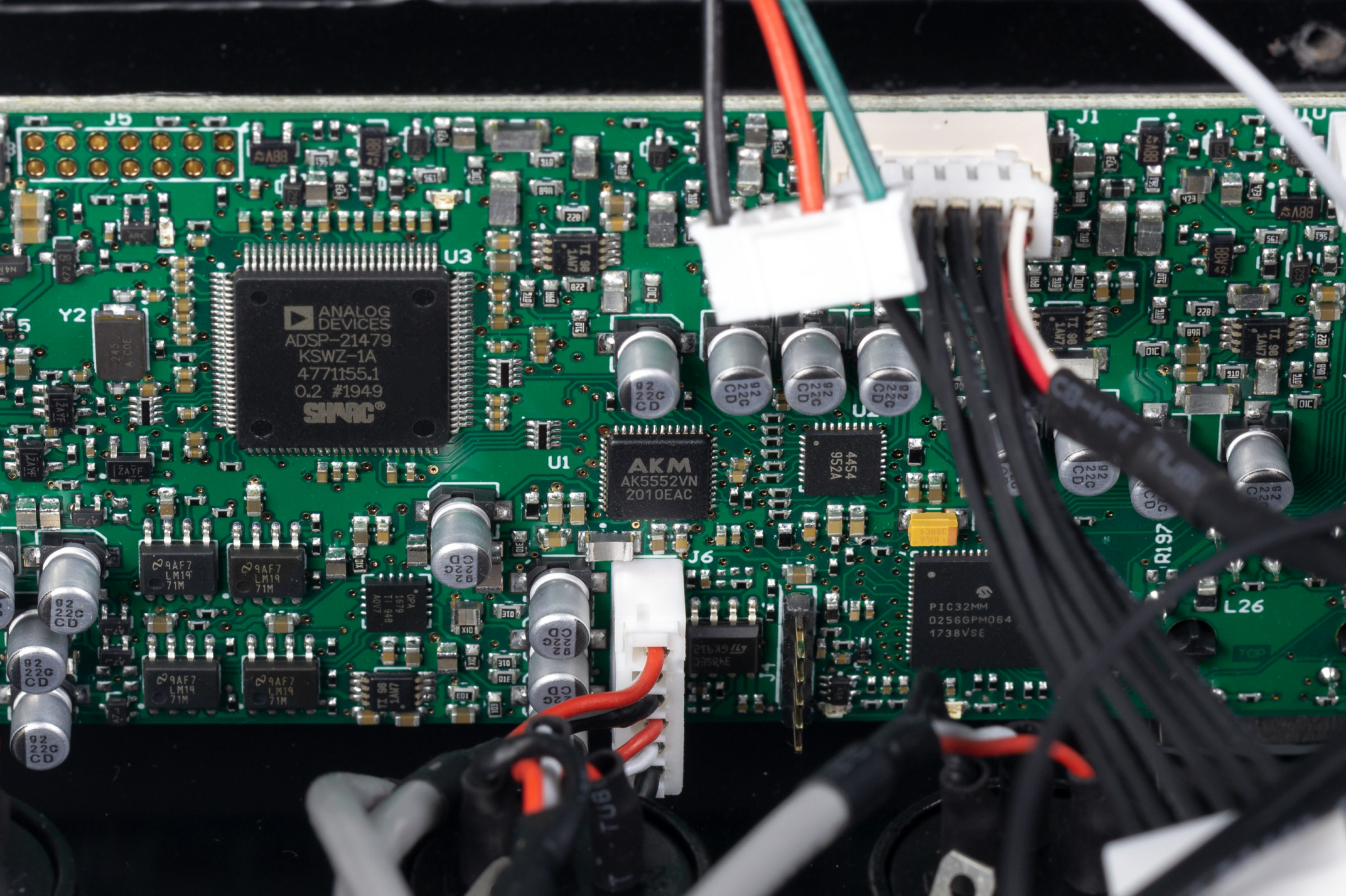
The DSP and converter board sits beside the amplifier. Analog Devices SHARC provides 32/40-bit processing. HEDD engineers designed and programmed all crossovers, filters, and processing. AK5552 ADC and AK4454 DAC chips offer strong performance. The analog-input ADC operates at 24-bit/96 kHz with 115 dB dynamic range. These are the best electronics we have seen in comparable ADC/DSP/DAC monitor designs.
There is no pure analog amplification mode. Analog input always passes through the ADC and DSP, and crossovers are exclusively digital. Direct amplifier input is unavailable. AES therefore avoids an extra analog-to-digital conversion and gives the best possible quality.
We tried balanced analog and AES digital inputs. Digital sounded better, although analog was also good. Consumer connection is less convenient because RCA inputs, including S/PDIF, are absent, but adapters can solve this. AES remains useful even with a consumer S/PDIF source: longer cables and balanced noise rejection help in studios full of equipment.
Lineariser is the BASS 08's main feature. Switching it on immediately changes the bass from blurred and resonant to coherent and controlled, making music more engaging. The subwoofer and monitors must also be matched in crossover frequency and relative delay. Correct adjustment makes the subwoofer impossible to locate by ear. Sound appears to come entirely from the monitors. This is the aim of a 2.1 system: compact satellites and subwoofer behaving like two large full-range speakers.
We particularly liked routing monitors through the subwoofer. The 5–7-inch satellites need not be HEDD models because phase departure in the midrange and treble is relatively small. We fed five-inch ADAM monitors from the analog outputs while the computer connected only to the subwoofer through AES. Results were excellent. Its crossover cleanly removes frequencies the satellites cannot reproduce, creating coherent sound without a gap.
Lineariser adds an unavoidable 30 ms delay because bass phase correction needs time. Disable it for real-time monitoring or playing live instruments through the speakers; latency then falls to 2.5 ms. We do not see this as a major problem. In 99% of cases, real-time monitoring concerns vocals and instruments mainly in the midrange, where Lineariser changes the sound least. Sound remains good without it.
DSP bass extension below 20 Hz is unusual, again trading amplifier headroom for coverage. We tried it and heard little difference because few recordings contain strong 20 Hz material. Such low frequencies also require a large room without resonant peaks or standing waves. Even our treated room with bass traps and panels was insufficient for accurate 20–30 Hz monitoring. Deep-bass enthusiasts need suitable space and specialized treatment, including wall and ceiling geometry that avoids parallel surfaces and frequency peaks and nulls.
We asked Klaus whether HEDD was developing room-response correction. He declined details but pointed to the star-marked third Lineariser position and said it remained a secret. Future announcements may reveal more.
Two port plugs and a threaded removal handle are included for sealed operation. In general, sealed cabinets can reproduce sound more precisely than bass reflex, but individual implementation matters. Either design can be good or bad and requires skilled engineering.
The BASS 08 ported implementation with Lineariser works excellently. Plugging the ports was not an unambiguous improvement in our treated room, where ported operation did not boom. Other rooms may differ. For studio work, one argument against sealed mode is that listeners usually use ported speakers: about 99.9% of consumer Hi-Fi and studio designs favor bass reflex for effective full-range output. Sealed operation also produces roughly 10 times more bass distortion because the driver works against the cabinet air volume rather than moving as freely. Yet sealed mode gives tighter bass that can suit some situations. Choose Closed or Ported by listening. HEDD provides a choice instead of imposing one solution.
AES is preferable to analog, but suitable sources are less common. We had 2 Lynx Studio devices with AES outputs. An inexpensive Neutrik S/PDIF-to-AES impedance-matching transformer is another option. We regret the loss of HEDD's modular input-card system. Dante users must now find a separate Dante-to-AES device, as must users of other interfaces.
Frequency-response measurements
We requested HEDD's own anechoic graphs because our room added peaks and dips around 30 Hz that varied with measurement position.

The first graph shows open ports and the standard 80 Hz crossover. Response is ideally flat.
The extended-range graph was especially interesting. It adds the lowest frequencies to the BASS 08.
The sealed response removes port reinforcement. Its roll-off is smoother as expected, and Extended mode gives exceptionally wide coverage.
Conclusions
The HEDD BASS 08 is a long-awaited studio subwoofer from Klaus Heinz and his team, combining years of development. While some established brands repeat old models, HEDD continues offering useful innovations at accessible prices. Buyers may compare Type 05/07 plus BASS 08/12 with three-way Type 20/30 monitors. We think the three-ways offer better upper bass, while the subwoofer system reaches lower, occupies less space, and costs less. Hear the range yourself, for example at the Dr.Head demonstration studio on Novy Arbat in Moscow.
Note. This is an adapted machine translation into English. It follows the “In simple terms” approach. Read the original article at https://prosound.ixbt.com/monitors/hedd-bass-08.shtml.