
Simple Way Audio Vacuum: hybrid tube studio preamp
Maxim Liadov
Our readers already know Simple Way Audio equipment. The brand is familiar to many guitarists and live sound engineers through its excellent stage and studio DI boxes. Its latest Russian-made mini DI range is selling so well that production can barely keep up. Read more in our reviews: Simple Way Audio J1 – JFET DI box with a field-effect transistor input and Simple Way D1: high-quality active DI box.
The Vacuum tube studio preamp, designed by Simple Way Audio engineers, brings the brand to a wider audience: musicians and sound engineers working in studios. We received the stereo version for testing. An 8-channel version can also be made to order.
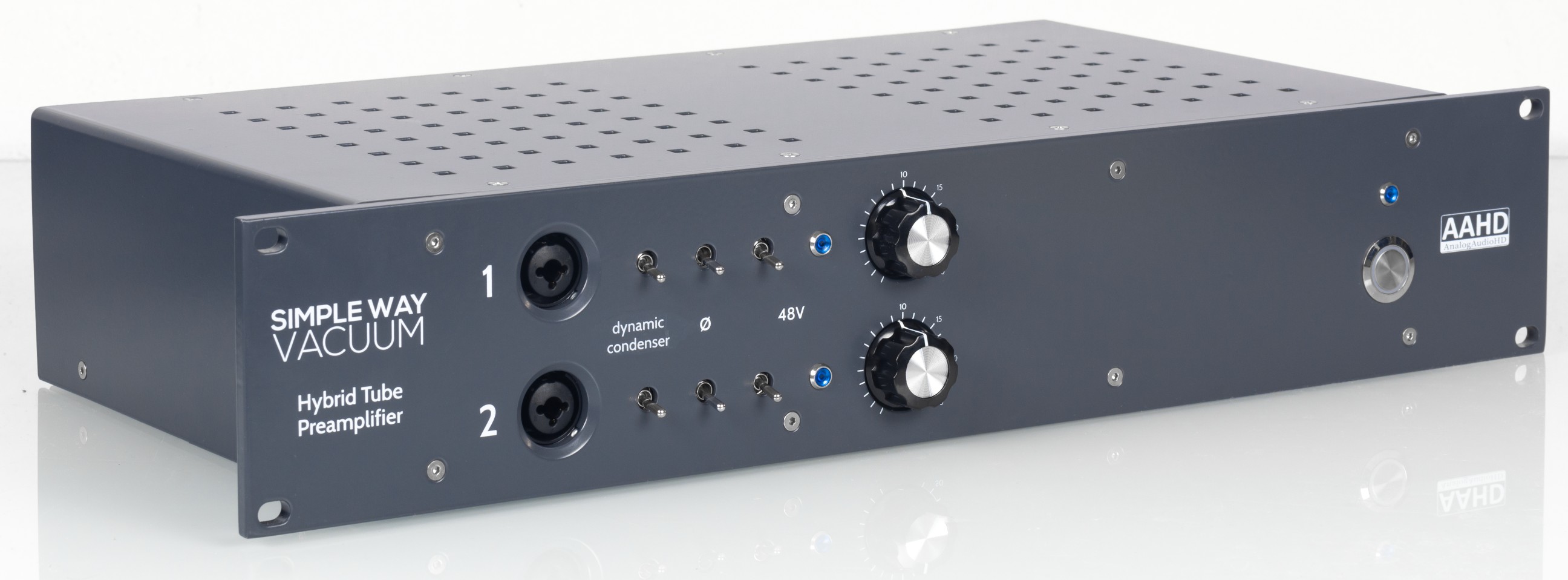
An important feature of the Simple Way Audio Vacuum is its unusual hybrid circuit, combining the strengths of tubes and transistors. An all-tube signal path would need many transformers for power supplies and coupling between stages. It would also need many high-power passive components, which do not always help the sound. The hybrid design keeps tubes in the input stage, which matters most for sound. Transistors handle other necessary but more practical functions, such as the output buffer. This makes the circuit simpler, more direct and highly linear. It keeps the best tube properties while avoiding output-matching problems with modern studio equipment: mixing consoles, hardware processors, recording interfaces and broadcast chains. Simple Way Audio proudly says that its tube preamp has lower noise and distortion than many transistor models. This is a strong claim. We wanted to connect our Neumann microphone and test it in practice.


SPECIFICATIONS:
- Input stage: tube, 12AX7 dual triode
- Output stage: transistor
- Circuit: fully balanced
- Switches: +48 V phantom power, condenser/dynamic, polarity inversion
- Gain: up to 60 dB
- Input impedance: 200 kohms
- Frequency response: 5 Hz–120 kHz at 50 dB gain
- Maximum output level: +35 dBu (1 kohm load)
- THD: <0.002% at 1 kHz
- THD+N: <0.004% at 1 kHz
- Dynamic range: 120 dB typical
- Output impedance: ≥30 ohms
- Power consumption: 57.6 W
- Power supply: 220 V, 50 Hz.
The wide bandwidth and large dynamic range are important specifications. They help preserve the dynamics of recorded instruments and vocals. A fully balanced circuit means that the signal stays balanced from input to output. It is never converted to an ordinary unbalanced signal. This better preserves the original and avoids unwanted effects.

Some background for readers unfamiliar with electronics history: RCA engineers in the USA developed the 12AX7 in 1946. During the golden age of tube equipment, it appeared in a huge number of preamps, amplifiers and guitar devices. 12AX7 is the American designation; the European equivalent is ECC83. The European version came much later and improved the construction and specifications. The basic design remained a dual triode. Its useful specifications and good linearity made it popular with audio designers, who still use it today. What about availability? Many versions of the original 12AX7/ECC83 are now made in Eastern Europe, Russia and China under around a dozen brands. Modern production standards make them suitable for audio. Audiophiles and musicians keep demand strong. Public figures suggest that at least 1 million 12AX7 tubes alone are sold each year. Chinese tubes are quite good but are considered the shortest-lived; they are also the cheapest. Russian-made tubes are closest in construction to the American 12AX7 original. The brands with Russian names are now also American-owned, and Russian factories make these tubes to US orders. Prices are reasonable and sound quality is very good. European ECC83 tubes are considered the highest-quality and most expensive. An original Telefunken can cost tens of thousands of rubles. Europe also made improved 12AX7 variants with lower noise and gain. There is no single right or wrong choice when looking for better sound. The most reliable approach is to try several types and choose the one that suits you. A particular tube's sound may appeal to you. For many people, finding that sound is an enjoyable creative process in itself.

The tubes sit inside shields. Their own glow is barely visible. The blue LEDs in the photo are not decorative tube lighting. They form a cathode current source with a large negative voltage. This lets the input accept +18 dBu without overload, which also makes the preamp useful for mastering.
The Simple Way Audio Vacuum accepts 12AX7 tubes and ECC83/82/81 types. The circuit automatically sets tube operating conditions, compensates for gain differences and maintains 0 volts at the output. This removes the need for output capacitors. In effect, the signal path has only one capacitor, at the input, to block DC.

The transistor output stage is on the underside of the preamp board. The circuit is well designed and fully balanced from input to output. The photo shows only 1 channel; the second is identical.

A separate cover contains the linear transformer power supply and large smoothing capacitors. The preamp is built to industrial standards. Component selection raises no concerns and matches leading international manufacturers.
For anyone who finds the case too plain, the manufacturer offers custom airbrushed finishes in different styles.
The manufacturer's website publishes measurements showing THD below 0.001% at 50 dB gain.

We wanted to check this ourselves. We used the Russian-designed Lisk Audio MUX interface with balanced inputs set to 8 V RMS sensitivity. We fed a low-level signal chosen to reproduce approximately the same test conditions.


Our measurements confirm the manufacturer's results. With the tube in our sample, we measured THD = 0.0008%. This is comfortably below the specified THD <0.002%. It also challenges the idea that tubes must produce many strong even-order harmonics. With skilled electronic design, a tube can be extremely linear. It also provides an impressive dynamic range. Our measured RMS noise was below -96 dB. Frequency response was flat to 100 kHz, as promised. These results put the device at a very high level. Many transistor preamps cannot match these specifications.
The gain control also surprised us. Although the knobs look like ordinary potentiometers, the circuit uses a custom discrete design with high-precision resistors. It gives convenient adjustment in decibels and several benefits for sound. This approach is rare and usually found only in expensive top-level equipment. The gain markings in dB are accurate, so you can rely on them.
How does the preamp work in a real studio? We compared the Simple Way Audio Vacuum with a high-quality discrete transistor preamp from Lisk Audio. Recording used the balanced ADC inputs of the Lisk Audio MUX interface: measured dynamic range >123 dBA and measured THD <0.00010%. The microphone was a Neumann TLM102 studio condenser.

The Simple Way Audio Vacuum worked very well with modern condenser microphones. There was much more gain than needed for voice. Even at high gain settings, the preamp stayed linear, with no tube overdrive or audible coloration. The output was already at a strong professional level of +20 dBu. We even had to select the ADC's lowest sensitivity using its relay switching.

Listening to the recording on ADAM active monitors left us very pleased. Such a clean, high-quality result was unexpected. When judging the Simple Way Audio Vacuum, set aside ideas about tube overdrive or automatic tube warmth. Its sound is very clean, with accurate tone and no loss of dynamics. There is no boomy bass or added warmth. None is needed: the sound is full and pleasant, with even small performance details clearly audible. The clever hybrid circuit probably deserves credit. It uses tubes where they help and leaves them out elsewhere. The result is an unusual device that could lead its category.

The manufacturer calls the sound Analog Audio HD, referring to high detail and wide bandwidth. We agree with that description. What do professional musicians and artists say? According to the manufacturer, several recording studios already use the preamp, and the results can be heard on commercial albums by major artists. This is strong evidence of its value in professional work.
Conclusions
Our Vacuum tests show that the Simple Way Audio preamp can be recommended for any studio, including top-quality microphones and demanding recording sessions. Recorded tracks are very clean, with wide dynamic and frequency ranges. They are ready for further hardware or software processing. This is not a mass-market product aimed mainly at beginners. It is better suited to musicians and sound engineers who understand the equipment. Connect it to high-quality recording equipment to get the best result. The preamp is produced in small batches or to order. To listen to or buy it, contact the manufacturer directly. You can also ask the developers for technical details. They are based in Russia, which makes support and servicing straightforward for local users. We wish the team success and more new engineering ideas.
The preamp was Vacuum provided
for testing by Pyotr Glushkov.
Official website Simple Way Audio
Note. This is an adapted machine translation into English. It follows the “In simple terms” approach. Read the original article at https://prosound.ixbt.com/interfaces/simpleway-vacuum.shtml.