
M-Audio M-Game RGB Dual review and test – interface/mixer with two USB ports and lighting
Maxim Liadov
Readers know M-Audio's new interface range from our M-Game Solo review. We found a carefully developed product suited to modern content creation, especially streaming. The larger RGB Dual is similar in many ways. Its name points to two USB connections.
The official video shows fully adjustable multicolour lighting. It can stay steady, pulse or display signal levels as a meter, looking attractive on camera. RGB Dual has more buttons and functions than Solo, but the same case, large volume knob and quick channel faders. Our main criticism is the glossy top, which shows fingerprints, though a cloth removes them easily.

Sample buttons increase from 3 to 5, with many entertaining jingles included. Two Voice FX buttons replace one for quick preset changes. FX Param changes the large central knob's function. As noted before, the $%^#* button for bleeping unwanted language is a particularly useful feature.
M-Game RGB Dual specifications
| Headphone output | |
| Power | 42 mW RMS into 32 ohms |
| Dynamic range | 113 dBA |
| Frequency response | 20 Hz–20 kHz (+0.1/-0.2 dB) |
| THD+N | 0.005% at 10 mW |
| Maximum level | +6.0 dBu, unloaded |
| Output impedance | 10 ohms |
| Balanced XLR microphone input | |
| Frequency response | 20 Hz–20 kHz (+0.4/-1.8 dB) |
| Signal-to-noise ratio | 109 dBA (+4 dBu) |
| Dynamic range | 110 dBA |
| THD+N | 0.0015% (+4 dBu) |
| Maximum level | +5 dBu |
| Sensitivity | -54 dBu |
| EIN | -130 dBu |
| Gain | 59 dB, plus 24 dB digital gain |
| 1/8-inch TRS microphone input | |
| Frequency response | 20 Hz–20 kHz (+0.4/-1.9 dB) |
| Signal-to-noise ratio | 105 dBA (+4 dBu) |
| Dynamic range | 109 dBA |
| THD+N | 0.0033% (+4 dBu) |
| Maximum level | +5 dBu |
| Sensitivity | -54 dBu |
| EIN | -127 dBu |
| Gain | 59 dB, plus 24 dB digital gain |
All RGB Dual specifications match Solo. They are good figures, exceeding budget interfaces at a similar price.

GAME USB is the new connection. STREAMING USB remains the main broadcast connection, while the second can connect a gaming computer. Running a game and OBS on one PC requires switching focus to change broadcast settings, inconvenient or sometimes impossible during a stream. Two USB connections solve this without a complex arrangement of standard devices.
M-Game supports professional XLR dynamic and condenser microphones, plus computer microphones on mini-jack. The Windows and Mac OS X panel enables +48 V for condensers. Hardware gain is at the rear for a reason: set it once for the microphone, then use the top fader for live volume changes without overloading the channel even at 100%. This follows professional equipment practice.
Other sockets are familiar colour-coded mini-jacks: pink MIC IN, black HP OUT, green MAIN OUT and blue AUX IN. Toslink accepts game-console audio. INPUT SWITCH is a TRS connection for a single or dual footswitch to trigger effects or samples.
The printer-style USB Type-B choice seems unusual beside USB-C. It may discourage connecting high-voltage phone chargers. A specific 6 V/2 A mains adapter is included. A separate POWER button is welcome, avoiding repeated unplugging.
Drivers are not publicly downloadable. An InMusic account and product serial registration are required. We disliked this restriction, but registration went smoothly and the download was quick.
The interface is English-only but friendly and easy to understand. A manual and many tutorials are available. HiDPI support scales graphics cleanly for 4K and higher-resolution displays.
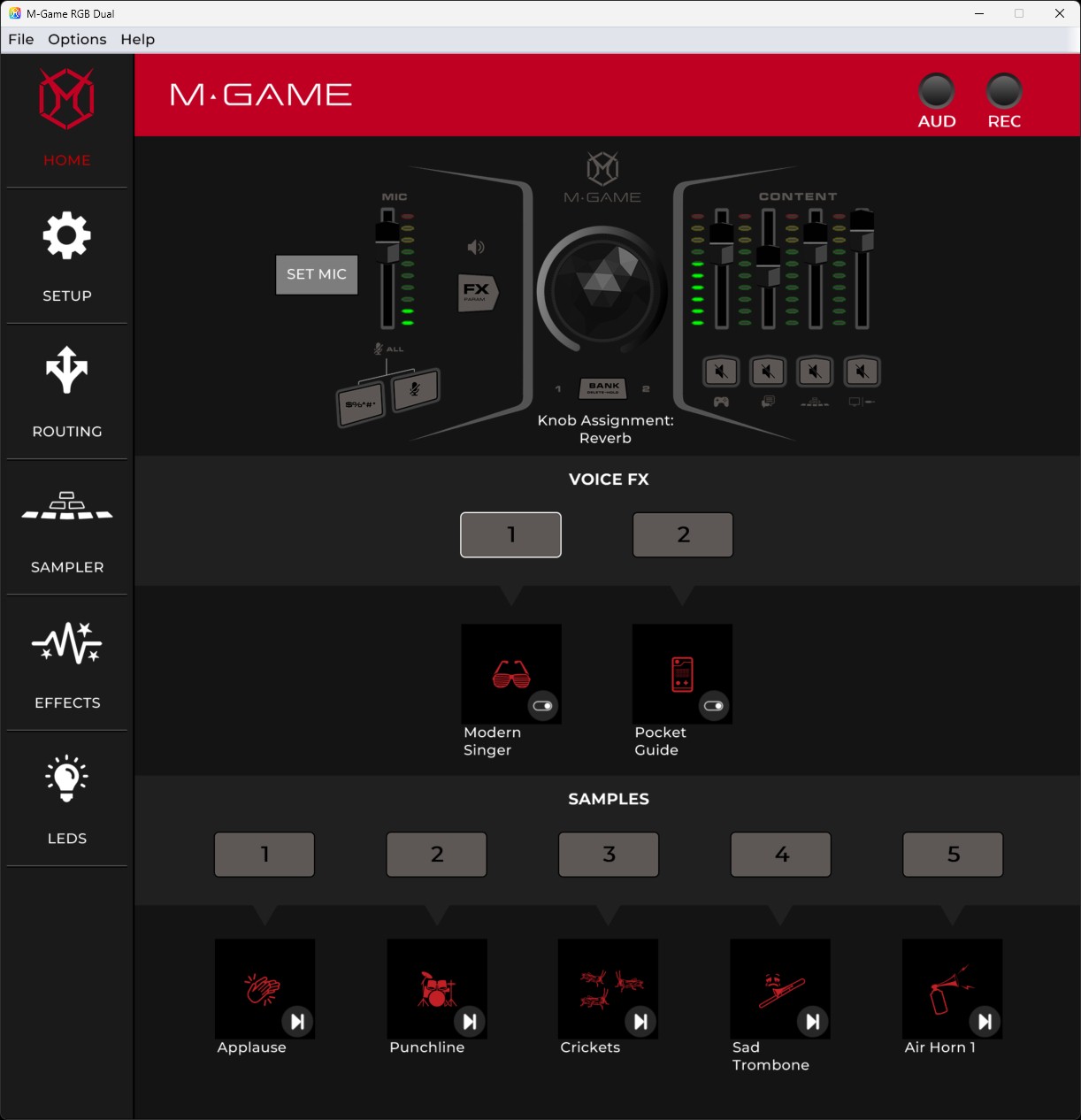
HOME shows the device and current button assignments.
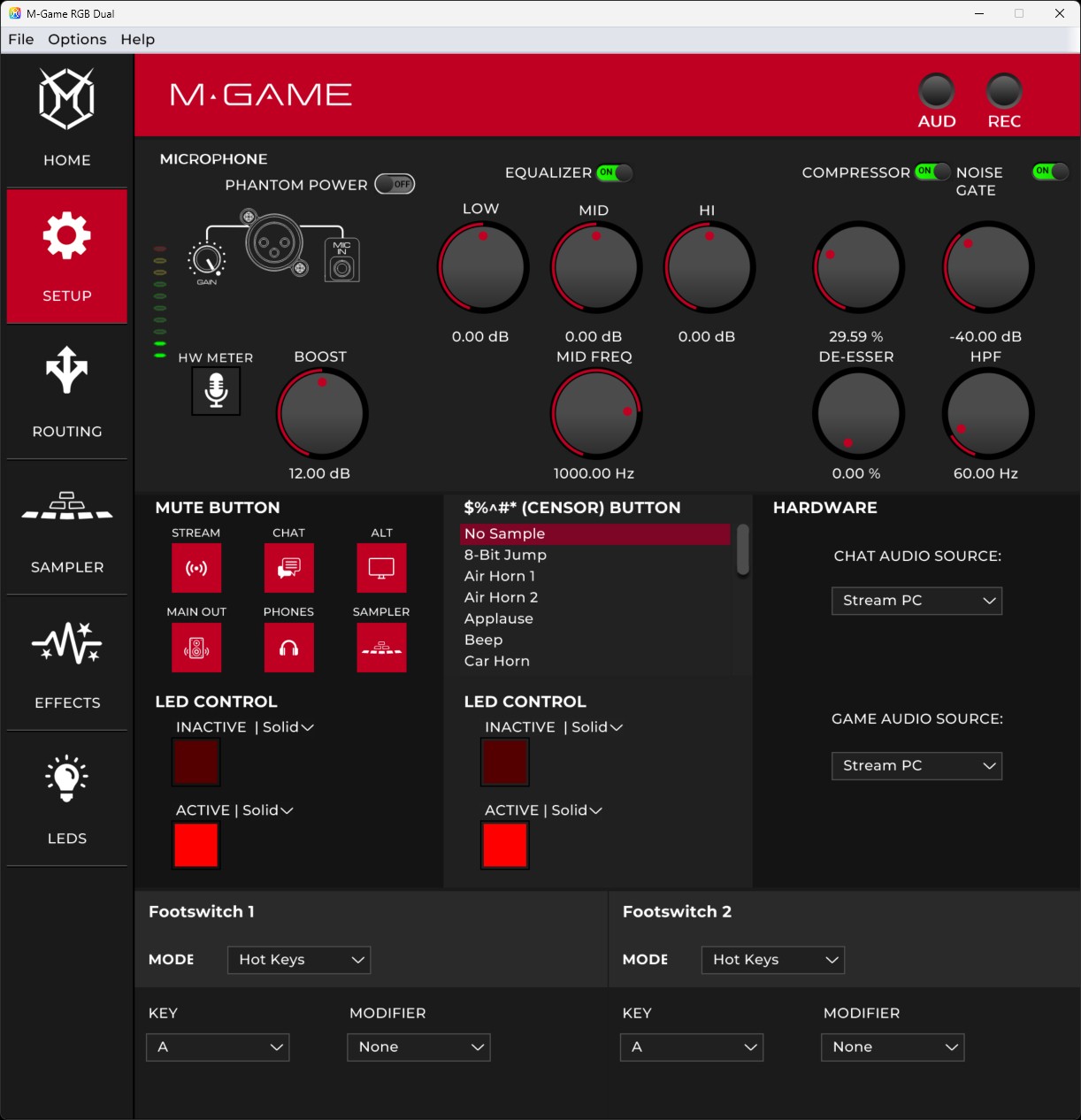
SETUP provides useful voice-streaming hardware processing: de-esser, compressor, gate and EQ. A digital boost adds +24 dB to normal hardware gain.

ROUTING is a matrix selecting which signals reach the stream and software or hardware outputs. Calls can be answered privately before being sent live.
These functions match professional equipment but use a friendly interface. Right-clicking opens channel levels for each submix, hidden by default.
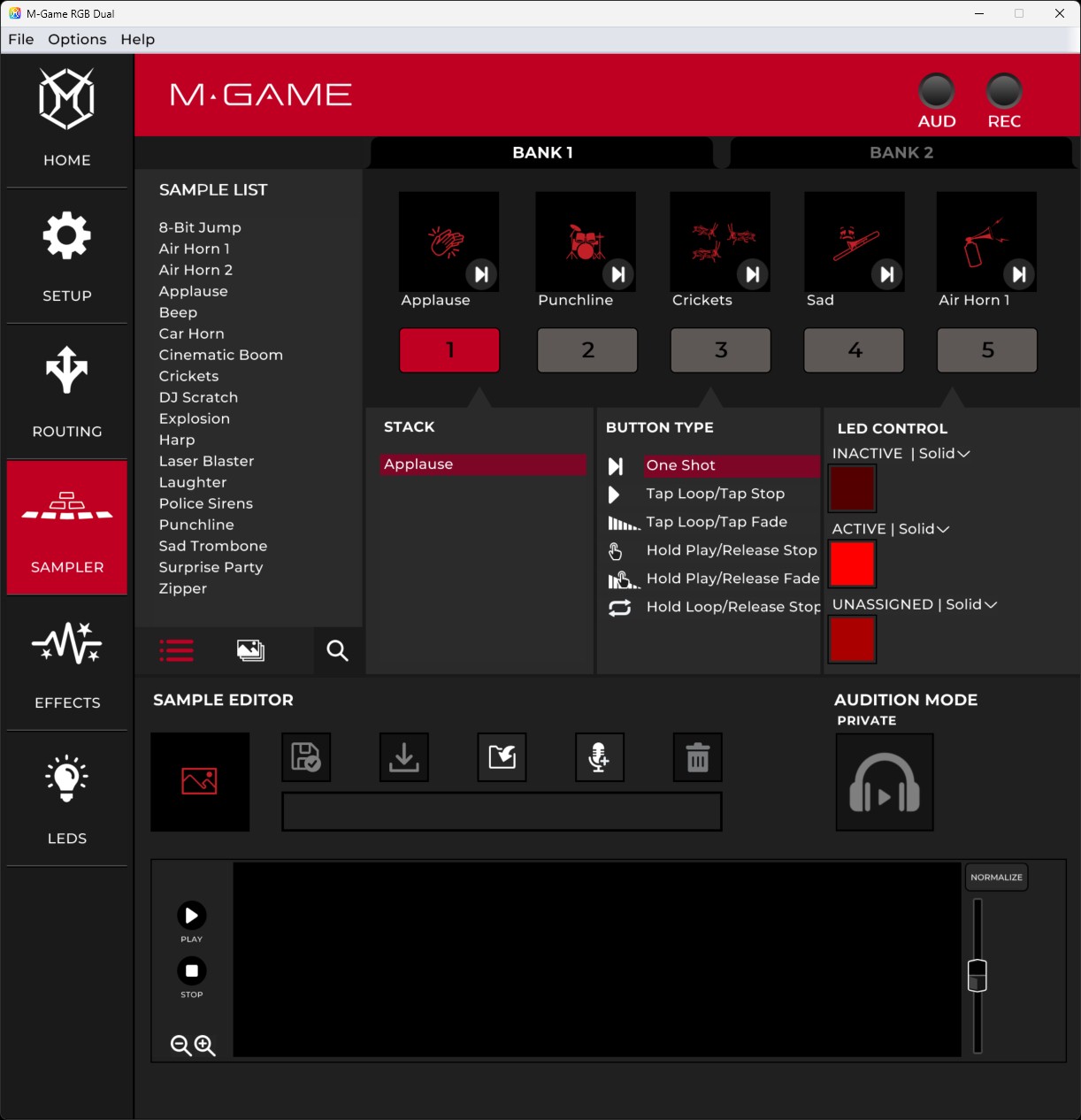
SAMPLER previews sounds and assigns them to buttons for use during broadcasts. Defaults include applause, a short transition, nature sounds, trombone and horn.

The effects tab adds VOCAL PROCESSOR, absent from Solo. It offers vocal Auto-Tune and creative voice changes. The other three remain DISTORTION, CHORUS and REVERB & ECHO.

LEDS changes the level-column appearance. The default gradient can be replaced with pulsing modes or professional-style level metering.

Firmware updates are also released regularly.
Both interfaces share hardware and even the circuit board. The main difference is an extra DSP. Despite an appearance some may dismiss as playful, RGB Dual has interesting original electronics.

The DREAM France processor was designed for audio. It has four-core 24-bit DSP, 56-bit multiply-accumulate operations, double-precision processing, vector instructions and built-in biquad filters, supporting complex effects.

Two TI PCM5102A DACs provide independent speaker and headphone outputs. Each supports 32-bit/384 kHz, 112 dB dynamic range and -93 dB THD+N.

TI PCM1840 ADCs support up to 32-bit/192 kHz and 4 mic/line channels, with 113 dB dynamic range and -98 dB THD+N.


The ON Semiconductor NCP2811 headphone amplifier delivers up to 60 mW per channel into 32 ohms. NOCAP avoids signal-path electrolytic capacitors, and startup/shutdown is click-free.


Latency is low at 5.9 ms with a 64-sample buffer. Output-only latency is lower still.

Features:
Input channels: 8
Output channels: 8
Input latency: 587
Output latency: 587
Min buffer size: 16
Max buffer size: 2048
Preferred buffer size: 512
Granularity: 16
ASIOOutputReady - supported
Sample rate:
8000 Hz - not supported
11025 Hz - not supported
16000 Hz - not supported
22050 Hz - not supported
32000 Hz - not supported
44100 Hz - not supported
48000 Hz - supported
88200 Hz - not supported
96000 Hz - not supported
176400 Hz - not supported
192000 Hz - not supported
352800 Hz - not supported
384000 Hz - not supported
Input channels:
channel: 0 (STREAM IN L) - Int32LSB
channel: 1 (STREAM IN R) - Int32LSB
channel: 2 (CHAT IN L) - Int32LSB
channel: 3 (CHAT IN R) - Int32LSB
channel: 4 (ALT IN L) - Int32LSB
channel: 5 (ALT IN R) - Int32LSB
channel: 6 (SAMPLER IN L) - Int32LSB
channel: 7 (SAMPLER IN R) - Int32LSB
Output channels:
channel: 0 (GAME OUT L) - Int32LSB
channel: 1 (GAME OUT R) - Int32LSB
channel: 2 (CHAT OUT L) - Int32LSB
channel: 3 (CHAT OUT R) - Int32LSB
channel: 4 (SAMPLER OUT L) - Int32LSB
channel: 5 (SAMPLER OUT R) - Int32LSB
channel: 6 (SYSTEM OUT L) - Int32LSB
channel: 7 (SYSTEM OUT R) - Int32LSB
The driver supports only 48 kHz, probably because DSP operates at one fixed rate.
Features:
Input channels: 2
Output channels: 4
Input latency: 687
Output latency: 587
Min buffer size: 16
Max buffer size: 2048
Preferred buffer size: 512
Granularity: 16
ASIOOutputReady - supported
Sample rate:
8000 Hz - not supported
11025 Hz - not supported
16000 Hz - not supported
22050 Hz - not supported
32000 Hz - not supported
44100 Hz - not supported
48000 Hz - supported
88200 Hz - not supported
96000 Hz - not supported
176400 Hz - not supported
192000 Hz - not supported
352800 Hz - not supported
384000 Hz - not supported
Input channels:
channel: 0 (CHAT IN L) - Int32LSB
channel: 1 (CHAT IN R) - Int32LSB
Output channels:
channel: 0 (GAME OUT L) - Int32LSB
channel: 1 (GAME OUT R) - Int32LSB
channel: 2 (CHAT OUT L) - Int32LSB
channel: 3 (CHAT OUT R) - Int32LSB
Connecting GAME USB activates a second device with a different channel count.
RMAA testing
Identical electronics and circuit boards allow us to use the same measurements for both models.
| Device under test | [ASIO] M-Game |
| Operating mode | 24-bit, 44 kHz |
| Audio interface | ASIO |
| Signal path | line-out |
| RMAA version | 6.4.5 PRO |
| 20 Hz–20 kHz filter | ON |
| Signal normalization | ON |
| Level change | -3.3 dB / -3.2 dB |
| MONO mode | OFF |
| Calibration signal frequency, Hz | 1000 |
| Polarity | inverted/inverted |
| Frequency response variation (40 Hz–15 kHz), dB | +0.09, -0.05 |
Excellent |
| Noise level, dB(A) | -112.3 |
Excellent |
| Dynamic range, dB(A) | 105.0 |
Excellent |
| Harmonic distortion, % | 0.00222 |
Excellent |
| Harmonic distortion + noise, dB(A) | -89.7 |
Good |
| Intermodulation distortion + noise, % | 0.00282 |
Excellent |
| Stereo crosstalk, dB | -91.3 |
Excellent |
| Intermodulation at 10 kHz, % | 0.041 |
Good |
| Overall rating | Excellent |
Detailed 24-bit/44 kHz input measurements in the RMAA report
Measurements confirm the good published specifications.
We tested the microphone input with a professional Neumann TLM 102 condenser. Hardware gain was sufficient without digital boost, and recording quality was good.

Hardware processing goes directly into the broadcast. Dual's main effects addition is VOCAL PROCESSOR, with vocal Auto-Tune and a harmonizer adding synthetic voices to form chords. Other modes alter vocal character. Headphone output is loud enough for mainstream models; 2/3 volume left useful headroom. The panel takes some learning, but the driver worked reliably without problems.
Conclusions
RGB Dual adds features at the top of the range, chiefly programmable RGB lighting and a second USB connection for serious bloggers and streamers. Electronics are better than its playful appearance suggests. Independent channels separate line and headphone outputs, and hardware processing is powerful. We liked the product. We hope future interfaces add full-sized audio sockets alongside mini-jacks.
Note. This is an adapted machine translation into English. It follows the “In simple terms” approach. Read the original article at https://prosound.ixbt.com/interfaces/m-audio-m-game-dual.shtml.