
M-Audio M-Track Duo – affordable two-channel audio interface with two preamps
Maxim Liadov
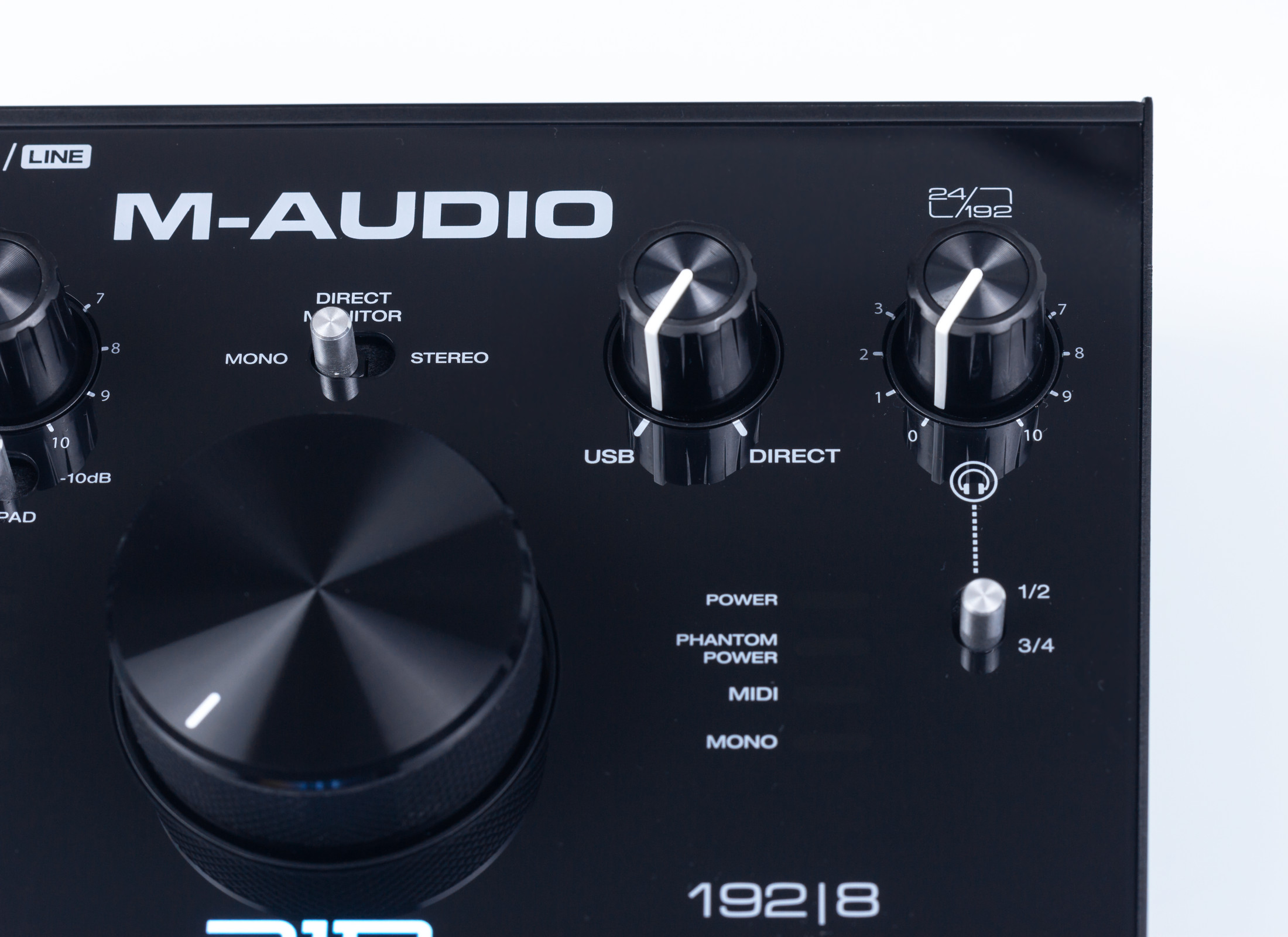
The M-Audio M-Track Solo and Duo arrived in 2021 for the price-sensitive $50–70 market. Solo has direct competitors at its price, but Duo sets a new affordability record. No competitor has yet offered two microphone/guitar inputs and balanced outputs for this amount. M-Audio also sells more advanced, expensive interfaces in the Air range, including M-Audio Air 192 | 4, M-Audio Air 192 | 6, M-Audio Air 192 | 8.
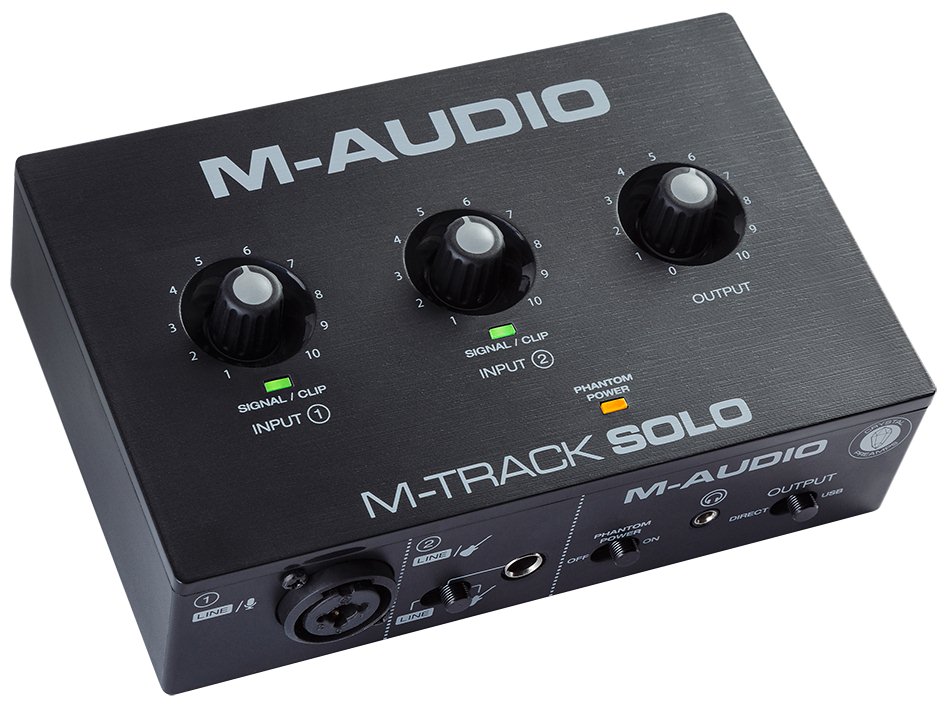
Here are the differences. Solo accepts one microphone, has unbalanced RCA line outputs and shares headphone and line volume. Duo adds two microphone inputs, balanced TRS outputs and separate headphone volume. Sound, electronics, driver and latency are identical. We find Duo more convenient even without needing two microphones. It has a full-size 6.3 mm headphone socket and independent volume, plus mono or stereo direct monitoring. Mono suits microphone and guitar; stereo suits recording stereo sources.
Both models have the essential professional functions: 54 dB gain adjustment, +48 V phantom power for condenser microphones, hardware monitoring and microphone/line and guitar/line input switching. Both use USB bus power.

Solo and Duo are compact and attractively designed. The top has a brushed-metal-style matte texture, light-grey lettering and recessed square LEDs. Appearance compares well with many competitors.
M-Audio M-Track Duo specifications
- Microphone input, balanced XLR:
- THD+N: 0.003%;
- EIN: -128 dBu, maximum gain, A-weighted;
- Gain range: 0 to +54 dB;
- Line inputs 1–2 (balanced TRS):
- THD+N: 0.002%;
- Gain range: -10 to +44 dB;
- Sensitivity: -43 dBu;
- Guitar inputs 1–2 (unbalanced TS):
- Impedance: 1 Mohm
- THD+N: 0.005%;
- Gain range: -10 to +44 dB;
- Main output, impedance-balanced TRS:
- THD+N: 0.002%;
- Maximum output level: +4 dBu;
- Headphone output
- THD+N: 0.02%
- Power: 60 mW into 32 ohms
- Dimensions: 164 × 55 × 114 mm;
- Weight: 0.30 kg.
The specifications also list 109 dB signal-to-noise ratio. This describes noise during silence rather than recording/playback dynamic range. We would also list the converters' 96 dB dynamic range. In this budget class, it does not prevent music creation.

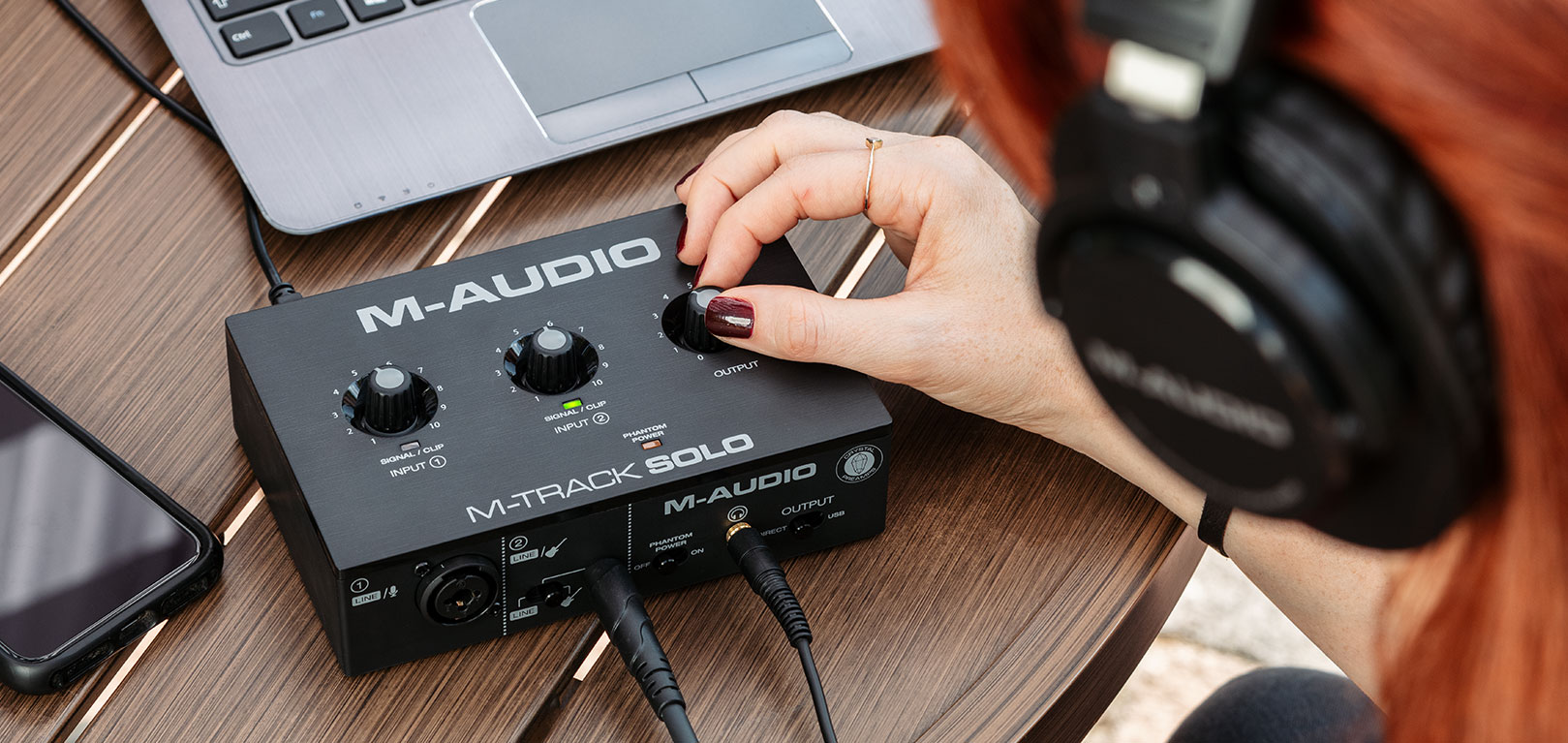
Unlike more expensive M-Audio models, there are no multi-segment meters, only signal and overload LEDs. Recessed knobs and a low 300 g weight suit portable use. Rubber feet hold it firmly for one-handed adjustment.

The +48 V microphone inputs accept two condensers, a microphone and guitar, or two guitars. A particularly useful feature is line-input mode, with line/guitar switches allowing signals to bypass preamp circuits. This is rare at such a low price.

Rear TRS outputs are specified as impedance-balanced. They connect budget studio monitors or powered computer speakers through TRS-to-RCA cables. USB Type-B carries USB 1.1 at 12 Mbit/s, so basic sound works without installing a driver. Installing the driver adds a control panel.
USB bus power is the only power source. A connection cable is included.

The PCM2900 combines a USB 1.1 controller and stereo codec. ADC specifications are 89 dB dynamic range and 0.01% THD+N; DAC figures are 96 dB and 0.005%.

JRC4580 op-amps serve line outputs, as in larger M-Audio interfaces.

Crystal preamps use transistor input stages followed by op-amp gain control.

A separate integrated headphone amplifier, most likely MAX9723, supplies 60 mW into 32 ohms. This is not a record but is a proper dedicated amplifier. Some budget interfaces provide 10 times less power using a general-purpose op-amp buffer.
All control uses hardware switches and knobs, so there is no separate device panel. Only a small standard M-Audio ASIO buffer panel is provided.

Latency is low: 8 ms with a 64-sample buffer. Output-only latency is lower.

Features:
Input channels: 2
Output channels: 2
Input latency: 175
Output latency: 174
Min buffer size: 16
Max buffer size: 2048
Preferred buffer size: 64
Granularity: 16
ASIOOutputReady - supported
Sample rate:
8000 Hz - not supported
11025 Hz - not supported
16000 Hz - not supported
22050 Hz - not supported
32000 Hz - not supported
44100 Hz - supported
48000 Hz - supported
88200 Hz - not supported
96000 Hz - not supported
176400 Hz - not supported
192000 Hz - not supported
352800 Hz - not supported
384000 Hz - not supported
Input channels:
channel: 0 (In 1) - Int32LSB
channel: 1 (In 2) - Int32LSB
Output channels:
channel: 0 (Out 1) - Int32LSB
channel: 1 (Out 2) - Int32LSB
Only 44 and 48 kHz are supported. This should not cause concern: higher sample rates do not automatically improve sound quality.
RMAA testing
| Device under test | [ASIO] M-Track Solo and Duo ASIO |
| Operating mode | 24-bit, 44 kHz |
| Audio interface | ASIO |
| Signal path | line-out |
| RMAA version | 6.4.5 PRO |
| 20 Hz–20 kHz filter | YES |
| Signal normalization | YES |
| Level change | 0.0 dB / -0.1 dB |
| MONO mode | NO |
| Calibration signal frequency, Hz | 1000 |
| Polarity | Correct/correct |
| Frequency response variation (40 Hz–15 kHz), dB | -0.05, -0.21 |
Very good |
| Noise level, dB(A) | -96.0 |
Excellent |
| Dynamic range, dB(A) | 96.8 |
Excellent |
| Harmonic distortion, % | 0.00392 |
Very good |
| Harmonic distortion + noise, dB(A) | -84.0 |
Good |
| Intermodulation distortion + noise, % | 0.00611 |
Excellent |
| Stereo crosstalk, dB | -93.6 |
Excellent |
| Intermodulation at 10 kHz, % | 0.00626 |
Excellent |
| Overall rating | Excellent |
See the RMAA report for details
Tests confirm the stereo codec specifications. The 96 dB limit follows from its lack of 24-bit operation. Other budget devices in 16-bit mode would give similar figures.

Results are as expected at this low price. For higher specifications, increase the budget and consider M-Audio Air 192 | 4, M-Audio Air 192 | 6, M-Audio Air 192 | 8.

We recorded a Neumann TLM102 through the microphone input. We again liked the Crystal preamp sound: natural tone without coloration. Headphone volume suits common 32-ohm headphones with sensitivity of 100 dB or higher.

The software bundle includes Pro Tools | First M-Audio Edition, MPC Beats, AIR Music Tech Xpand!2 multitimbral instrument, Eleven Lite guitar processing and 20 AVID effects plug-ins. Even beginners can start creating music immediately.






Conclusions
The M-Track Duo sets an affordability record for interfaces with two microphone inputs and balanced outputs. It offers attractive design, compact size, low-latency ASIO drivers, good preamps and a successful 60 mW headphone amplifier. A small premium over Solo adds a second microphone input and separate headphone volume. The main limit is support for only 16-bit/44 or 48 kHz. For higher formats, consider the M-Audio Air 192 | 4, M-Audio Air 192 | 6, M-Audio Air 192 | 8.
Note. This is an adapted machine translation into English. It follows the “In simple terms” approach. Read the original article at https://prosound.ixbt.com/interfaces/m-audio-duo.shtml.