
Arturia V Collection 11: the 2025 update to Arturia's virtual instrument collection
Grigory Liadov
The 2025 V Collection update adds six products. Four synthesizers are Jup-8000 V, Synthx V, Pure LoFi, and MiniBrute V. Two Augmented hybrid instruments, MALLETS and YANGTZE, join them. SEM V and the existing Augmented series have also been revised.
A lower-cost V Collection Intro edition is available from this year. It contains about a quarter of Arturia's instruments and provides an introduction to the collection.
V Collection 11 contains 45 complete products with distinctive sounds, detailed settings, and individual control options. Each runs as a VST, AU, or AAX plug-in, or standalone. At the time of this review, the full V Collection 11 PRO version costs 45990 rubles. The entry-level V Collection 11 INTRO edition costs 12990 rubles. Both are available from official dealers in Russia.
V Collection is built around software versions of classic keyboards. Jup-8000 V and Synthx V continue this tradition, modeling earlier hardware synthesizers. Other additions are original Arturia products. MiniBrute V recreates the company's modern analog MiniBrute. The creative Pure LoFi instrument is designed for characteristic lo-fi sounds. The two new Augmented instruments provide extensive morphing. As usual, we will focus on the six additions. Other V Collection instruments are covered in our earlier reviews.
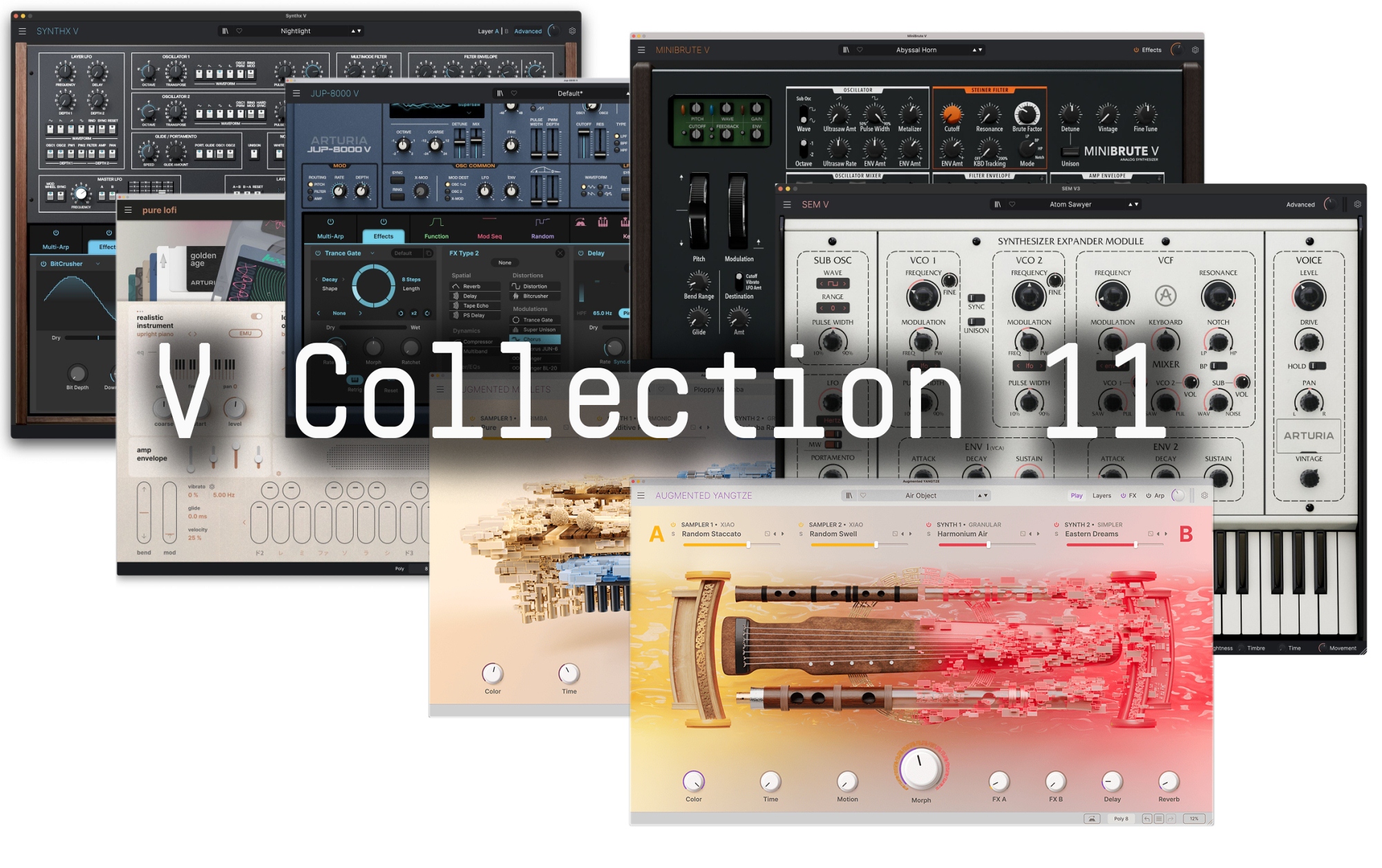
The original review emphasizes modeling, with little use of samples, as central to Arturia's virtual instruments. This provides expressive sound and unusual settings beyond conventional sample playback. Arturia aims to reproduce original circuits and mechanisms in detail, then adds presets, automation, modulation, and modern effects.
Jup-8000 V
Jup-8000 V models the classic Roland JP-8000 digital synthesizer, widely used in 2000s electronic music. Its bright Supersaw oscillator is a defining feature: seven sawtooth waves are slightly detuned above and below the main pitch rather than playing in exact unison. The JP-8000's distinctive sound helped define trance music.
Arturia does more than reproduce Roland's software algorithms: it aims to model the authentic instrument's sound. Jup-8000 V also adds advanced features for modern projects.
Two oscillators form the sound. Oscillator one provides the main character, with seven types: Supersaw, Triangle Modulation, Noise, Feedback Oscillator, Square, Sawtooth, and Triangle. A small display shows the waveform. Two pitch controls and two sliders adjust the main parameters, depending on waveform. Oscillator two offers square, triangle, and sawtooth, with two tuning controls and two fixed waveform controls. A balance knob sets their relative levels. Oscillator two can also modulate oscillator one, with interaction settings in OSC COMMON.
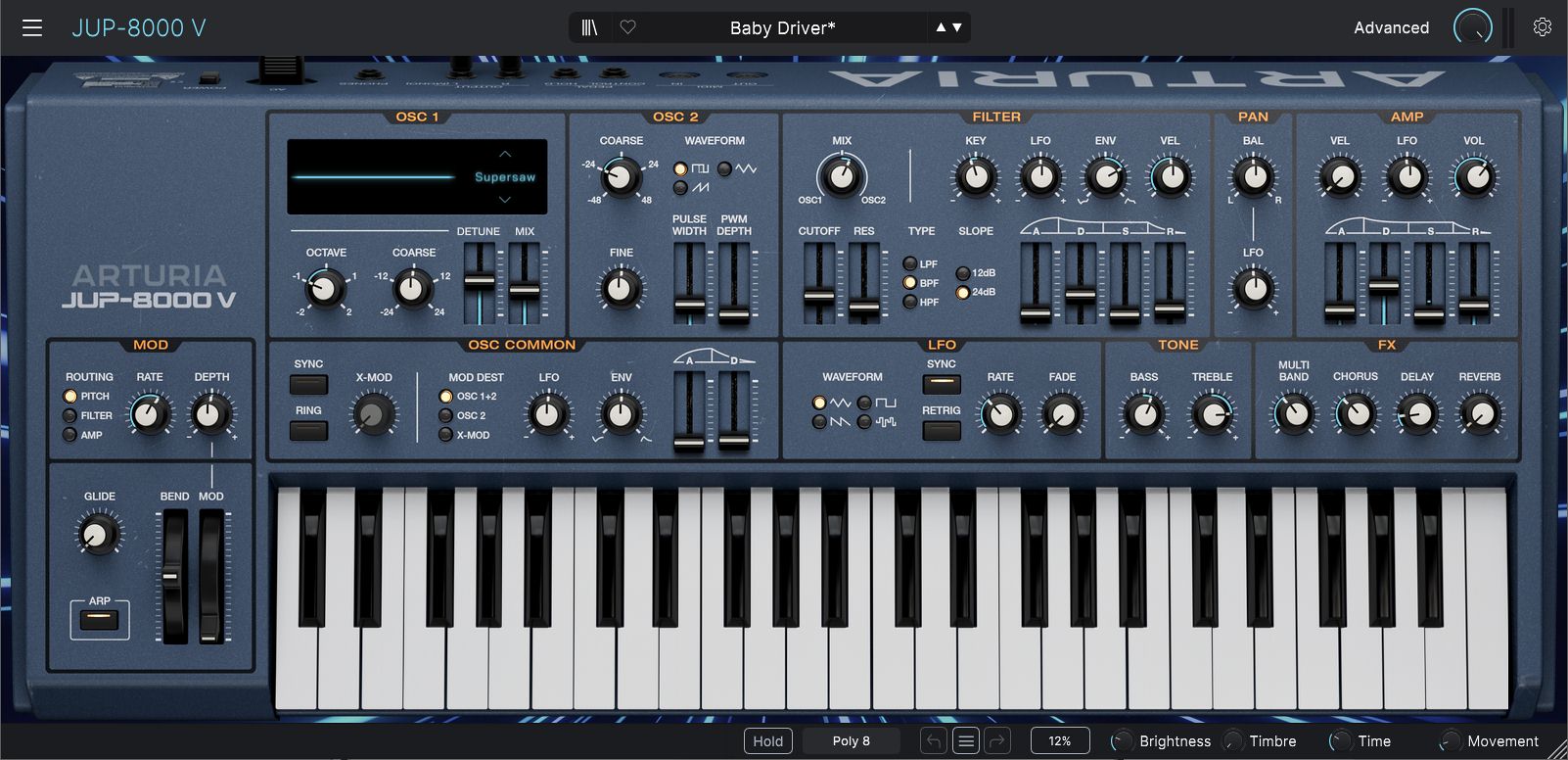
Arturia recreates the hardware filter rather than adding new functions. It has three modes and simple controls, alongside filter envelope and cutoff modulation settings. Amplitude uses ADSR. The LFO offers three waveforms or Sample & Hold.
Jup-8000 V runs up to four effects together. Main-page knobs adjust their amounts. Detailed settings are in Advanced view, alongside the sequencer/arpeggiator, extra modulation, MIDI keyboard configuration, and macro assignments.
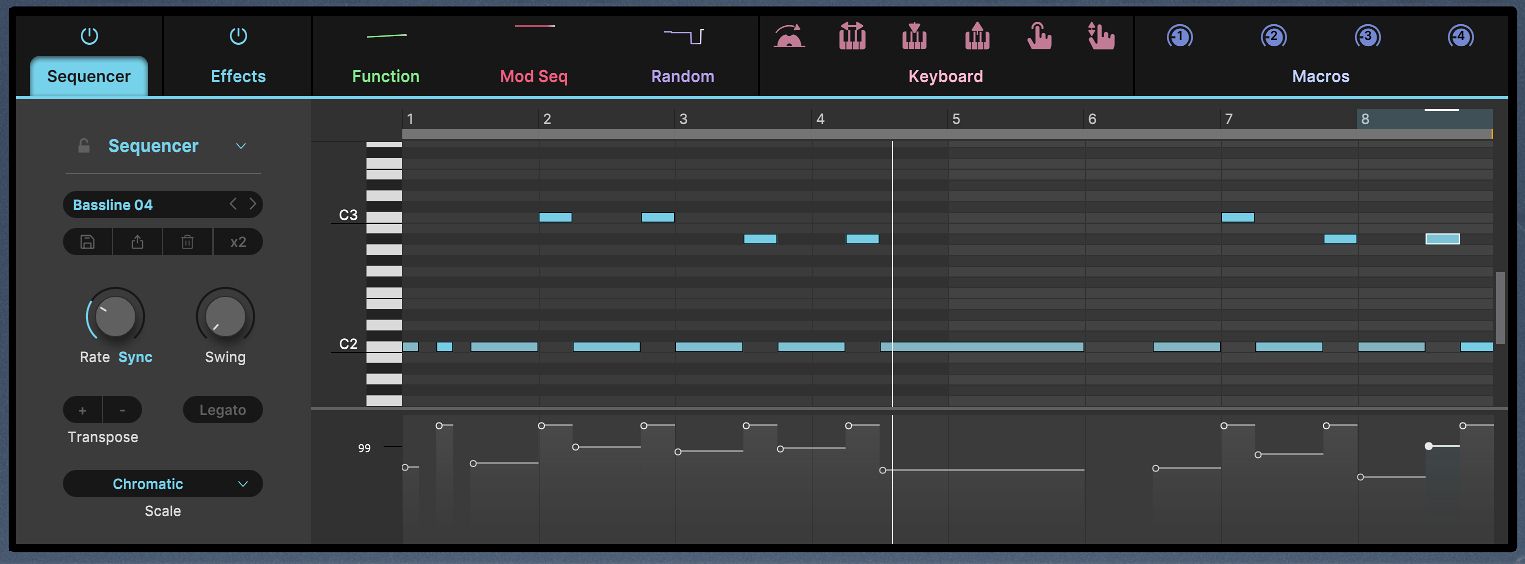
The polyphonic Jup-8000 V sequencer has a familiar piano roll for DAW-style editing. Maximum length is 64 beats. Supplied rhythms and patterns can be edited or transformed easily.
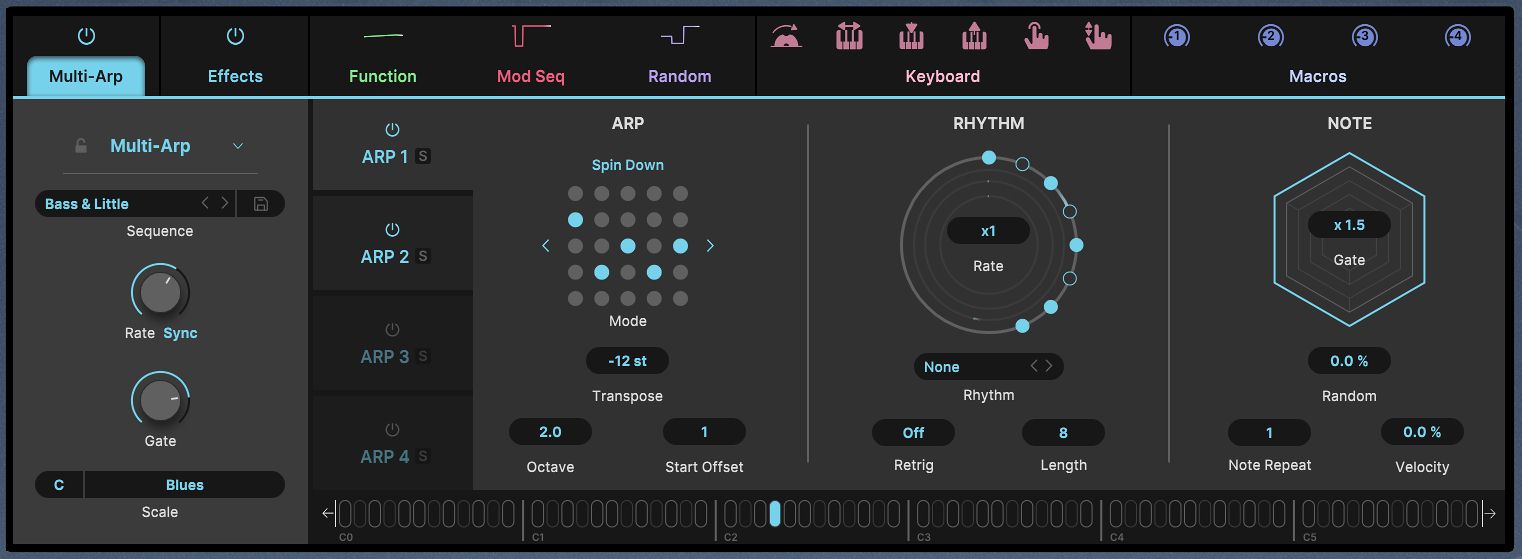
The arpeggiator is interesting too. Four arpeggios can run together with different patterns and lengths. Its unusual graphical view clearly shows all active parameters. As with the sequencer, ready-made patterns suit common synthesizer sounds.
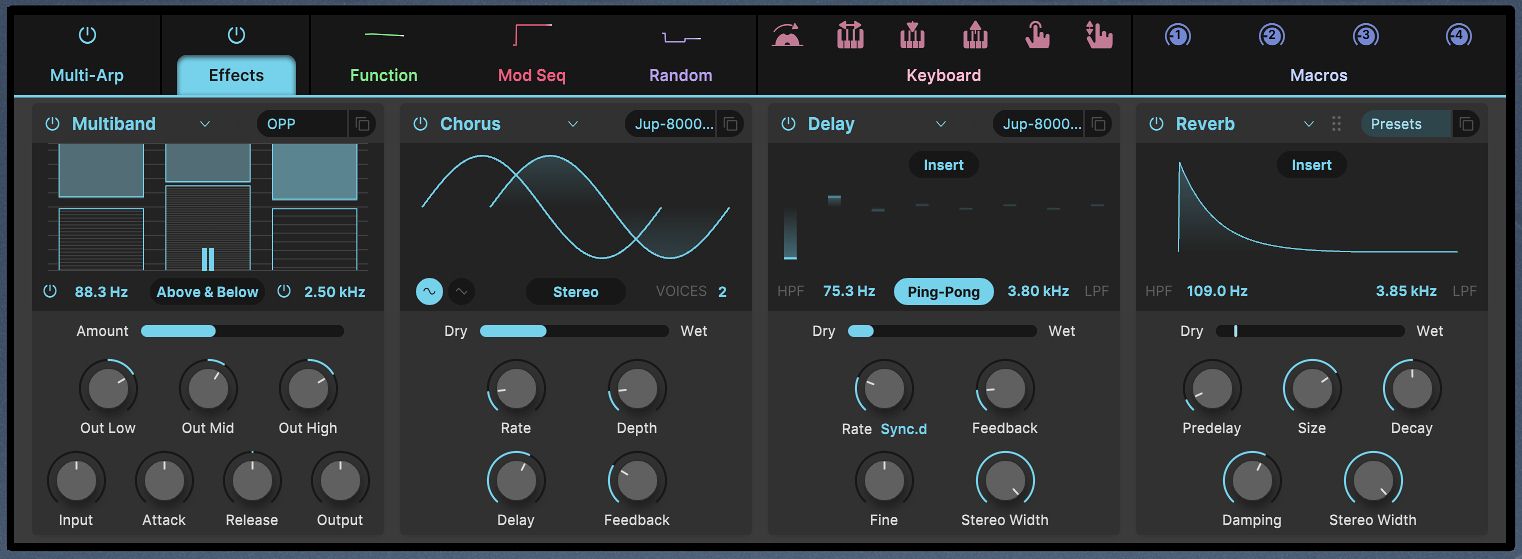
Four stereo effect slots run in series. 17 types cover frequency, dynamics, and spatial processing, with graphical controls and extra settings.
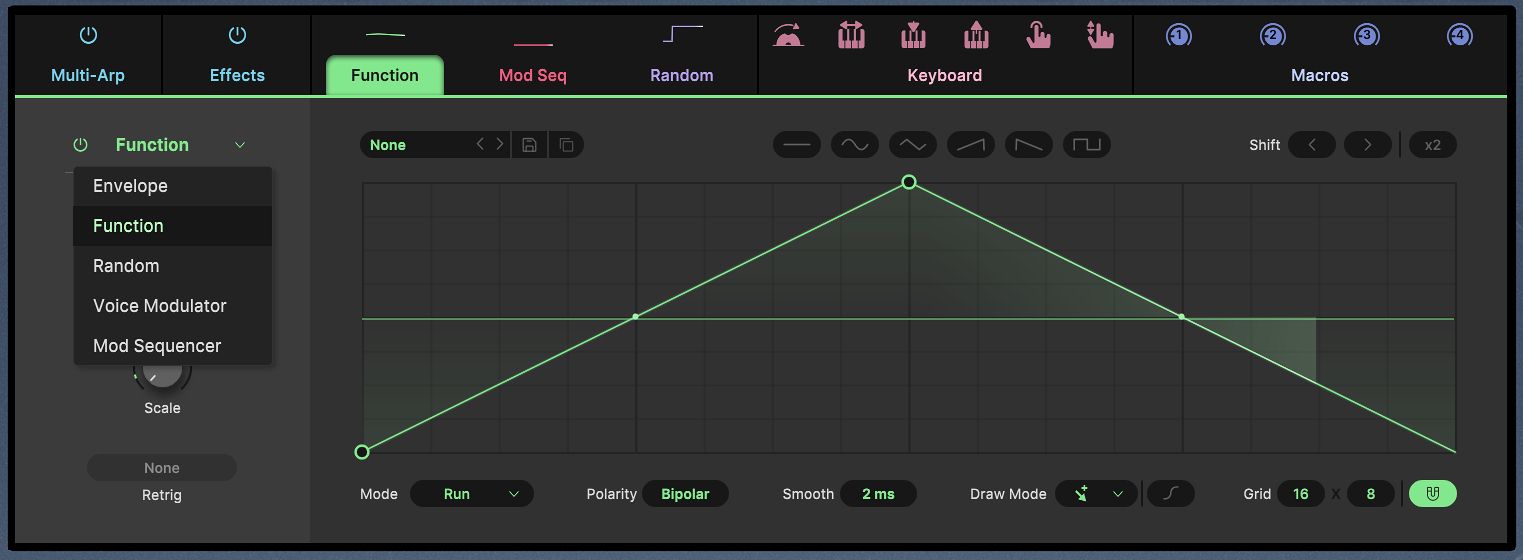
Three extra modulation sources can target almost all main parameters. Each offers five source types. Envelope provides ADSR; Function draws complex shapes; Random changes values rhythmically. Voice Modulator generates values when a new note is played. Mod Sequencer animates values rhythmically.
Jup-8000 V offers an excellent interface and useful extras, including modulation and effects. Sound quality is high, as with other V Collection recreations. A demo and examples are available on the official page of the manufacturer.
Synthx V
Synthx V models the rare and interesting Elka Synthex. This programmable 8-voice polyphonic synthesizer was made in Italy in the 1980s. According to the review, Elka Synthex was the first polysynth to deliver high-quality sound from digitally controlled oscillators (DCOs). Their stability set Synthex apart from Prophet, OB, and Jupiter competitors. It is now regarded as one of the finest analog polysynths.
Bitimbrality is a key feature. Two complete sounds can run together, as if there were two Synthex instruments. A single sound can be used, but multitimbral operation is more interesting.
Two identical oscillators have fixed waveforms, pitch, pulse-width, and level controls. They can ring-modulate each other. White or pink noise adds another sound source. A resonant filter offers five modes. Filter and amplitude envelopes use conventional ADSR.
Each layer has its own LFO, with separate modulation-depth controls for different destinations. A master LFO can affect both layers together, but has only a triangle waveform.
Alongside modern effects, Arturia retains the hardware chorus model. Its three modes progressively enrich the sound, as on the original.
Unison stacks all voices of the selected layer into one dense sound. It becomes monophonic, especially suitable for basses and leads. SPREAD in PAN/VOLUME then distributes the unison voices across the stereo field, widening the sound.
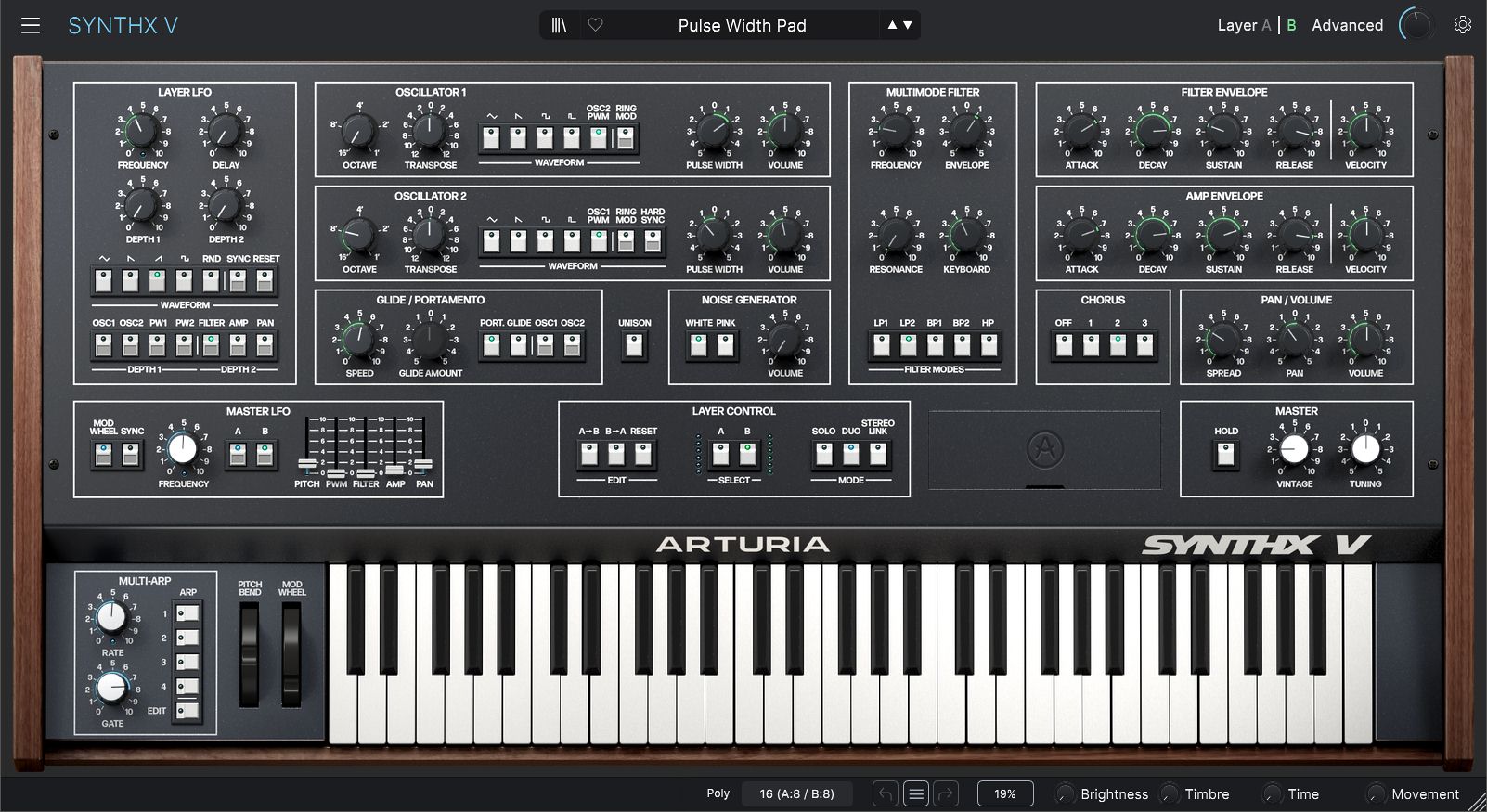
An extra oscillator-dispersion section affects both layers, adding warmth and analog-style variation. If Synthx V sounds too clean and stable, users can introduce small differences.
Advanced settings offer the same extra functions as Jup-8000 V.
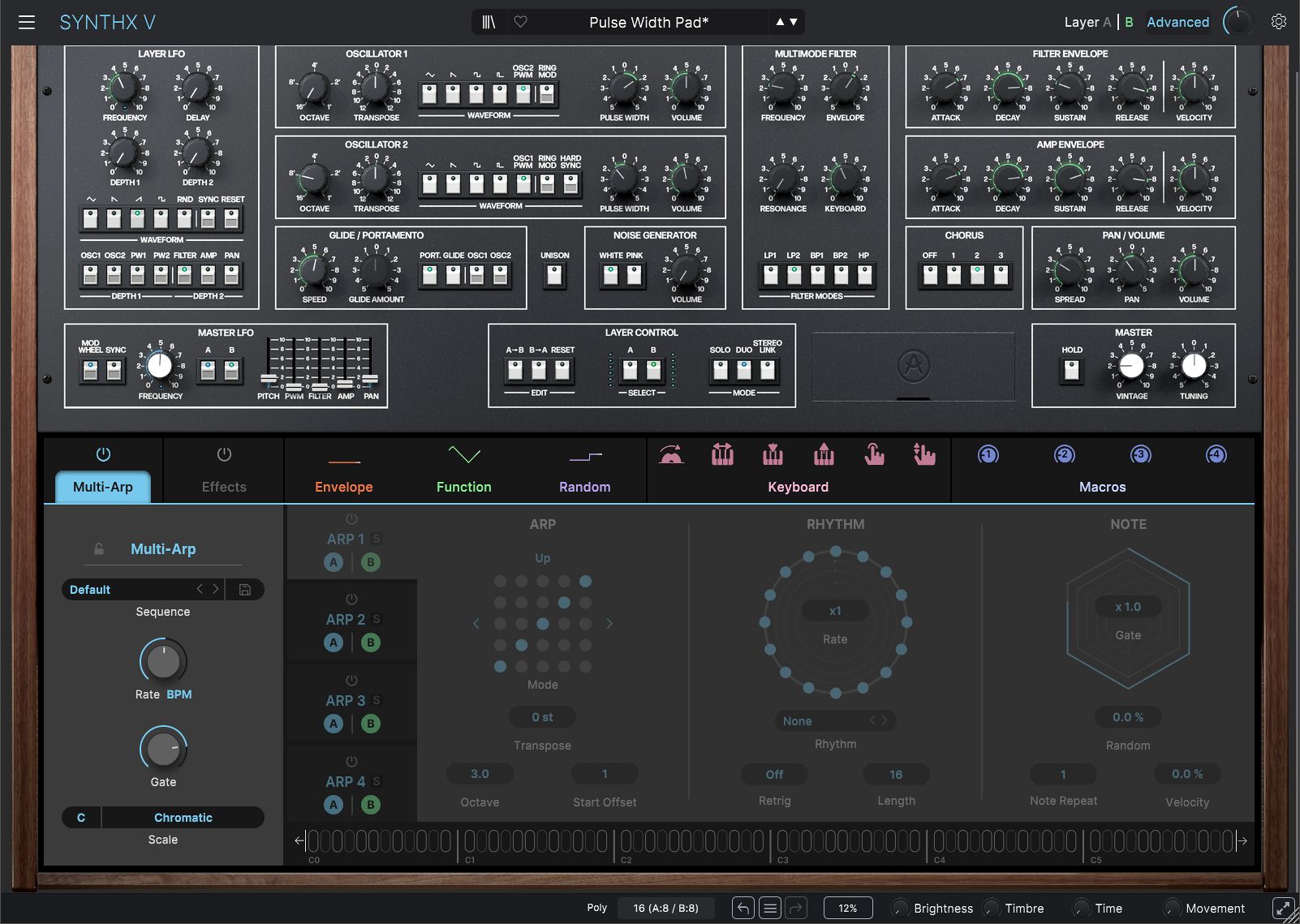
These include an arpeggiator/sequencer, effects, three extra modulation sources, controller configuration, and macro assignments.
Synthx V sound and operation can be assessed through examples and a demo on the official product page . It is another strong V Collection instrument, clearly reflecting Arturia's approach. The Elka Synthex analog sound is modeled thoroughly and convincingly.
MiniBrute V
MiniBrute V models Arturia's first analog hardware synthesizer, MiniBrute. After MiniFreak V joined the collection, a software MiniBrute seemed only a matter of time. V Collection 11 now has a second virtual recreation of Arturia hardware. Note that MiniBrute V models the original 2012 MiniBrute, rather than the current MiniBrute 2.
MiniBrute V retains the hardware's features and adds advantages. It is polyphonic, offering four- or eight-voice operation alongside retrigger and mono legato. Four effects are also included.
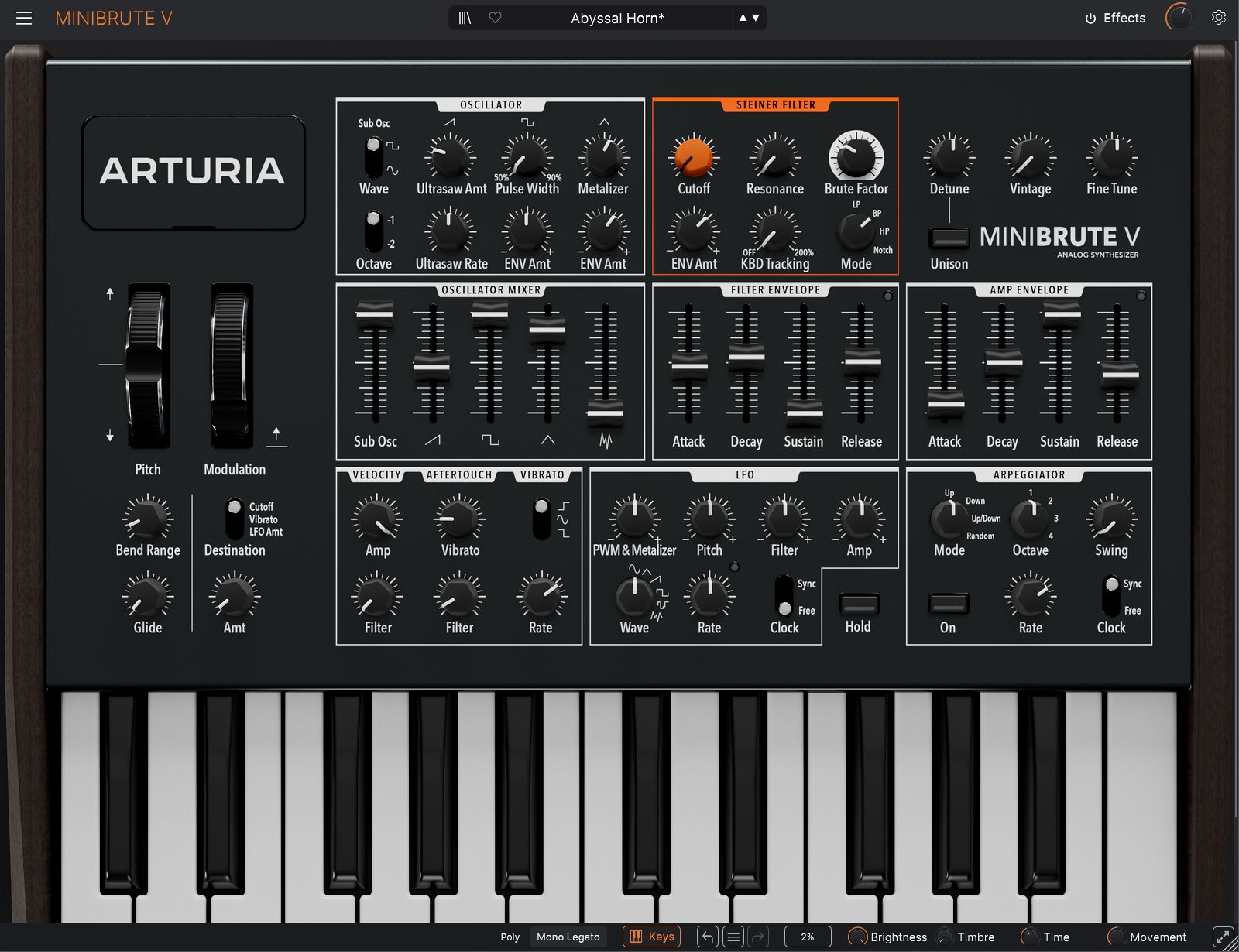
One oscillator generates several waveforms together, each mixed with its own fader. Every waveform has a shaping control. Ultrasaw Amt adds phase-shifted copies of the sawtooth. Pulse Width adjusts the square wave. Metalizer adds harmonics to the triangle wave.
The familiar two-pole Steiner-Parker filter is used. Brute Factor, a defining Brute-series feature, adds saturation through a feedback-like process. Its software model captures this distinctive character well.
The LFO selects noise or one of five waveforms. Modulation settings cover oscillator pitch, rate, amplitude, filter cutoff, and pulse width, as described in the source.
Unison stacks all voices for monophonic operation. An additional parameter-dispersion section introduces analog-style oscillator instability.
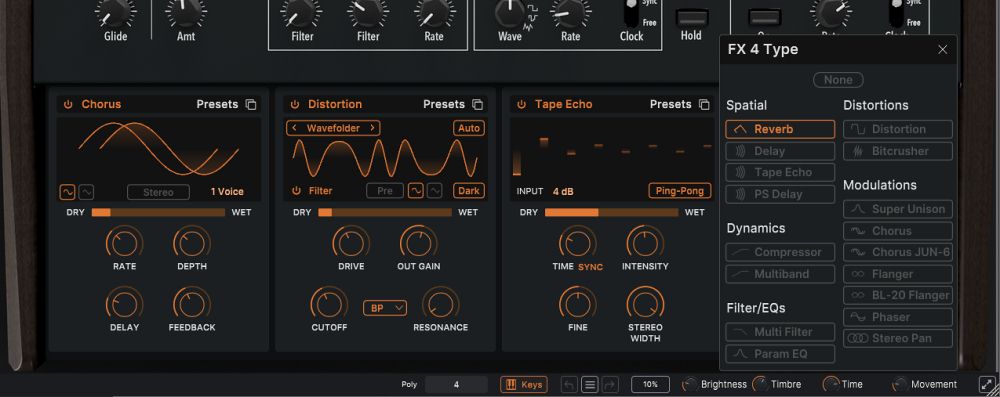
Four stereo effects run in series. Each slot chooses from 17 pedal-style effects covering frequency, dynamics, and spatial processing. These familiar effects appear in many Arturia products.
MiniBrute V should appeal to users who want a classic sound, limited synthesis complexity, and simple controls. Its character still sounds interesting and fresh. Examples are available on the official MiniBrute V page.
Pure LoFi
Pure LoFi creates characteristic lo-fi sounds. This is a new direction for Arturia, although Augmented already shows that the company can create original products as well as hardware recreations.
Three independent sources form the sound. The first two are identical, each offering samples of acoustic instruments, including keyboards; a creative sample-playback mode; or a LoFi oscillator with conventional waveforms. The third plays noise or short drum and percussion samples. Combinations of these samples and modes create everything from soft pads to complex hybrid textures.
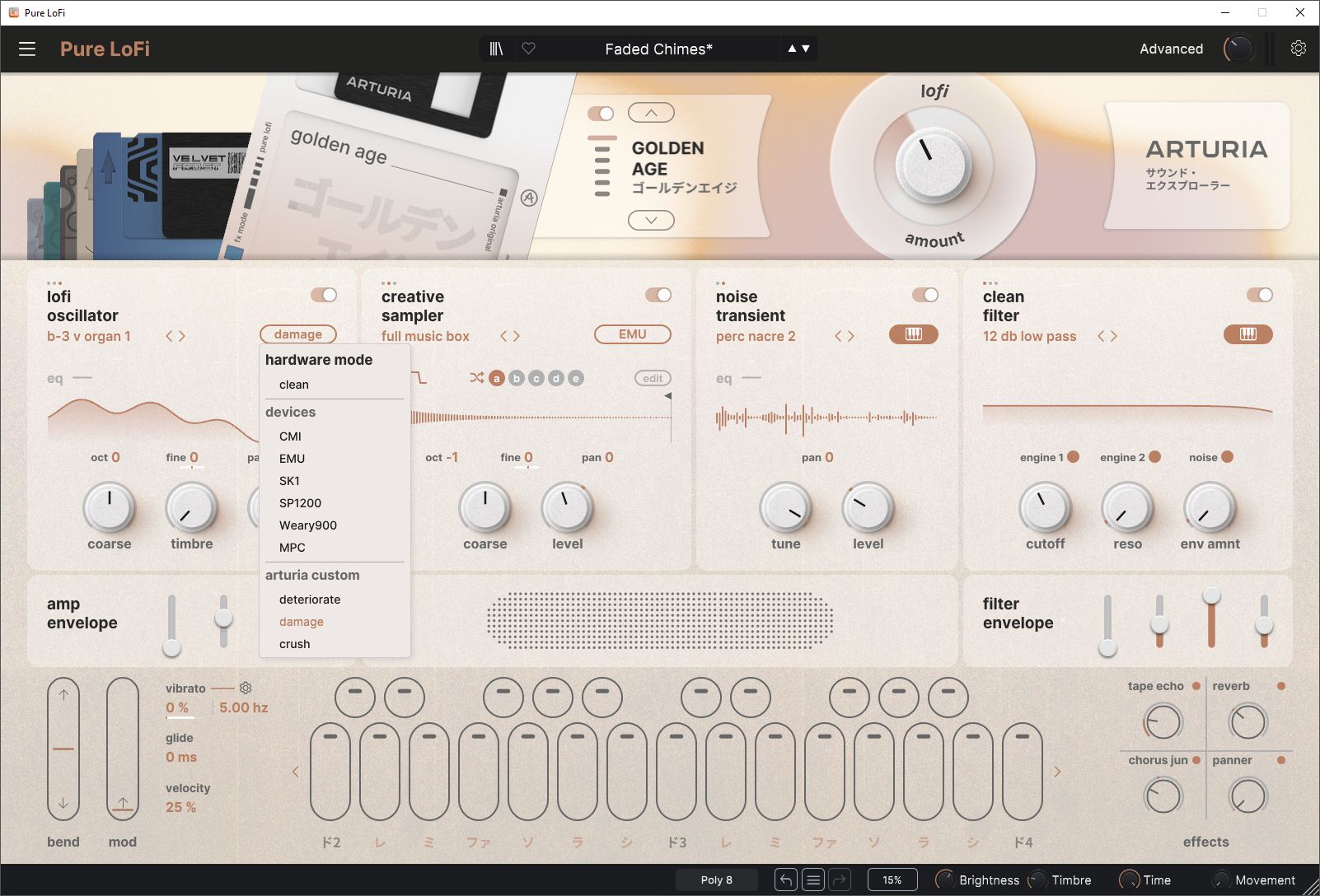
The most interesting part is the following processing. Main engines can emulate hardware coloration from Fairlight CMI, Emulator II, Casio SK-1, E-mu SP-1200, Akai S900, and Akai MPC60. Three additional Arturia modes add bit crushing and downsampling: Deteriorate, Damage, and Crush.
The LoFi filter comes from Arturia Pigments 6. It reduces sample rate for extra coloration. A conventional resonant filter is also available.
The main attraction is the LoFi processor, which adds characteristics of reel-to-reel recorders and old tube playback equipment. Six modes provide different processing. Golden Age adds warmth, subtle saturation, and soft compression. Velvet Frost adds a light tape character and grainy highs. Vintage Glow adds gentle analog overdrive. Dim Memories lowers fidelity, blurs the sound, and softens transients. Cathodic Tube models a bright, hard tube response. Fuzzy Line produces more aggressive dirt.
One main knob sets the effect amount for simple control. Additional controls allow more detailed adjustment of the lo-fi processing.
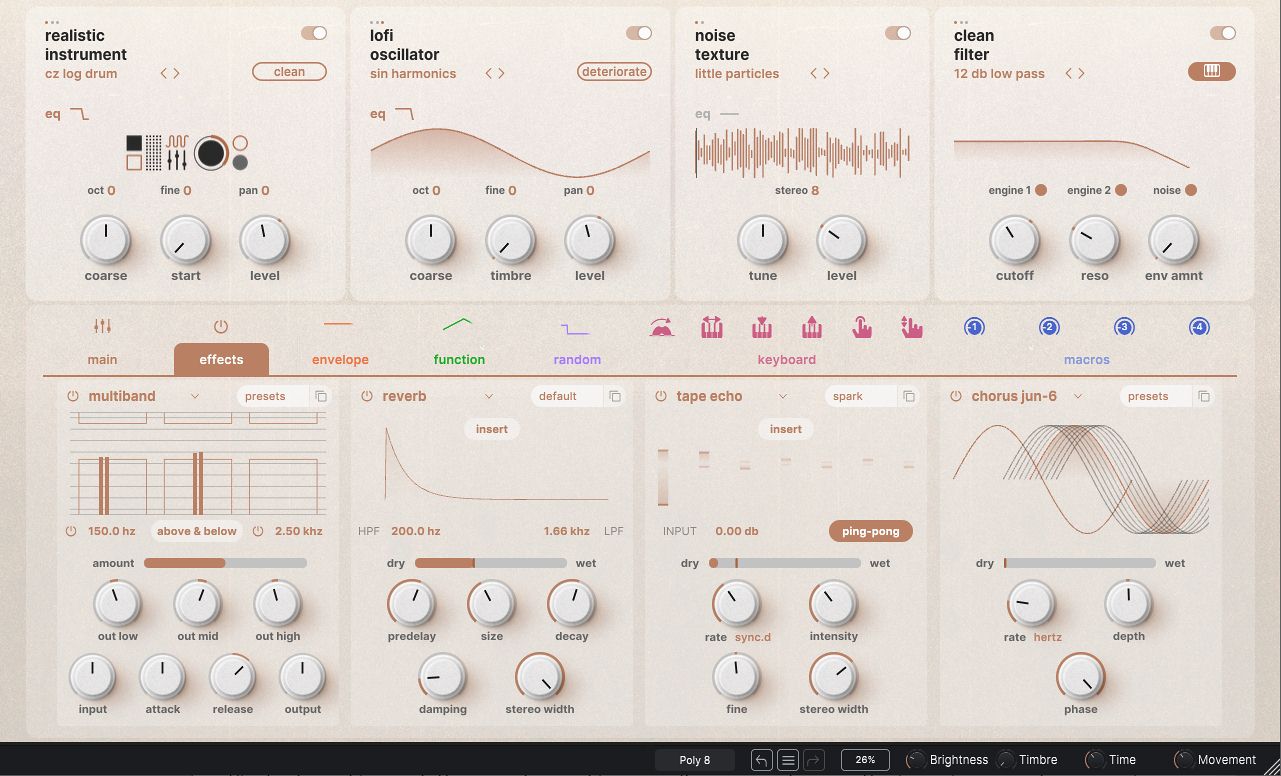
Standard Arturia advanced features include effects, modulation, MIDI controller settings, and macro assignments.
Pure LoFi is an original, distinctive instrument. Its wide options for atmospheric sounds should be valuable to musicians working in lo-fi styles.
Pure LoFi examples and a full demo are available on the official page of the manufacturer.
Augmented MALLETS and Augmented YANGTZE
These additions continue the Augmented series. Sampling and synthesis combine to transform familiar acoustic instruments smoothly. Morphing is the main strength, rather than conventional sampler or synthesizer editing. MALLETS contains celesta, tubular bells, marimba, and vibraphone samples. YANGTZE uses traditional Chinese instruments.
All Augmented instruments share two main layers, A and B. Their basic transition is a level crossfade. Extensive macro control makes the resulting changes more interesting.
The recent Augmented update revises the interface for clearer, more effective interaction. The core instruments otherwise remain the same.
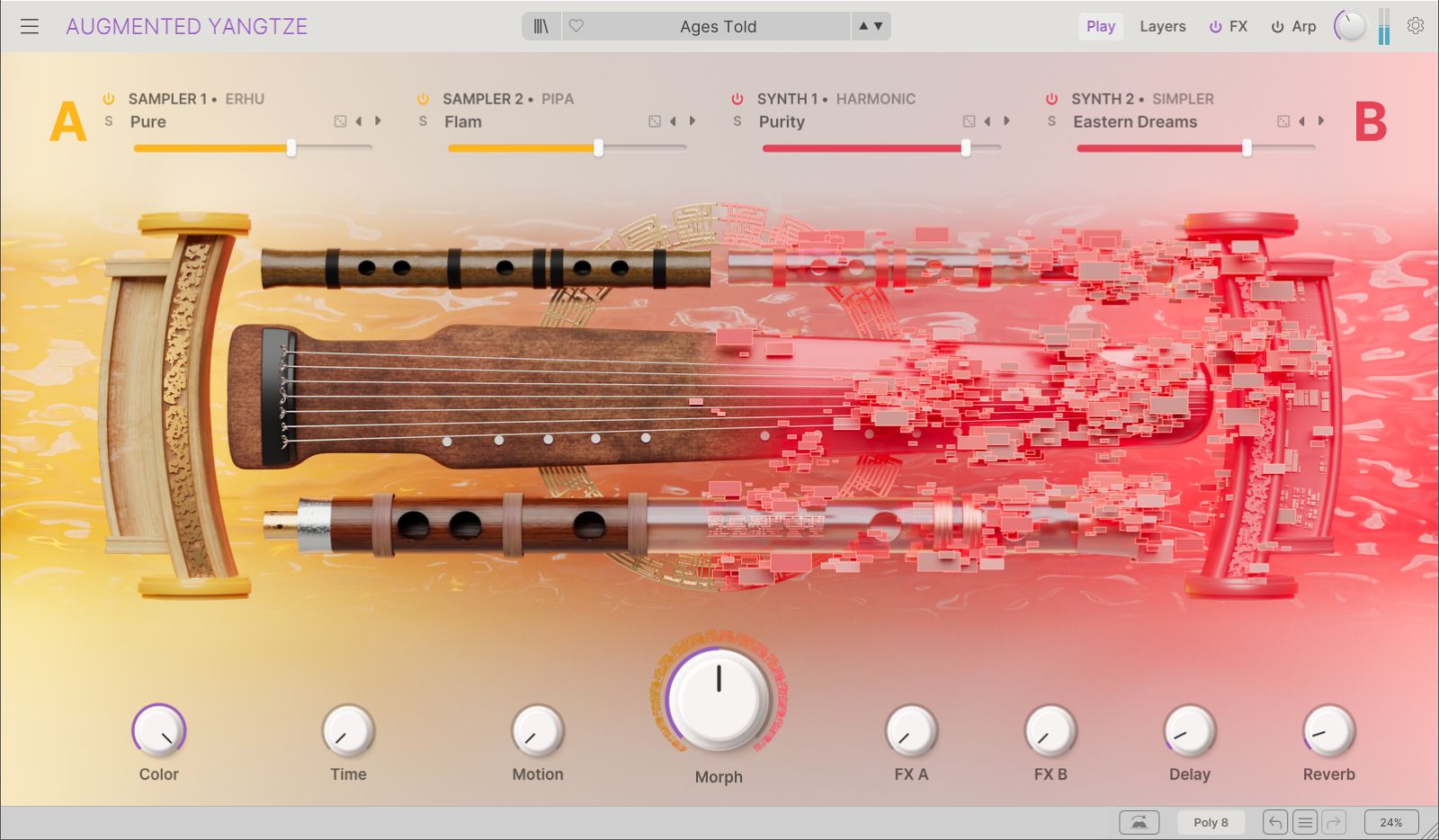
Previously, the main view showed only knobs. It now displays samples used in the current preset and allows switching within the selected category. Knobs move to the lower part of the window without changing their functions.
Four right-hand knobs control effects. Reverb and delay are fixed master effects. FX A and FX B each select from 14 effect types. Color, Time, and Motion on the left assign parameters from six categories. Morph controls up to twelve parameters together.
Each layer has two slots for an acoustic sample or a simple synthesizer. Controls are limited but useful. The sampler provides ADSR settings. Synthesis choices are Analog, Granular, Harmonic, and Wavetable, with different but still simple controls. Six filter options follow: resonant low-pass SEM, Multimode, and Surgeon; Comb and Phaser comb-style filters; and Formant.
Advanced view now shows more functions at once. The lower section displays its settings independently of the upper section, making control easier.
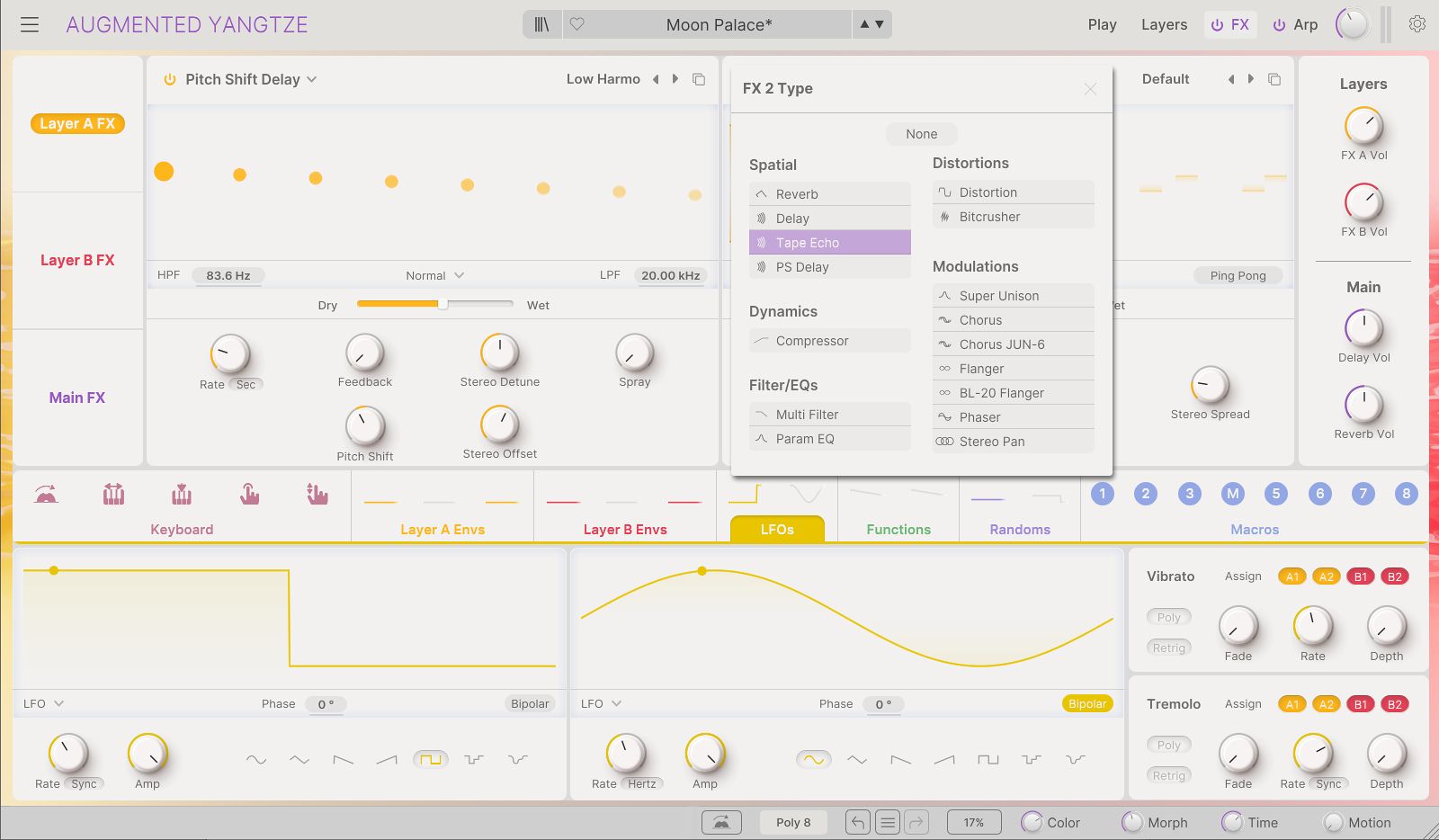
Each layer can use two effects. Familiar options include filters, compression, distortion, bit crushing, chorus, stereo widening, phaser, flanger, reverb, and delay. Graphical controls can be changed dynamically by modulation sources.
Modulation comes from two independent LFOs, two randomizers, and two Function generators with selectable, editable waveforms. Velocity, Aftertouch, Pitch, and Modulation can also act as sources.
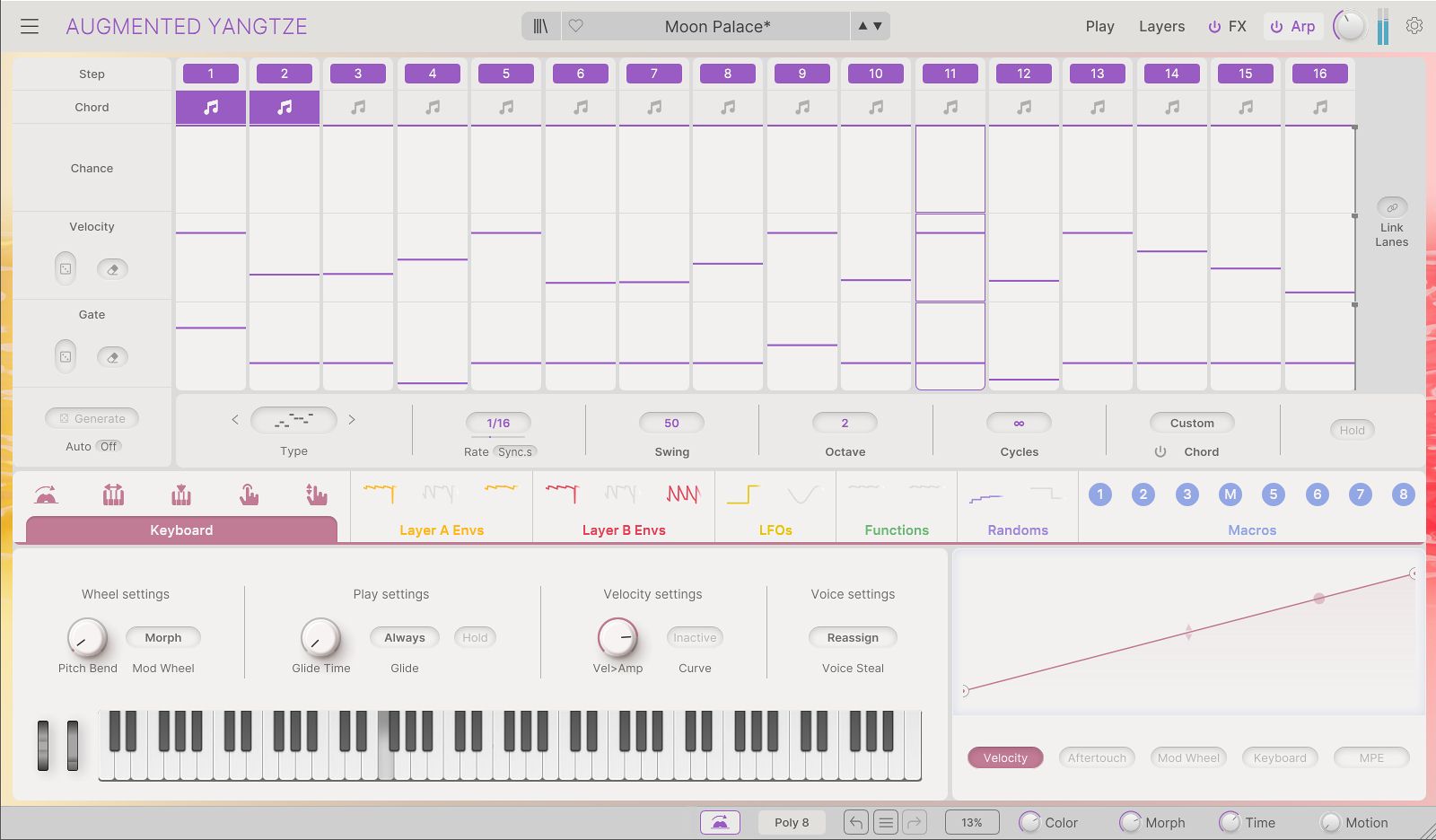


The arpeggiator/sequencer is unchanged. It records individual notes and plays complete chords, with per-step volume and duration adjustment.
Augmented is a useful sound-design series. The two additions bring unusual colors and bright percussion sounds. Many presets demonstrate their full potential. We recommend downloading demos to try them. Sound examples are available on the manufacturer's official website.
Conclusions
Arturia continues updating V Collection at a welcome pace. This expansion suits both fans of analog synthesizer recreations and users of modern original instruments. The additions deserve attention and can enhance a musician's collection. Continued improvements and new functions help users explore current ideas and experiment with sound.
Jup-8000 V and Pure LoFi particularly stand out. A more consistent interface is also appearing across the new products, making control easier and more comfortable.
Quality, variety, and continued development keep V Collection among musicians' popular choices.
Note. This is an adapted machine translation into English. It follows the “In simple terms” approach. Read the original article at https://prosound.ixbt.com/soft/arturia-vcollection11.shtml.