
Arturia V Collection X: Arturia's 2023 virtual instrument collection
Grigory Liadov
Arturia continues its regular V Collection updates. The tenth version, V Collection X, adds CP-70 V electric piano, MiniFreak V software synthesizer, and Acid V bass synthesizer. Augmented STRINGS and VOICES are joined by BRASS, PIANO, and WOODWINDS. Mini V and Wurli V have been extensively revised. Three sound-designer packs also add 450 presets for different V Collection instruments.
V Collection X contains 39 complete instruments with distinctive sounds, detailed settings, and individual control features. Each runs as a VST, AU, or AAX plug-in, or standalone. At the time of this review, the full collection costs €599. Upgrading from the previous version costs significantly less.
Most instruments model classic keyboards from the last century. Two additions continue that tradition. CP-70 V recreates the Yamaha CP-70 electric piano, popular in the 1970s and 1980s. Acid V models the Roland TB-303 bass synthesizer, widely used in electronic music since the 1990s. We have already met MiniFreak V through its MiniFreak hardware counterpart. Augmented offers modern instruments with extensive morphing. We will examine these additions more closely.
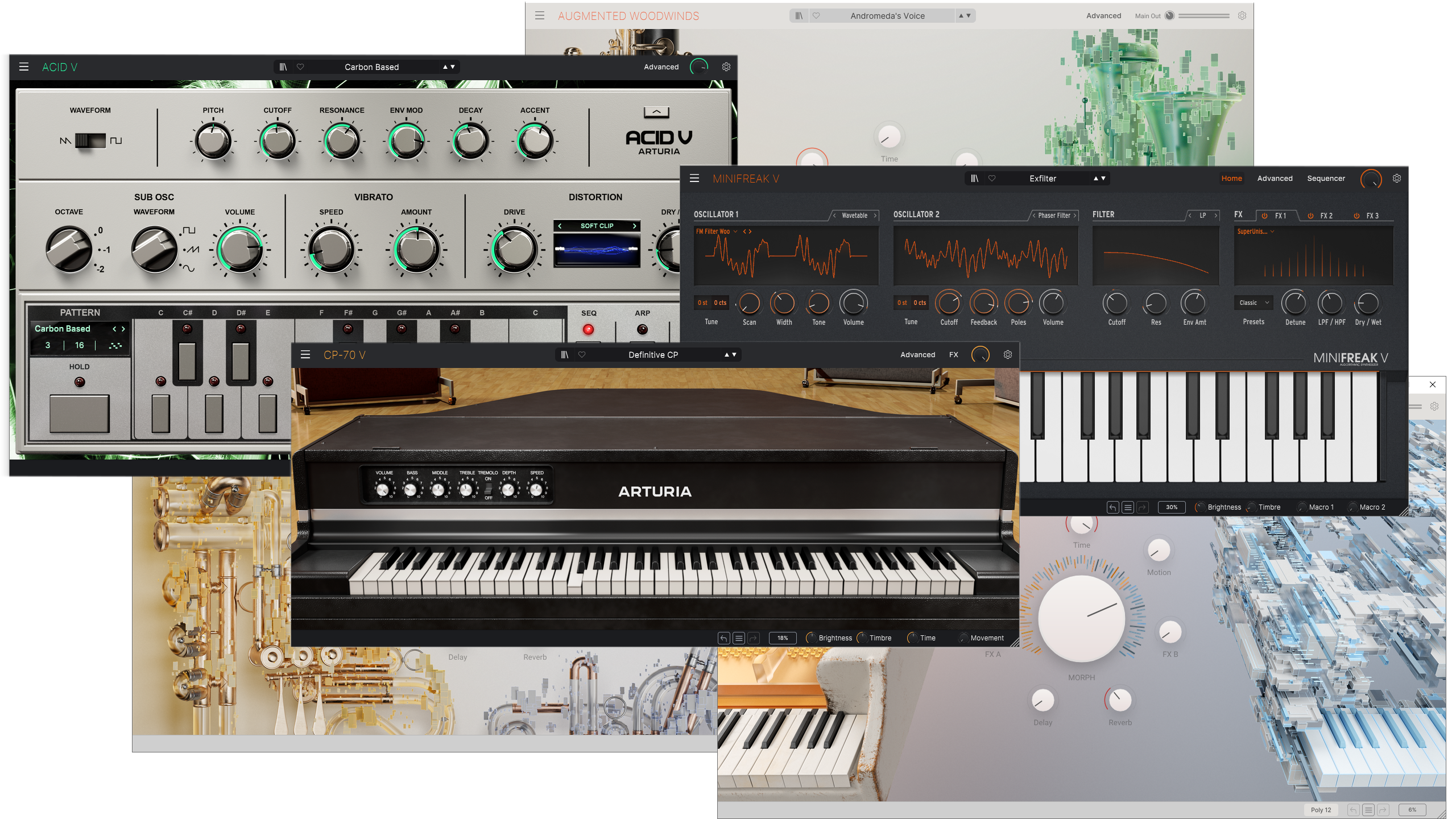
The original review emphasizes modeling, with little use of samples, as central to Arturia's virtual instruments. This provides expressive sound and unusual controls beyond conventional sample playback. Arturia aims to reproduce original circuits and mechanisms in detail, then adds presets, automation, extra modulation, and modern effects.
Acid V
Acid V models Roland's famous TB-303 bass module, released in 1981. Initially, it found little support among musicians and was discontinued after poor sales. Later, electronic musicians adopted its distinctive sound. Its character and CV/Gate connections made it common in studios and live setups. At the time of this review, Roland again offers the bass module in a revised form.
Acid V recreates the 1981 instrument's functions and adds modern conveniences. A graphical sequencer/arpeggiator replaces programming from the small keyboard. Its familiar sequence view is easier to use. The keyboard remains in the interface, but transposes the programmed pattern rather than entering it.

The main synthesis controls follow the hardware, including ACCENT, which changes amplitude and filter-envelope decay together. Like TB-303, Acid V is monophonic, with one oscillator offering sawtooth or square waves. Arturia adds a sub-oscillator with three waveform options, blended continuously and transposed one or two octaves down. A distortion section adds aggression, with 14 processing types.
Three playback modes are available. SEQ plays the stored sequence, triggered and transposed by a key or DAW note. Arpeggiator mode continuously patterns the held notes. EXT plays melodies from a DAW or external MIDI controller. The built-in sequencer gives especially interesting results through its modulation.
Advanced view opens the sequencer, modulation, and effects sections.

The step sequencer creates patterns up to 64 beats long. Supplied rhythms and patterns are easy to edit with many functions. Alongside conventional playback settings, almost any parameter can be randomized. Users can vary only note duration or accents, or transform the whole pattern with TRANSMUTATION and adjustable randomness. Sequences can stay within a selected scale, particularly useful for random changes that avoid out-of-scale notes. These options greatly expand the creative potential of this apparently modest sequencer.

Modulation is another powerful Acid V tool. Three sources can target almost every knob, including main effect parameters. The familiar Arturia modulation panel supports conventional ADSR shapes and complex repeating patterns. Clear displays, flexible editing, and practical assignments make sound movement easy to create.

Four stereo effect slots run in series. There are 17 effect types covering frequency, dynamics, and spatial processing. Effects have graphical controls and complete settings available for modulation.
Acid V includes more than 150 presets organized by tags. A demo and sound examples are available on the official page of the manufacturer.
CP-70 V
CP-70 V models the legendary Yamaha CP-70 electric piano, popular with touring musicians in the late 1970s. Its relatively compact size and advanced pickups produced a bright, clean sound that suited touring keyboard players. Its recognizable character appears on many hits from the period, and some musicians still use it.
Arturia recorded eight velocity layers with long release samples to match CP-70 closely. Recordings capture both the line output and a stereo pair of ribbon microphones. The plug-in balances direct and microphone signals.

For greater CP-70 V realism, Arturia also models the original preamp, EQ, and tremolo. Main-page controls adjust these to taste. Other controls are in Advanced view.

An adjustable velocity curve adapts CP-70 V to the MIDI keyboard and playing style. Users can choose presets or draw a custom curve. Other settings cover conventional instrument parameters.

Six guitar-pedal-style effects run in series. These familiar effects appear in many Arturia products. The first four slots offer conventional guitar effects. Slot five models a Fender Twin amplifier or Leslie cabinet, both used with CP-70 in the period. The final slot provides reverb.
CP-70 V includes presets with different settings and effects. A full demo and sound examples are available on the page of the manufacturer.
MiniFreak V
MiniFreak V is a software copy of the hardware Arturia MiniFreak, reviewed earlier. Initially, the plug-in worked only with the hardware connected and made operation easier, especially in a DAW. Later, MiniFreak V became available as an independent instrument.
MiniFreak V includes all the polyphonic hardware's functions. It has two oscillators; the second can modulate the first. Each offers 14 main signal types, from conventional waveforms to more complex shapes. Some oscillator designs come from Mutable Instruments and Noise Engineering modular products. Oscillator one can also use the audio interface input. Oscillator two has six extra processing configurations for the first, mainly filters, frequency/ring modulation, and the destructive Destroy algorithm.
MiniFreak V visually represents almost all main modes and parameters, making internal changes immediately visible.

Three extra controls smoothly change the oscillator sound. Their roles vary with oscillator type, and all can be modulated. Alongside waveform transformation, the filter is central to MiniFreak V. It models the analog multimode Oberheim SEM design. The 12 dB/octave filter offers Low Pass, Band Pass, and High Pass, with cutoff and resonance controls. Env sets the filter-envelope modulation amount.
The main page also has stereo effects. Up to three can run together, selected from ten types: Chorus, Phaser, Flanger, Reverb, Delay, Distortion, Bit Crusher, 3 Bands EQ, Peak EQ, and Multi Comp.

Modulation deserves attention. Because MiniFreak V originally worked with the hardware, assignments use the same matrix. Sources sit on the left and destinations across the top. Amounts are set at their intersections. The whole routing is easy to see.
Sources include two LFOs, ADSR and cycling envelopes, velocity, and aftertouch. The touch strip and macros add control. A macro can assign up to four parameters to the strips for simultaneous adjustment. Factory presets already use effective assignments that strongly change the sound.

The arpeggiator has 8 main patterns and four advanced modes for creative variations. The sequencer creates patterns of 64 beats. Alongside pitch, length, and velocity, it records four extra parameters, freely chosen for each sequence. Spice & Dice modifies the current phrase to add variation.
The MiniFreak hardware hybrid synthesizer impressed us. It is good that users can now work with its software version independently. MiniFreak V examples and a full demo are available on the official page of the manufacturer.
Augmented BRASS, Augmented PIANO, and Augmented WOODWINDS
These three continue the Augmented series. They bring new possibilities to familiar acoustic instruments, combining sampling and synthesis with smooth sound transformation. Morphing matters more here than deep sampler or synthesizer editing.
Arturia recorded real instruments for the sample content. However, faithful acoustic playback alone is not the main aim. Augmented's strength is smoothly transforming one sound into another, especially from acoustic samples to a fully synthesized, pulsing sound with a different texture.

All Augmented instruments share two main layers, A and B. Their basic transition is a level crossfade. Extensive macro assignments make the resulting transformation more interesting.
Four lower knobs control effects. Reverb and delay are fixed master effects; FX A and FX B offer two selectable effects. Color, Time, and Motion each control groups of six parameters. Morph can control 12.

Each layer has two slots for an acoustic sample or simple synthesis. Controls are limited but allow useful changes. The sampler has ADSR settings. Synth options are Analog, Granular, Harmonic, and Wavetable. Parameters vary by engine but remain few in number.
Six filter types are available. SEM, Multimode, and Surgeon are resonant low-pass filters. Comb and Phaser provide comb-style processing, and Formant provides a formant filter. Most parameters can be modulated by sources placed on a dedicated tab.

Two LFOs, two randomizers, and two Function generators are available, with selectable and editable waveforms. Velocity, Aftertouch, Pitch, and Modulation can also act as control sources.

Augmented also includes an arpeggiator/sequencer for notes or chords, with per-step volume and duration editing.


Each layer can use two effects. Familiar Arturia options include filters, compression, distortion, bit crushing, chorus, stereo widening, phaser, flanger, reverb, and delay. Their graphical controls can be changed dynamically by modulation sources.
As noted earlier, Augmented instruments are distinctive and interesting. Many presets demonstrate their full range. The series is a useful tool for film work and sound design. We recommend installing the demo to hear this yourself. Augmented examples are available on the official website of the manufacturer.
Conclusions
As usual, the V Collection update is exciting and attractive. Acid V and MiniFreak V particularly stand out. CP-70 V's refined sound should appeal to demanding keyboard players, while the new Augmented instruments suit sound designers. It is good that Arturia lets users try every plug-in and decide from personal experience.
Note. This is an adapted machine translation into English. It follows the “In simple terms” approach. Read the original article at https://prosound.ixbt.com/soft/arturia-vcollection10.shtml.