
Sennheiser HD 400 PRO — professional open-back headphones
Maxim Liadov
Sennheiser has recently focused strongly on professional products, with considerable success. For example, the Sennheiser EW-D digital wireless system left an excellent impression and surprised us with its many modern innovations.
Today we test the new professional HD 400 PRO, which may change how audio-production users view Sennheiser. Its open design suits tasks from composing to mixing and mastering.

A company representative says the model starts a new Sennheiser PRO headphone range for professionals needing detailed, honest, high-resolution sound for creative work.
Our experience confirms strong demand for light, comfortable headphones with excellent sound in studios of every size. Music creation involves much more than final mixing: writing instrumental parts, choosing sounds from hundreds of gigabytes of libraries, editing loops and grooves, selecting effects, playing electronic instruments, and preparing rough edits. These stages take hours, days, or weeks. Working inside the studio is not always best. Inspiration can arrive away from the monitor-equipped room. Good headphones therefore complement quality studio monitors, even the most advanced Neumann models.

We already owned the successful HD 560S, recently released for the company's anniversary, so the HD 400 PRO was not entirely unexpected. The HD 560S sounds excellent but is a consumer model. It can serve audio work, though less conveniently. Its long, stiff cable transmits touch and impact noise into the headphones. That matters less for a relaxed home listener than for a professional moving around at a computer, where the cable hits objects. For work, we therefore bought a coiled cable and a short fabric-covered straight cable.


The HD 400 PRO includes both a coiled cable and a short straight one with soft rubber covering that does not transmit impacts to the listener. A plug adapter adds versatility. Professional equipment often uses both mini-jacks, especially recorders and cameras, and full-size 6.5 mm jacks. The HD 560S instead has a fixed 6.5 mm plug emphasizing desktop use. Both models share the same twist-lock detachable cable socket, so cables can be exchanged. We especially liked the HD 400 PRO coiled cable: it felt better than inexpensive third-party versions and worked well with the HD 560S.

Sennheiser's professional and consumer model numbers have separate histories and cannot be compared directly. The long-running 5XX consumer series targets the middle market. The newer HD 560S, specifically with S, has a promising new driver that competes with and sometimes exceeds the 6XX series. It retains simpler 500-series ergonomics. Despite market segmentation, buyers welcomed it as a bestseller and strong value, using it professionally as well. Sennheiser may have developed the HD 400 PRO to build on that success. Appearance is similar, but we feel some improvements place it slightly above the HD 560S.
The number 400 is not a lower ranking than the consumer 5XX series. Professional naming follows a separate logic. Above the HD 25, HD 200 PRO, and HD 300 PRO, the HD 400 PRO is the professional flagship. Its price also places it above consumer 5XX models.
Sennheiser HD 400 PRO specifications
- Acoustic principle: dynamic, open-back
- Fit: over-ear
- Frequency response: 6–38000 Hz
- THD: <0.05% (1 kHz, 90 dB SPL)
- Impedance: 120 ohms
- SPL: 110 dB (1 kHz, 1 Vrms)
- Plug: 3.5 mm (1/8-inch), with 6.3 mm (1/4-inch) adapter
- Weight: 240 g without cable
The especially low 0.05% THD specification stands out. It improves on the HD 560S and HD 600 and is comparable with the HD 660S. Other figures indicate a new 120-ohm driver with 110 dB/V sensitivity. Weight is only 240 g without cable. The open design prevents cue monitoring during microphone recording, but is often preferable for other professional tasks, especially critical listening.


The cups are conventional, with a more neutral logo without a shiny insert. There is no luxury styling or extra charge for design details. The HD 400 PRO is an everyday working tool.


The headband has two foam cushions with glued velour covers. Construction is simple and typical of Sennheiser.

Fit adjustment is conventional, with a little cup rotation. All structural parts are plastic, keeping weight very low. Will it become loose? The similar HD 560S construction remained firm through our year of use.
Frequency-response measurements
Our measurements use the hardware and software measurement system RightMark™ Audio Analyzer PRO. A Danish-made Brüel & Kjær 4153 Artificial Ear/Ear Simulator (IEC 60318-1), costing about 5000 euros, was used.


The Brüel & Kjær fixture effectively simulates ear acoustic impedance up to 16 kHz. Frequency-response measurements are for reference only and should not be used to guess the sound.


The responses are similar, but HD 400 PRO midrange is more linear. Bass has no emphasis; the measured roll-off comes from the fixture and is absent in listening. The treble dip followed by a peak resembles the Harman target.
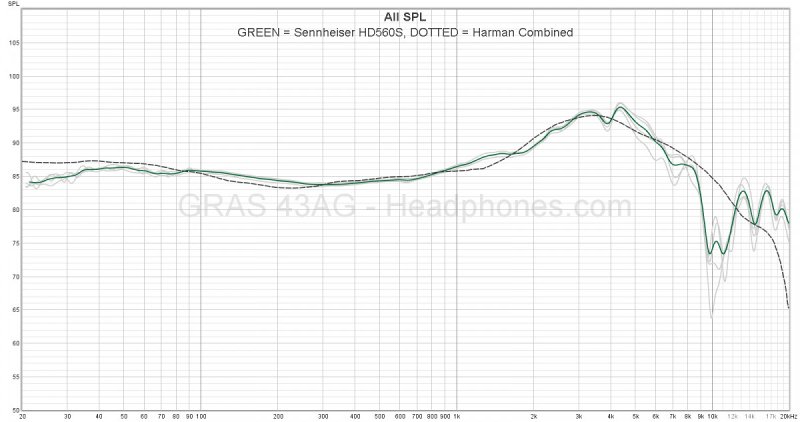
Theory and listening evidence suggest that Harman represents the neutral balance familiar from speakers in a room. Many manufacturers now aim for this kind of headphone response. HD 560S measurements on a GRAS 43AG illustrate the approach. The target's bass boost was added more recently after studies found younger listeners preferred stronger bass. Such results deserve some caution because findings can change. So far, even midrange without peaks or dips appears desirable. Bass and treble must be present, but their ideal shape remains under study and debate, partly because hearing is nonlinear. A straight response is not necessarily the perceptual goal; smooth changes matter more. As level rises or falls, the range edges can change while the sound still seems convincing and tonally neutral.
Sound quality
The HD 400 PRO sounds highly detailed, with a wide stereo image appealing to professionals and audiophiles. Midrange definition stands out: the whole region is clear and tonally accurate. Detail does not become tiring because it is not accompanied by unpleasant distortion or emphasis. Bass and treble remain audible without dominating.
Treble retains the familiar Sennheiser character. The HD 400 PRO is closer to the HD 560S than to 600-series models. Quick switching favored the HD 400 PRO for us. The HD 560S is closer to the HD 6XX, with coherent sound and calmer treble. It justifies its audiophile focus and costs less. Choosing headphones is rarely clear-cut and often comes down to taste. No model is perfect, so personal priorities should guide the decision.
Amplifier demands are reasonable, but a high-quality source reveals more of the HD 400 PRO's potential. The benefit of a better audio chain is clearly audible.
Low weight and long-session comfort are major strengths of the HD 400 PRO. The velour pads are excellent, with no wish to replace them. We also liked the soft straight cable for portable sources. The affordable price explains the minimal essential accessories, but an optional carrying case would be welcome.
Conclusions
We began with no specific expectations and found one of the strongest products in Sennheiser's range. The HD 400 PRO is a serious design clearly using recent driver developments. It should appeal to many professionals and audiophiles. Those familiar with the HD 560S can view it as an upgraded professional version with more detail and two detachable cables. Its detail and transparency set a new professional standard at this price. We look forward to more models like it.
Note. This is an adapted machine translation into English. It follows the “In simple terms” approach. Read the original article at https://prosound.ixbt.com/monitors/sennheiser-hd400pro.shtml.