
JBL EON ONE Compact — a portable active PA system with a digital four-channel mixer and built-in battery
Grigory Liadov
JBL continues to expand its speakers for musicians and public events. Introduced at the end of 2019, the EON ONE Compact differs from earlier models through its very small size and built-in battery operation.
JBL positions the EON ONE Compact for solo performers, presenters, DJs, fitness instructors and other tasks needing good sound in small spaces. It is also suitable for karaoke.
There is no need to buy a separate mixer or set up complex connections. Simply plug a microphone, guitar or another instrument into the available sockets. JBL calls it an all-in-one system for good reason.
The EON ONE Compact includes a four-channel digital mixer with Bluetooth and high-quality Lexicon and dbx signal processing. It can be controlled from the speaker or a tablet. By PA standards, the system is very small.
JBL EON ONE Compact specifications
| General | |
| Acoustic design | Bass reflex |
| Cabinet | Molded plastic |
| Woofer | 8" |
| Tweeter | 1" |
| Frequency range | 37.5 Hz–20 kHz |
| Dispersion | 100° × 60° |
| Maximum peak SPL at 1 m | 112 dB |
| Amplifier | |
| Type | Class D |
| Power | 88 W into 4 ohms at 1% THD |
| Mixer | |
| Inputs | 2 × XLR/TRS, 1/4-inch TRS, 1/8-inch TRS, Bluetooth (10 m range) |
| USB | 2 × USB-A: 5 V/2 A and 5 V/1 A |
| Outputs | 1/8-inch TRS headphones; 1/4-inch TRS pass-through |
| Effects | Reverb, delay, chorus |
| Battery | |
| Capacity | 6100 mAh |
| Charging time | 2.5 hours without signal; 6 hours during use |
| Operating time | Up to 12 hours |
| Other specifications | |
| Dimensions | 291 × 255 × 399 mm |
| Weight | 8 kg |
The JBL EON ONE Compact looks like a conventional active speaker. Its moulded plastic enclosure, typical of portable PA systems, keeps weight down to just 8 kg.

This is a two-way bass-reflex system. It has an 8-inch polymer woofer cone and a one-inch tweeter. Two front ports sit on either side between the drivers. A metal grille protects the drivers from dust and damage.

A large top handle makes carrying easy. There is also a recess for a tablet.

A socket underneath allows mounting on a speaker stand.

The speaker can also lie horizontally. Its angled cabinet and rubber pads provide a suitable position and reduce vibration transfer. Controls and sockets remain conveniently accessible in this orientation.

Up to 4 sources can connect at once. The first two channels have combo XLR/TRS sockets for microphones or line-level devices.
The first microphone input can supply +48 V phantom power. Channel three has a Hi-Z TRS input for a guitar. Channel four accepts Bluetooth or an AUX source through a mini-jack. A PASS THRU output links additional speaker systems.
A mini-jack headphone output carries the master signal. The two USB ports only charge mobile devices: one supplies 5 V/1 A and the other 5 V/2 A.

A compartment at the back houses a 6100 mAh lithium-ion battery. Rated running time is 12 hours. Charging is possible both while switched off and during normal use. Charging while operating takes longer: six hours instead of two and a half.
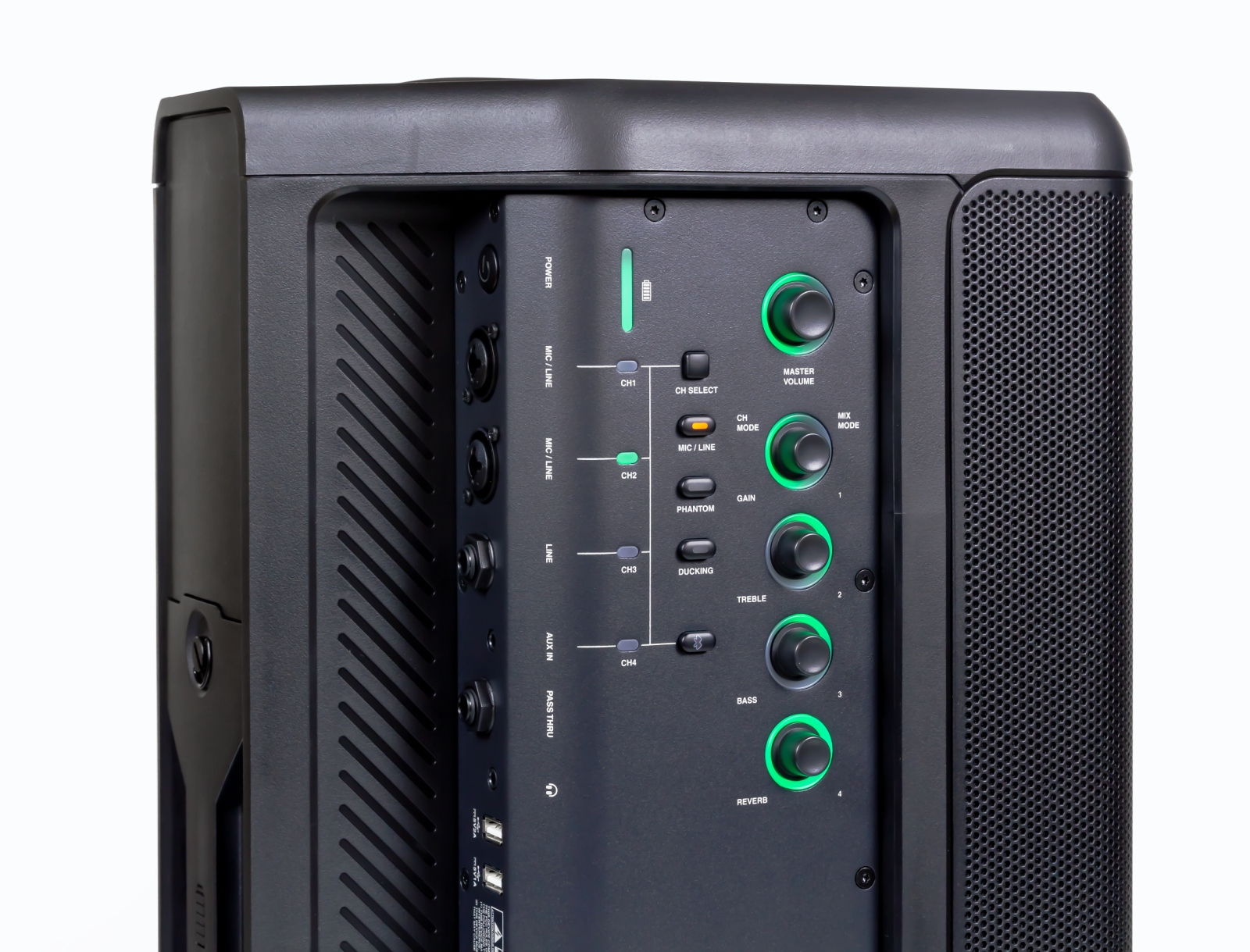
The JBL EON ONE Compact controls are simple and well designed. CH SELECT switches channels, while the knobs adjust level, EQ and effects send. In MIX Mode, the knobs adjust the four channel levels.
LED rings show current values and make adjustment easy. More detailed settings are available in JBL Compact Connect for iOS and Android. The app is simple and easy to understand, with convenient access to all mixer parameters.

The first app tab shows every mixer channel. Here you can quickly change levels, select modes and open detailed settings. Ducking is available on the first and second inputs. Its threshold, reduction amount and recovery time are adjustable.

Each input has a multiband graphic equalizer with cutoff filters. Unfortunately, the EQ display cannot be enlarged and is slightly awkward at this size. For precise settings, use the sliders on the right.

The FX bus offers 3 effects: Reverb, Delay and Chorus. Only essential settings are provided. Quality is quite good and comparable to processing in hardware mixers. Even with limited controls, good results are possible.

A multiband EQ on the master output adapts the system to the room, for example by reducing resonances or adding brightness. Another major digital-mixer advantage is saving settings in SNAPSHOTS. Recalling prepared settings makes it possible to start a performance quickly without repeated setup.
Several JBL EON ONE Compact speakers can be linked. Each can be assigned a channel for stereo playback or set to duplicate a mono signal. Bluetooth routing follows the same principle.
The mixer's digital section uses an Analog Devices ADAU1452 DSP. Conversion is handled by a six-channel 24-bit/192 kHz CS42526 codec. Its specified DAC/ADC performance is 114 dB dynamic range and 100 dB THD+N.

The Class D amplifier uses a TI TPA3221 chip. In two-channel mode, it provides 88 W into 4 ohms at 1% THD, more than enough for this portable system. All electronics sit in a separate isolated compartment to prevent unwanted noises and resonances at high volume.
Frequency-response measurements
Our measurements use the hardware and software measurement system RightMark™ Audio Analyzer PRO. We also use an Earthworks M50 measurement microphone with the following specified data:
- Serial number: 9291C
- Sensitivity at 1 kHz: 26.4 mV/Pa
- Frequency response variation, 20 Hz–20 kHz: 0.2 dB
- Frequency response variation, 3 Hz–50 kHz: +1/−3 dB (roll-off from 45 kHz)

Sound
Despite its small size, the EON ONE Compact performs impressively. Compact dimensions and battery power should not give the wrong impression.
EON ONE Compact sound quality is very good and comparable to full-sized PA systems. The small woofer cannot provide rich output in the deepest bass, but bass is very good for an 8-inch driver.
The well-designed bass-reflex system gives strong coverage from 50 Hz.
There is more than enough volume for a small room. At high levels, the sound stays clean and comfortable, without obvious distortion or overload. In this case, Class D amplification is an excellent choice and proves fully effective.
To test the preamps, we connected a wired dynamic microphone. We wanted to check voice clarity and detail, especially with backing music playing. Overall, we were pleased. With flat EQ, the midrange was less expressive, but equalization produced a bright, full sound. The JBL EON ONE Compact therefore handles its main task very well.
Direct control from the speaker is particularly useful. You can quickly adjust volume or EQ, disable Ducking and make other changes without looking for the right button, tab or slider on a mobile screen.
We also tested automatic ducking. Its extra settings are welcome: they allow adjustment to the background music level and microphone sensitivity.
Conclusions
The JBL EON ONE Compact performed very well. Unlike earlier models, it is particularly well suited to portable use: supporting musicians' performances, providing quality sound for home parties or helping set up a home music studio.
We found no particular weak points. Controls are convenient and the system is well executed. It remains a personal PA and should not be seen as a replacement for full-sized speakers. However, even against other active PA systems of a similar size, the JBL EON ONE Compact is very attractive.
Note. This is an adapted machine translation into English. It follows the “In simple terms” approach. Read the original article at https://prosound.ixbt.com/monitors/jbl-eon-one-compact.shtml.