
AuraSonics DESK 3 USB — compact active three-inch monitors with passive radiators
Grigory Liadov
In recent years, studio speaker manufacturers have increasingly developed compact models. More brands now include monitors with three-inch woofers. Small monitors make better use of workspace, an important consideration in modern recording environments. Compact speakers are also easy to transport, allowing users to work in different places, including on-location projects.
The Russian company "AudioProject" brings its development experience and understanding of market needs to this global trend with the new monitors sold under its AuraSonics DESK 3 USB brand.
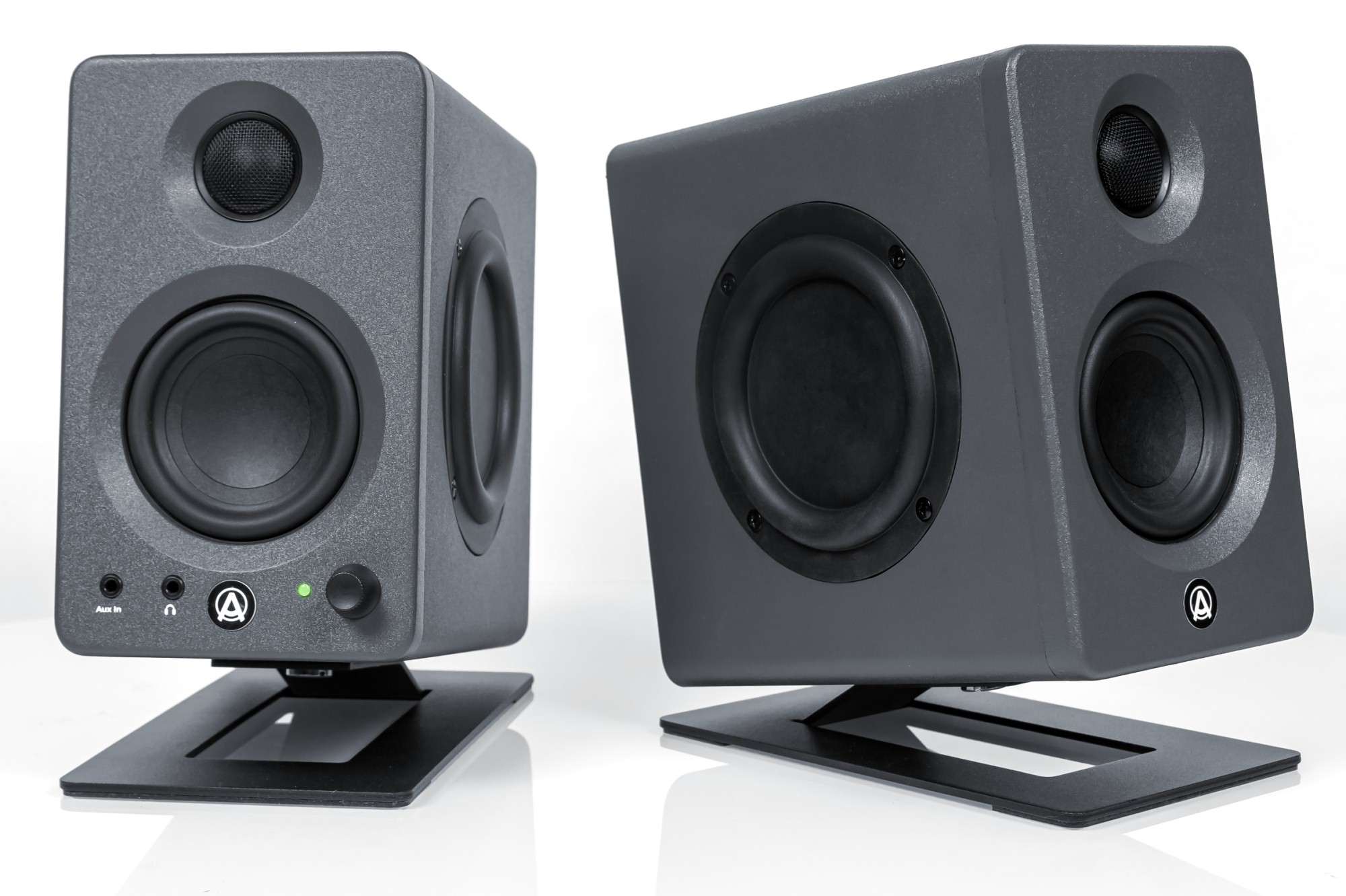
Creating full-range speakers in small cabinets is a difficult engineering task. Manufacturers use various solutions to extend bass response and produce a fuller sound. The DESK 3 USB uses passive radiators instead of conventional bass-reflex ports. Each speaker has two passive radiators, making the AuraSonics design interesting and unusual. Another notable feature is the wide choice of connections, uncommon in compact speakers. The DESK 3 USB provides analog and digital inputs, Bluetooth, and even a subwoofer output. Let us take a closer look.
AuraSonics DESK 3 USB specifications
| Drivers | |
| Woofer | 3" |
| Cone | Polymer |
| Tweeter | Fabric dome tweeter |
| Driver size | 0,75" |
| Passive bass radiator | 2 x 3,5" |
| Amplifier | |
| Amplifier type | Digital, Class D, 4 channels |
| Total power | 80 W |
| Crossover | 3 kHz |
| Connections | |
| Analog input | TRS, mini-jack |
| Digital input | USB (Type C), S/PDIF (RCA, Toslink) |
| Wireless | Bluetooth V5.3 |
| Headphone output | Mini-jack |
| Subwoofer output | RCA |
| Other specifications | |
| Frequency range | 42 Hz–20 kHz |
| Maximum SPL | 100 dB |
| Cabinet | MDF, vinyl laminate finish |
| Dimensions | 110 x 180 x 180 mm |
| Weight of both monitors | 2.99 kg |
The AuraSonics DESK 3 USB is an active two-way speaker pair with the amplifier in one cabinet. The woofers and tweeters have separate amplification. The passive speaker therefore connects through a special four-contact cable. This cable is 2 meters long, enough for convenient placement on a desk.
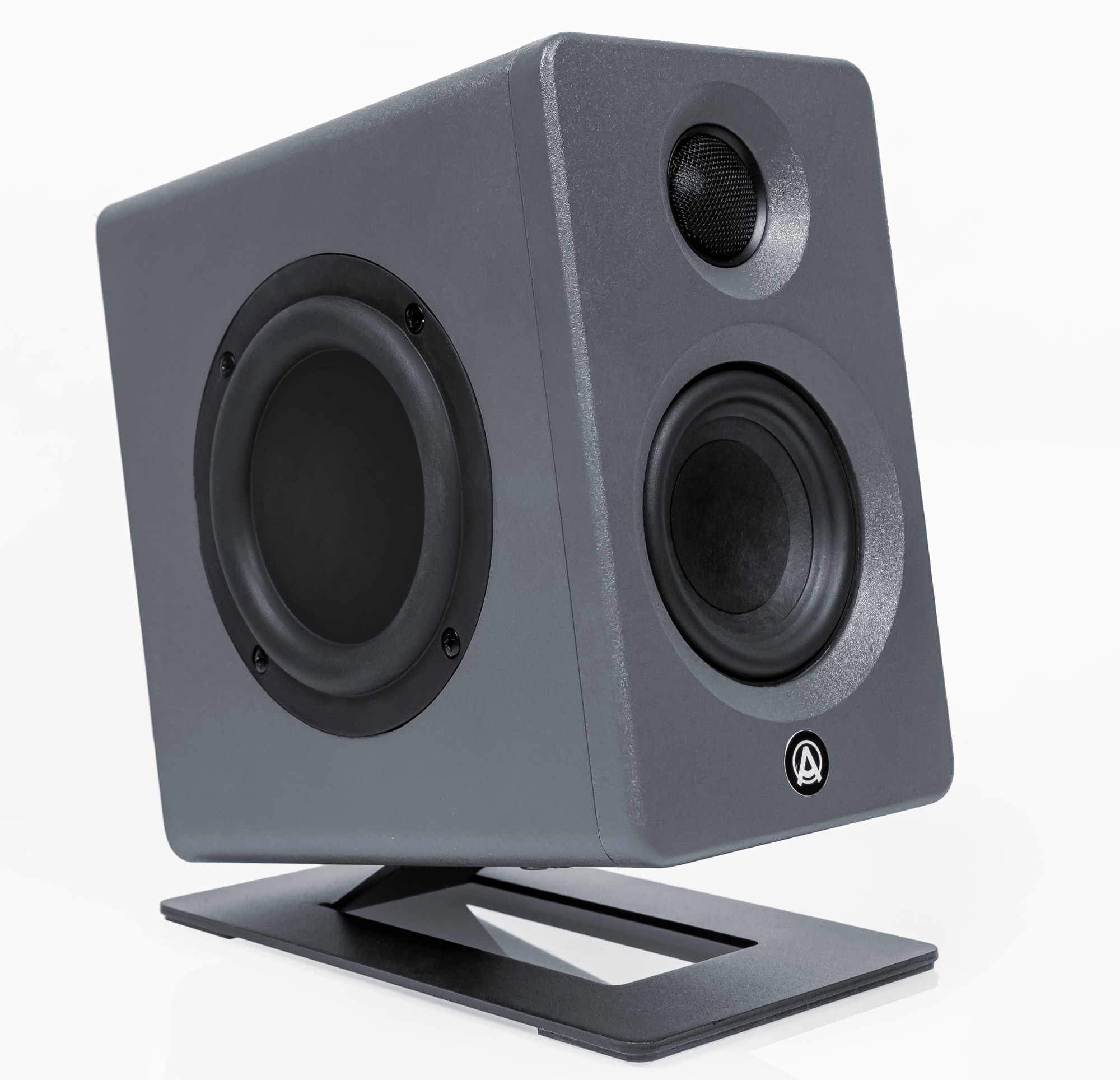
The monitor cabinets are made from MDF with a laminate finish. Passive radiators certainly increase manufacturing costs. However, this design makes the monitors even smaller and more attractive.
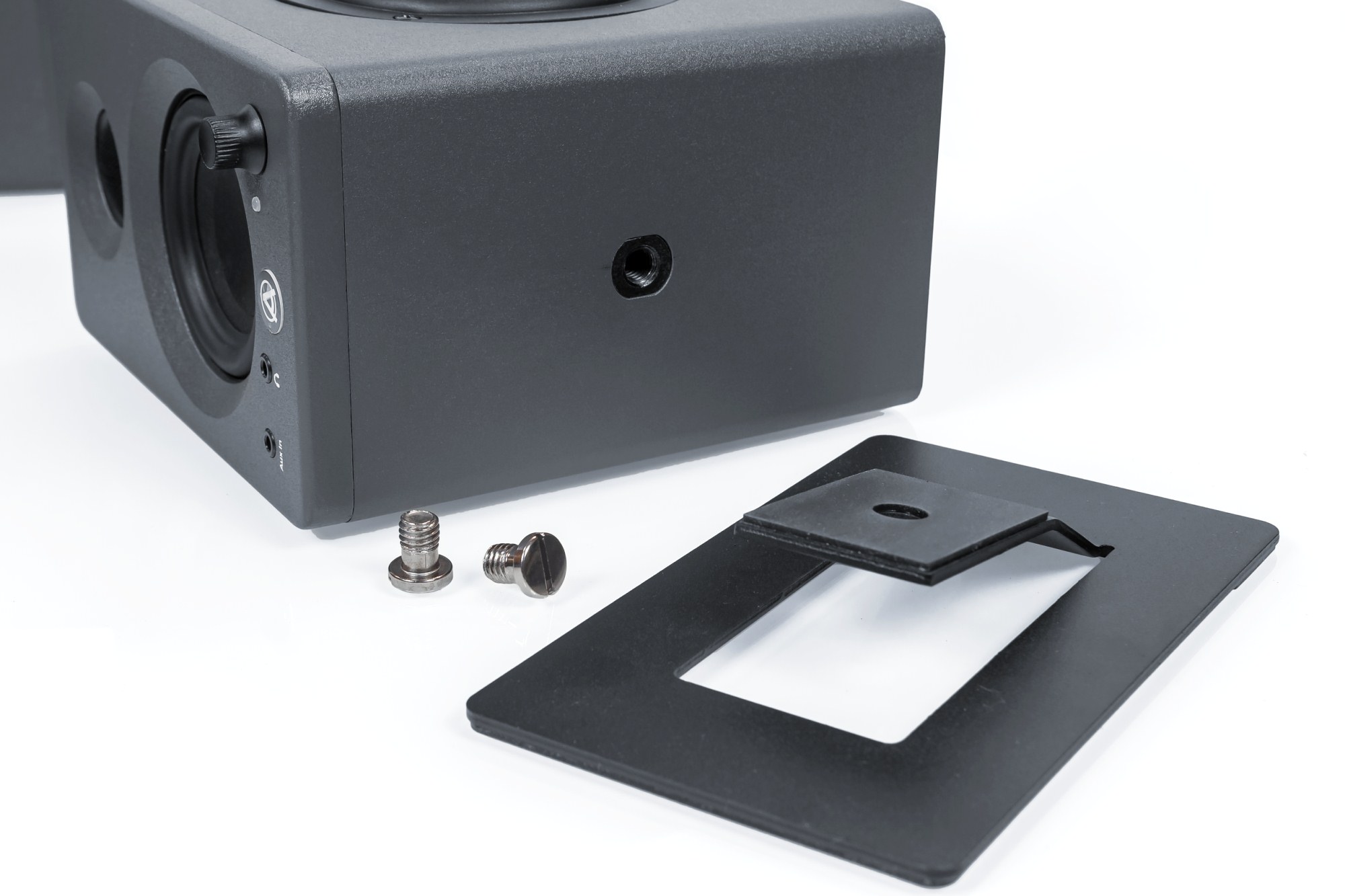
The DESK 3 USB monitors are intended mainly for use on a desk beside a computer. The supplied stands tilt the monitors toward the listener at the correct angle. These metal stands attach securely to the cabinets. Rubber pads at the contact points provide vibration isolation.
The monitors can also be mounted on straight vertical microphone stands. Standard 1/4-inch threaded mounting holes are provided.
Placement without the stands is possible too. Self-adhesive rubber pads are included for the user to attach to the cabinets.
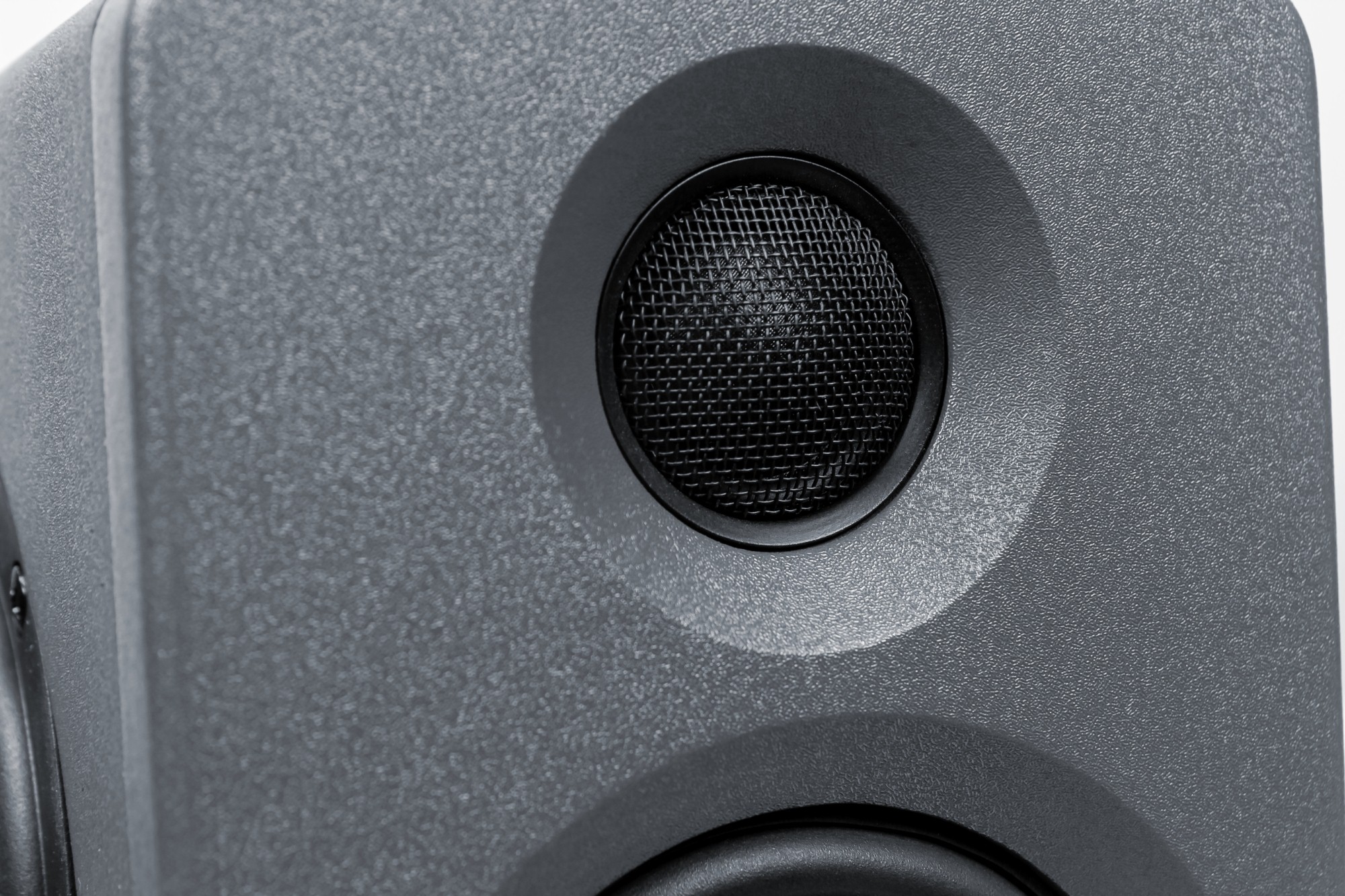
The drivers use conventional construction: a fabric dome tweeter and a three-inch woofer with a polymer cone and soft rubber surround. Both drivers use waveguides to widen dispersion.
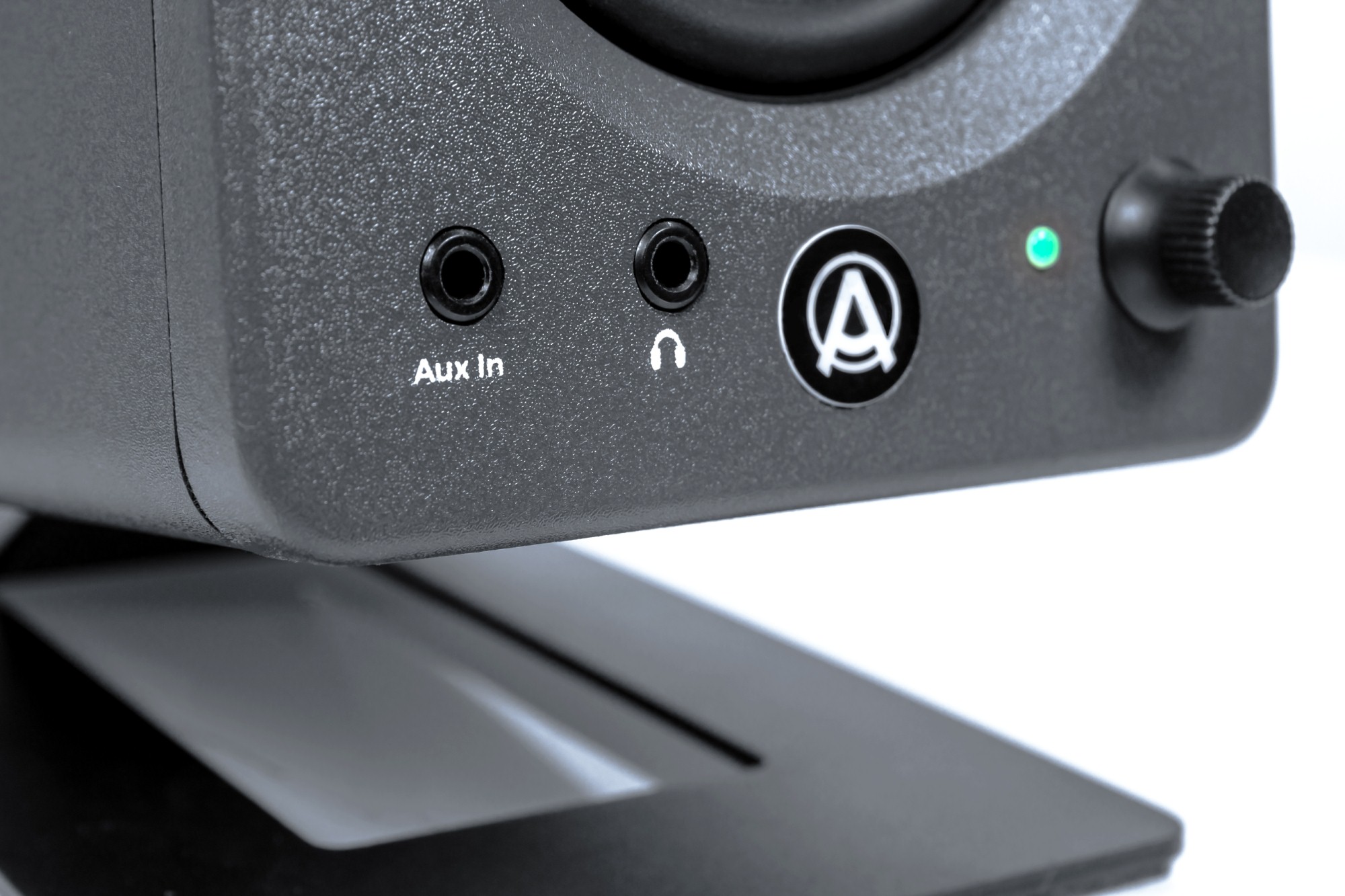
The main controls are at the bottom of the active speaker. There is a volume knob that also selects the input mode, a headphone output, and an additional line input. Connecting headphones automatically mutes the speakers.
The power indicator also identifies the operating mode. Green indicates the analog input; red and yellow indicate the digital inputs. Bluetooth is blue, while USB mode is purple.
All other controls and connection sockets are on the rear of the active monitor.
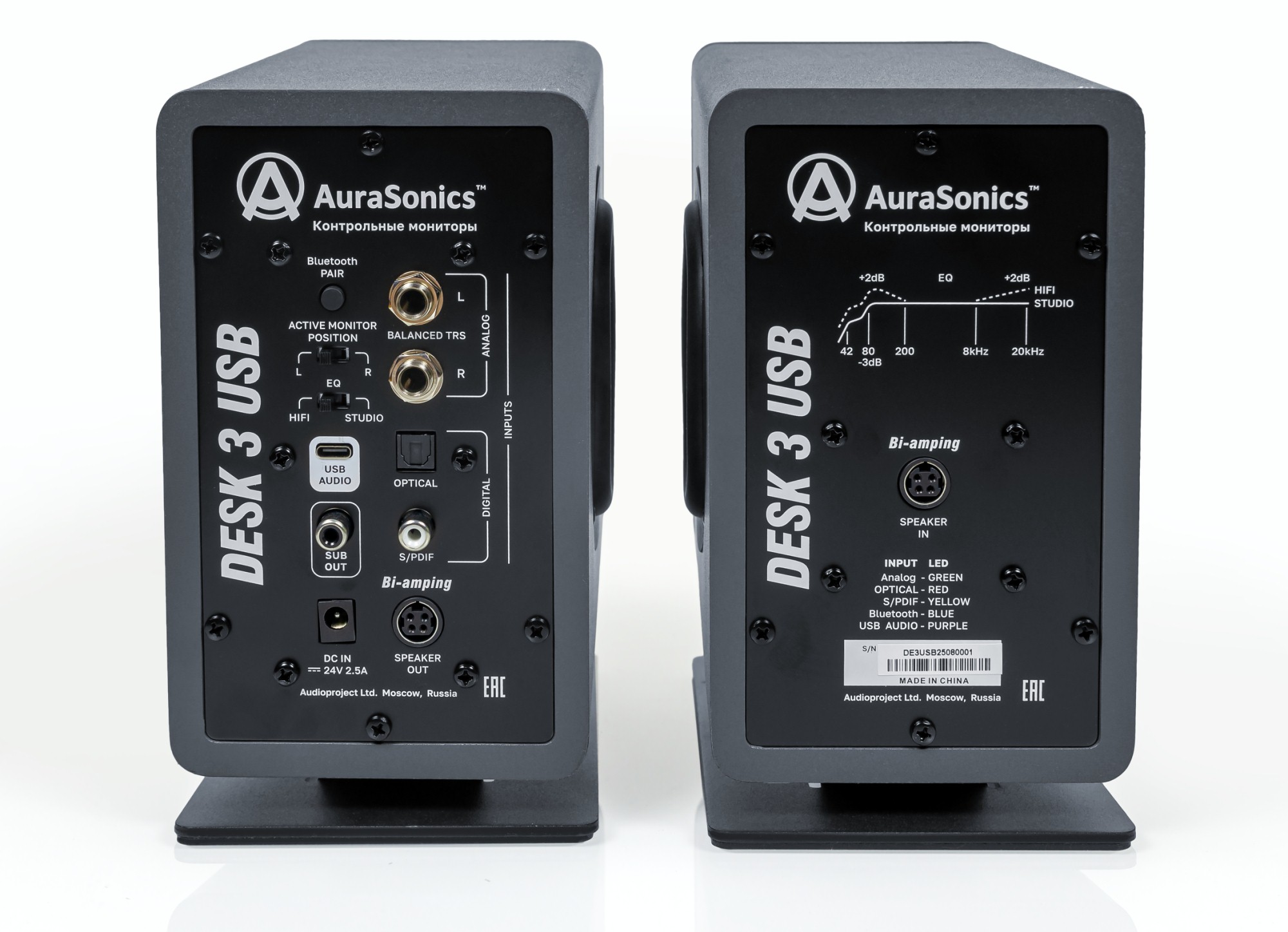
As noted above, the monitors offer many connection options. The balanced analog input uses TRS sockets. Digital audio can be connected through either coaxial or optical interfaces. A USB Type-C socket also provides direct computer connection. In this mode, a new playback device called DESK 3 appears in the operating system.
There is even a subwoofer output. It carries a mono signal made by summing the left and right channels. Its level follows the monitor volume, so one knob controls the whole system.
A channel selector lets the user place the speaker with the controls on either the left or the right. Set the switch to L if the active speaker is on the left, or R if it is on the right.
The monitors also offer two equalizer modes, HIFI and STUDIO. Our measurements will identify the affected frequencies and show all changes on the frequency-response graph.
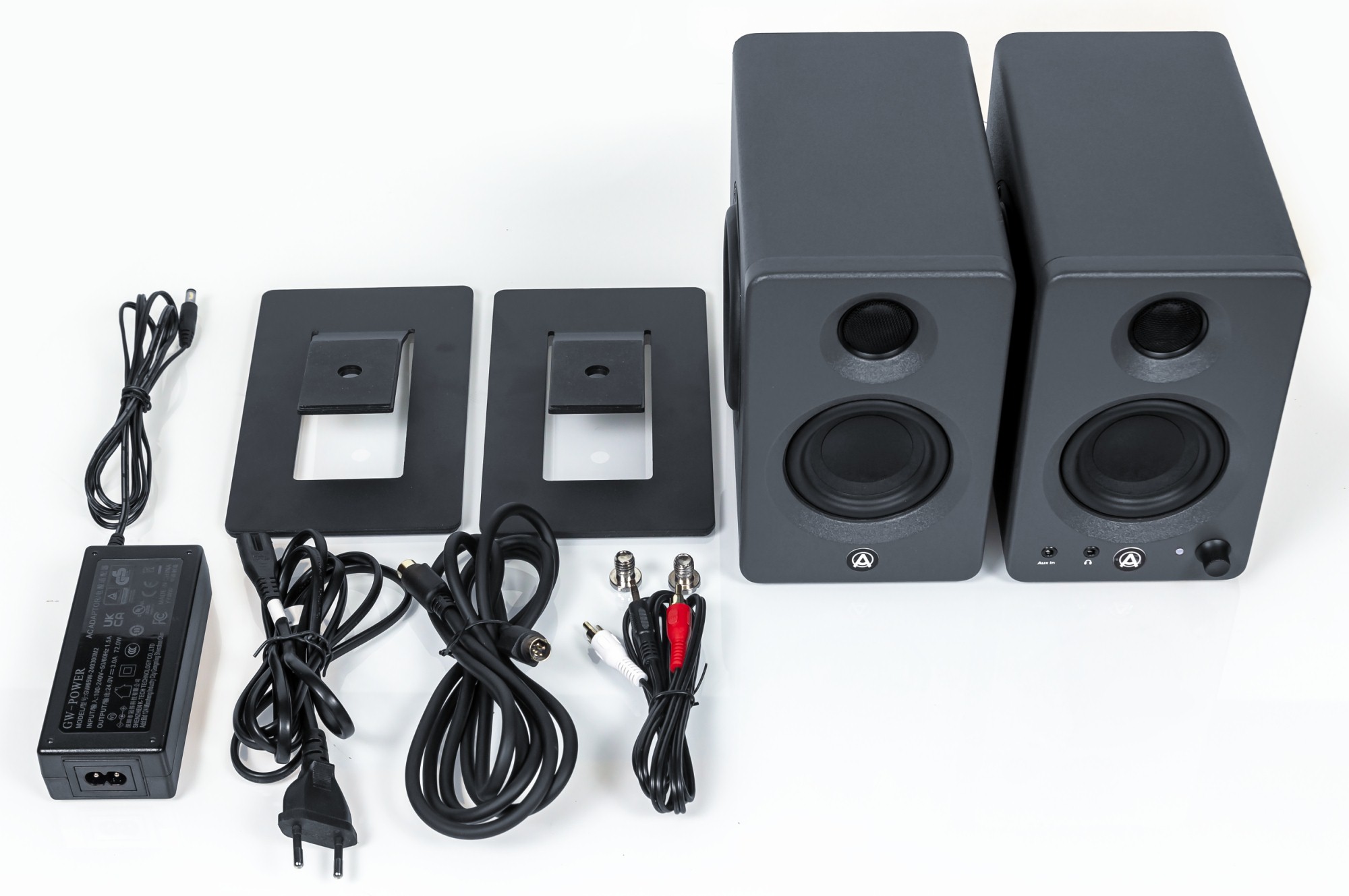


The AuraSonics amplifier operates in Class D. As in full-size monitors, each driver has separate amplification. Rated amplifier power is 30 W for each woofer and 10 W for each tweeter. This should be enough for compact speakers. An external 24 V adapter supplies power.
Measurements
Our measurements use the hardware and software measurement system RightMark™ Audio Analyzer PRO. We also use the measurement microphone Earthworks M50, with the following specified data:
- Microphone serial number: 92901C
- Microphone sensitivity at 1 kHz: 26.4 mV/Pa
- Microphone frequency-response variation from 20 Hz to 20 kHz: 0.2 dB
- Microphone frequency-response variation from 3 Hz to 50 kHz: +1/−3 dB (roll-off from 45 kHz)
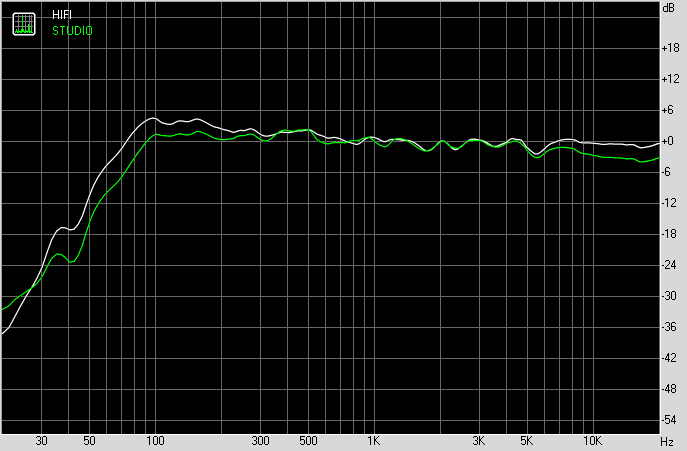
Frequency response measured on the tweeter axis
The response is reasonably flat across the operating range. Response variation is very good for inexpensive speakers. HIFI differs from STUDIO through bass and treble equalization. Our measurements show adjustments within 3 dB above 5 kHz and below 400 Hz.
Sound
The AuraSonics DESK 3 USB produces an impressive sound. The passive radiators have a clear purpose: bass performance is impressive for the size. These very small monitors sound bass-rich and reasonably full. When listening to music, we did not feel that bass was missing or that the lower register was disconnected from the rest of the sound. The DESK 3 USB cannot match full-size monitors in bass, especially in sound pressure and definition. Still, the bass fullness is very good for compact speakers.
For the fullest midrange and especially treble, listen on the driver axis. The monitors are somewhat directional. Moving off-axis can change the tone and reduce treble energy. On-axis listening therefore gives the fullest sound. It is useful that the supplied stands aim the monitors toward the listener. For background listening, however, these characteristics do not have a significant effect.
HIFI mode adds a little bass and treble for a more striking sound. The change is not very strong by ear, with bass showing the clearest difference. This mode is best used at lower volumes to avoid noticeable distortion, especially with bass-heavy music. In our opinion, the speakers sound most engaging in STUDIO mode at above-average volume.
Of the available connections, balanced analog is preferable when using a modern audio interface. Wireless connection gives the lowest sound quality.
Conclusions
After a close examination, we found the AuraSonics DESK 3 USB an interesting model worth considering. It is especially pleasing that development was led by the Russian company AudioProject. The key feature is clearly the passive radiators, which set the DESK 3 USB apart from other compact models. The radiators are not just attractive decoration: they make a useful contribution to bass fullness, one of the main challenges for portable speakers.
The AuraSonics DESK 3 USB looks modern and seems to offer connections for almost any situation. Sound quality is good for inexpensive compact speakers. The monitors are suitable both for music listening and for work.
Note. This is an adapted machine translation into English. It follows the “In simple terms” approach. Read the original article at https://prosound.ixbt.com/monitors/aurasonics-desk3usb.shtml.