
ADAM S3H — three-way active midfield monitors
Maxim Liadov
ADAM's new flagship S series differs significantly from all its earlier active monitors. It uses hardware DSP for the first time. This corrects driver frequency and phase response and accurately aligns all bands in the digital crossover.

The specifications immediately show the differences between the models. Each has its own newly developed drivers. Amplifier power and intended listening distance also differ: nearfield, midfield or main monitoring. Shared features are a cast-metal enclosure and an AMT tweeter called S-ART.
| S2V | S3V | S3H | S5V | S5H | |
| ELE woofer | |||||
| Number | 1 | 1 | 2 | 1 | 2 |
| Mounting diameter | 182 mm (7 inches) | 223 mm (9 inches) | 182 mm (7 inches) | 320 mm (12 inches) | 223 mm (10 inches) |
| Voice coil diameter | 39 mm (1.5") |
50 mm (2") |
39 mm (1.5") |
76 mm (3") |
76 mm |
| Cone material | Hexacone | Hexacone | Hexacone | Hexacone | Hexacone |
| DCH midrange driver | |||||
| Number | 1 | 1 | 1 | 1 |
|
| Mounting diameter | 100 mm (4 inches) | 100 mm (4 inches) | 100 mm (4 inches) | 100 mm (4 inches) | |
| Voice coil diameter | 60 mm (2.4 inches) | 60 mm (2.4 inches) | 60 mm (2.4 inches) | 60 mm (2.4 inches) | |
| Cone material | Carbon- Composite |
Carbon- Composite |
Carbon- Composite |
Carbon- Composite |
|
| S-ART tweeter | |||||
| Number | 1 | 1 | 1 | 1 | 1 |
| Diaphragm area | 4" (2420 mm²) |
4" (2420 mm²) |
4" (2420 mm²) |
4" (2420 mm²) |
4" |
| Equivalent dome diameter | 56 mm (2.2 inches) | 56 mm (2.2 inches) | 56 mm (2.2 inches) | 56 mm (2.2 inches) | 56 mm (2.2 inches) |
| Air velocity ratio | 4:1 | 4:1 | 4:1 | 4:1 | 4:1 |
| Amplifier | |||||
| Bass amplifier | 1 | 1 | 2 | 1 | 2 |
| Type | Class D | Class D | Class D | Class D | Class D |
| Power | 300 W | 500 W | 500 W (×2) | 700 W | 700 W (×2) |
| Midrange amplifier | 1 | 1 | 1 | 1 |
|
| Type | Class D | Class D | Class D | Class D | |
| Power | 300 W | 300 W | 300 W | 300 W | |
| Treble amplifier | 1 | 1 | 1 | 1 | 1 |
| Type | Class A/B | Class A/B | Class A/B | Class D | Class D |
| Power | 50 W | 50 W | 50 W | 100 W | 100 W |
All models have an AES digital input as standard. A balanced analogue XLR input is also provided.
| S2V | S3V | S3H | S5V | S5H | |
| Settings | |||||
| Input sensitivity | Adjustable | Adjustable | Adjustable | Adjustable | Adjustable |
| Parametric EQ | 6x | 6x | 6x | 6x | 6x |
| Low-pass filter | 1x | 1x | 1x | 1x | 1x |
| High-pass filter | 1x | 1x | 1x | 1x | 1x |
| Presets | 5x | 5x | 5x | 5x | 5x |
| Delay | 0 to 5 ms | 0 to 5 ms | 0 to 5 ms | 0 to 5 ms | 0 to 5 ms |
| Connectors | |||||
| Analog input | XLR | XLR | XLR | XLR | XLR |
| Impedance | 48 kohms | 48 kohms | 48 kohms | 48 kohms | 48 kohms |
| Maximum input level | +24 dBu | +24 dBu | +24 dBu | +24 dBu | +24 dBu |
| Digital input | AES3 | AES3 | AES3 | AES3 | AES3 |
| General specifications | |||||
| Frequency response | 35 Hz–50 kHz | 32 Hz–50 kHz | 32 Hz–50 kHz | 26 Hz–50 kHz | 24 Hz–50 kHz |
| THD above 100 Hz | <0,4% | <0,4% | <0,4% | <0,3% | <0,3% |
| Maximum peak SPL, pair at 1 m | ≥ 120 dB | ≥ 124 dB | ≥ 126 dB | ≥ 128 dB | ≥ 131 dB |
| Crossover | 3 kHz | 250 Hz / 3 kHz | 250 Hz / 3 kHz | 250 Hz / 3 kHz | 250 Hz / 3 kHz |
| Weight | 11 kg | 25 kg | 26.6 kg | 52 kg | 72.6 kg |
| Dimensions | 346 × 222 × 338 mm | 536 × 293 × 380 mm | 280 × 585 × 380 mm |
698 × 390 × 520 mm |
430 × 885 × 500 mm |
Today we test the professional ADAM S3H, with two 7-inch woofers. It covers both nearfield and midfield monitoring. To monitor the lowest frequencies, a listening distance of at least 3 metres is recommended.
A powerful amplifier is essential in a treated studio control room with bass traps, absorption and wall diffusers. Around half the acoustic energy is absorbed to reduce early and late reflections. Volume headroom therefore matters greatly. Ordinary monitors in such a studio may struggle, distort and fail to deliver their full sound.

The cast-metal enclosure brings each monitor's weight to an impressive 26 kg. The structure is strong and well damped, with no unwanted noises even at very high volume. The S3H reaches 126 dB maximum SPL, much higher than ordinary active monitors.
The following information is based on the manufacturer's website:

The new S-ART tweeter is handmade at the Berlin factory, like X-ART in previous ADAM monitors. The assembly method has changed and testing is more extensive. The tweeter delivers natural dynamics and accurately follows sudden signal changes.

ADAM Audio engineers developed the 100 mm (4-inch) midrange driver for the S series as a hybrid of dome and cone designs. Its very rigid single-piece diaphragm combines the clean decay and linear response down to 200 Hz of a dome with the long excursion of a cone. The result is greater clarity in the critical midrange, without distortion even at high volume.
The DCH driver diaphragm (Dome, Cone, Hybrid) uses a special laminated carbon-fibre composite. The driver maintains piston motion up to 8 kHz without cone breakup, even at high volume. This avoids unwanted resonances and coloration across its operating range. The driver also sits closer to the S-ART tweeter. Several features come from the ELE woofer: the surround, spider, magnet system, ventilation, anodized basket and large 65 mm (2.5-inch) voice coil. There are differences too, including a foam surround.
The woofer uses ELE, short for Extended Linear Excursion. ADAM engineers developed it specifically for the S series. Three components were designed together: the driver, enclosure and bass-reflex system. Engineering calculations and modern computer modelling balanced low moving mass, internal damping and a very rigid honeycomb cone. The basket was designed to eliminate unwanted resonances and distortion. The resulting woofer offers clear, transparent sound even at high SPL.

Another important ELE feature is the spider. Its movement stays linear at large excursions in either direction, allowing low-distortion bass at high SPL. Unlike comparable systems, low-frequency output is not restricted and the original dynamics are preserved. A soft spider would allow uncontrolled movement at high SPL. The S series spider instead controls the cone and returns it to its starting position. It is very strong and supports low-distortion reproduction throughout the frequency range.
The surround is also more flexible than many current designs. This increases useful cone travel, improves dynamics and reduces distortion. Finally, the anodized basket removes heat efficiently to keep the driver cool.
The woofers also use SMA, Symmetrical Magnet Assembly. Compared with previous drivers, it triples the linear magnetic field region in which the voice coil moves. The cone can therefore move more air while remaining linear, producing higher SPL. Bass remains accurate and free of distortion even at greater excursion. Rounded ventilation openings reduce turbulence and unwanted noise.
In the S2V, S3H and S3V, parabolic magnet sections prevent unwanted field modulation and significantly reduce harmonic distortion. Anti-modulation rings keep the magnetic field symmetrical and minimize intermodulation distortion.
A modern DSP handles digital processing. Settings can be adjusted with a push encoder and OLED display, or through the free ADAM Audio S Control application over USB.
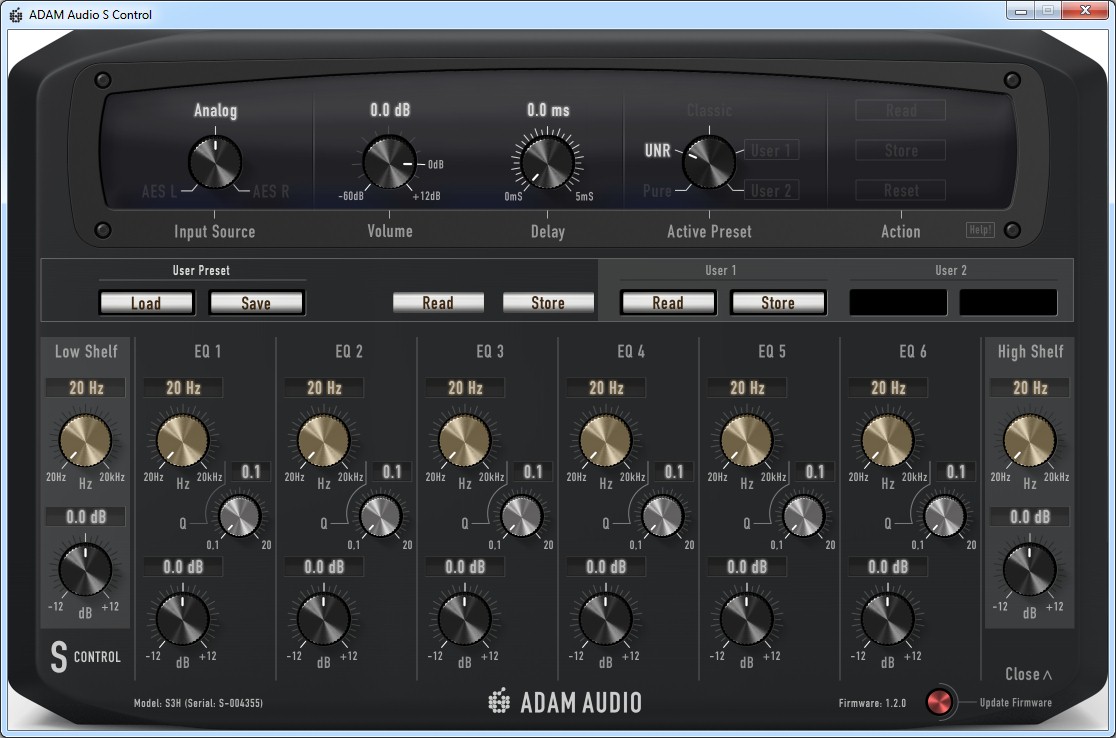
The controls compensate for room peaks, dips and uneven absorption at different frequencies. There are 8 fully adjustable parametric EQ sections: cutoff filters at the range limits and adjustable-Q filters in between. All settings can be saved as presets.
Listening
We can fairly be called ADAM supporters. At the time of our S3V review, we owned 3 ADAM monitor models; now we own 5. That reflects a deliberate choice rather than chance. We have also spent a long time listening to every ADAM model, from compact three-inch speakers with a subwoofer to huge main monitors that needed five people to carry them into the room.
The ADAM S3H is our clear favourite for sound quality. We liked it much more than the new series' S2V and S3V. Treble clarity is similar across the range, but S3H midrange detail is much better. The bands also seem best integrated in this model. S2V and S3V have different enclosures, amplifiers and drivers. Firmware may also play a part: the crossovers are fully digital, and newer firmware may have improved the filters. We heard the smaller models with firmware 1.0 at the very start of sales, when our impressions were less positive. The S3H's higher price may also allow better construction and components with fewer compromises. Bass quantity seemed no greater than in other 7-inch monitors, but it was fast. For deep sub-bass, a subwoofer remains necessary: replacing one is not the S3H's job. For a wider range, ADAM offers 10-inch and 12-inch drivers in the S5V and S5H.
The factory presets are useful. Pure, based on flat anechoic response, sounded worst to us. Its purpose is unclear; it may suit listeners who judge sound by measurements alone. To our ears, the result was dull. UNR, tuned in real studios, sounded best and also gave the flattest response at our listening position. Another mode simulates the S3A for users familiar with classic ADAM models. All the controls needed for personal room adjustment are available too.
Measurements
Our measurements use the hardware and software measurement system RightMark™ Audio Analyzer PRO. We also use the measurement microphone Earthworks M50, with the following specified data:
- Microphone serial number: 92901C
- Microphone sensitivity at 1 kHz: 26.4 mV/Pa
- Microphone frequency-response variation from 20 Hz to 20 kHz: 0.2 dB
- Microphone frequency-response variation from 3 Hz to 50 kHz: +1/−3 dB (roll-off from 45 kHz)

We measured frequency response with the second preset, UNR, in a treated room with bass traps and acoustic panels. The 4 drivers are spread across the baffle, so the microphone is inevitably off-axis to some of them. The graph changes significantly as the microphone moves. Interestingly, moving the listener over the same area does not change the perceived timbre. Human hearing differs greatly from a measurement microphone: ears do not point directly at the source and average incoming sound, including a significant amount of reflected energy. These measurement limitations explain why perceived timbre does not exactly match the graphs. Still, measurements across the sound field confirmed that the ADAM S3H's average response is flat and matches its specifications. The official anechoic graph, measured at 4 metres, is shown below:

We can only hope that users have a properly treated studio suited to large midfield monitors. Response down to 30 Hz in an arbitrary room may create standing-wave problems and prevent the monitors from performing at their best.

The phase performance graph, shown as group delay in milliseconds, is equally interesting. It is completely flat down to 100 Hz, indicating good alignment of the three bands. A flat line across the whole range without technical compromise would require main monitors with 12-inch or larger drivers, placing still greater demands on the room. The ADAM S3H therefore offers a good balance between size, weight and performance. Further improvement, and higher prices, are always possible.
Conclusions
We liked the ADAM S3H much more than the S2V and S3V. We think the 7-inch drivers cover the most important range more effectively and with good clarity. Frequencies below 50 Hz still need to be checked on main monitors or a subwoofer.
The ADAM S3H's main strengths are excellent midrange and treble quality and high SPL for midfield listening. It is best suited to a professional recording studio with a treated control room. By the standards of three-way studio monitors in this class, its price is reasonable and attractive.
Note. This is an adapted machine translation into English. It follows the “In simple terms” approach. Read the original article at https://prosound.ixbt.com/monitors/adam-s3h.shtml.