
Zoom ZDM-1 Podcast Mic Pack — a podcasting bundle with a dynamic microphone and headphones
Ready-made streaming and recording bundles have become popular. Manufacturers offer many combinations at different prices. Zoom's ZDM-1 Podcast Mic Pack contains a microphone and headphones. The included software is Steinberg's WaveLab Cast.
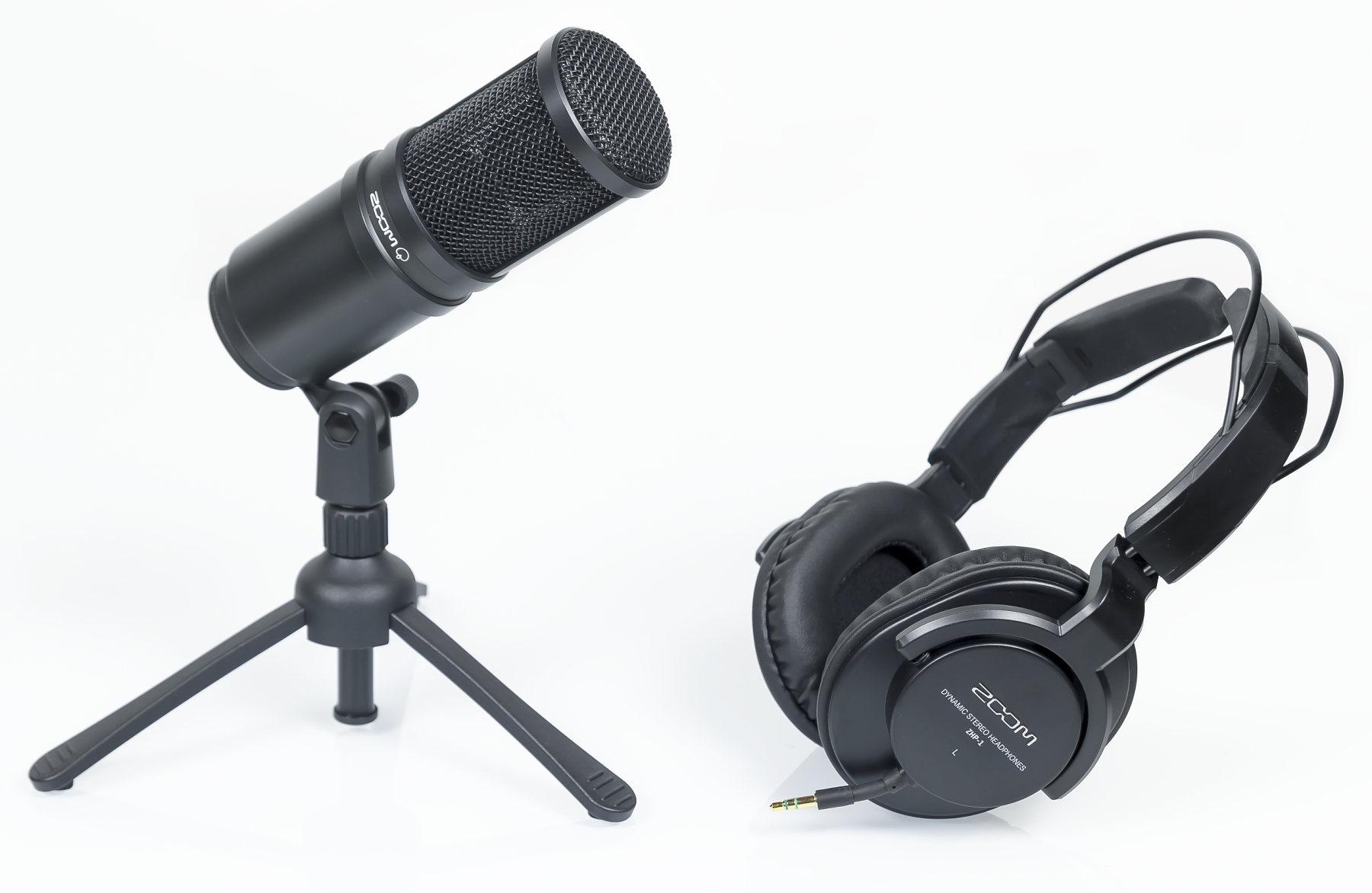
Notably, the Zoom ZDM-1 PMP includes a dynamic microphone. Similar recording bundles usually use condenser microphones, which pick up background sounds readily and require phantom power. A dynamic microphone is less demanding, needs no phantom power, and focuses on the source in front. The ZDM-1 is therefore preferable in an untreated room or noisy conditions.
Zoom ZDM-1 Podcast Mic Pack specifications
| ZDM-1 microphone | |
| Type | Dynamic |
| Polar pattern | Supercardioid |
| Frequency range | 50 Hz–18 kHz |
| Sensitivity | -54 dBV |
| Output impedance | 200 ohms |
| Minimum load impedance | 200 ohms |
| Maximum SPL | 135 dB |
| Connections | XLR |
| Dimensions | 150 × 54 mm |
| Weight | 400 g |
| ZHP-1 headphones | |
| Type | Dynamic, closed-back |
| Drivers | 40 mm |
| Sensitivity | 97 ±1.5 dB (1 mW) at 1 kHz |
| Frequency range | 10 Hz–20 kHz |
| Power handling | 200 mW |
| Impedance | 68 ohms |
| Earpad material | Artificial leather |
| Cable length | 3 m |
| Connections | Mini-jack |
| Weight | 220 g |
| Package contents | |
| Microphone, microphone cable, foam windscreen, desktop stand, headphones, headphone cable, 1/4-inch TRS adapter, Steinberg's WaveLab Cast software | |

Bundle components are usually sold separately too. At present, only the microphone from the ZDM-1 Podcast Mic Pack is available separately; the ZHP-1 headphones should follow soon. Buying the package also adds a desktop microphone stand and cable.

The ZDM-1 looks like a studio microphone, with a conventional cylindrical cast-metal housing and fine metal grille at the top. A foam windscreen protects the diaphragm from breath. It reduces the low-frequency energy of plosives very effectively while barely affecting treble. We recommend it for close voice recording.
According to the manufacturer, the ZDM-1 can handle very loud sound, with a stated maximum SPL of 135 dB. With the right gain setting, microphone clipping should therefore be very unlikely.
The microphone has one fixed supercardioid polar pattern. Its capsule points directly toward the top, so that end must face the source for a full recording. It cannot record several people sitting around it. Although the side mesh resembles a condenser microphone's grille, little sound is picked up from the sides.

The open-housing photo shows the internal design. The ZDM-1 diaphragm faces upward in a special frame that reduces housing noise and vibration. The microphone also suppresses electromagnetic interference from power lines, computer monitors, mobile phones, and other equipment.

A bracket attached to the bottom mounts the microphone on a stand or boom arm. The supplied folding Zoom TPS-4 desktop stand places it 25–30 cm above the desk. The tripod is stable and height-adjustable. Rubber feet prevent sliding and add some vibration isolation. A standard XLR connector provides the audio connection, with a 2 m cable included.

The ZDM-1 recording quality pleasantly surprised us. An inexpensive microphone often brings compromises such as boomy bass or reduced treble. Neither problem is present here. Sound quality is very good, and voice sounds pleasant even without processing. Its capabilities are similar to the more expensive Shure BETA 58A handheld microphone, an excellent result. A small treble rise improves clarity without sounding exaggerated or strongly colored. The foam windscreen slightly reduces sibilants and makes the highs calmer. Midrange is fairly neutral and bass is complete. Proximity effect is present but not strong enough to deserve special concern.
Like all desktop microphone stands, the TPS-4 does not provide enough isolation from desk impacts, such as typing. Ideally, use a floor stand or boom arm with a shock mount.
ZHP-1 headphones
The Zoom ZHP-1 headphones are a full-size closed-back model with over-ear pads. The structure does not fold. Only the earcups move, rotating relative to their supports.


The headphones are very light at 220 g and sit comfortably. Two metal bands form the headband. There is no manual height adjustment; cushioned supports maintain the required position.

The headphones use 40 mm dynamic drivers. The photo shows the earcup interior. The diaphragm is centered and protected by a plastic grille. Fabric adds internal damping. Stated sensitivity is 97 dB and nominal impedance 68 ohms.
The oval foam earpads have artificial-leather covers. There is enough space inside to avoid extra pressure on the ears. In our view, however, the pads are a little firm.

The cable is detachable, but unlike most models, its connector is on a short cable coming from the earcup rather than on the cup itself. A plastic clip locks the two connectors together. A hard pull on the long cable still separates them without damaging the connection. The straight cable is 3 meters long and ends in a mini-jack. A 1/4-inch TRS adapter is included.
Overall sound quality is good. For an affordable closed-back model, the ZHP-1 is fairly balanced without one frequency range dominating. Its main characteristics are slightly emphasized treble and a relatively natural midrange. It is suitable for checking voice tone. Isolation is typical for closed-back headphones: some sound escapes at high volume, but not enough to be critical during recording.
Frequency response measurements
Measurements used the software and hardware system, RightMark™ Audio Analyzer PRO. We used a Danish-made Brüel & Kjær 4153 Artificial Ear/Ear Simulator (IEC 60318-1)

These measurements are for reference only and should not be used to guess the model's sound. The Brüel & Kjær simulator effectively reproduces ear acoustic impedance up to 16 kHz.

Zoom ZHP-1 headphone frequency response graph
Overall, the ZHP-1 measurements are typical of affordable closed-back headphones. The graph has an even midrange and small rises at the extremes. Treble EQ can soften the high-frequency sound if desired.
Conclusions
Zoom's podcast bundle is very interesting, mainly because the microphone is an excellent model in its own right. The headphones are less outstanding, but make sense and fit the package well. The ZDM-1 Podcast Mic Pack is inexpensive, so it can also be viewed as an expanded ZDM-1 microphone package with more accessories.
Note. This is an adapted machine translation into English. It follows the “In simple terms” approach. Read the original article at https://prosound.ixbt.com/microphones/zoom-zdm-1pmp.shtml.