
Thronmax MDrill ONE, MDrill ONE PRO, MDrill GHOST, MDrill Zone, MDrill ROSA, M8 PRO — affordable, eye-catching microphones for streamers
The company Thronmax focuses mainly on microphones for streamers and bloggers. Its range currently includes about twenty USB microphone models with stylish designs and distinctive lighting. The manufacturer also offers interesting boom arms and monitor mounts with good looks and thoughtful construction.
Today we will look at the MDrill microphones, which form the core of Thronmax's range.
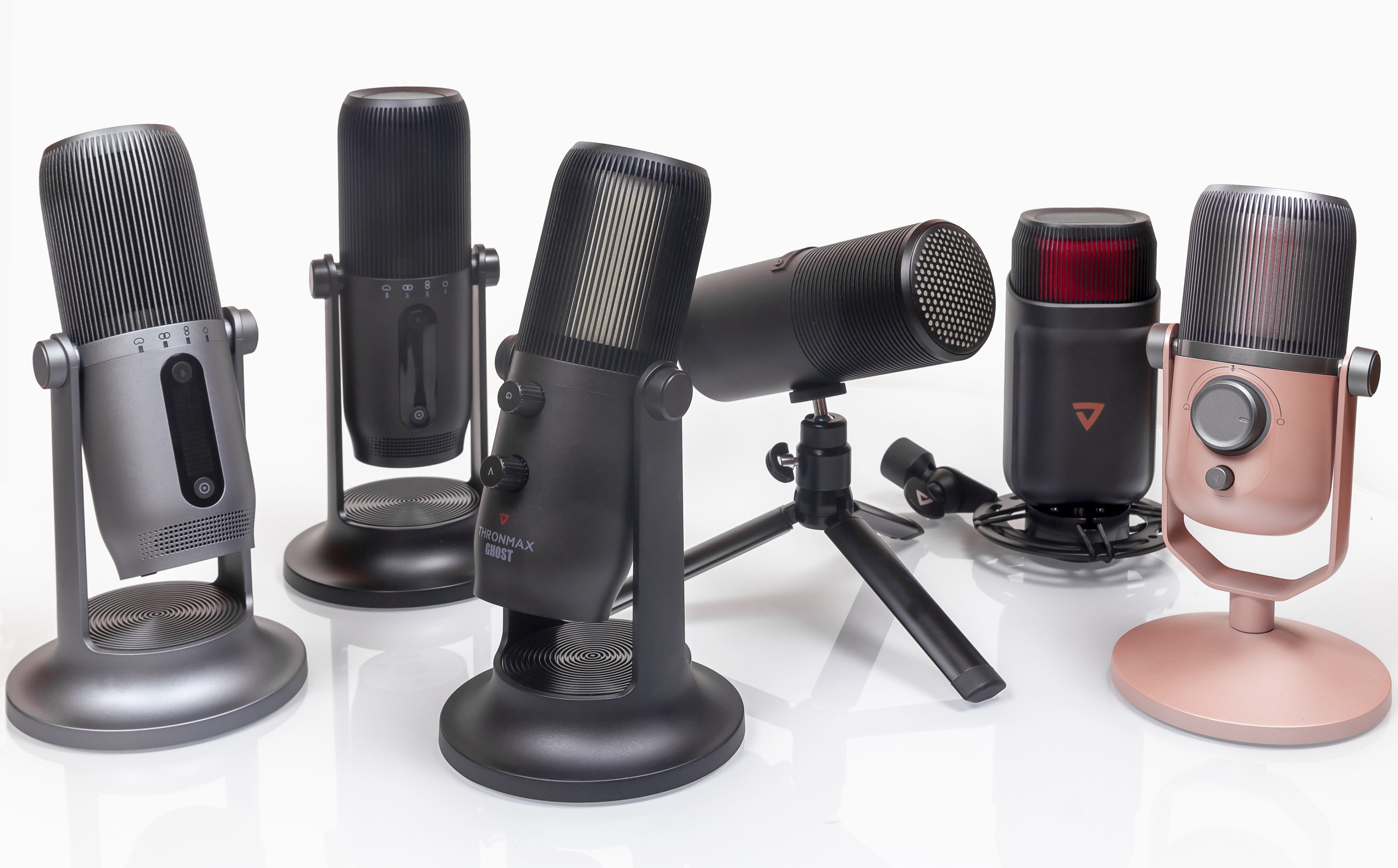
Thronmax microphones are affordable mass-market products for a broad audience, from beginners to streamers who value convenience and appearance. Among many competitors, they stand out with bright designs, lighting, and multiple capsules that allow different polar patterns.
MDrill ONE
The MDrill ONE is the simplest model in the series. Its main difference from the other USB models is recording format: it supports only 16-bit/48 kHz computer recording.
Three identical 16 mm capsules provide four pickup modes: cardioid, figure-eight, stereo, and omnidirectional. Black and silver versions are available; the photo shows silver.
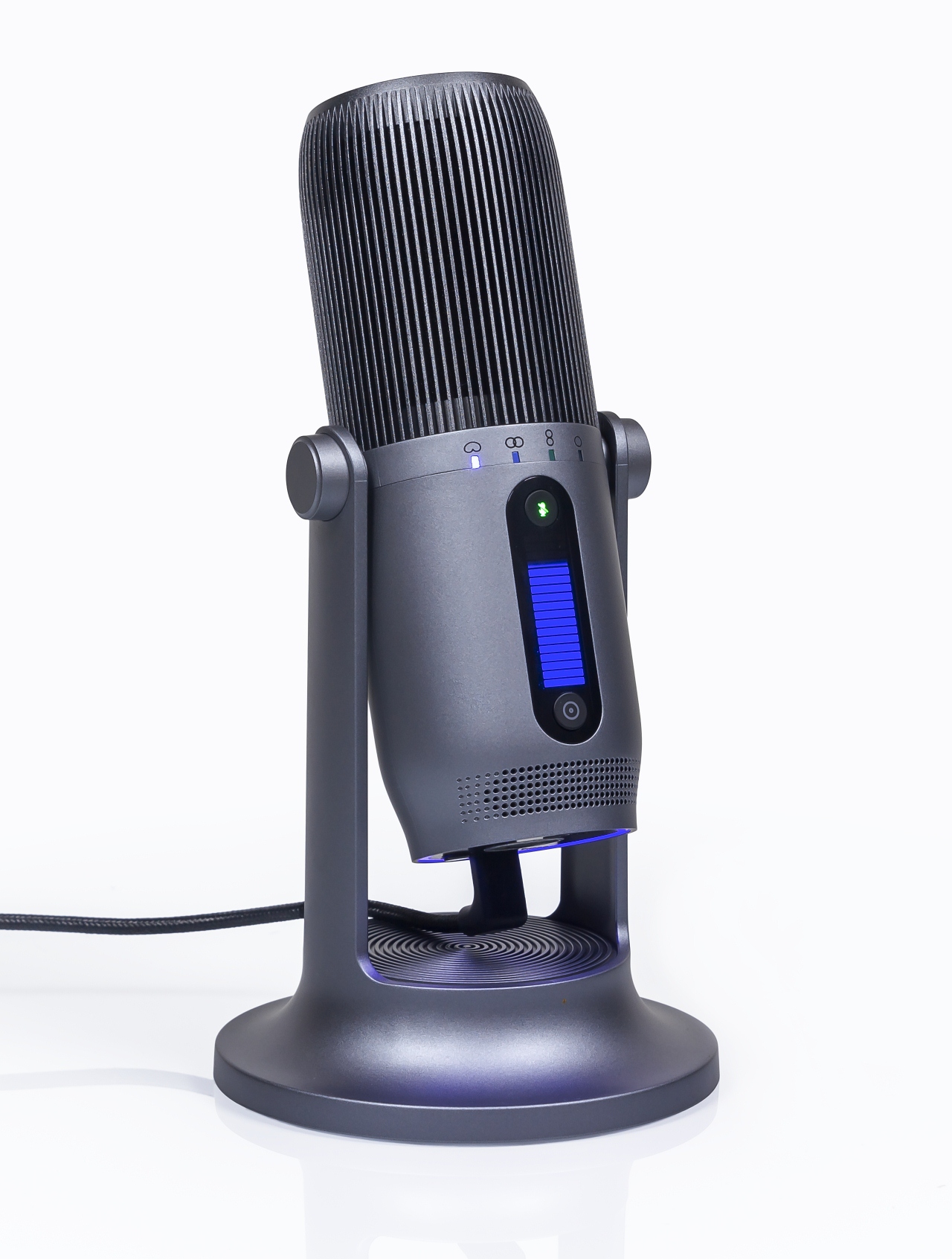
Thronmax microphones share similar, and sometimes identical, structures and controls. The base and lower housing are plastic. The metal top uses a lengthwise grille rather than conventional mesh. This original construction gives the microphones a distinctive appearance.
The microphones are intended mainly for desktop use. Their weighted bases hold them securely in different positions. A rubber pad underneath provides some vibration isolation. Stand mounting is also possible through two standard threaded holes at the microphone's bottom.
MDrill ONE specifications
| Type | Condenser |
| Capsule | 3 × 16 mm electret capsules |
| Polar pattern | Cardioid, stereo, figure-eight, omnidirectional |
| Frequency range | 20 Hz–20 kHz |
| Operating formats | 16-bit, 48 kHz |
| Connections | USB Type C |
| Lighting | 7 modes |
| Display and indicators | Gain and headphone volume |
| Headphone output | Mini-jack |
| Power | 180 mW |
| Impedance | 16 ohms |
| Frequency range | 15 Hz–22 kHz |
| Hardware controls | Gain, volume, mute, pickup mode and lighting selection |
| Package contents | Microphone on a stand, USB connection cable |
Like other good USB microphones, the MDrill ONE has a mini-jack headphone output for direct, latency-free monitoring. Its output power is modest but sufficient for typical low-impedance headphones.
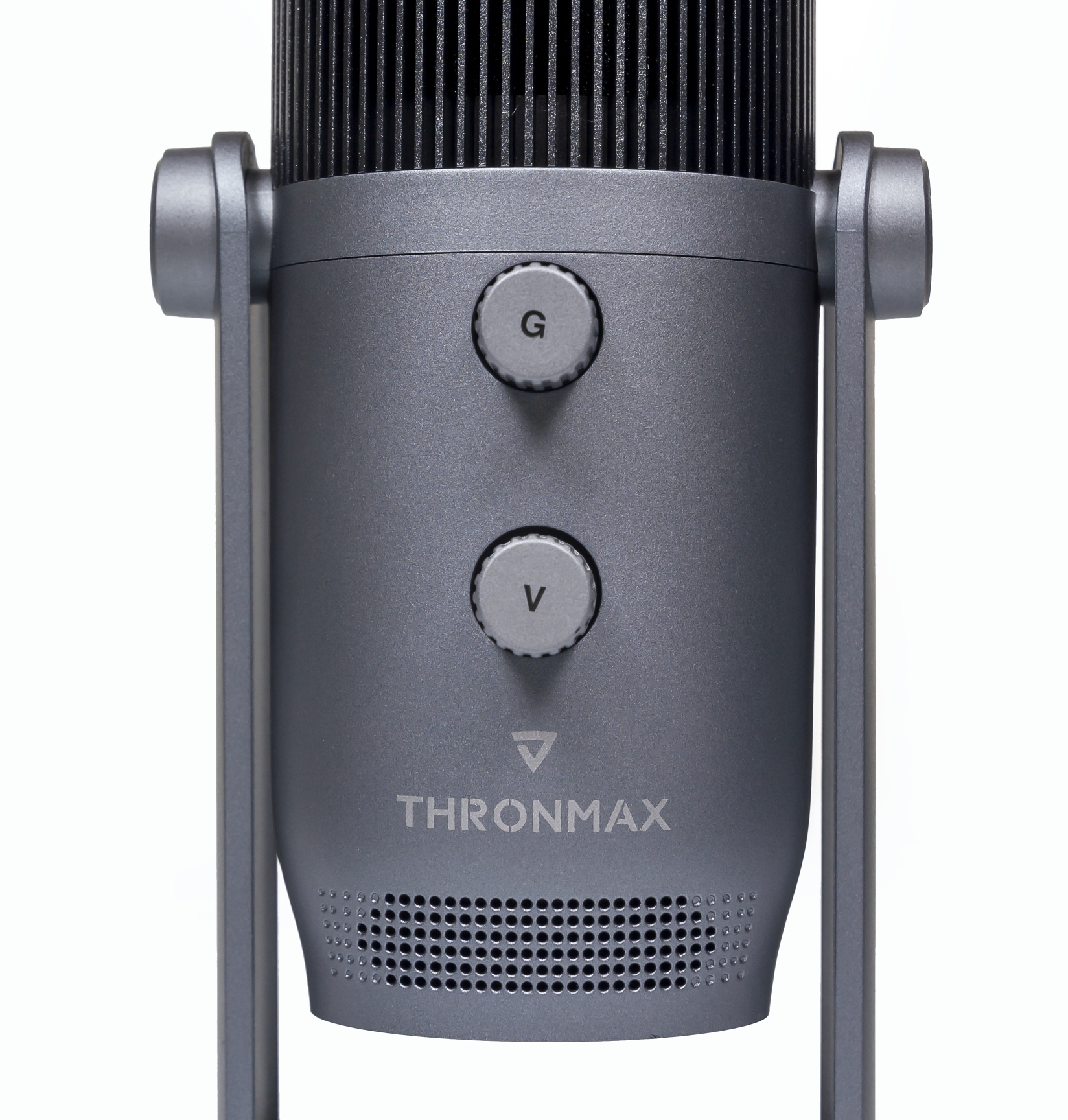
Separate rear controls adjust headphone volume and microphone sensitivity. Bright front indicators make level adjustment easier: green for gain and blue for headphone volume. There is no balance control between microphone monitoring and general playback, and no clipping indicator.
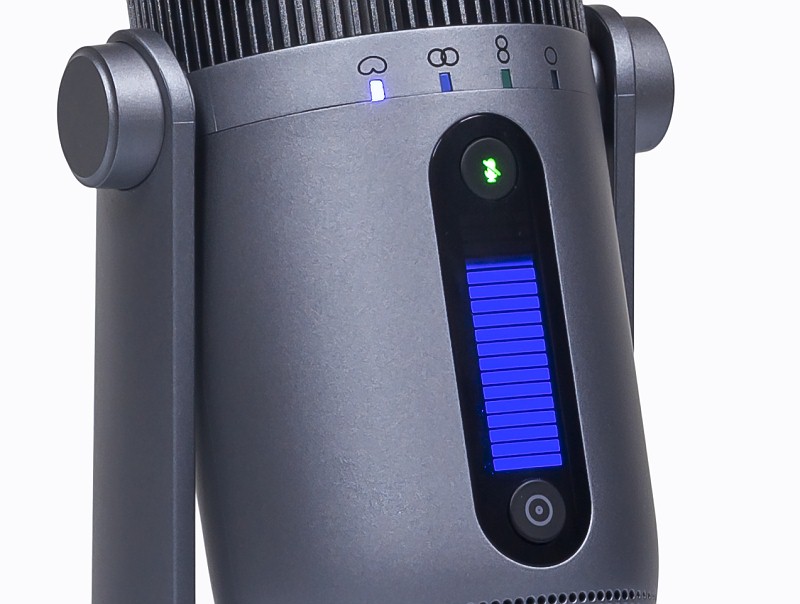
The lower button with a circle symbol selects pickup mode. The microphone-symbol button temporarily mutes the signal sent to recording, while headphone monitoring continues.
The MDrill ONE has lighting only at the bottom. An LED ring lights the area beneath the microphone in one of seven colors. A button underneath changes the mode. Lighting can also be switched off.
MDrill ONE PRO
The MDrill ONE PRO is otherwise identical but has better electronics supporting 24-bit/96 kHz recording.
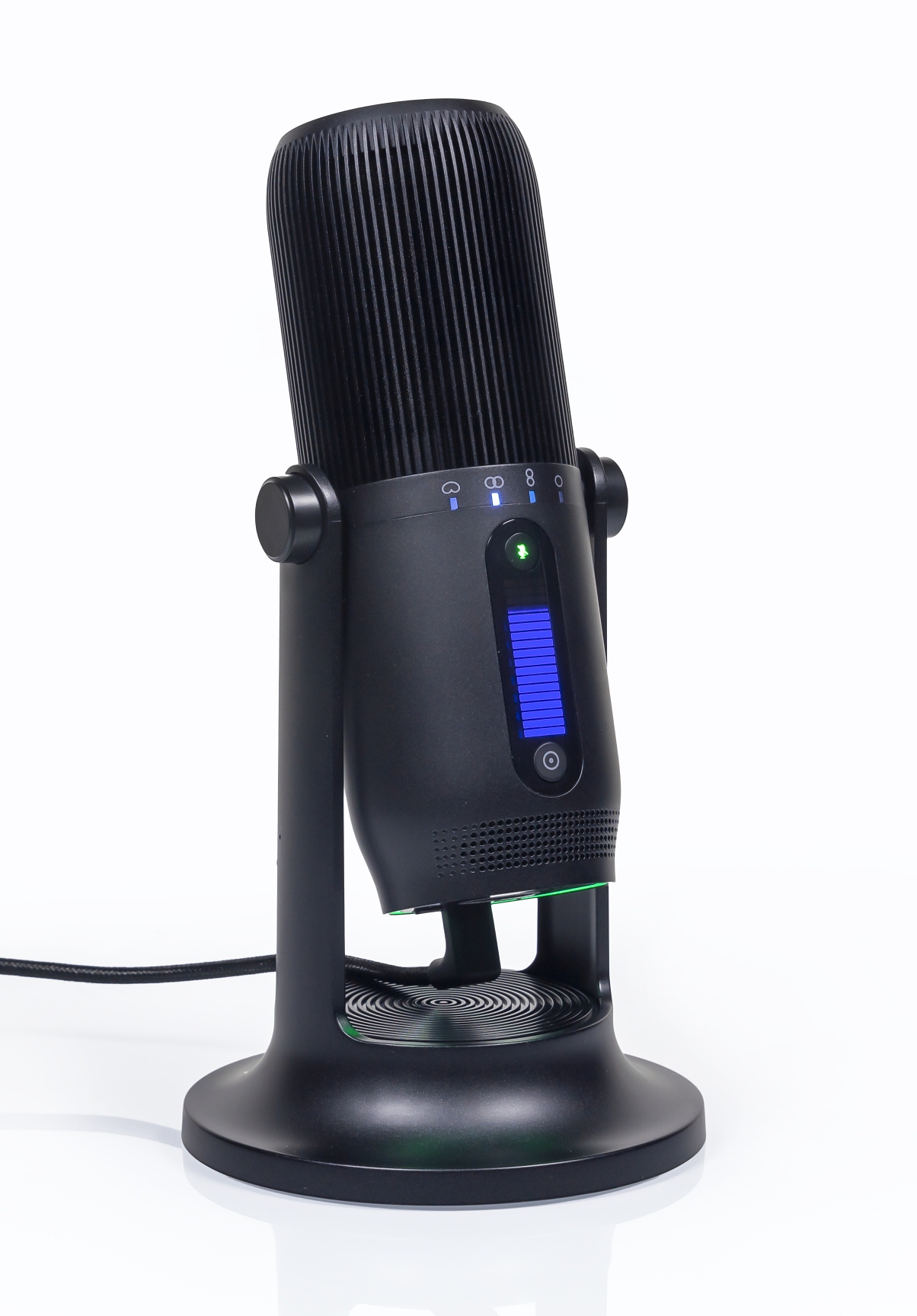
Its appearance is unchanged, with the same two color options. The photo shows the black version.
MDrill ONE PRO specifications
| Type | Condenser |
| Capsule | 3 × 16 mm electret capsules |
| Polar pattern | Cardioid, stereo, figure-eight, omnidirectional |
| Frequency range | 20 Hz–20 kHz |
| Operating formats | 24-bit, 96 kHz |
| Connections | USB Type C |
| Lighting | 7 modes |
| Headphone output | Mini-jack |
| Power | 180 mW |
| Impedance | 16 ohms |
| Frequency range | 15 Hz–22 kHz |
| Hardware controls | Gain, volume, mute, pickup mode and lighting selection |
| Package contents | Microphone on a stand, USB connection cable |
The ONE PRO also uses three identical 16 mm electret capsules. Lighting works the same way: the lower LED ring offers seven colors or can be disabled completely.
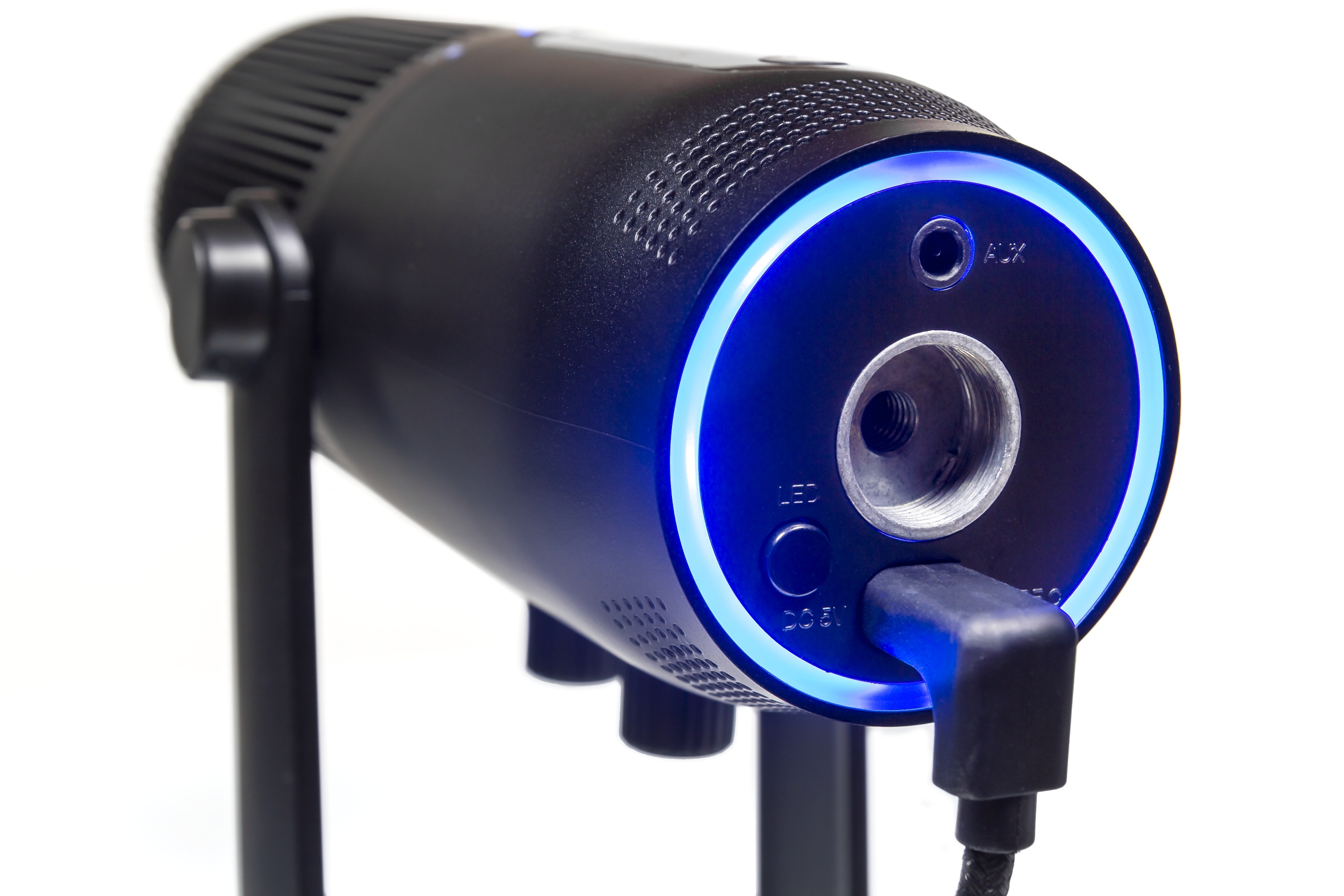
All Thronmax USB microphones connect through USB Type-C. A 3-meter cable is included. Its right-angle plug allows the cable to fit under the microphone without sharp bends.
No drivers are needed for normal use. Connect the microphone to the computer and it works. Windows, Linux, and Mac are supported. Professional Windows ASIO applications require the universal ASIO4ALL driver.
MDrill GHOST
The MDrill GHOST is the most expensive and advanced model, with striking LED lighting and touch controls.
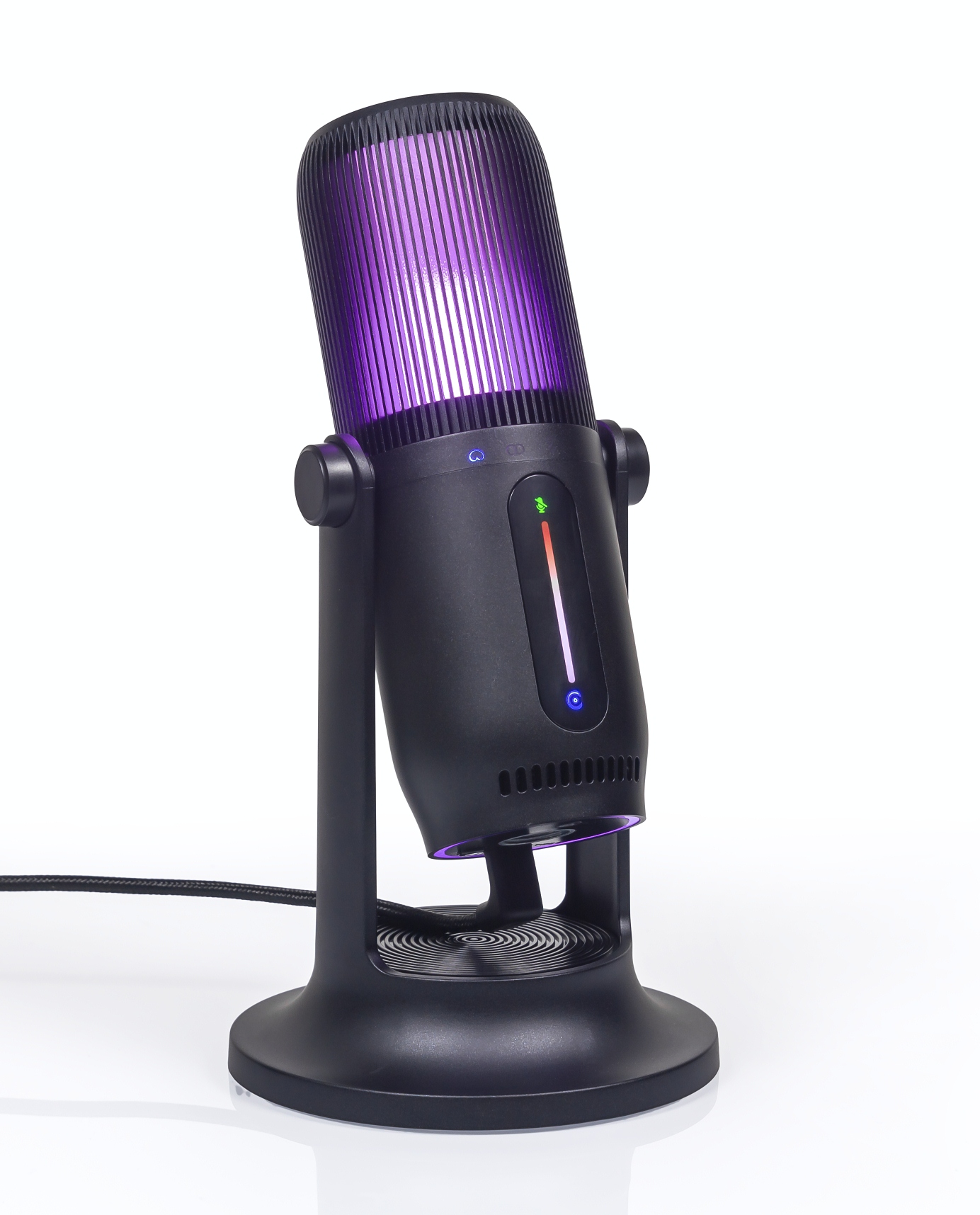
Construction and main functions match the previous model. Three capsules provide four pickup modes. The microphone supports 24-bit/96 kHz recording and direct hardware monitoring.
The main difference is the GHOST's unique top lighting. There are 24 modes, including steady illumination in seven colors, pulsing at different speeds, and smooth color transitions.
The lighting is bright and attractive, especially on camera in low light. There is no software control or way to replace the lighting patterns. A microphone button cycles through the available modes.
MDrill GHOST specifications
| Type | Condenser |
| Capsule | 3 × 16 mm electret capsules |
| Polar pattern | Cardioid, stereo, figure-eight, omnidirectional |
| Frequency range | 20 Hz–20 kHz |
| Operating formats | 24-bit, 96 kHz |
| Connections | USB Type C |
| Lighting | LED lighting, 24 modes |
| Headphone output | Mini-jack |
| Power | 180 mW |
| Impedance | 16 ohms |
| Frequency range | 15 Hz–22 kHz |
| Hardware controls | Gain, volume, lighting modes, touch pickup-mode selection and mute |
| Package contents | Microphone on a stand, rigid case, stand bracket, 2 USB cables |
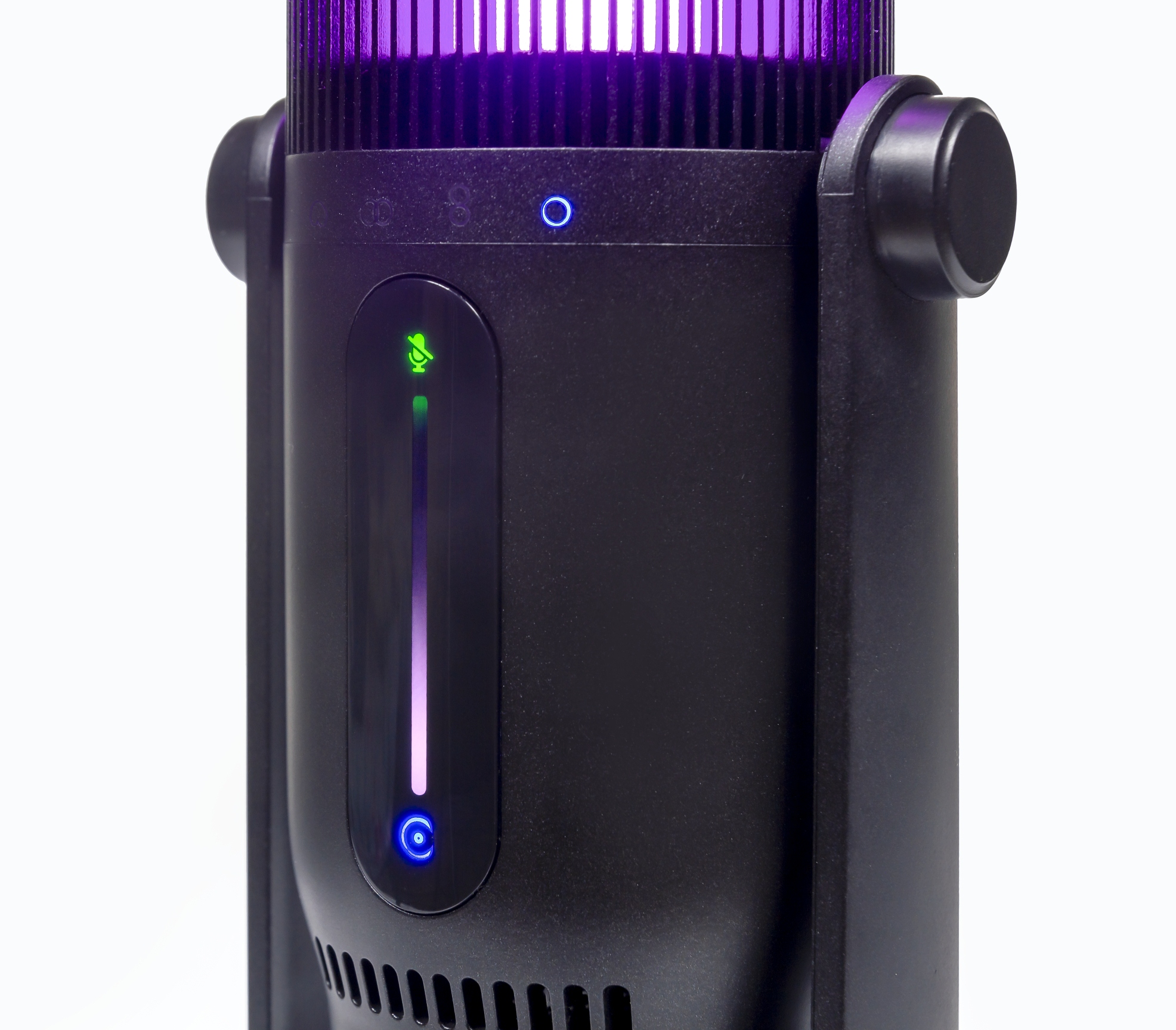
The previous two models use clicking buttons for pickup selection and MUTE. The GHOST uses silent touch buttons instead.
The indicator was also redesigned. Along with showing adjustments, it displays recording level in real time, helping detect overload. MUTE works more conveniently too: it silences the microphone in recording or broadcasting and in the headphones.
Sound quality is roughly the same across these three similar models and is good. Choose mainly according to price and convenience. Considering the 16 mm electret capsules, tone is fairly natural and full, allowing direct broadcast without post-processing. Different pickup patterns help with group recording. Cardioid is most suitable for one person.
Sensitivity is sufficient for voice at a distance. However, greater distance and higher gain also make background noise, room reverb, and desk noise more audible. No desktop stand or tripod can keep every desk impact out of the recording, regardless of built-in protection. Close recording needs extra breath protection because the internal pop filter is insufficient.
The GHOST's accessory package is extensive: a rigid storage case, a stand bracket, and 2 USB cables with Type-C and Type-B plugs at the other end.
MDrill ROSA
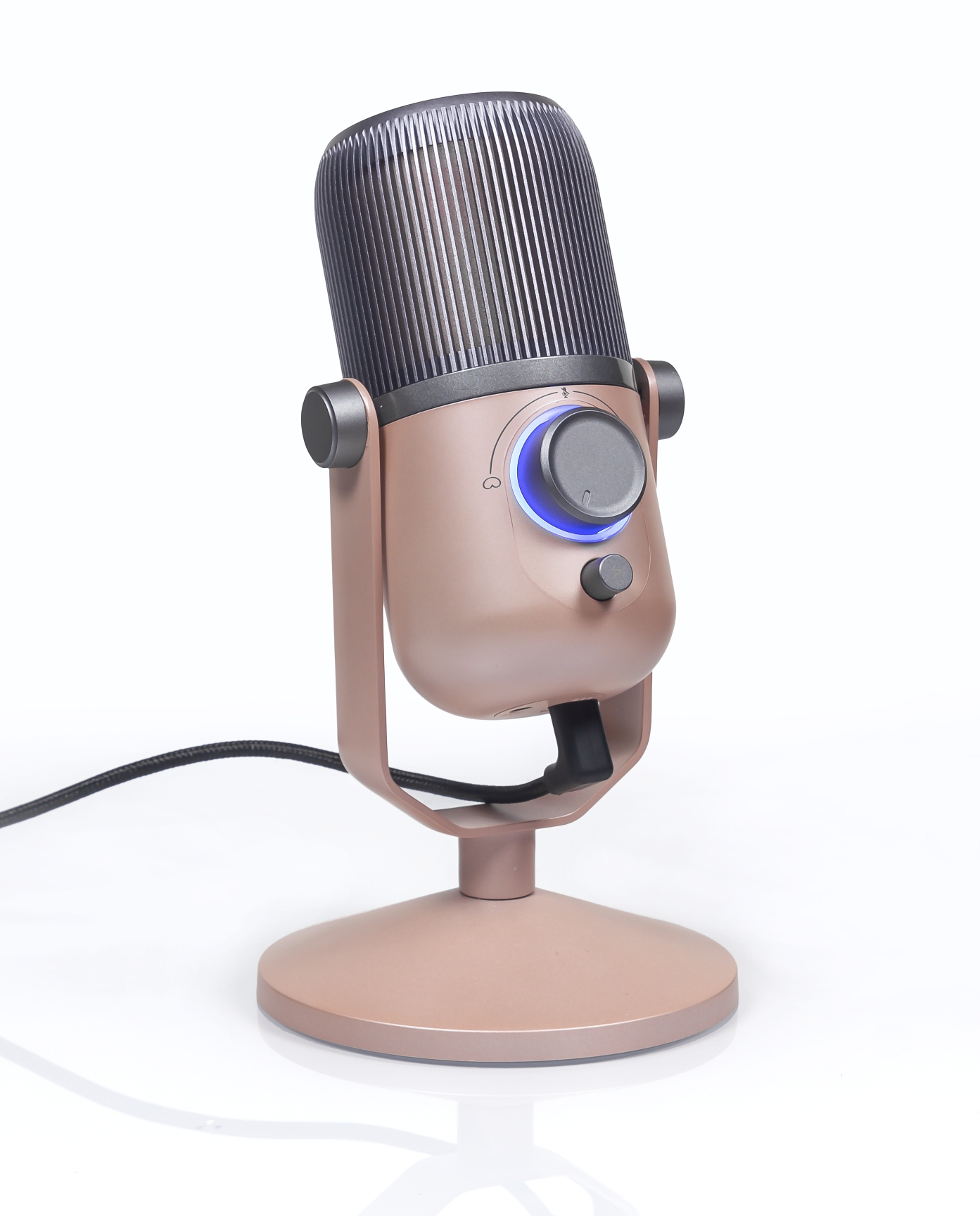
The MDrill ROSA is an alternative pink version. It is clearly aimed at a female audience and matches other items and room decor in that color scheme.
MDrill ROSA specifications
| Type | Condenser |
| Capsule | 2 electret capsules, 16 mm and 10 mm |
| Polar pattern | Cardioid, omnidirectional |
| Frequency range | 20 Hz–20 kHz |
| Operating formats | 24-bit, 96 kHz |
| Connections | USB Type C |
| Headphone output | Mini-jack |
| Power | 180 mW |
| Impedance | 16 ohms |
| Frequency range | 15 Hz–22 kHz |
| Hardware controls | Gain, volume, lighting modes, touch pickup-mode selection and mute |
| Package contents | Stand, USB cable, foam windscreen |
Two capsules, 16 mm and 10 mm, provide cardioid and omnidirectional pickup. Sensitivity control is unusual. The large knob mutes at its center position. Turning it toward either end increases sensitivity for the corresponding capsule configuration.
The smaller lower knob adjusts headphone output volume.
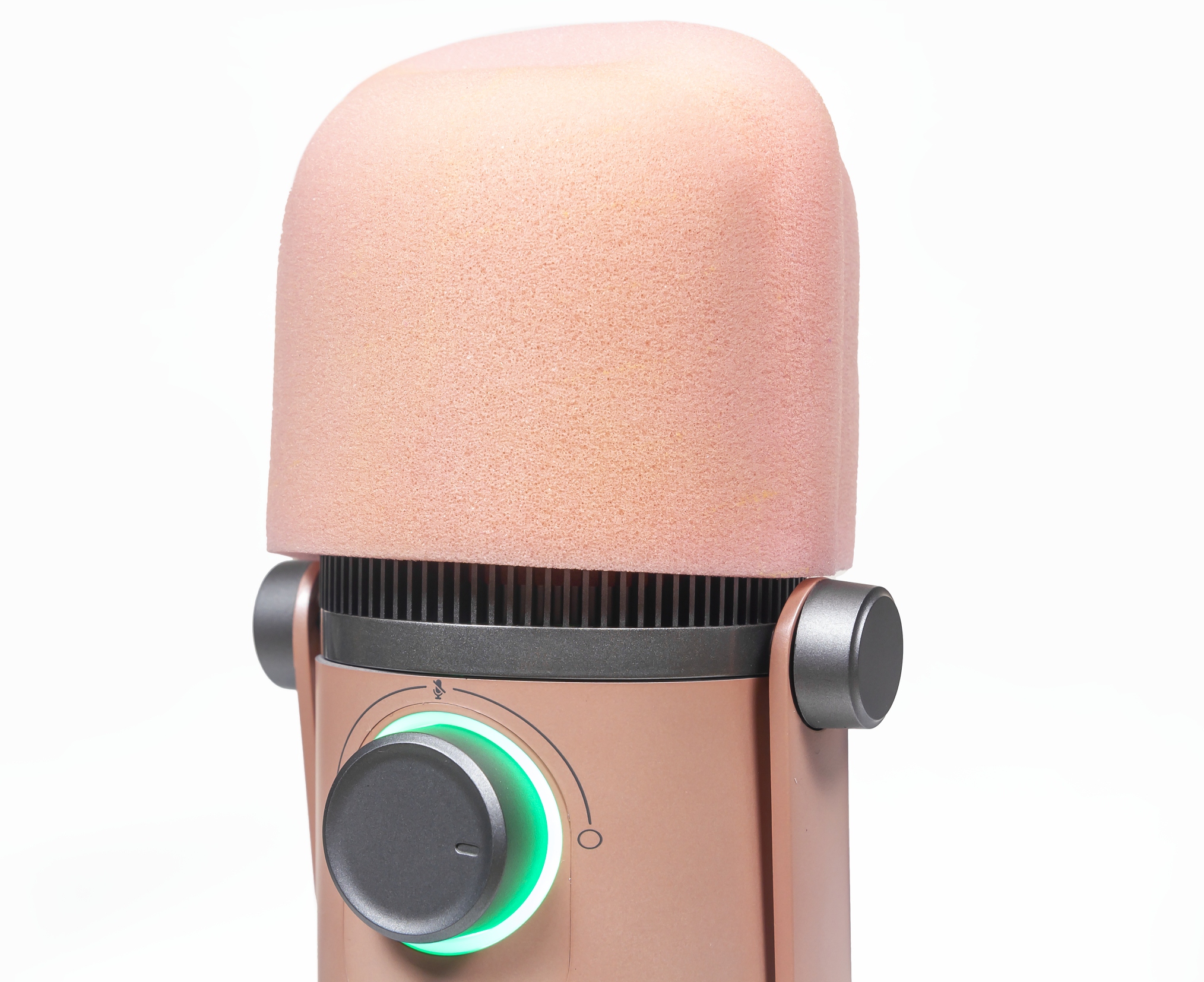
The package includes a pink connection cable and an attractive cap-shaped foam windscreen.
The ROSA sound is simpler than that of the previous models but remains good. Its main difference is less full bass, which is less important for a higher-pitched female voice.
M8 PRO
Thronmax also offers more traditional-looking microphones that are equally attractive. One is the M8 PRO.
This condenser USB microphone includes a tripod mount. It has a fixed cardioid pattern but two capsules. The main 16 mm capsule records the wanted signal; an extra 6 mm capsule detects steady unwanted noise for cancellation.
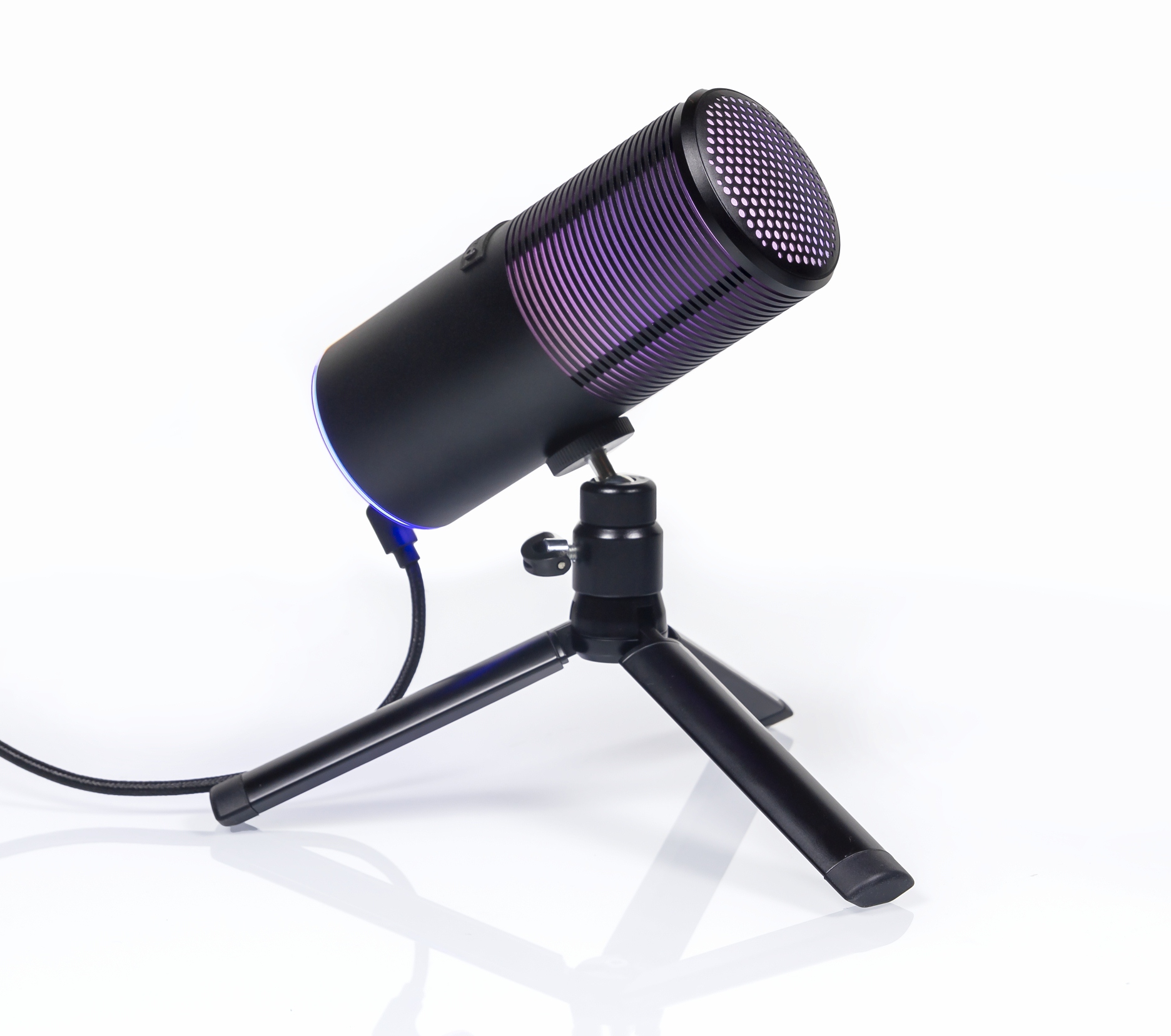
Active noise cancellation is useful in a USB microphone. Computer cooling or air-conditioning noise can be unpleasant in a recording. Post-production may reduce it, but extra live processing is inconvenient during streams.
M8 PRO specifications
| Type | Condenser |
| Capsule | 2 electret capsules, 16 mm and 6 mm |
| Polar pattern | Cardioid |
| Frequency range | 20 Hz–20 kHz |
| Maximum SPL | 112 dB |
| Sensitivity | 4.7 mV/Pa |
| Total harmonic distortion | 0.5% |
| Operating formats | 24-bit, 192 kHz |
| Connections | USB Type C |
| Lighting | LED lighting, 24 modes |
| Headphone output | Mini-jack |
| Power | 180 mW |
| Impedance | 16 ohms |
| Frequency range | 15 Hz–22 kHz |
| Hardware controls | Headphone volume, lighting modes, mute |
| Package contents | Tripod, adapter, USB connection cable |
The M8 PRO supports 24-bit/192 kHz recording. This is unlikely to have much practical use here, but suggests more modern electronics. Unfortunately, opening the microphone would damage its finish, so we can only make that assumption.
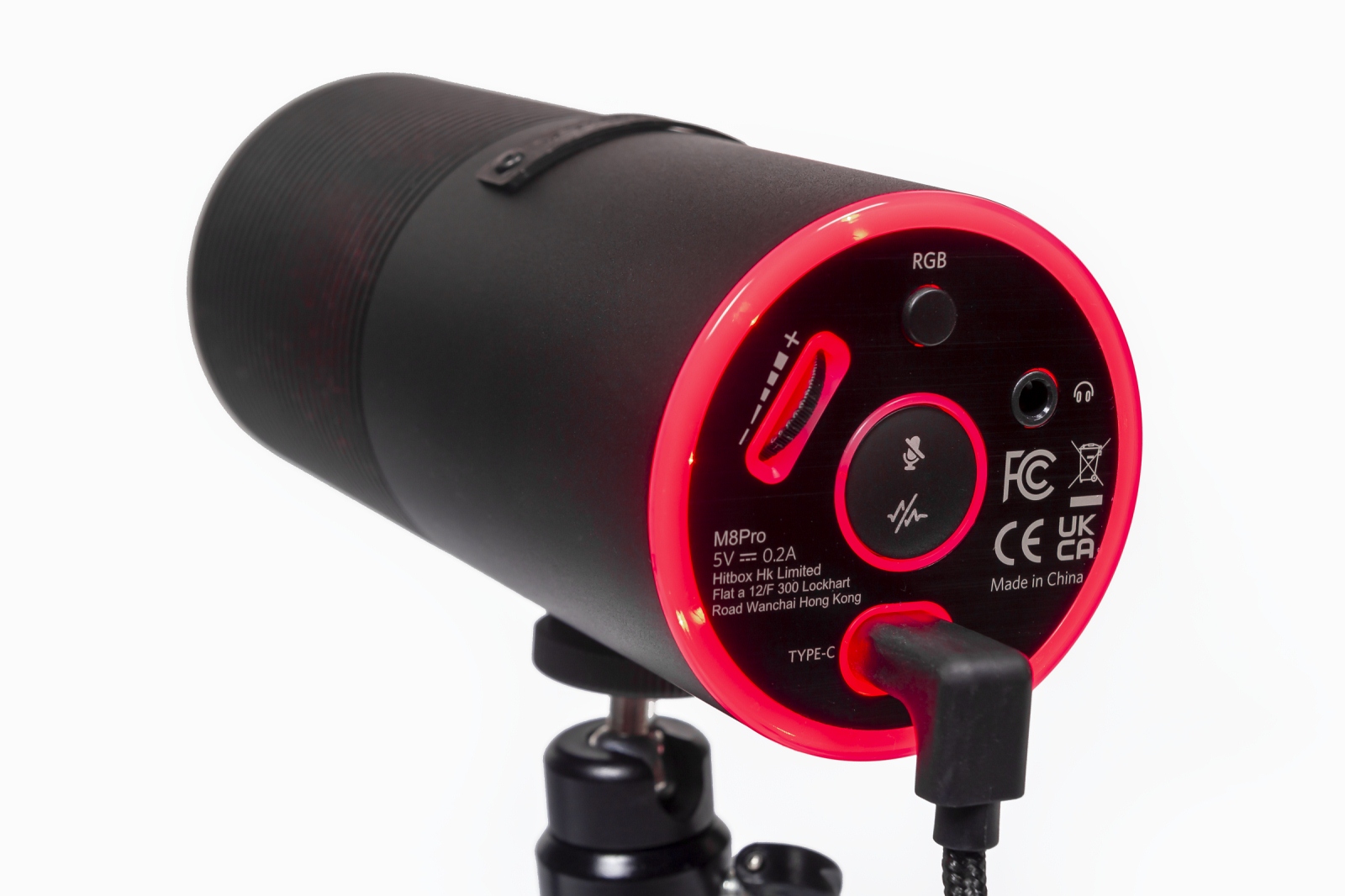
All controls and connections are underneath. USB Type-C connects to the computer, and a mini-jack provides headphone output. A stepped rotary control adjusts headphone volume. The large central button mutes the microphone, and RGB selects lighting modes.
Like the GHOST, the M8 PRO has LED lighting with many modes. The lower ring differs: it is always blue, changing to red in MUTE mode.
The capsule is at the end, which should face the source for a full recording. The side grille reduces housing resonances that would create a hollow, tube-like sound.
The supplied tripod and adapter allow a higher microphone position. Although the feet have rubber inserts, we always recommend a separate stand or boom arm for good recordings.
The M8 PRO records well. There is no manual sensitivity control; automatic level setting makes operation easier for ordinary users. Keep a suitable distance rather than recording voice very close. Overall, we have no recording-quality complaints.
MDrill Zone
Thronmax's range goes beyond USB. The MDrill Zone is an XLR model with a 25 mm condenser capsule.
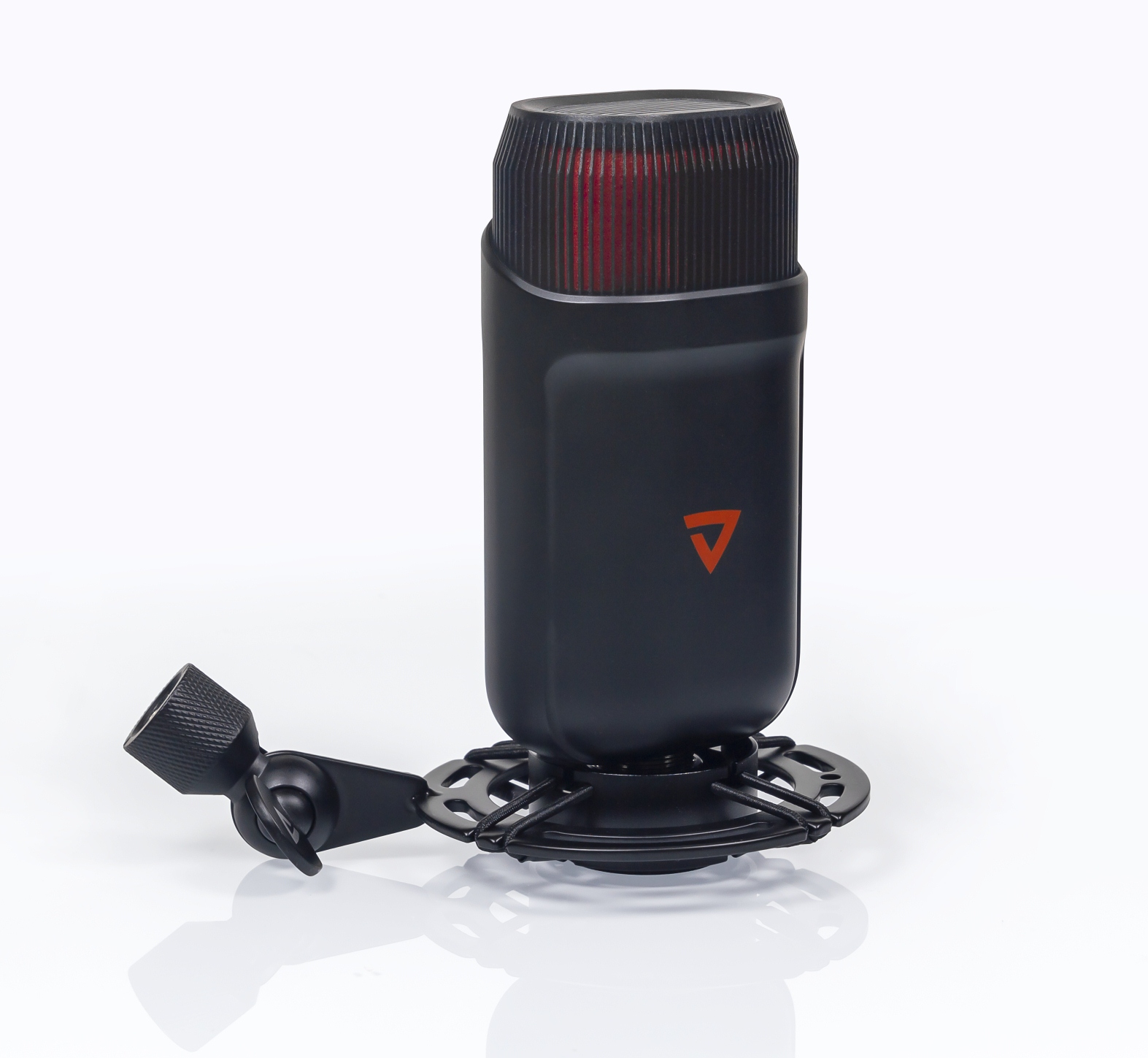
Its design is unusual: a large metal body with an original shape. The shock mount suggests upside-down use on a boom arm, like some broadcast microphones.
MDrill Zone specifications
| Capsule | 25 mm electret |
| Polar pattern | Cardioid |
| Frequency range | 25 Hz–20 kHz |
| Sensitivity | 15 mV/Pa |
| Impedance | 200 ohms |
| Equivalent noise level | 20 dB |
| Signal-to-noise ratio | 80 dB |
| Maximum SPL | 124 dB |
| Required power supply | 48 V |
| Connections | XLR |
| Dimensions | 60 × 130 mm |
| Weight | 544 g |
| Package contents | Microphone, shock mount |
The microphone needs +48 V phantom power. Even this model has lighting: two red LEDs under the protective grille illuminate when power is supplied.
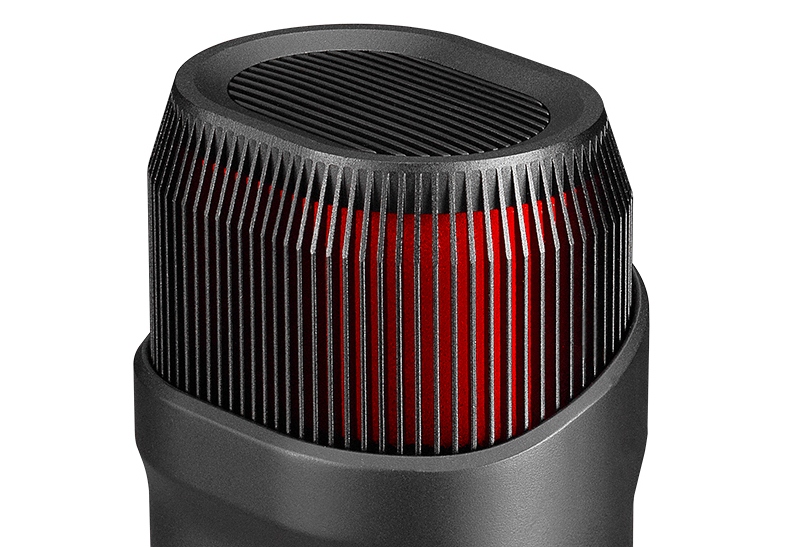
The fixed pattern is cardioid, with the active side facing the manufacturer's logo. The distinctive MDrill grille protects the capsule. According to the manufacturer, its more open structure scatters sound less than conventional mesh, preserving clarity and detail. This model still has an extra fabric screen and at least one metal-mesh layer on the capsule itself. The practical benefit is therefore limited, but the design looks excellent.
The Zone records quite well. An electret capsule has limits, but performance is good for its class. We would like slightly more treble and midrange detail, although tone is reasonably natural overall.
Conclusions
Our experience with Thronmax microphones was productive. We gained a clear understanding of the models, which feel like good USB microphones with bright styling and capable sound. For common affordable 16 mm electret capsules, sound quality is good. We preferred the GHOST and M8PRO, with their more interesting designs, slightly fuller sound, and striking lighting.
Note. This is an adapted machine translation into English. It follows the “In simple terms” approach. Read the original article at https://prosound.ixbt.com/microphones/thronmax-mic.shtml.