
Shure SLX-D — a digital version of the popular affordable Shure SLX wireless system
Grigory Liadov
In autumn 2020, Shure introduced the new SLX-D digital wireless system. It replaces the discontinued popular analog SLX and almost completes Shure's move to digital wireless transmission. The only exception is the entry-level analog BLX series.
Among Shure's professional systems, the SLX-D sits between the GLX-D and QLX-D. It is more advanced than the GLX-D while remaining affordable to a broad audience.
Shure positions the SLX-D for many uses, from education and personal use in corporate spaces to major music venues and important events.
The SLX-D provides high-quality digital transmission with a 120 dB dynamic range in the 470–616 MHz range. For Russia, the available version uses 518–562 MHz. Up to 32 SLX-D systems can work together in this range.

The SLX-D includes single- or two-channel receivers, a bodypack transmitter, and a handheld transmitter with many capsule options. Importantly, it supports Shure wireless accessories such as antennas, splitters, and amplifiers, allowing expansion.
Both single-channel and two-channel receivers are available, as shown in the video below.
The system is sold in the following configurations:
- SLXD24/B58/B87A/B87C/K8/SM58/SM86: single-channel receiver and handheld transmitter with a choice of capsule
- SLXD24/58: single-channel receiver, handheld transmitter, and bodypack transmitter with WL185 lavalier microphone
- SLXD14: single-channel receiver and bodypack transmitter with WA305 instrument cable
- SLXD14/153B/153T/83/85/93/DL4/B98H/SM35: single-channel receiver and bodypack transmitter with a choice of lavalier or headset microphone
- SLXD14D: two-channel receiver and two bodypack transmitters
- SLXD24D/B58/SM58: two-channel receiver and two handheld transmitters with SM58 or B58A capsules
The handheld transmitter supports all Shure interchangeable capsules. The bodypack also accepts the manufacturer's headset, lavalier, and instrument microphones.
SLXD4 receiver specifications
| Wireless system type | Digital, |
| Operating frequency range | 470–937.5 MHz; 518–562 MHz for our region |
| Frequency tuning step | 25 kHz |
| Image rejection (IR) | >70 dB |
| RF sensitivity | -97 dBm |
| Operating range | Up to 100 m with line of sight |
| Latency | 3.2 ms |
| Frequency response | 20 Hz–20 kHz (+1, -2 dB) |
| Dynamic range | 120 dBA at 1% THD |
| THD | <0.02% |
| Gain adjustment | -18 dB to +42 dB (1 dB steps) |
| Output level adjustment | -18 dB to +42 dB (1 dB steps) |
| Antenna connectors | 2 x BNC |
| Transmitter pairing | IR port |
| Display and indicators | LCD display |
| Power supply | 15 V, 600 mA |
| Connections | Balanced 1/4-inch TRS and XLR outputs, Ethernet port |
| Housing | Metal |
| Dimensions | 42 × 197 × 152 mm |
| Weight | 816 g |
The SLX-D has two receiver options: the single-channel SLXD4 shown in the photo and the SLXD4D, effectively two single-channel receivers in one housing. The housing is strong metal. Supplied side brackets allow rack installation.

The large LCD shows system parameters. Microphone signal level and RF strength are on the left; current settings and transmitter battery status are on the right. For easier use of several systems, the display can prominently show receiver name, frequency, or selected channel.
The menu is simple but offers many settings, including synchronization with other receivers, receiver presets, and clear gain adjustment with a level meter. Controls consist of two buttons and a rotary encoder. Operation is familiar and straightforward. Transmitter pairing uses the conventional IR port.

Balanced TRS and XLR outputs connect to other equipment. Ethernet links similar systems for more channels and firmware updates. Up to 32 SLX-D channels can operate together in the available band.
As expected in an expandable system, the antennas are removable with BNC connectors. The manufacturer states a 100-meter range with the supplied antennas, good for an affordable system. A 15 V adapter powers the receiver. A locking thread on the power connector prevents accidental disconnection.

SLXD2 handheld transmitter specifications
| Capsule | SM58, dynamic |
| Polar pattern | Cardioid |
| Modulation type | Shure Propietary Digital |
| Occupied bandwidth | <200 kHz |
| Antenna type | Single-Band Helical |
| RF output power | 10 mW/1 mW |
| Transmitter housing | Aluminum |
| Power supply | 2 × 1.5 V AA batteries/SB903 rechargeable pack |
| Dimensions | 37.1 × 176 mm |
| Weight | 147 g |
The SLX-D handheld transmitter follows Shure's familiar microphone design. It has an all-metal housing and interchangeable capsules.

Shure capsules are known worldwide and serve as a reference for many stage-microphone manufacturers. Artists and rental companies value their sound and practical reliability. Major venues and events commonly use Shure wireless systems. We also like Shure stage microphone sound and confidently recommend the American manufacturer's products.
Our package uses the simplest, most affordable SM58 capsule. Sets with more expensive capsules are also available, and transmitters or capsules can be bought separately. The SLXD2 supports all Shure interchangeable capsules, including the flagship KSM models.

Controls are conveniently placed on the transmitter. A small informative display shows linked receiver data and battery status. Slightly recessed buttons prevent accidental presses and can also be locked completely. Settings include microphone sensitivity from 0 to 21 dB in 3 dB steps, power selection between 10 mW and 1 mW, and a low-cut mode.

The power indicator is green during normal operation and turns red when the battery is low. Power comes from two AA batteries or a Shure SB903 rechargeable pack. With the SB903, the system shows exact remaining operating time rather than battery bars. The lithium-ion pack also offers a larger capacity of 1200 mAh at 3.6 V.
The SLXD1 bodypack works with headset, lavalier, and instrument microphones.

SLXD1 bodypack transmitter specifications
| Connection | TA4M |
| Impedance | 1 Mohm |
| Maximum input level | 8,2 dBV |
| Equivalent input noise (EIN) | –118 dBV |
| Modulation type | Shure Propietary Digital |
| Occupied bandwidth | <200 kHz |
| Antenna type | 1/4 Wave |
| RF output power | 10 mW/1 mW |
| Transmitter housing | ABS plastic |
| Power supply | 2 × 1.5 V AA batteries/SB903 rechargeable pack |
| Dimensions | 98 × 68 × 25.5 mm |
| Weight | 89 g |
The SLXD1 looks modern and attractive. It is small and light, with rounded edges for comfortable use on a belt, in a pocket, or elsewhere on clothing. A metal clip provides secure attachment.

Instrument cables and microphones connect through a TA4 connector with extra locking. The power switch and indicator are on top. The indicator turns red at low battery levels.

The bodypack display matches the handheld transmitter's. It shows selected frequency, linked receiver name, group and channel, and battery status. Menus and available settings are the same.


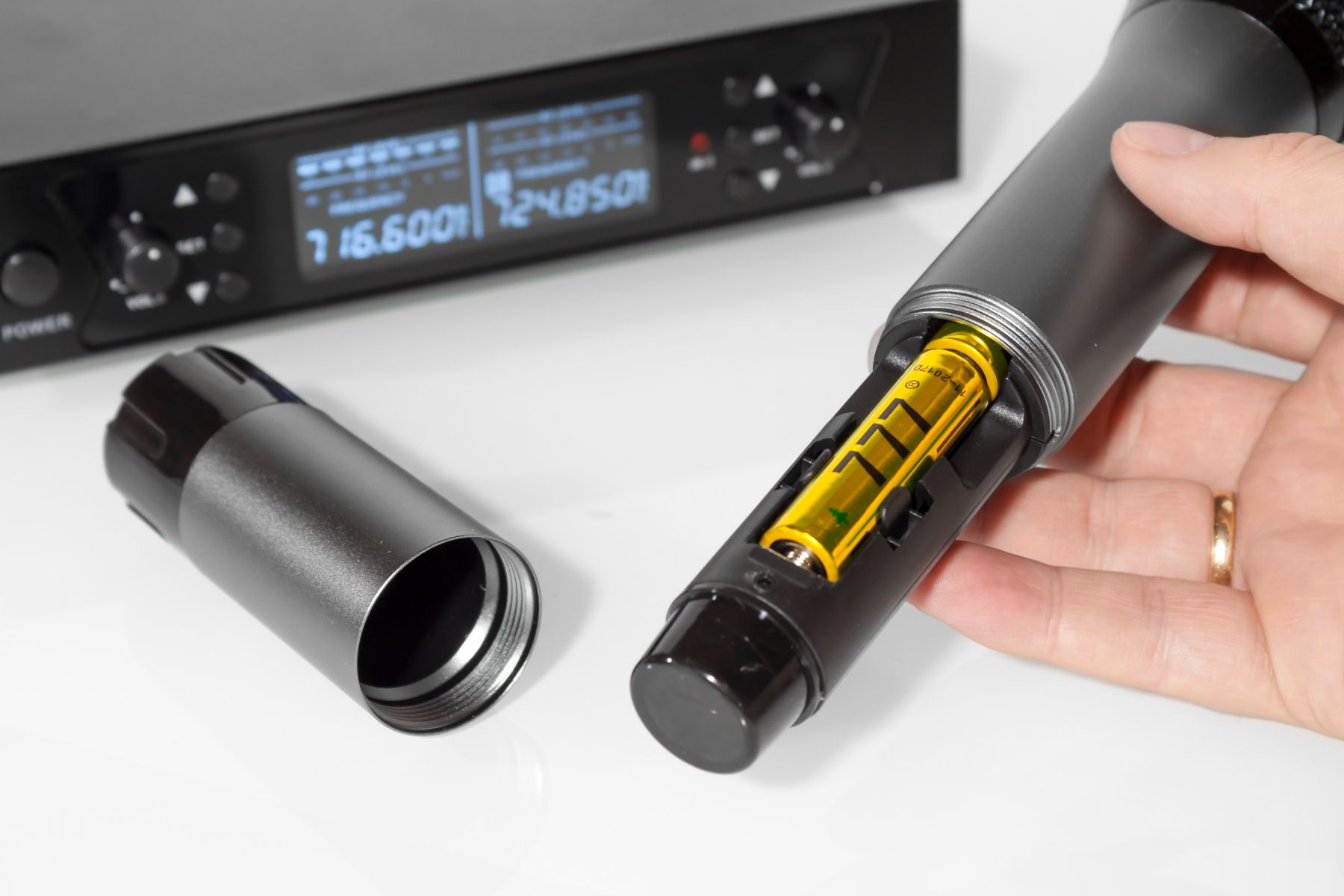


The bodypack uses two AA batteries or a branded SB903 rechargeable pack.

Two charger options are available. The SBC203 shown in the photo charges two transmitters at once without removing their batteries. The SBC10-903 charges one pack after it is removed from the transmitter.
We tested the SLX-D in simple, typical conditions: a room about 100 square meters in area. The handheld transmitter moved actively while remaining in line of sight of the receiver. We had no difficulties or problems. Reception was excellent, without dropouts, defects, or digital artifacts. The system was fully ready about 10 seconds after switching on. Scanning and pairing were simple and took less than a minute.
The handheld transmitter sounded no different to us from a wired microphone. Our SLX-D package used an SM58 capsule. EQ can add further speech clarity if needed.
The full benefits appear in more complex conditions with several systems operating together. Even simple tasks reveal its strengths: high sound quality, stable reception, and easy use. The choice of a suitable transmitter capsule is also important.
Conclusions
The Shure SLX-D is a worthy digital replacement for the popular analog SLX. In our view, it is one of the best affordable professional wireless options. Unlike many inexpensive digital systems, it avoids Wi-Fi frequencies and uses UHF for more predictable, stable reception. Despite its low price, it offers full professional capabilities and many configurations. It remains simple and convenient enough to suit both enthusiasts and professionals.
Note. This is an adapted machine translation into English. It follows the “In simple terms” approach. Read the original article at https://prosound.ixbt.com/microphones/shure-slx-d.shtml.