
RODE VideoMic NTG — an on-camera shotgun microphone with USB microphone functionality
Maxim Liadov
The Australian professional microphone manufacturer RODE is a leader in on-camera microphones. Its VideoMic products appear in millions of videos made by professionals and enthusiasts worldwide. They combine affordable prices with excellent sound and useful features. The author has used a RODELink Filmmaker Kit digital wireless lavalier system for interviews for many years and has no complaints. The new RODE VideoMic NTG clearly continues this tradition of good, affordable professional products. The photo below shows it mounted on a modern compact cinema camera.

Along with extensive location and studio video features, this model adds USB microphone operation when connected to a computer. It can therefore record blogs and streams without an extra budget sound card. In USB mode, the analog 3.5 mm output becomes a headphone monitoring output, and the gain knob becomes a volume control.
The video shows an innovative, versatile design. It is intended not only for camera mounting but also for many other uses.

RODE VideoMic NTG specifications
Acoustic design |
Pressure gradient, electret capsule |
| Polar pattern | Supercardioid |
| Frequency range | 20 Hz–20 kHz |
| Frequency response | 35 Hz–18 kHz ±3 dB |
| Output impedance | 10 ohms |
| Signal-to-noise ratio | 79 dBA |
| Dynamic range | 105 dBA |
| Equivalent noise level | 15 dBA |
| Sensitivity | -26 dB re 1 V/Pa (50 mV at 94 dB) |
| SPL at 1% THD | 120 dB |
| Low-cut filter | 75 Hz, 150 Hz |
| Battery operating time | >30 hours |
| Battery capacity | 350 mAh |
| Output connectors | 3.5 mm mini-jack USB-C |
| Bit depth | 24-bit |
| Sample rate | 48 kHz |
| Operating system requirements | Mac OS 10.12, Windows 10 |
Weight (g) |
94 |
| Dimensions | Diameter: 21.6 mm; length: 171 mm |
The specifications show a full-range microphone with a narrow pickup pattern that needs to face the source. The capsule is a professional low-noise design. Built-in battery life is impressive. An external USB-C power source allows continuous operation.

The manufacturer's frequency response graph shows the range and low-cut filter behavior. There are 75 Hz and 150 Hz settings, plus bypass, covering almost any situation. The microphone itself is linear up to 10 kHz, without midrange peaks or dips. The polar plot shows that inaccurate aiming reduces the highest frequencies. If the microphone points above the sound source in the frame, its high-frequency boost can restore a more natural tonal balance.

The microphone packaging was good enough to photograph.

An outer sleeve covers the main box. The main features are listed immediately, from battery operation to the manual gain control at the microphone's end.

Size and weight are fairly small for this device type. The microphone mounts easily on a light photo or video camera. The supplied suspension protects against tripod impacts and noise while the operator changes camera or lens settings.

The package includes everything needed: the microphone, foam windscreen, and flexible rubber suspension with a camera-shoe mount. A 3/8-inch threaded hole underneath accepts a standard microphone stand, such as the small RODE Tripod shown in the official video.
For strong wind outdoors, an optional RODE WS11 fur windscreen is available. The WS11 was designed specifically for this microphone.
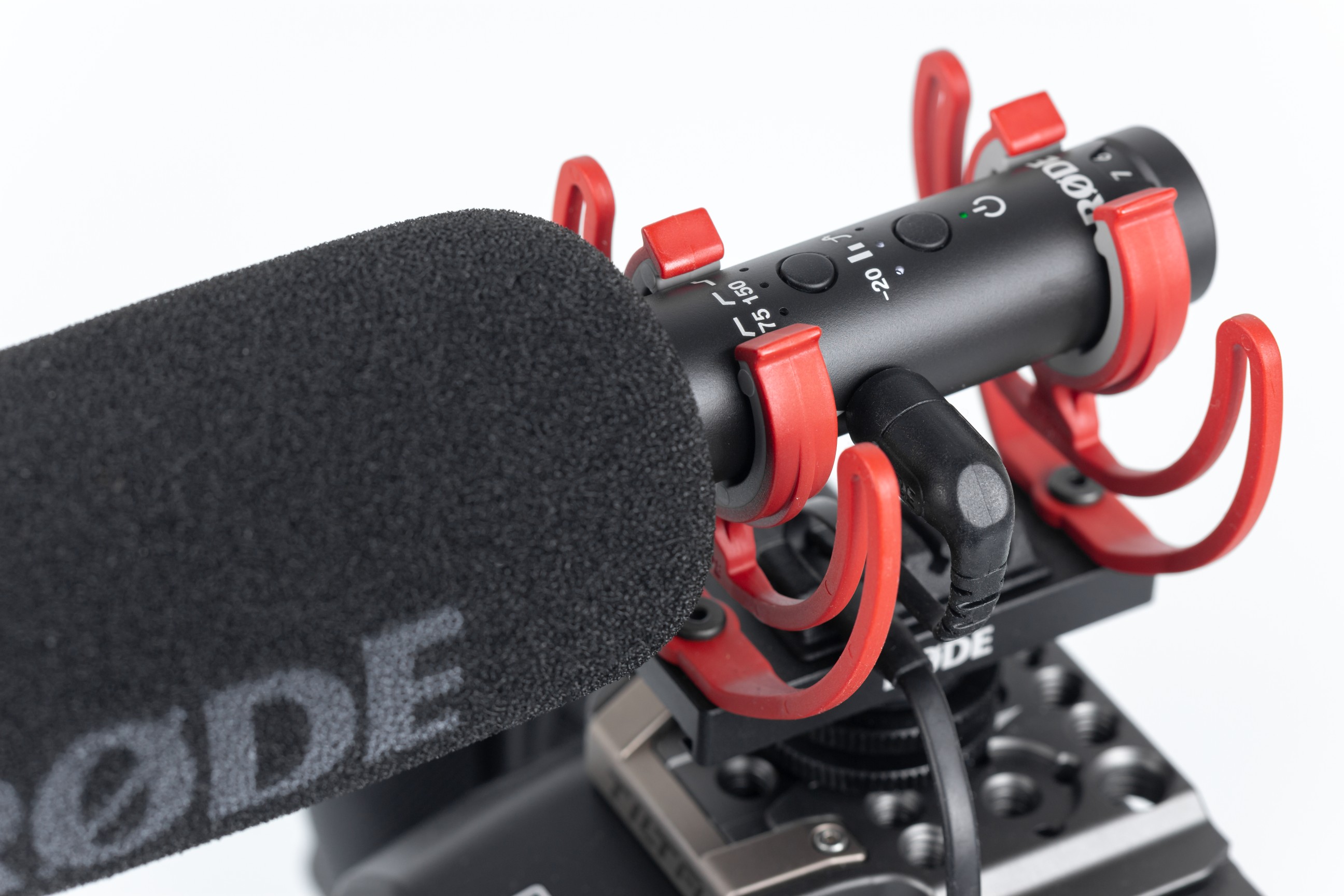
The camera-shoe mount has a sliding rail and locking nut. This moves the microphone away from the camera screen and noise sources, such as a noisy autofocus lens. On a stand, moving the balance point toward the microphone's center improves stability. A thick section of the supplied cable passes through the mount and acts as another partly rigid spring element. It also prevents the loose cable from hitting the camera housing and adding noise. Everything is well considered. For a professional video camera's XLR input instead of a mini-jack input, an adapter can be bought separately from RODE or another manufacturer.
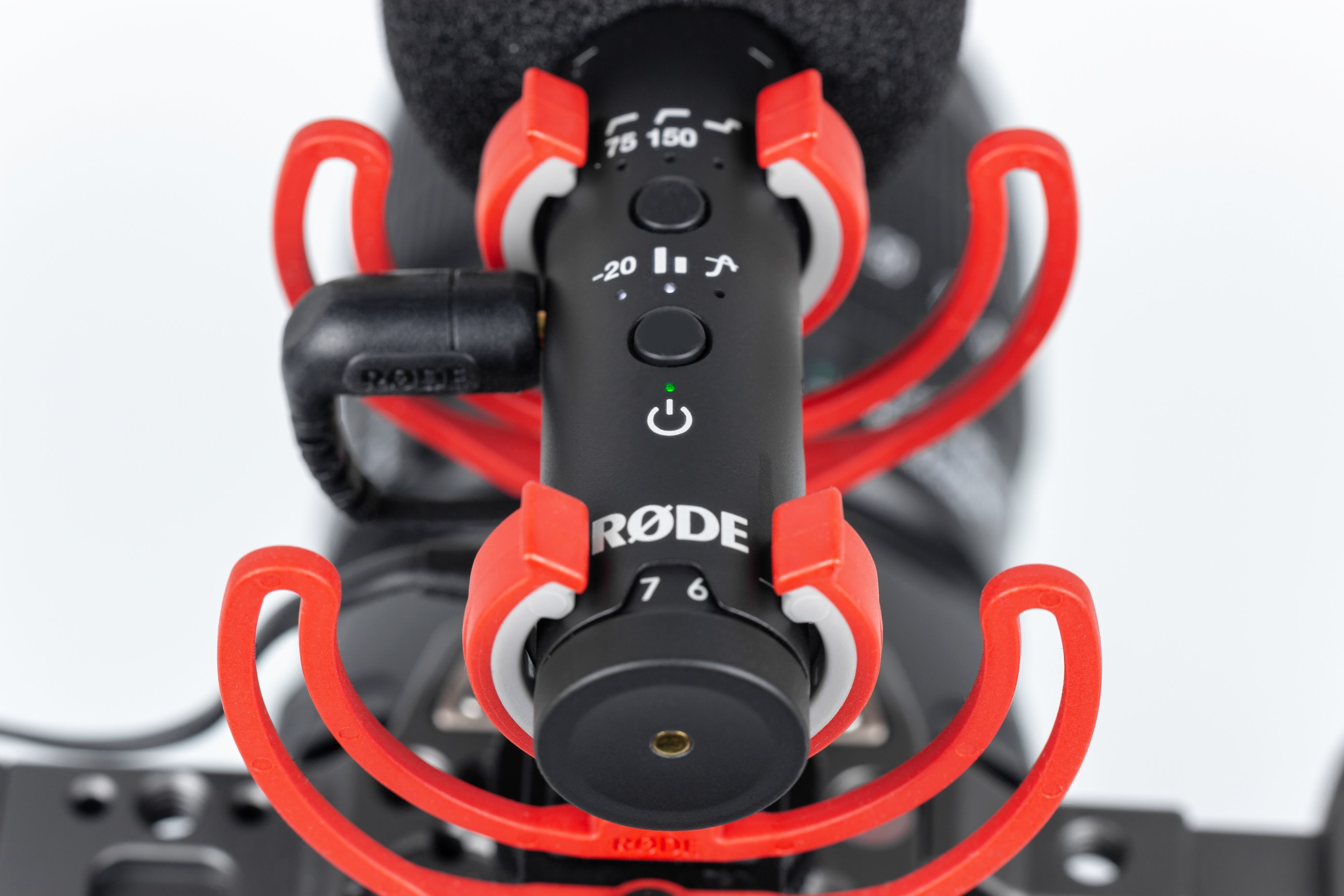
All controls are on top. A green LED lights during operation. This is an active microphone with internal circuitry and a fixed rechargeable battery. Auto-sensing can switch it on with the camera and save battery power when idle. It detects +5 V power at the microphone input. A power button still allows manual switching. Full battery charging takes 2 hours.
White LEDs show modes. A -20 dB PAD handles loud events. A two-channel recording mode puts a lower-level version of the signal on the right channel. This helps when most sound is quiet but sudden loud events may occur. Instead of recording everything too quietly to avoid overload, the user keeps a safety channel. The rightmost LED, marked with a waveform crossing the maximum line, warns of overload. RODE's useful gain wheel at the microphone's end shows its setting with white numbers. This is not a passive attenuator: it adjusts the built-in preamp's gain and can produce a high output level. The camera's weak and often noisy preamp can then be set low for a cleaner recording.
Comparison with the cinema camera's built-in microphones and a RODE lavalier
The BMPCC 6K is a fairly expensive professional camera that promotes its high-quality built-in microphones: 4 small units working in pairs. This made a comparison with the VideoMic NTG and RODELink Filmmaker Kit lavalier especially interesting. For fairness, we matched recording levels and placed the speaker a comfortable 1.5 meters in front of the camera. We aimed the VideoMic NTG slightly below the mouth, toward the chest. This position is often recommended for speech. In normal listening, our ears are not directly in front of the speaker's mouth, so excessive treble is unnecessary. EQ can still adjust it afterward.

The VideoMic NTG had a huge sound-quality advantage. This was genuinely professional sound, with fuller tone and almost no room sound. The speaker seemed about 20 cm from the microphone rather than 1.5 meters away. The camera microphones' only questionable advantage was stereo. Their recording contained much more room sound, as if the microphone were 10 meters away. Window-related rumble and every small background sound were obvious, including cars in the neighboring street. Even on an expensive cinema camera, built-in microphones are mainly useful for a backup ambient track.
The RODELink Filmmaker Kit digital wireless lavalier benefits mainly from being close to the source. Room reverb and echo were completely absent. However, its tone sounded less natural than the VideoMic NTG. The lavalier is better suited to reporting, active TV shows, blogs, and webinars. For studio filming, film production, and full, high-quality voice, a shotgun microphone is more suitable. Ideally, place it above the actor on a boom rather than on the camera.

Recording the same signal to two channels with a 20 dB level difference is a very useful VideoMic NTG feature. It allows the operator to focus on video settings without a sound assistant. If the main channel overloads unexpectedly, the second track can provide clean audio.
Use as a USB microphone
USB operation is new for RODE's on-camera microphones. Bloggers often place good vocal microphones outside the frame for streaming. At that distance, voice tone becomes worse and the microphone captures desk impacts, keyboard and mouse clicks, and other background sounds. We wanted to see what a professional shotgun could offer in this situation. The RODE needs no extra sound card: connect it to the computer by USB, with no driver required. The audio device supports 24-bit operation. On our Windows 7 system, only 48 kHz was available. In this mode, the microphone's gain wheel controls headphone monitoring volume only. Recording level uses the operating system slider. Sensitivity is very high. We liked the built-in low-cut filter for online broadcasting. Overall recording quality is good, and the supercardioid pattern keeps background sounds low. Room reverb is more audible than with a lavalier or a large-diaphragm vocal microphone used close up. This is an interesting option, but buying a shotgun solely for blogs and streams is less clearly justified. Most features, including suspension, wind protection, camera clearance, gain headroom, and battery operation, are intended for camera use. A simpler microphone may be sufficient for streaming. If the VideoMic NTG is already available and the user wants to avoid extra sound cards, it makes sense to use it instead of a budget microphone. It is clearly better than built-in webcam or camera microphones and cheap computer microphones with tiny capsules.
Conclusions
Our tests showed that the RODE VideoMic NTG is worth its price. It delivers the required quality and many useful features. Several generations of NTG development give the manufacturer extensive experience, clearly reflected here. Everything is well designed for productive daily work.
Note. This is an adapted machine translation into English. It follows the “In simple terms” approach. Read the original article at https://prosound.ixbt.com/microphones/rode-videomic-ntg.shtml.