
PreSonus Revelator Dynamic — a dynamic USB microphone with hardware processing
Grigory Liadov
PreSonus continues to expand its range with built-in Revelator hardware processing. After the PreSonus Revelator microphone and the PreSonus Revelator io24 USB interface, the American manufacturer introduced another microphone, the Revelator Dynamic. It uses a dynamic capsule instead of an electret capsule.
For readers unfamiliar with Revelator, the key feature is built-in digital signal processing (DSP). Every Revelator device provides high-quality effects in real time without monitoring delay. This is important for streams, broadcasts, and live performance. The algorithms come from the more expensive PreSonus StudioLive Series III mixers and deliver professional sound. This helps explain the range's popularity with streamers, bloggers, and musicians.
Everything needed is already inside the microphone. Connect it to a computer and start creating. A built-in audio interface and headphone output allow monitoring with effects. Users can adjust headphone volume and gain and switch effects presets. A mixer with flexible configuration and routing supports different applications. The microphone includes Studio One Artist and the Studio Magic package of virtual instruments and effects, allowing recording and post-processing straight after purchase.
PreSonus Revelator Dynamic specifications
| Microphone | |
| Capsule | Dynamic |
| Polar pattern | Cardioid |
| Maximum SPL | 135 dB (<3% THD) |
| Frequency range | 20 Hz–20 kHz |
| Sensitivity | 1.6 mV/Pa |
| Headphone output | |
| Connector | 1/8" TRS |
| Frequency range | 20 Hz–20 kHz |
| Power | 22.6 mW into 16 ohms |
| Distortion | 0,01% |
| Impedance | 16 ohms |
| Dynamic range | 77.5 dB |
| Audio interface | |
| Type | USB 2.0 |
| Operating formats | 24-bit/44.1 kHz, 48 kHz, 88.2 kHz, and 96 kHz |
| Signal-to-noise ratio | 110 dB |
| Power supply | USB bus power |
| Hardware controls | Gain, monitoring, preset selection, Mute |
| Software controls | Gain, polar pattern selection, mixer control, preset selection |
| Effects | High Pass Filter, Noise Gate, Compressor, EQ, Limiter, Comb Filter, Delay, Doubler, Ring Modulator, Vocoder, Reverb |
| Other specifications | |
| Dimensions | 222 × 83 × 130 mm |
| Weight | 420 g |
The Revelator Dynamic is based on the PreSonus PD-70 broadcast microphone. It can be called a USB version of the popular PD-70 because it uses exactly the same dynamic capsule. We welcome the choice of a known, good-quality capsule rather than an experiment.

As with other broadcast models, the capsule is at the end, which should face the source during recording. The special bracket allows free microphone rotation whether it is attached to a boom arm, floor stand, or supplied tripod.

The included tripod holds the microphone steadily on a desk. In the position shown, the capsule is 35 cm above the surface, a comfortable height for speech recording. The tripod is a compromise that works well on location. For a permanent workspace, a boom arm is preferable. It reduces unwanted noise and vibration in recordings and frees desk space.

Three protective layers reduce breath and plosives: foam on the capsule, a metal mesh structure against physical damage, and an external foam cover. Together, these are generally sufficient for good recordings.
Microphone controls are similar to those on the condenser PreSonus Revelator. Two multi-function buttons and an endless rotary control handle the main modes.

Preset switches hardware-processing presets, described below. Holding it bypasses all effects for a clean signal. Monitor changes the rotary control's function. Multicolor button illumination shows the active mode.
The rotary control adjusts headphone volume, gain, and the balance between the microphone and other system or application sounds. Pressing it mutes either the microphone or headphones, according to the selected setting. An indicator on the control turns red on clipping. All other settings are available in the device control panel.

Connections are on the bottom: a headphone output and a reversible USB-C port for the computer. The supplied cable is 2 m long. An extra threaded hole allows mounting directly to the housing.
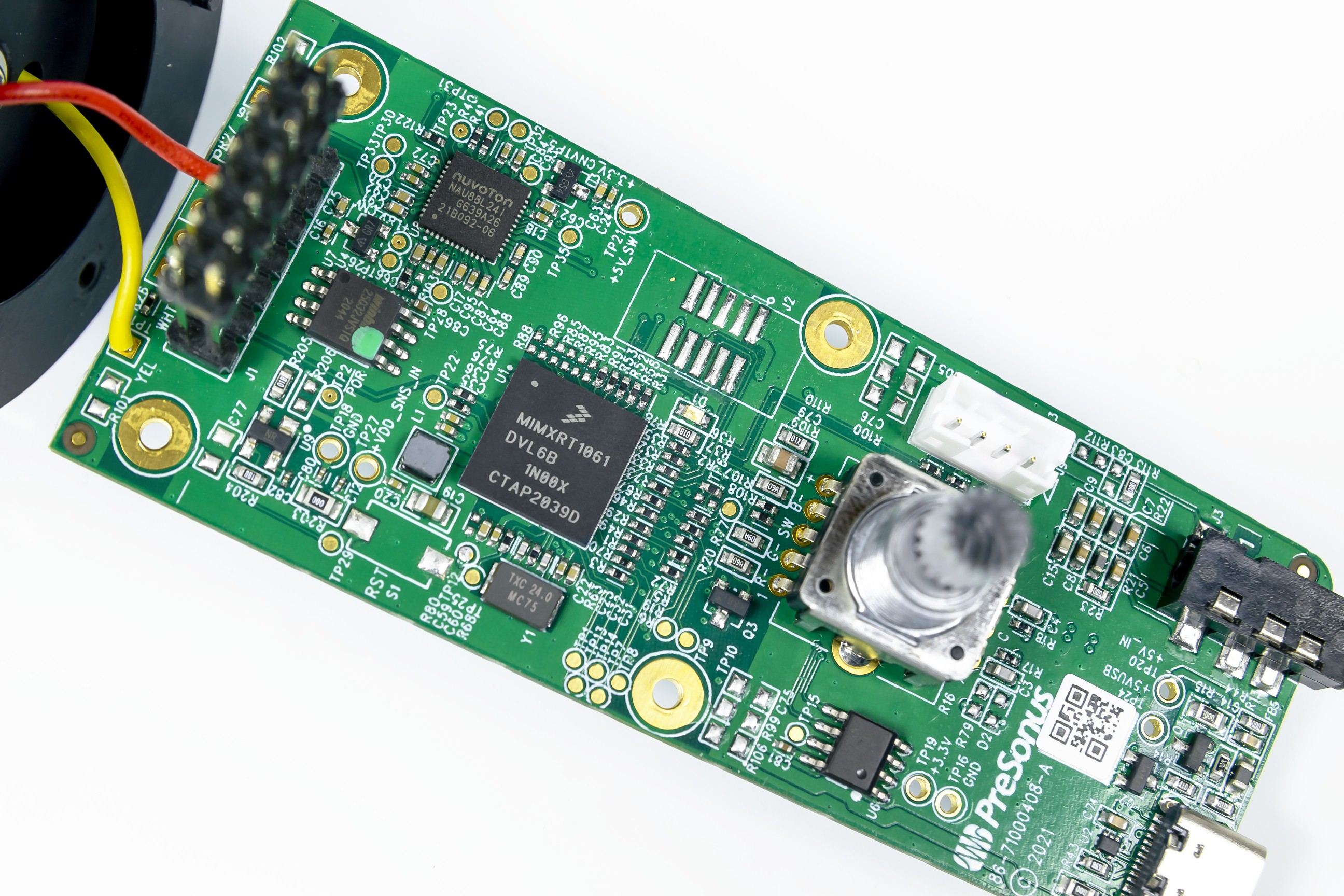
Inside, the Revelator Dynamic looks almost identical to the condenser Revelator, except for a different codec. The NAU88L24IG provides ADC THD+N of -85 dB and a signal-to-noise ratio of 100 dB. The headphone output has THD+N of -77 dB and a signal-to-noise ratio of 103 dB. A microphone preamp and headphone amplifier are integrated into the codec. The same ARM Cortex-M7 processor handles Revelator DSP algorithms.
The microphone supports 64-bit Windows 10 or later and macOS 10.13.6 or later. A dedicated driver must be installed to access all functions and settings.

Universal Control has the same layout across PreSonus devices. It selects sample rate and buffer size. Importantly, ASIO support allows use in professional audio applications. Most USB microphones do not offer this.
Processing settings are in a separate, attractively designed mixer panel. The Revelator Dynamic offers the same hardware processing as the condenser Revelator.
Two extra virtual sources make the microphone flexible in audio applications. The system shows three input devices and three output devices. The first correspond to the physical microphone input and headphone output. The other two are virtual sources for recording and broadcasting in different programs.

The mixer-style control panel sets the levels of all sources through buses for individual mixes. Users can choose not only where to send a signal, but which signals are included and at what level. To reduce confusion, the latest firmware renames the virtual sources. Instead of simply Loopback, they are now Virtual Output playback devices and Stream Mix recording devices.
As noted earlier, Revelator devices have excellent routing, better than many audio interfaces and far beyond ordinary USB microphones without control panels. PreSonus does very well here.
Hardware processing is equally impressive. A full set of high-quality effects provides professional sound. Beginners and experienced users can both work comfortably. Ready-made presets suit common situations, while advanced settings expose all the main parameters.

The Fat Channel hardware effects chain has 5 blocks in a fixed order: low-cut filter, gate, compressor, equalizer, and limiter. A Voice section provides creative processing. Separate reverb is not part of the presets and works on its own FX bus.
These effects reproduce the signal path of PreSonus StudioLive professional live mixers. Voice processing therefore approaches the sound of real radio stations, where a microphone processor normally applies EQ and dynamics after the presenter's microphone. The manufacturer has given an affordable microphone genuinely professional functions.
Global presets store all effect settings for instant recall. There are 8 factory presets and 8 user slots. The 4 most-used configurations can be assigned to a separate block and selected with PRESET on the microphone.
The effects work very well and look excellent. Their graphical interfaces match expensive DAW plugins. For example, the equalizer and compressor each have three versions that differ in both appearance and processing algorithms.

The options include a conventional graphical display and vintage-model emulations with fixed parameter values and characteristic saturation.

The compressor likewise offers a conventional interface with standard controls and a compression curve, plus tube and FET emulations with analog-style saturation.


The Voice section contains six effects: Doubler, De-Tune, Vocoder, Ring Modulator, Filter, and Delay. These can transform voice tone beyond recognition and add deliberate distortion.
Revelator hardware processing is very interesting. The control panel combines many settings with an attractive, convenient interface. Effects quality is good, and dynamics processing and EQ are implemented to a high standard, providing professional sound.

We also liked the microphone itself. Even with all effects disabled, voice sounds full and fairly detailed. Few users will ignore the available processing, but the raw voice already sounds good. For an affordable dynamic USB microphone, the Revelator Dynamic is very capable. There is a slight bass and treble boost, but this matters little with such extensive processing available.
Conclusions
We welcome a dynamic USB microphone with Revelator processing. A condenser microphone is not always the best choice, especially in an untreated room or noisy conditions. A gate helps only partly. A dynamic microphone is preferable in such situations.
PreSonus USB microphones set a high standard and make professional audio equipment easier to choose. Similar results are possible with a normal microphone, but require extra equipment and raise questions about stability, latency, and routing. With a PreSonus USB microphone, connect it and start working. Controls are simple, hardware effects are professional, and advanced settings are available for experienced users. Two extra loopback channels help organize streams.
The closest alternative is a better-quality microphone paired with a Revelator audio interface. That is a higher level of equipment with a significant price increase.
Note. This is an adapted machine translation into English. It follows the “In simple terms” approach. Read the original article at https://prosound.ixbt.com/microphones/presonus-revelator-dyn.shtml.