
ISK BM-800, ISK S700 and ISK AT-100 USB — affordable recording microphones
Grigory Liadov
ISK was founded by American audio engineers who wanted affordable studio microphones and headphones with sound close to expensive industry standards. ISK's growing popularity in Asia, Europe, South America, and North America suggests that they succeeded.
The manufacturer is Ningbo Yinzhou Shengke Electronics Co. Ltd, an Asian company specializing in high-quality microphones, professional microphone accessories, headphones, and stands. Its turnover increased by a factor of 10 in 5 years. ISK products are already used in many home and professional studios worldwide.
The company belongs to one of the world's 3 largest microphone manufacturers. It is therefore no surprise that products for many respected brands are made at the ISK factory and appear in music shops under other names and at very different prices.
Today we will look at the ISK BM-800, ISK S700, and ISK AT-100 USB microphones.

All three are condenser microphones intended for studio use. They differ in appearance and capsule type. The ISK AT-100 also has an integrated USB interface.
Our short video introduces each model and includes a female vocal recording made with the ISK BM-800. The video is in 4K, so we recommend watching full-screen:
The written review has no video time limit, so we can discuss each model in more detail.
ISK BM-800
The ISK BM-800 is the most expensive and advanced of the three. It is positioned as a full studio microphone for voice and musical instruments. Its large-diaphragm capsule provides detailed, natural sound. Like other studio condenser microphones, the BM-800 requires +48 V phantom power.

ISK BM-800 specifications
| Capsule | 34 mm condenser |
| Polar pattern | Cardioid |
| Maximum SPL | 132 dB |
| Frequency range | 20 Hz–20 kHz |
| Sensitivity | -34 dB ±2 dB (0 dB = 1 V/Pa at 1 kHz) |
| Signal-to-noise ratio | 78 dB |
| Required power supply | 48 V |
| Connections | XLR |
| Dimensions | 46 × 150 mm |
| Weight | 346 g |
| Package contents | Case, shock mount, foam windscreen |
The ISK BM-800 has a traditional studio microphone design. A strong cylindrical metal housing supports a metal grille protecting the capsule. The microphone is slightly smaller than usual. Its circuit board would fit even in a much smaller housing, so a transformerless microphone has no real need for a bulky body. A shock mount is already included, avoiding the need to find one in the correct size.
The microphone has a fixed cardioid polar pattern. The active side of the capsule faces the manufacturer's logo. There is no low-cut filter switch on the housing.

The capsule has a large, gold-plated 34 mm diaphragm. This is effectively the largest size used in most studio models. It is good to see such capsules in microphones affordable to a broad audience. A rubber support isolates the capsule from housing vibration and handling noise.

Inside is a transformerless discrete FET circuit, providing the stated low noise and high sensitivity.

The supplied shock mount is all metal, unlike budget mounts. It has no fragile plastic parts. A spring ring surrounds the microphone body and holds it in the basket. Damping material protects the contact area between the microphone and metal ring. The grip is very firm, allowing horizontal or upside-down use.

The ISK BM-800 has a good accessory package. A rigid carrying and storage case holds the microphone, shock mount, and foam windscreen neatly. Unfortunately, no pop filter is included; one should be bought separately.
ISK S700
The ISK S700 is also a condenser microphone, but uses a smaller electret capsule than the BM-800. Its price is about half as high, a major benefit on a limited budget.

ISK S700 specifications
| Capsule | 18 mm condenser |
| Polar pattern | Cardioid |
| Maximum SPL | 136 dB (<1% THD) |
| Frequency range | 20 Hz–20 kHz |
| Sensitivity | -36 dB ±2 dB (0 dB = 1 V/Pa at 1 kHz) |
| Signal-to-noise ratio | 78 dB |
| Self-noise | 16 dBA |
| Required power supply | 5 V |
| Connections | XLR |
| Dimensions | 55 × 43 × 167 mm |
| Weight | 368 g |
| Package contents | Shock mount, connection cable |
The ISK S700 looks attractive. Its elongated rectangular housing and large grille recall classic AKG studio microphones. The design has a clear appeal.

The housing is cast metal, with the capsule exactly in the center. Unfortunately, the microphone cannot be taken apart, so we cannot show the internal construction. It is visible through the grille, however. The capsule looks almost the same as the one in the ISK AT-100 USB.
A specially designed shock mount is included. It grips the microphone firmly by the lower stem and allows any orientation. The S700 can work with +5 V power, allowing direct connection to a DSLR camera or a computer's mini-jack microphone input. Like the previous model, it has a cardioid polar pattern.

The microphone includes the mount and a cable with XLR connectors at both ends.
ISK AT-100USB
The ISK AT-100 USB is a condenser microphone with an integrated USB interface. It is intended mainly for speech, including podcasts and online broadcasts. It is among the most affordable devices, yet includes a shock mount and a small desktop tripod.

ISK AT-100USB specifications
| Capsule | 18 mm condenser |
| Polar pattern | Cardioid |
| Maximum SPL | 136 dB (<1% THD) |
| Frequency range | 20 Hz–20 kHz |
| Sensitivity | -38 dB ±2 dB (0 dB = 1 V/Pa at 1 kHz) |
| Signal-to-noise ratio | 77 dB |
| Self-noise | 17 dBA |
| Connections | USB |
| Dimensions | 48 × 165 mm |
| Weight | 300 g |
| Package contents | Shock mount, tripod, USB cable |
The ISK AT-100 USB looks excellent, much like a full studio microphone with an analog connection. Only the connector on the bottom reveals its USB design.
The microphone is simple, with no hardware controls, monitoring, or power indicator. The operating system sees it as a standard input device. Sensitivity is adjusted in software.

The 18 mm electret capsule sits on a rubber base for vibration isolation. The microphone has a fixed cardioid polar pattern.


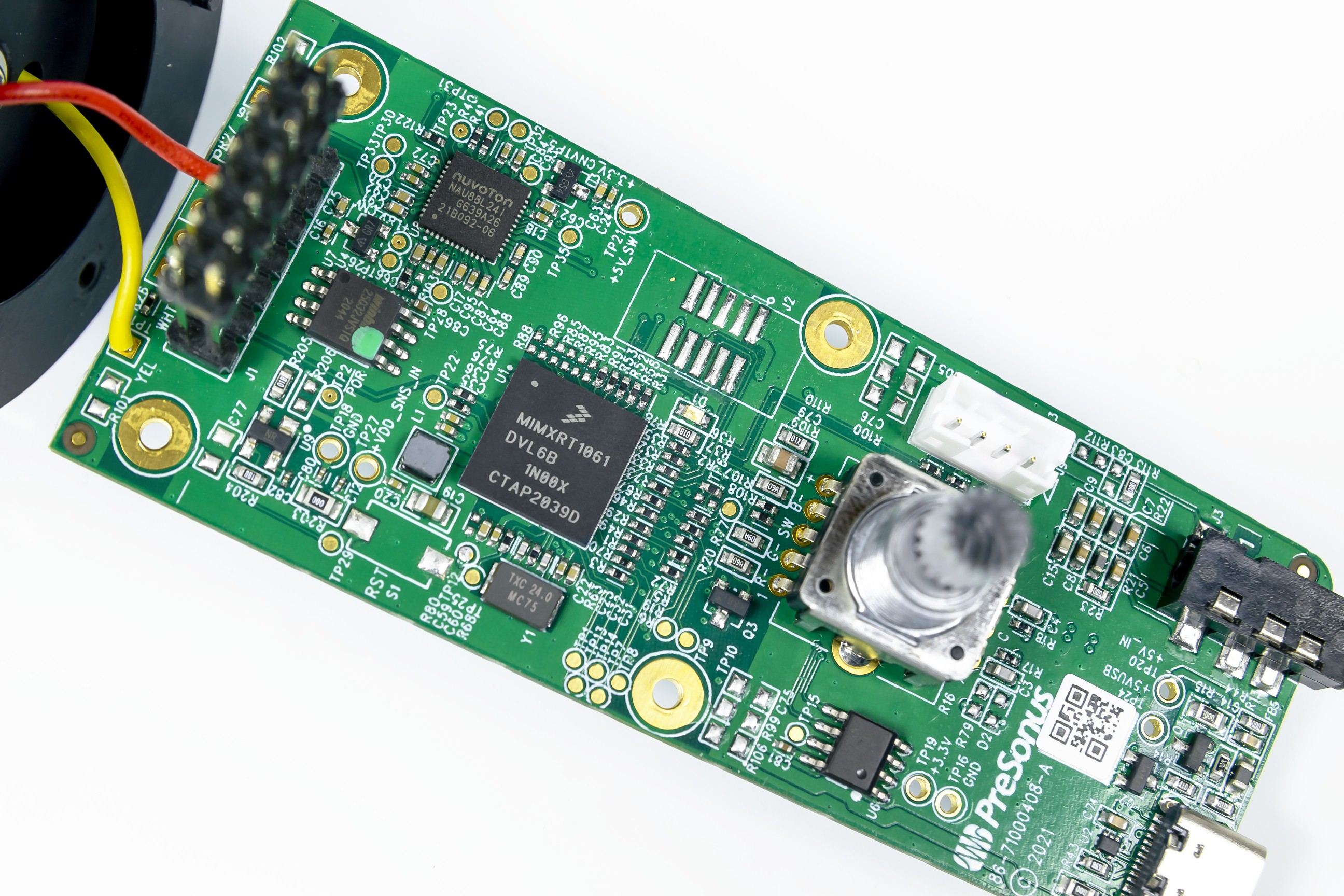


The electronics use a CMedia CM6327 integrated chip, combining a USB controller and a single-channel ADC. Its specifications are a dynamic range of 96 dB and THD+N of -89 dB ~ to -96 dB. Overall, these figures are very good for an affordable microphone.

The folding desktop tripod places the capsule about 20 cm above the desk. It is stable, but we recommend a separate stand or boom arm. No desktop tripod can completely isolate desk noise. Moving objects, typing, and other sounds will reach the recording. The higher the microphone sensitivity, the more clearly these noises will be heard.
The shock mount is metal, like the one supplied with the higher-end ISK BM-800. It grips the microphone firmly and allows any angle toward the source.
Recording quality
We tested the microphones on speech and vocals in studio conditions. Overall, we were pleased. The ISK microphones provide good recording quality that meets modern requirements.

As expected, the most advanced BM-800 with its large diaphragm gives the best recordings. Its tone is the fullest, with good detail and definition. Users often ask whether large capsules offer a real benefit in budget microphones. Much depends on implementation. In this particular BM-800, the advantage over common electret-capsule microphones is clear in every respect.
The S700 records less expressively, with a slight lower-midrange emphasis. It still performs well and gives good results after EQ. The ISK AT-100USB also has useful capabilities. However, its lack of a headphone output makes it difficult to recommend for professional recording. Speech is its best use.
Conclusions
The ISK microphones are interesting options. We find the top BM-800 with its large capsule the most attractive. Despite its affordable price, it has all the qualities of a studio microphone and is fully suitable for professional use. The other two models are interesting too. The S700 is a good electret model, while the AT-100 adds a USB option for a broad audience. All three combine attractive prices with excellent looks and good accessory packages.
Note. This is an adapted machine translation into English. It follows the “In simple terms” approach. Read the original article at https://prosound.ixbt.com/microphones/isk-mic.shtml.