
Direct Power DP-220 VOCAL, DP-200 VOCAL, DP-200 HEAD, and DP-200 INSTRUMENTAL — an affordable analog wireless system series
Grigory Liadov
Direct Power Technology develops and manufactures professional audio equipment. Since 2015, it has supplied reliable, practical equipment for public leisure areas, shopping centers, office buildings, and concert venues. Its approach combines proven solutions with new developments.
In 2019, the brand added wireless systems for stage performance, karaoke, studios, and television. Its engineers designed headset, vocal, and instrument systems to industry standards while keeping prices attractive.
The Direct Power DP-200 devices under review form an analog wireless series operating in the 650–700 MHz UHF band. Several models differ mainly in transmitter type. These are budget systems, among the most affordable available, but they stand out with diversity RF operation and selectable frequencies. Informative displays show all the parameters needed in use.
DP-220 VOCAL
The flagship DP-220 VOCAL package contains a two-channel receiver and two handheld transmitters.

As its name suggests, the DP-220 VOCAL is intended for singing. Up to 5 systems can operate simultaneously within the available band. Microphone sensitivity is also sufficient for speech.
Receiver specifications
| Number of channels
|
Two |
| Operating frequency range | 650–700 MHz |
| Signal modulation | FM |
| Operating range | Up to 100 m with line of sight |
| Frequency deviation | ±50 kHz |
| AF range | 100 Hz–10 kHz |
| Signal-to-noise ratio | 50 dB |
| THD | <5% (at 1 kHz) |
| Sensitivity | 105 dB |
| Transmitter pairing | IR port |
| Display and indicators | Two LCD displays |
| Power supply | 14 V, 400 mA |
| Housing | Metal |
| Connections | 1/4-inch TRS mixed output, separate balanced XLR outputs |
The receiver has an all-metal housing. Rackmount brackets are included.

The DP-220 has two large LCDs showing all main system parameters. Only this model in the series has unusual yellow illumination; the single-channel receivers use more familiar blue. Large characters remain easy to read from a distance. Along with the selected frequency and fixed settings, the displays show changing RF strength and transmitter signal level.
Operation is simple, like that of many similar systems. The system is ready within 10 seconds of startup. After scanning, it automatically selects the most suitable frequency. The user then synchronizes the transmitter through the IR port. Manual frequency selection is also available and is necessary when several systems work at once. A lock prevents accidental setting changes, leaving only volume and power available.

Separate balanced XLR outputs connect the system to other equipment. An unbalanced 1/4-inch TRS output mixes both microphones. Removable antennas allow the use of an antenna splitter.
Transmitter specifications
| Capsule
|
Dynamic |
| Polar pattern | Cardioid |
| Housing | Aluminum |
| Maximum sound pressure level | 130 dB SPL |
| Maximum output power | 300 mW |
| Spurious emissions | < -55dBc |
| Frequency stability | ±10 PPM |
| Power supply | Two AA batteries |
| Operating time | Up to 8 hours |
| Display and indicators | LCD display |
| Receiver pairing | IR port |
The handheld transmitter has a metal housing with decorative plastic side inserts. A fairly large display and a power button near the bottom are provided. The microphone starts quickly and switches off without clicks or thumps. When the transmitter is turned off, the receiver automatically mutes that channel to prevent extra interference.

The microphone display shows channel, selected frequency, and remaining battery charge. The IR synchronization port is next to it.

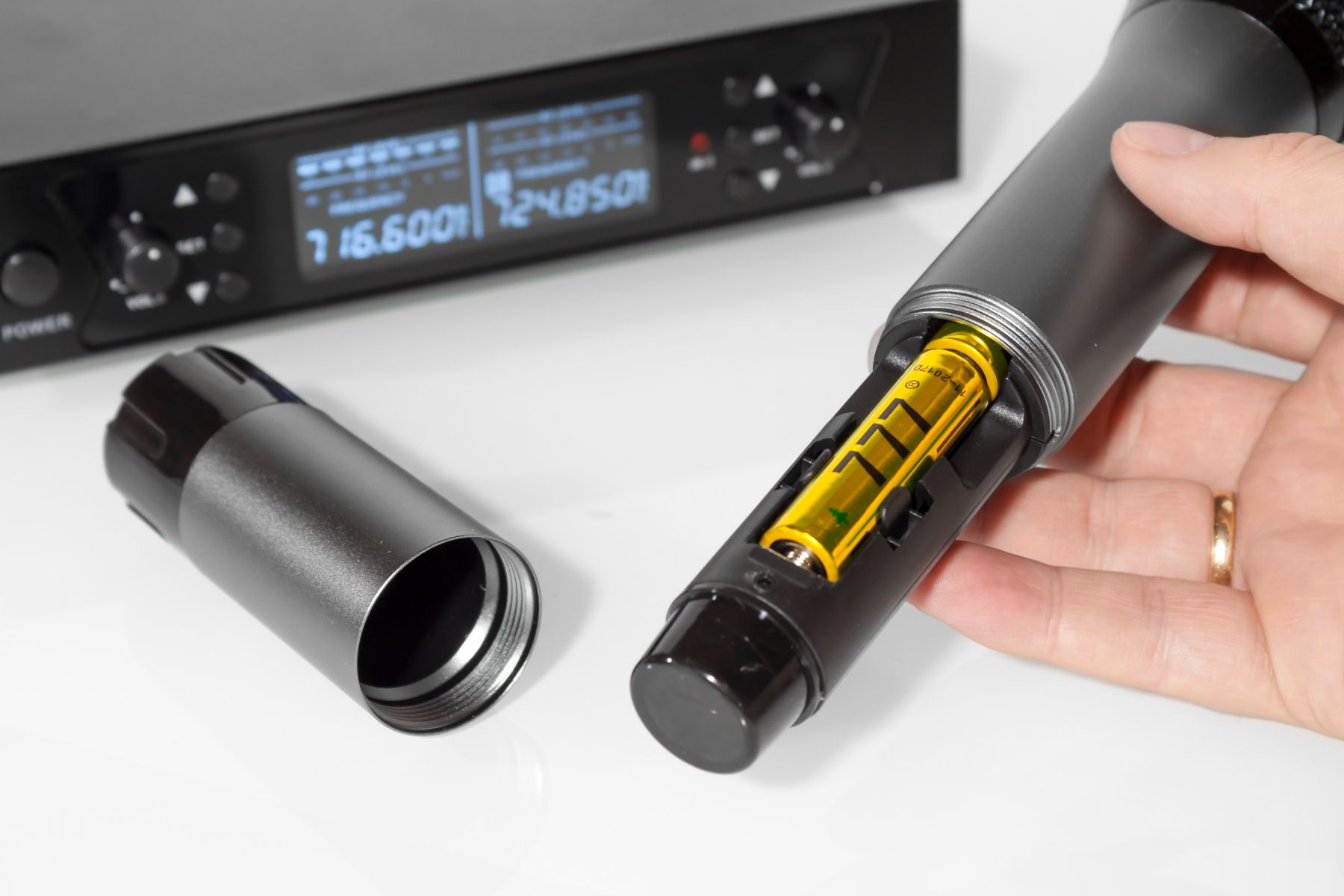
Two AA batteries power the microphone. Unlike most handheld transmitters, the battery compartment is in the center rather than the bottom. Unscrew the housing at the capsule joint to replace the batteries.

Direct Power currently offers only one handheld transmitter type, with a dynamic capsule and cardioid polar pattern. The photo shows the capsule. A rubberized suspension isolates it from the housing, and a foam cover under the metal grille provides extra breath protection.

The microphones look identical. Blue and yellow silicone pieces help identify them in use. The rings around the microphones look a little awkward, but the covers on the antenna sections are an excellent solution.
Sound quality is quite good and comparable to the best affordable wired models. The main strengths are an even midrange and good bass coverage. However, midrange clarity falls quickly as the microphone moves away, and capsule isolation from handling noise is weak. Even so, these are very successful microphones for the budget category.
DP-200 VOCAL
The DP-200 VOCAL is similar but has a single-channel receiver and one handheld transmitter.

The receiver has the same functions as the flagship DP-220. The DP-200 also offers diversity RF operation in the 650–700 MHz UHF band and manual frequency selection in 200 kHz steps. Up to 10 systems are stated to work at once. All packages in the series use the same DP MH handheld microphone.

The DP-200 receiver also has a metal housing and can mount in a rack using extra brackets. Its display shows selected frequency, RF strength, and transmitter signal level. Setup and operation are identical to the previous model.




Two rear outputs provide balanced XLR and unbalanced TRS connections. There is also a sensitivity control, absent from the higher-end receiver.
DP-200 INSTRUMENTAL
The DP-200 instrument package contains a single-channel receiver and a DP BP bodypack transmitter.

The simple transmitter follows a conventional bodypack design. Its light plastic housing has a metal belt clip. Like the handheld microphone, it has a display showing selected frequency and battery level.

Two AA batteries provide a stated operating time of up to 8 hours. Unlike the handheld microphone, the bodypack dims its display after a while to save power.

A 1.2-meter cable is included for a guitar or another instrument with a mono output. A locking thread secures the connector.
DP-200 HEAD
The DP-200 HEAD is intended for presentations and events. It includes a DP BP bodypack transmitter and a headset microphone.

The skin-colored headset microphone has a two-ear support made from thin steel wire, with adjustable microphone position. Unfortunately, no technical microphone information is available. Its quality is sufficient for clear speech, which meets the purpose of this headset type.
Conclusions
Overall, Direct Power wireless systems are interesting options that compare well with other affordable systems. Along with low prices, they offer diversity receivers, selectable frequencies, and fairly good handheld microphone capsules. They remain simple, practical devices with useful displays and minimal settings.
Note. This is an adapted machine translation into English. It follows the “In simple terms” approach. Read the original article at https://prosound.ixbt.com/microphones/dp-200.shtml.