
Arturia MiniFuse Recording Pack — a recording bundle with an interface, microphone, and headphones
Grigory Liadov
Recording bundles from professional equipment manufacturers are becoming more common. Available packages range from simple USB microphone and headphone sets to large bundles with a mixer or even studio monitors. Arturia has introduced its MiniFuse Recording Pack, consisting of an audio interface, microphone, and headphones.
These packages are especially attractive to a broad audience because they are complete, affordable solutions that can be used immediately. Users do not need to study connection types and compatibility: all the devices are designed to work together without unexpected problems. The Arturia MiniFuse Recording Pack follows this approach. It contains a two-channel MiniFuse 2 USB interface, a CM1 condenser microphone, full-size EF1 headphones, and a range of software.
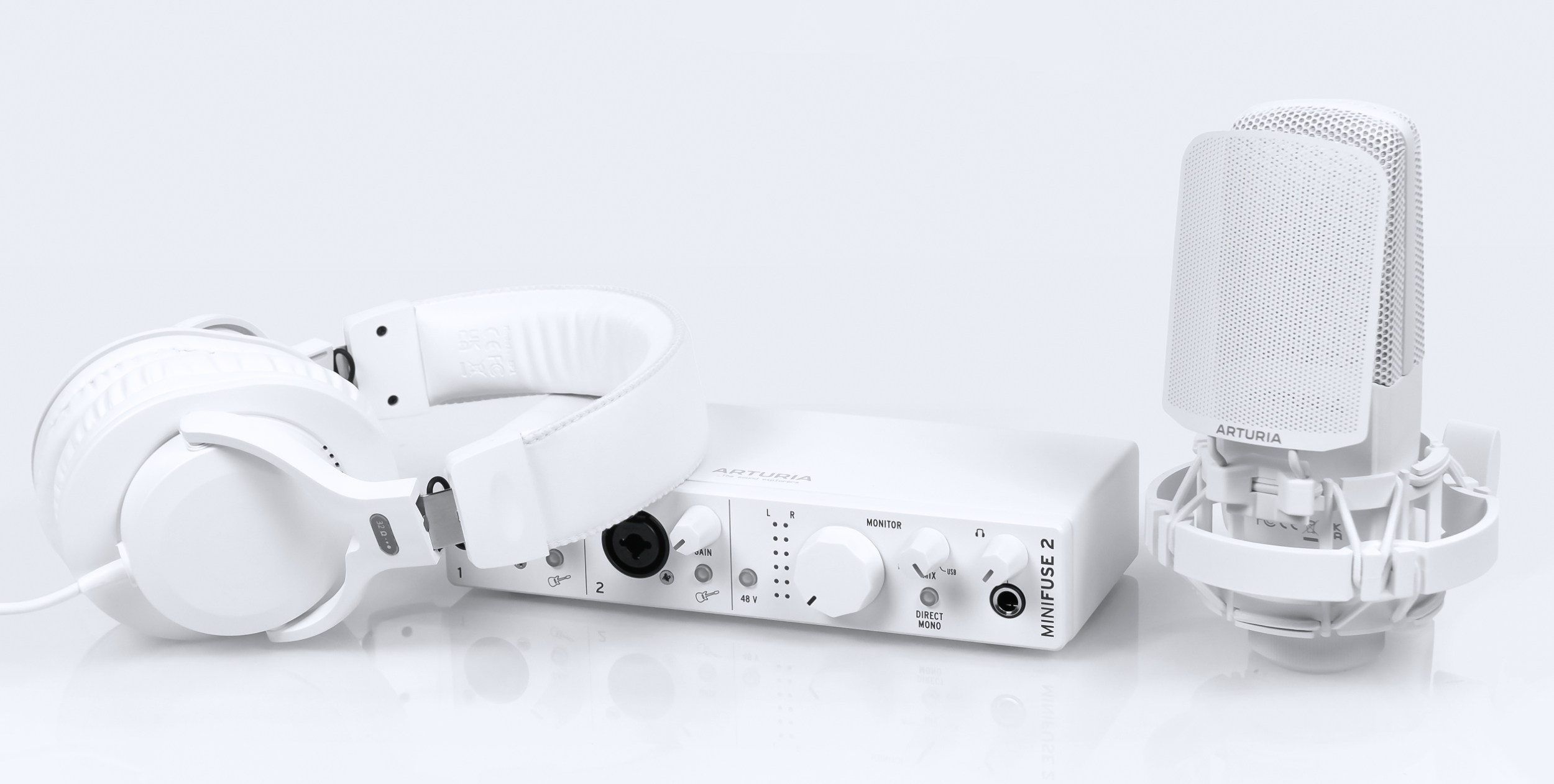
The microphone can record voice and instruments, while the closed-back headphones allow monitoring during recording. The interface provides high recording quality and latency-free monitoring. Connection cables are included, and the supplied software can be used to achieve professional results. The only extra purchase needed is a stand or boom arm for the microphone. This is hardly a problem: any microphone stand will work, even a very inexpensive one.
An interesting feature of the Arturia MiniFuse Recording Pack is the choice of two colors. Most studio equipment is available only in black. Arturia offers both traditional black and an all-white version, shown in the photos. Every device has a white housing, including the microphone, and even the connection cables are white.

The MiniFuse 2 audio interface is the core of the bundle. It belongs to the affordable portable MiniFuse series, familiar to our readers from detailed reviews. The MiniFuse 2 is a two-channel USB interface with two microphone/instrument inputs and two outputs. Its microphone inputs provide the +48 V phantom power needed by studio condenser microphones. It also offers hardware input monitoring and separate headphone and line-output volume controls. Other strengths include a powerful headphone output, extra Loopback channels, and a USB hub. More details about the MiniFuse 2 are available in our review.
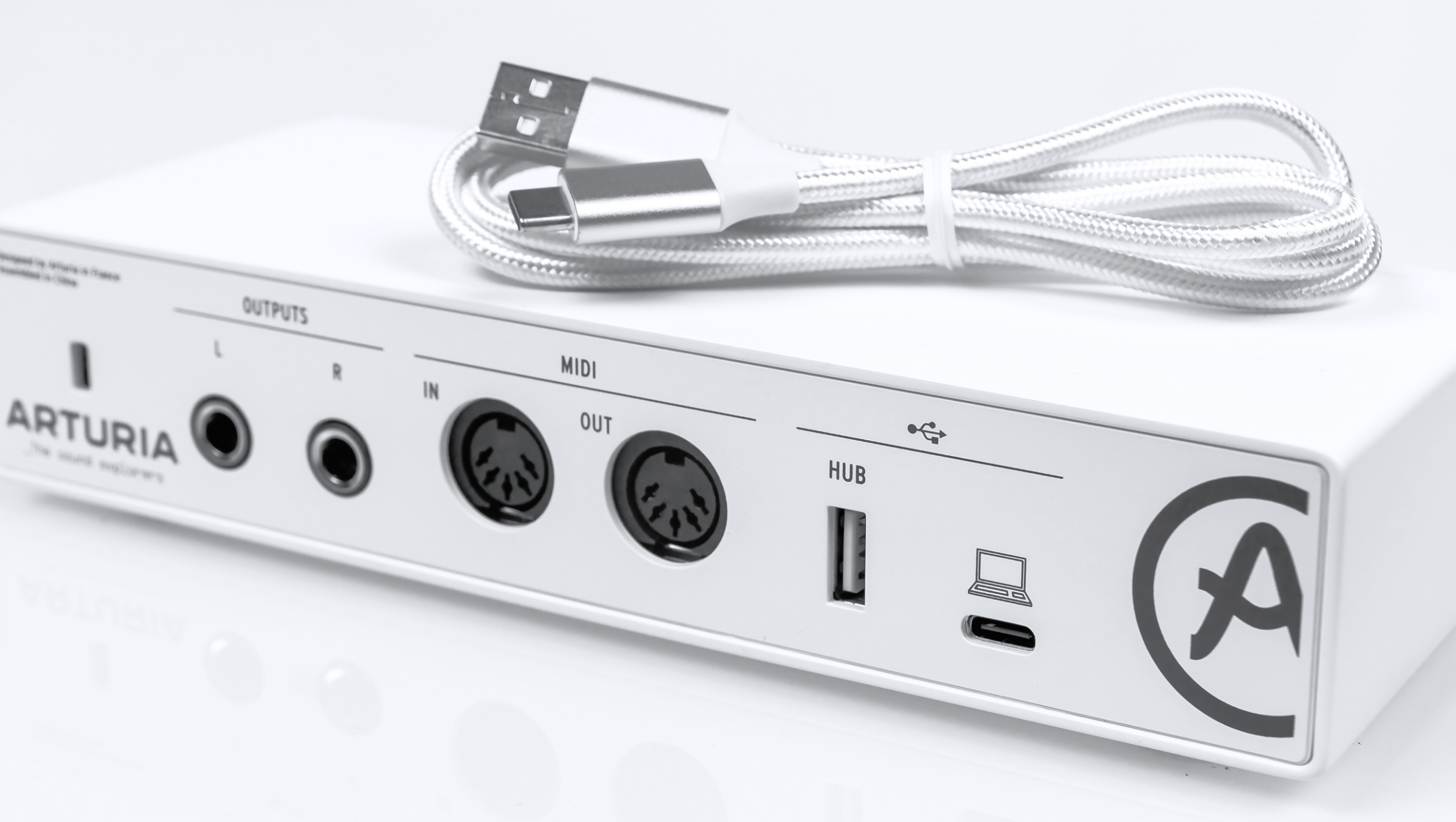
The interface looks good and fits this Arturia bundle well. Its converters have more than enough quality for the supplied microphone and headphones. If the user later wants an upgrade, the interface should be the last component that needs replacement.
The headphones and microphone are new to us. They are available only as part of the MiniFuse 2 bundle and cannot be bought separately, at least for now.

The headphones are a full-size closed-back model. The closed design makes them suitable for monitoring while recording with the microphone. The earpads completely surround the ears and provide the necessary isolation. The elongated pads use medium-firm foam covered with a leather material.

The headphones use a common design that has proved itself in professional work. A broad headband plate is covered with leather, with a soft foam cushion along its entire underside. The headphones do not fold, but the structure is reliable. Sliding headband sections adjust the fit. A hinge also allows a small amount of vertical rotation.

The headphones use 40 mm dynamic drivers. As in other good models, each driver is angled slightly toward the ear. Fabric damps the internal earcup volume, and small holes vent it to the outside. The manufacturer states a sensitivity of 99 dB and an impedance of 32 ohms.

The fixed cable connects to the left earcup. It is straight and 3 meters long, with a mini-jack plug at the end. A screw-on 1/4-inch TRS adapter is included.
As usual, we measure the headphones with our Danish-made Brüel & Kjær 4153 Artificial Ear/Ear Simulator (IEC 60318-1), which costs about 5000 euros. Measurements use the RightMark™ Audio Analyzer PRO software and hardware system.

The Brüel & Kjær simulator effectively reproduces the ear's acoustic impedance up to 16 kHz. Frequency response measurements are provided only as a reference. They should not be used to guess how the headphones sound.

The measured frequency response is typical of affordable closed-back headphones. Its shape resembles an inverse Harman curve, but with stronger variations. Similar responses are common in many closed-back models, suggesting some shared characteristics. In any case, the measurements show which areas can be equalized if desired.
The Arturia EF1 headphones sound quite good. Their main characteristics are strong bass and a slight treble emphasis. Given the low price, it would be unfair to demand outstanding performance. We see no obstacle to using them for professional work. The headphones handle high volume well, offer full-range monitoring and a closed-back design, and remain comfortable during long sessions. They are a good option in their price range.
The Arturia CM1 microphone is also interesting. Rather than a large traditional studio housing, it has a compact body with an original shape. The unusual pop filter and attractive white finish make it stand out further.

The CM1 is a condenser microphone with a single electret capsule and a cardioid polar pattern. The package includes an elastic shock mount and a metal-mesh pop filter. The filter attaches to the edge of the mount and is easily removed for distant recording or acoustic instruments.

Inside the microphone is a full discrete circuit using modern surface-mount (SMD) components. Sensitivity is -36 dB, and the manufacturer states a maximum SPL of 130 dB. The circuit needs +48 V phantom power, supplied by the included MiniFuse 2 interface.

A branded XLR microphone cable is supplied. Its white insulation matches the other devices. The cable is 3 meters long.
We tested the Arturia MiniFuse Recording Pack in studio conditions. We mainly recorded voice, because vocals and speech are the supplied microphone's main uses. To assess the microphone more accurately, we recorded two microphones at the same time. A Neumann TLM102 served as the reference.

In our view, recording quality is good. Despite the electret capsule, the recording has a full sound, enough detail, and responds well to processing. Voice tone is fairly neutral, with no particular frequency emphasis. There is, of course, a difference in detail compared with large-diaphragm microphones. Even so, the Arturia CM1 records very well for an entry-level model. The supplied pop filter handles plosives effectively by dispersing the airflow. Despite its metal construction, it adds no whistling sounds or resonances.
We recorded in Cubase, our usual application. Users can instead use the supplied software. The package includes Ableton Live Lite, Analog Lab Intro, four Arturia effects plugins, NI GUITAR RIG 6 LE guitar processing, and Auto-Tune Unlimited pitch correction.
Conclusions
Arturia's recording bundle is very interesting. The MiniFuse Recording Pack is one of the few affordable, well-balanced packages that can deliver good professional results. The MiniFuse 2 interface allows the microphone and headphones to perform fully while leaving room for future upgrades. In our view, this ready-made package is a useful choice for bloggers and streamers. It offers both excellent functionality and an attractive appearance, which matters when equipment is shown on camera.
Note. This is an adapted machine translation into English. It follows the “In simple terms” approach. Read the original article at https://prosound.ixbt.com/microphones/arturia-recordpack-white.shtml.