
PreSonus AudioBox GO – an extremely compact and affordable 2×2 interface
Maxim Liadov
The PreSonus AudioBox GO has been called the king of budget USB recording interfaces. It is among the lightest and smallest devices in its class, yet offers functions comparable to larger, more expensive models. Despite the low price, it has everything a musician needs: a proper XLR microphone input with +48 V phantom power, a separate guitar input with headroom for peaks, balanced TRS line outputs and even separate headphone volume. Its 50 dB gain range matches larger PreSonus models.
What is different? The AudioBox GO stops at 96 kHz, with input/output figures of 90/102 dBA. For an entry-level device this is less important, and comparable with USB microphones and common mixers that musicians use without complaints. Users needing higher specifications or more channels can choose from PreSonus's wide range, including AudioBox USB 96, Studio 24c, Studio 26c, Studio 68c, Studio 1810c and Studio 1824c.

The attractive case has no protruding screws and uses rounded corners. When carried in a bag, it should not tear or scratch nearby headphones or a laptop. The AudioBox GO has a USB-C connector carrying ordinary USB 2.0. A USB-C cable works, whether its other end is USB-C or a standard USB 2.0 plug.
The manufacturer's official video introduces the AudioBox GO:
The video presents the AudioBox GO for music production, podcasting and blogging, and as an affordable way to record guitar and vocals at home. Let us examine the specifications:
AudioBox GO specifications
| General | |
|---|---|
| Frequency range | 44.1, 48, 88.2, 96 kHz |
| Bit depth | 24-bit |
| ADC chip dynamic range | 90 dBA |
| DAC chip dynamic range | 102 dBA |
| Microphone inputs | |
| Maximum level | +10 dBu |
| Gain | 50 dB |
| THD+N | <0.004% |
| Phantom power | +48 V |
| Guitar/line inputs | |
| Maximum signal level | +13 dBu, guitar +19 dBu, line |
| Gain | 50 dB |
| Impedance | 750 kohms |
| Line outputs | |
| Connector | TRS, impedance-balanced |
| Maximum level | +10 dBu |
| THD+N | <0.007% |
| Headphone amplifier | |
| Power | 30 mW/channel into 60 ohms |
| Signal-to-noise ratio | 90 dBA |
| THD+N | <0.08% |
| Dimensions and weight | |
| Height | 44 mm |
| Width | 84 mm |
| Depth | 108 mm |
| Weight | 0.24 kg |
Signal levels are high, exactly as on the PreSonus Studio 24c, and the headphone amplifier is relatively loud. Other figures are as expected. The remarkable point is the 240 g weight: a record low.

The compact case places every connector except headphones on the rear. The front has level knobs. A large Main volume knob controls the balanced TRS outputs, with a separate small headphone knob beside it. Headphones use a full-size 1/4-inch TRS socket. A lit button activates phantom power. Input 1 and 2 gain knobs sit on the left. Importantly, there is a hardware input/playback mix knob and even overload indicators. It has the controls expected from larger interfaces.

The rear combo XLR/TRS Mic/Line input accepts a professional condenser microphone. The second input is for guitar. Two balanced TRS Main Out sockets feed active monitors. The interface runs from USB bus power only.

As in other recent models, a 32-bit NXP LPC4320 ARM processor handles USB.

Chip shortages and the absence of AKM converters have forced manufacturers to find alternatives. Here, a TSI TSCS253 provides conversion, with ADC dynamic range of 90 dBA and DAC dynamic range of 102 dBA. The preamp follows the larger models: a discrete transistor input stage followed by JRC 4580 gain control. A JRC4556A op-amp acts as headphone current buffer, typical in this class.

The standard PreSonus control panel checks for firmware updates and offers installation. It does not describe the changes; usually these are small compatibility fixes.

After updating, there are few settings to adjust. Unlike larger models, it has no Loopback option. Otherwise, the driver is fully professional, with ASIO and fast response.

Latency is low: just 5.8 ms with a 64-sample buffer at 44 kHz. The interface worked without problems at this setting.
Device: AudioBox ASIO Driver
Features:
Input channels: 2
Output channels: 2
Input latency: 142
Output latency: 115
Min buffer size: 16
Max buffer size: 2048
Preferred buffer size: 64
Granularity: -1
ASIOOutputReady - not supported
Sample rate:
8000 Hz - not supported
11025 Hz - not supported
16000 Hz - not supported
22050 Hz - not supported
32000 Hz - not supported
44100 Hz - supported
48000 Hz - supported
88200 Hz - supported
96000 Hz - supported
176400 Hz - not supported
192000 Hz - not supported
352800 Hz - not supported
384000 Hz - not supported
Input channels:
channel: 0 (Input 1) - Int32LSB
channel: 1 (Input 2) - Int32LSB
Output channels:
channel: 0 (Main Out Left) - Int32LSB
channel: 1 (Main Out Right) - Int32LSB
Sample rates up to 96 kHz are supported. The headphone output always carries the same signal as the line outputs.
RMAA testing
| Device under test | [ASIO] Studio USB ASIO Driver |
| Operating mode | 24-bit, 44 kHz |
| Audio interface | ASIO |
| Signal path | External loopback (line-out - line-in) |
| RMAA version | 6.4.5 PRO |
| 20 Hz–20 kHz filter | YES |
| Signal normalization | YES |
| Level change | -1.4 dB / -1.2 dB |
| MONO mode | NO |
| Calibration signal frequency, Hz | 1000 |
| Polarity | Correct/correct |
| Frequency response variation (40 Hz–15 kHz), dB | +0.32, -0.37 |
Good |
| Noise level, dB(A) | -90.9 |
Very good |
| Dynamic range, dB (A) | 90.6 |
Very good |
| Harmonic distortion, % | 0.013 |
Good |
| Harmonic distortion + noise, dB(A) | -75.1 |
Average |
| Intermodulation distortion + noise, % | 0.016 |
Very good |
| Stereo crosstalk, dB | -88.2 |
Excellent |
| Intermodulation at 10 kHz, % | 0.034 |
Good |
| Overall rating | Very good |
See the RMAA report for details
Tests generally confirm ADC and DAC specifications. Dynamic range is limited by the ADC; the DAC alone would give higher figures. Distortion meets the specification.

The distortion test shows a harmonic spectrum typical of an inexpensive stereo codec.
We tested the microphone input with our usual Neumann TLM102. Voice recording needed 90% gain, but some headroom remained. The preamp borrowed from larger PreSonus models performs well.


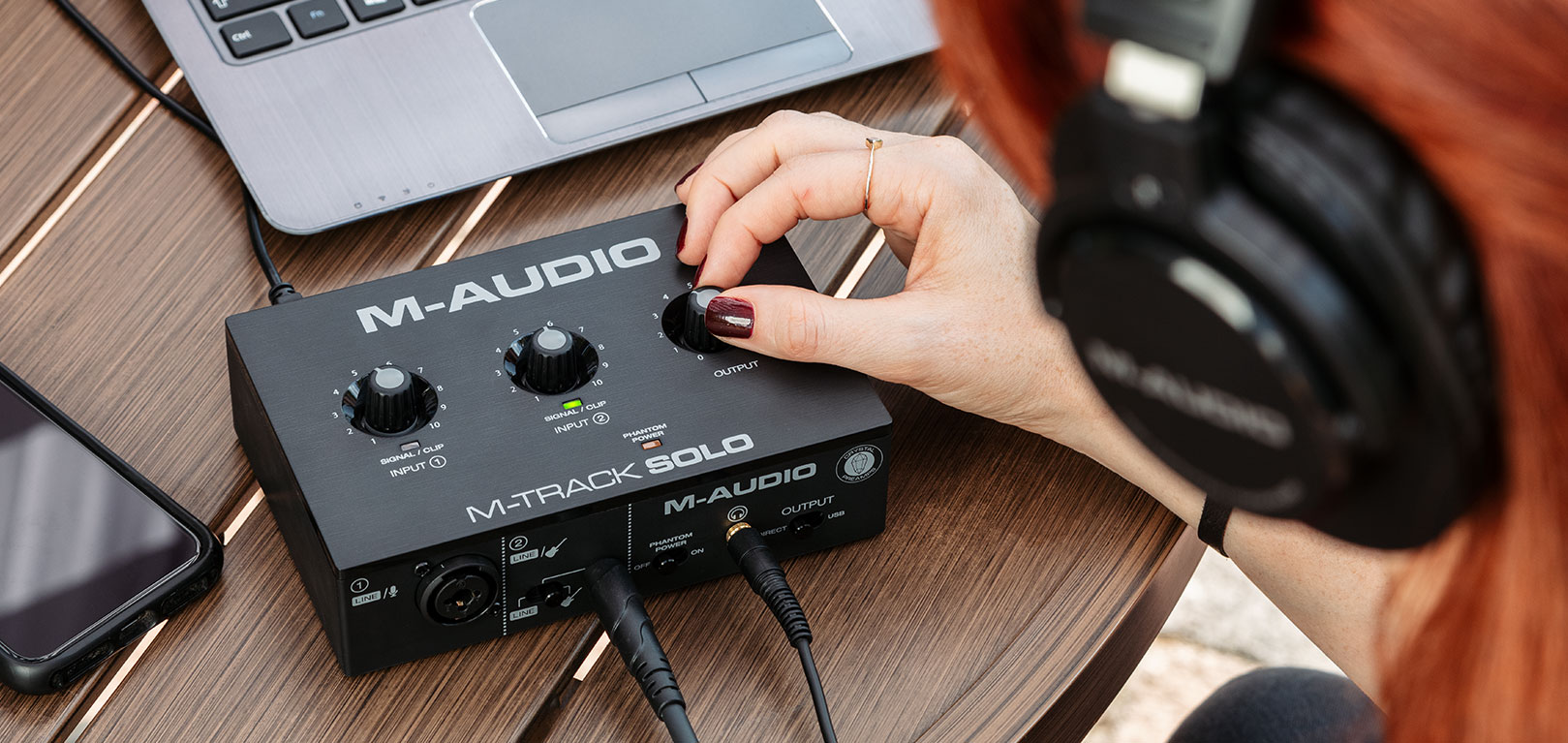
Line-output playback quality suits the class and is usable professionally. Users wanting higher quality should consider larger models. The headphone amplifier suits common headphones. Its purpose here is to send a backing track to a performer, and it does that well. The Mix control conveniently balances input and backing track in the performer's headphones.
Conclusions
The PreSonus AudioBox GO is an affordable professional interface for personal use and location recording, with quality comparable to portable recorders and USB microphones. It has the essentials for musicians and includes PreSonus software to start creating immediately. Preamps are good, and simple controls suit beginners. It works best with entry-level monitors and microphones, where users are unlikely to hear a benefit from a more expensive interface.
Note. This is an adapted machine translation into English. It follows the “In simple terms” approach. Read the original article at https://prosound.ixbt.com/interfaces/presonus-audiobox-go.shtml.