
M-Audio M-Track Solo – professional audio interface for just $50
Maxim Liadov
M-Audio audio interfaces are established, reliable and affordable products for a wide audience. We previously reviewed the Air range, including M-Audio Air 192 | 4, M-Audio Air 192 | 6, M-Audio Air 192 | 8.
Now we turn to the M-Track Solo and Duo, introduced in 2021. At $50 and $70, they target users who want to connect a condenser microphone or guitar without paying for expensive advanced equipment.
Solo and Duo differ significantly. Solo accepts one microphone and uses unbalanced RCA line outputs; Duo accepts two and has balanced TRS. Duo also has separate headphone volume, while Solo shares it with line output. Sound and electronics are identical, so choose by your needs. Both offer essential professional functions: 54 dB gain, +48 V phantom power, hardware monitoring, and microphone/line and guitar/line switching.
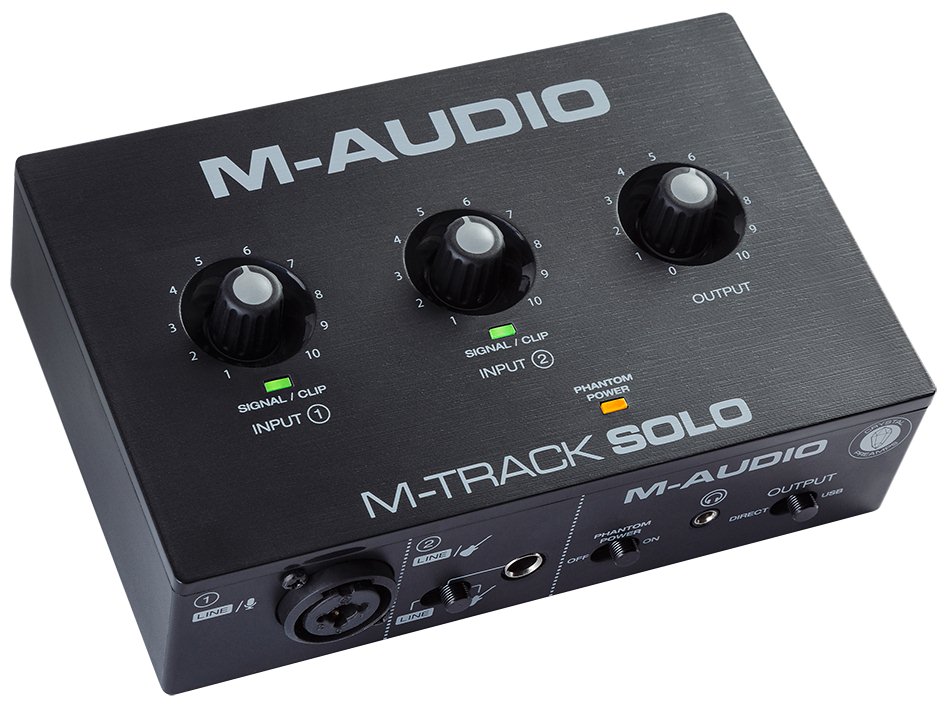
Both models have attractive, restrained styling, without cheap-looking panels or protruding screws. Two compact plastic halves clip tightly together and are secured by 4 recessed screws beneath rubber feet. The top has a brushed-metal-style matte texture, light-grey lettering and recessed square LEDs. Engineers and designers have worked carefully: appearance compares well even with expensive models.
M-Audio M-Track Solo specifications
- Microphone input, balanced XLR:
- THD+N: 0.003%;
- EIN: -128 dBu, maximum gain, A-weighted;
- Gain range: 0 to +54 dB;
- Line inputs 1–2 (balanced TRS):
- THD+N: 0.002%;
- Gain range: -10 to +44 dB;
- Sensitivity: -43 dBu;
- Guitar inputs 1–2 (unbalanced TS):
- Impedance: 1 Mohm
- THD+N: 0.005%;
- Gain range: -10 to +44 dB;
- RCA outputs:
- THD+N: 0.002%;
- Maximum output level: +4 dBu;
- Headphone output
- THD+N: 0.02%
- Power: 60 mW into 32 ohms
- Dimensions: 164 × 55 × 114 mm;
- Weight: 0.30 kg.
Specifications also list 109 dB signal-to-noise ratio. This is noise during silence rather than recording/playback dynamic range. We would also list the converters' 96 dB dynamic range. In this budget class, it does not prevent music creation.

Unlike more expensive M-Audio models, there are no multi-segment meters, only signal and overload indicators. Recessed knobs and a very low 300 g weight suit portable use. Rubber feet hold it firmly for one-handed adjustment.

The +48 V microphone input accepts a condenser on channel 1 while guitar uses the second channel. Line-input mode allows a signal to bypass preamp circuits, rare in this price range.

Rear RCA outputs easily connect inexpensive active speakers or budget studio monitors. USB Type-B carries USB 1.1 at 12 Mbit/s, so basic sound works without driver installation. Installing the driver adds a control panel.
USB bus power is the only power source. A connection cable is included.
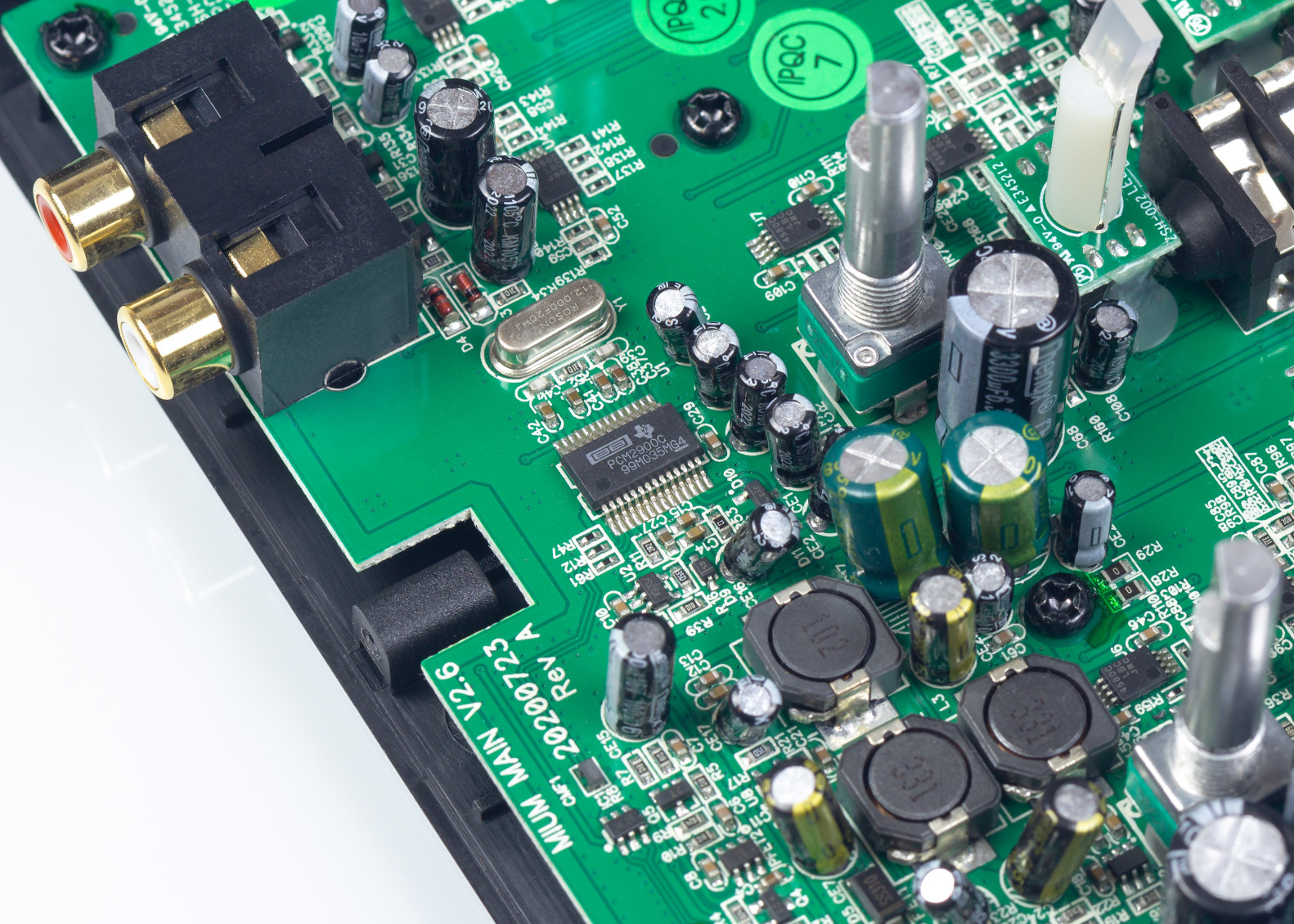


The PCM2900 combines a USB 1.1 controller and stereo codec. ADC specifications are 89 dB dynamic range and 0.01% THD+N; DAC figures are 96 dB and 0.005%.

Crystal preamps use transistor input stages followed by op-amp gain control.

A separate integrated headphone amplifier, most likely MAX9723, supplies 60 mW into 32 ohms. This is not a record but is a proper dedicated amplifier. Some budget interfaces provide 10 times less power using a general-purpose op-amp buffer.
All control uses hardware switches and knobs, so there is no separate device panel. Only a small standard M-Audio ASIO buffer panel is provided.

Latency is low: 8 ms with a 64-sample buffer. Output-only latency is lower.

Features:
Input channels: 2
Output channels: 2
Input latency: 267
Output latency: 174
Min buffer size: 16
Max buffer size: 2048
Preferred buffer size: 64
Granularity: 16
ASIOOutputReady - supported
Sample rate:
8000 Hz - not supported
11025 Hz - not supported
16000 Hz - not supported
22050 Hz - not supported
32000 Hz - not supported
44100 Hz - supported
48000 Hz - supported
88200 Hz - not supported
96000 Hz - not supported
176400 Hz - not supported
192000 Hz - not supported
352800 Hz - not supported
384000 Hz - not supported
Input channels:
channel: 0 (In 1) - Int32LSB
channel: 1 (In 2) - Int32LSB
Output channels:
channel: 0 (Out 1) - Int32LSB
channel: 1 (Out 2) - Int32LSB
Only 44 and 48 kHz are supported. This should not cause concern: higher sample rates do not automatically improve sound quality.
RMAA testing
| Device under test | [ASIO] M-Track Solo and Duo ASIO |
| Operating mode | 24-bit, 44 kHz |
| Audio interface | ASIO |
| Signal path | line-out |
| RMAA version | 6.4.5 PRO |
| 20 Hz–20 kHz filter | YES |
| Signal normalization | YES |
| Level change | 0.0 dB / -0.1 dB |
| MONO mode | NO |
| Calibration signal frequency, Hz | 1000 |
| Polarity | Correct/correct |
| Frequency response variation (40 Hz–15 kHz), dB | -0.05, -0.21 |
Very good |
| Noise level, dB(A) | -96.0 |
Excellent |
| Dynamic range, dB(A) | 96.8 |
Excellent |
| Harmonic distortion, % | 0.00392 |
Very good |
| Harmonic distortion + noise, dB(A) | -84.0 |
Good |
| Intermodulation distortion + noise, % | 0.00611 |
Excellent |
| Stereo crosstalk, dB | -93.6 |
Excellent |
| Intermodulation at 10 kHz, % | 0.00626 |
Excellent |
| Overall rating | Excellent |
See the RMAA report for details
Tests confirm the stereo codec specifications. The 96 dB limit follows from its lack of 24-bit operation. Other budget devices in 16-bit mode would give similar figures.

Results are as expected at this low price. For higher specifications, increase the budget and consider M-Audio Air 192 | 4, M-Audio Air 192 | 6, M-Audio Air 192 | 8.

We recorded a Neumann TLM102 through the microphone input. We again liked the Crystal preamp sound: natural tone without coloration. Headphone volume suits common 32-ohm headphones with sensitivity of 100 dB or higher.
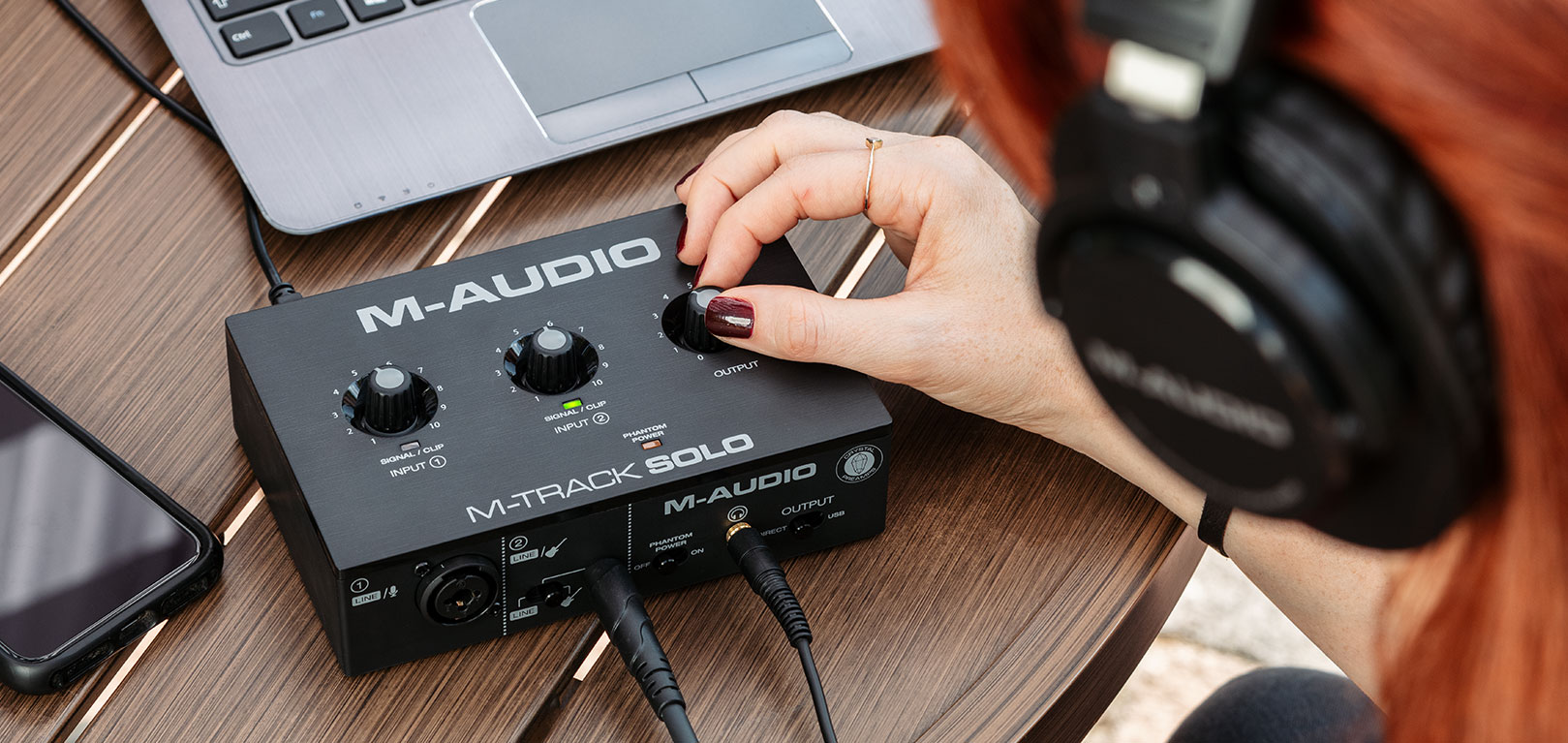
The software bundle includes Pro Tools | First M-Audio Edition, MPC Beats, AIR Music Tech Xpand!2 multitimbral instrument, Eleven Lite guitar processing and 20 AVID effects plug-ins. Even beginners can start creating music immediately.

Conclusions
The M-Track Solo is currently the most affordable full professional interface on the market. It combines attractive design, low weight, compact size, low-latency ASIO drivers, good preamps and a useful headphone amplifier. The slightly more expensive Duo adds a second microphone input and separate headphone volume. The main difference from higher-priced models is support for only 16-bit/44 or 48 kHz. For higher formats, consider the M-Audio Air 192 | 4, M-Audio Air 192 | 6, M-Audio Air 192 | 8.
Note. This is an adapted machine translation into English. It follows the “In simple terms” approach. Read the original article at https://prosound.ixbt.com/interfaces/m-audio-solo.shtml.