
iCON Cube 2 Nano S: a two-channel audio interface with top-class converters
Grigory Liadov
Our tests of iCON ProAudio interfaces show significant progress in its latest models. For example, the iCON Harrison 32C uses high-quality converters and hardware console processing. Support for software effects in its mixer gives it a clear advantage over competitors.
Today we test another interesting new iCON ProAudio product, the affordable Cube 2 Nano S. The compact Cube series has existed for years, but its 2025 update is particularly attractive. What caught our attention?
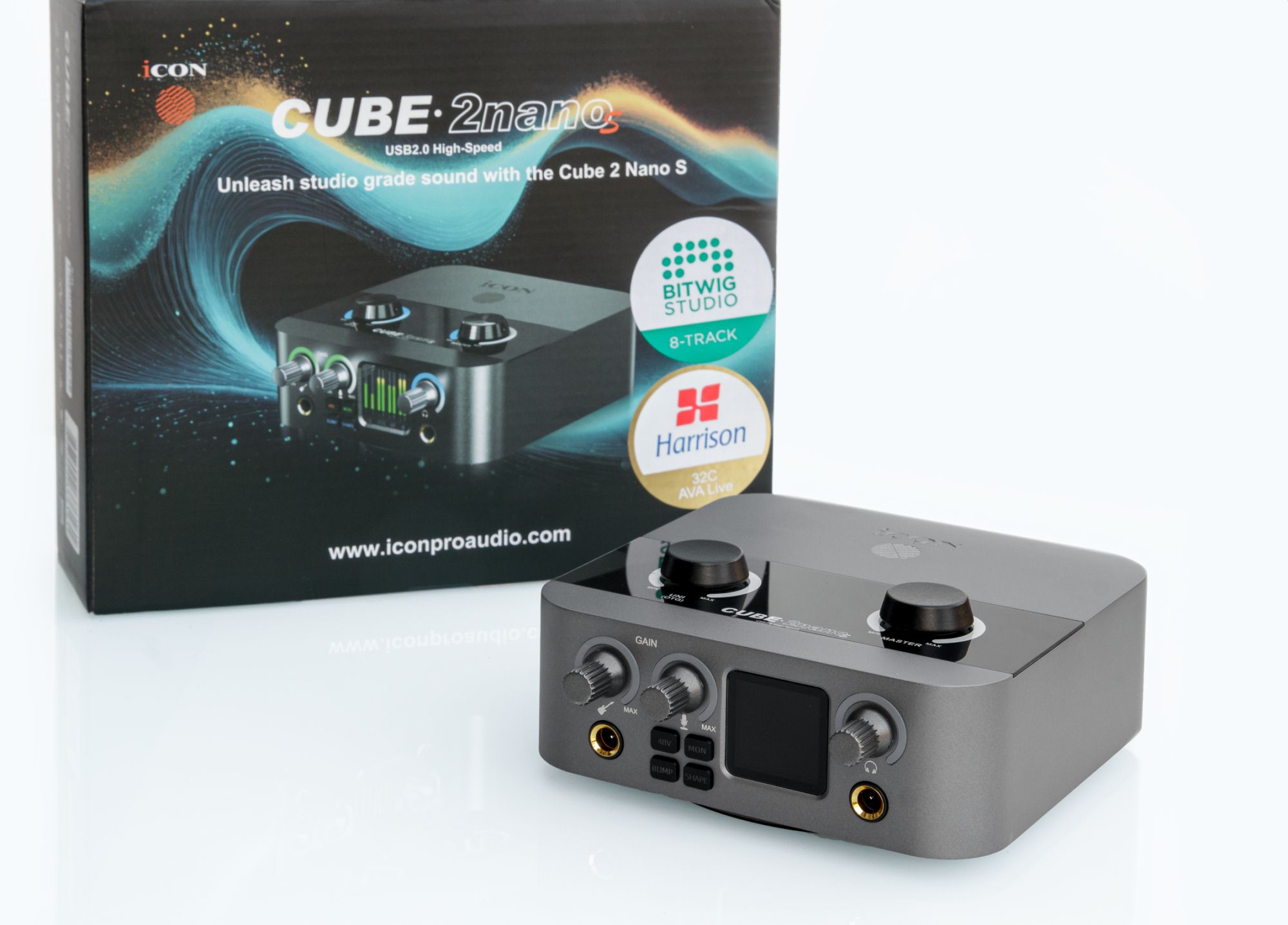
The iCON Cube Nano S uses modern top-class converters. Mainstream interfaces often deliberately use inexpensive converters with modest specifications. Only a few recent models have offered strong figures. The Cube Nano S joins the leading group with an ES9822PRO ADC rated at 125 dBA dynamic range and a CS43198 DAC rated at 130 dBA. The rest of its circuitry meets a similar standard. The models also look attractive, have a colour display and apply VST plug-ins to input and output channels in real time.
iCON Cube 2 Nano S specifications
| ADC | |
| Dynamic range | 125 dBA |
| THD+N | -117 dB at -1 dBFS |
| DAC | |
| Dynamic range | 130 dBA |
| THD+N | -115 dB at 0 dBFS |
| Microphone input (balanced XLR) | |
| Frequency response | 20 Hz–20 kHz ±0.5 dB |
| IEN | -120 dB |
| Maximum input level | +18 dBu |
| Gain range | 60 dB |
| Guitar input | |
| Frequency response | 20 Hz–20 kHz ±0.5 dB |
| Impedance | 390 kohms |
| Maximum input level | +10 dBu |
| Gain range | 39 dB |
| Balanced line output | |
| Frequency response | 20 Hz–20 kHz ±0.5 dB |
| Maximum output level | +10 dBu |
| Headphone output | |
| Frequency response | 20 Hz–20 kHz ±0.5 dB |
| Impedance | 10 ohms |
| Maximum output level | +20 dBu |
| Other specifications | |
| Dimensions | 135 × 152 × 60 mm |
| Weight | 688 g |
The published figures describe the converter chips rather than the finished device. However, our measurements show very good actual dynamic range and distortion too.
As before, the Cube Nano range has two models differing in size and channel count. We test the smaller Cube 2 Nano S, with two inputs and two outputs.
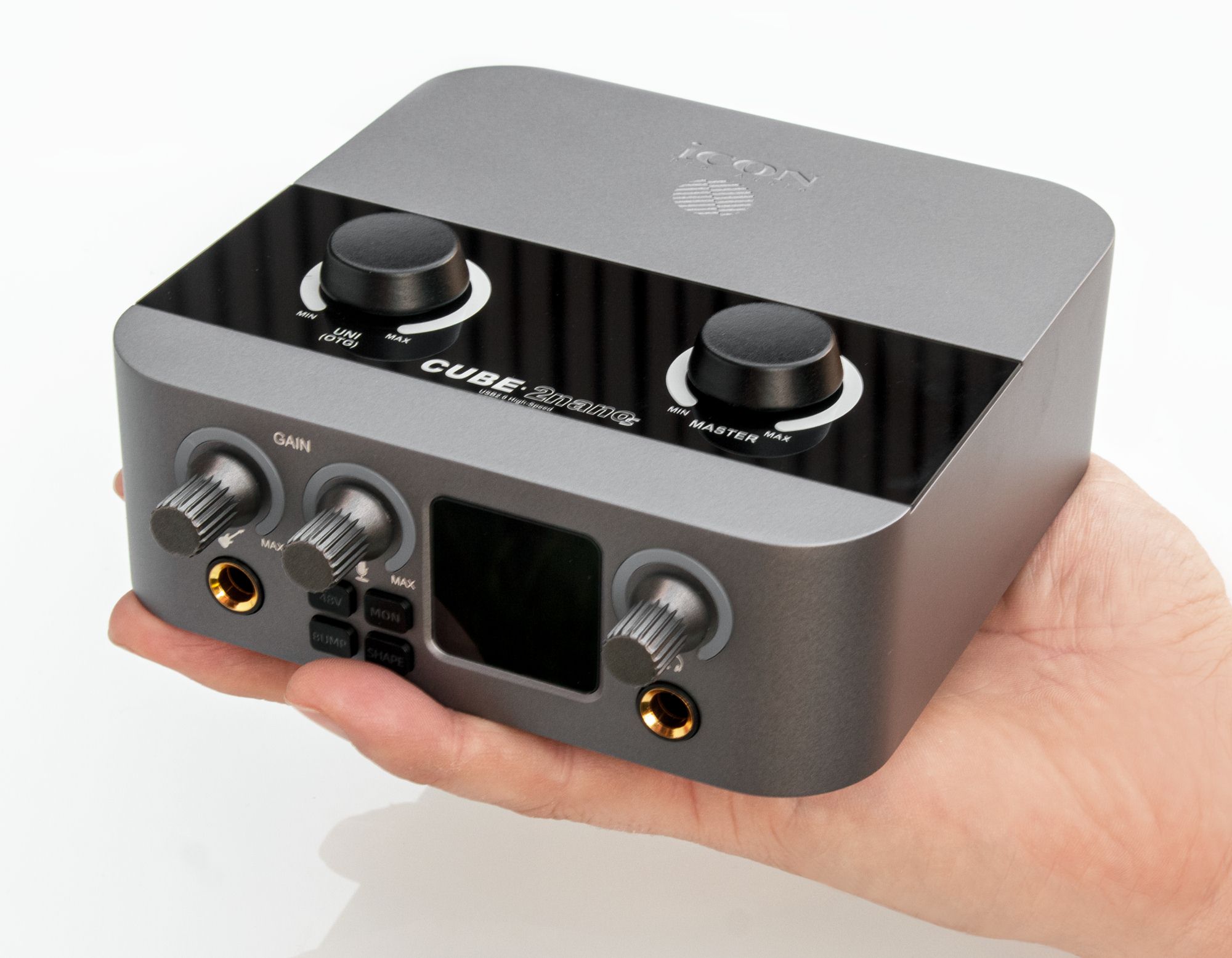
Its small size and square case are immediately noticeable. The photograph beside a hand shows just how compact it is.
Its appearance follows the earlier generation, with changes that improve ergonomics and operation.
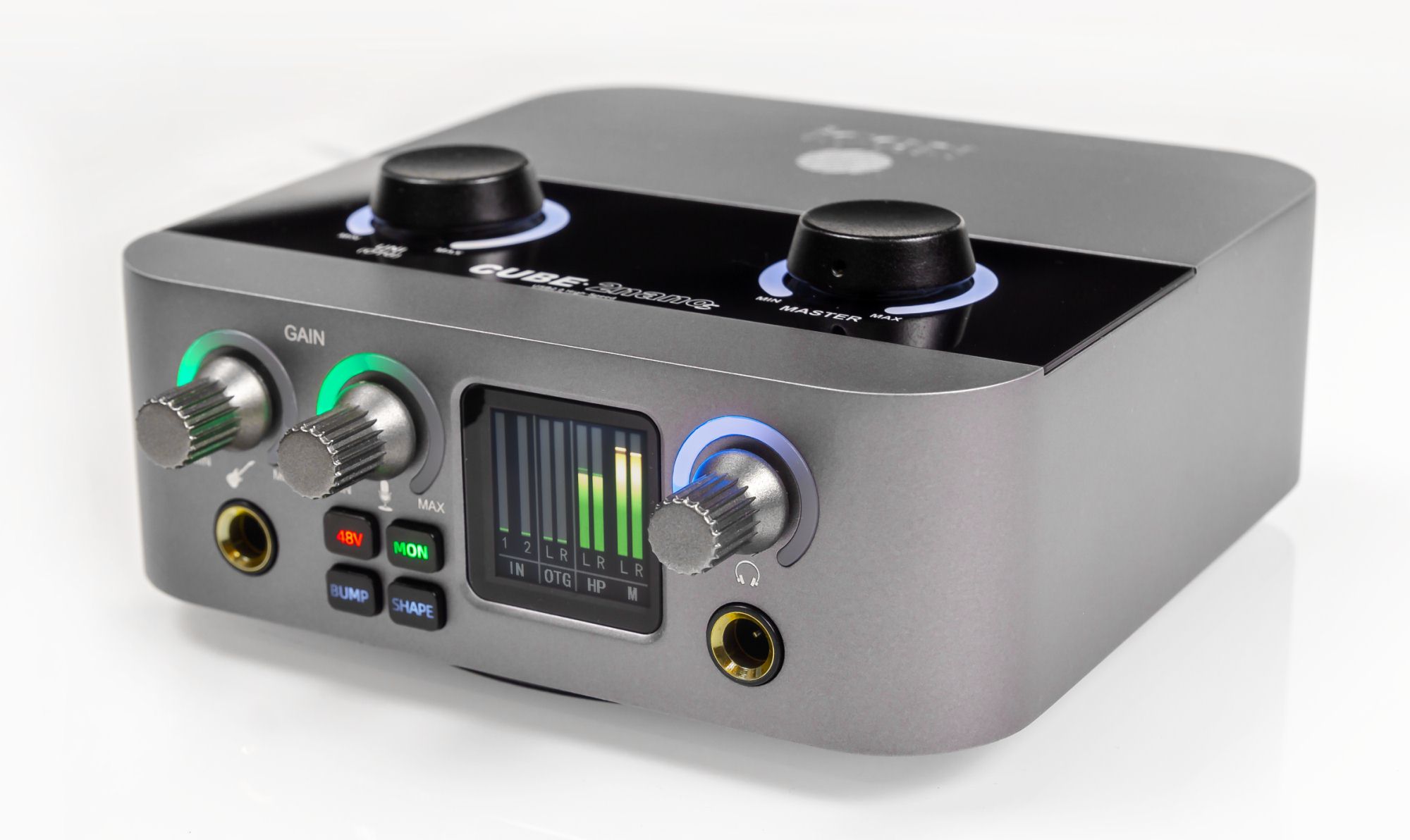
The main addition is a good high-resolution display. It shows input and output levels and the exact dB value when a control is adjusted.
Line output and OTG mobile-device volume knobs are now on top. The front has TRS sockets for guitar input and headphones. The large XLR microphone connector has moved to the rear.
LEDs around the knobs indicate the set level. They are not precise references, so use the numeric values and meters for accurate adjustment.
Four mode buttons sit below the microphone gain knob. +48 V phantom power and direct monitoring are familiar, but Bump and Shape need explanation. These Cube Nano features act only on the microphone input. BUMP enables a low-cut filter with a small boost near its 60 Hz cutoff. SHAPE improves clarity through mild midrange and treble EQ, boosting the signal by a few dB. Both work well for voice recording and streaming, improving sound with one button.
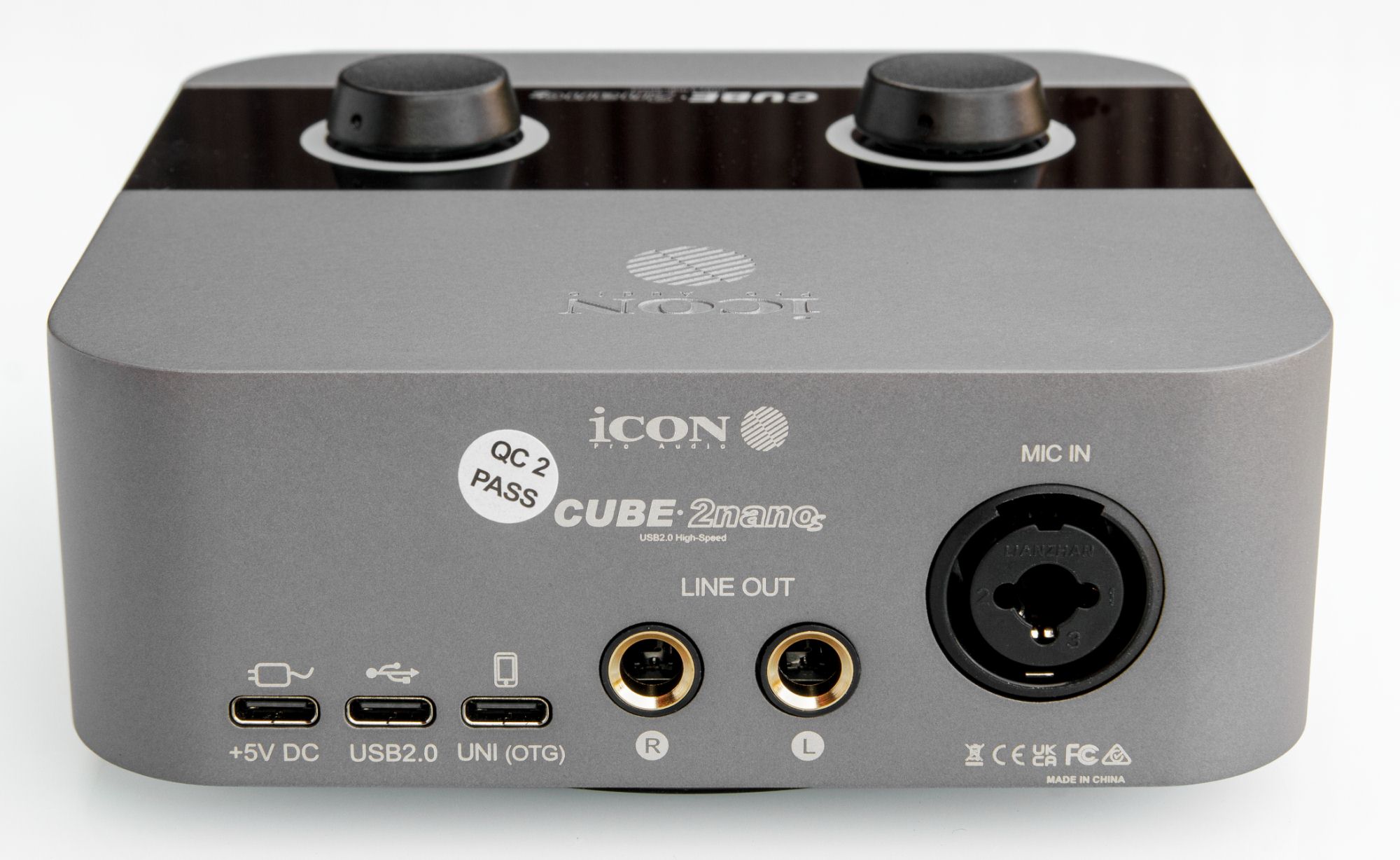
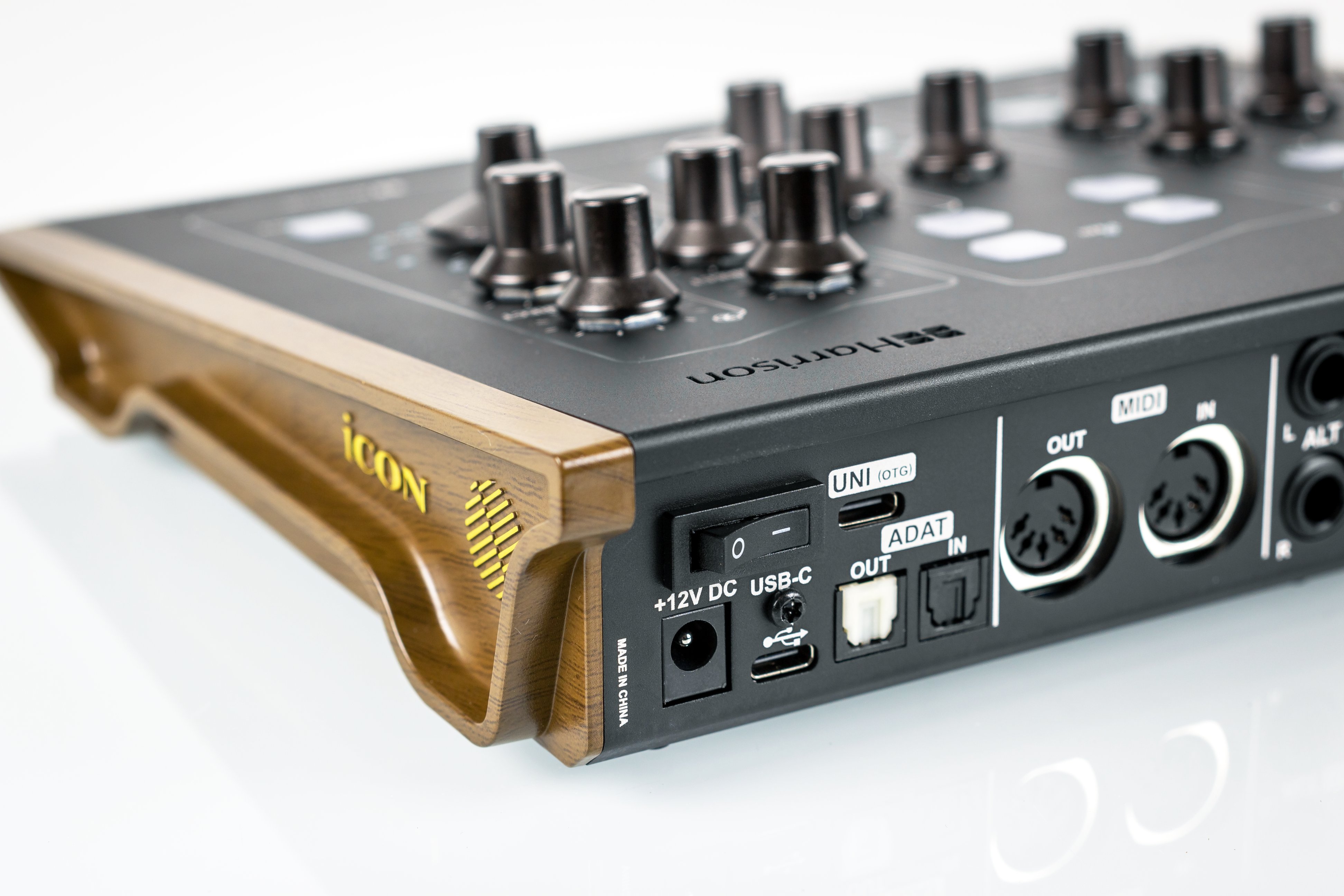
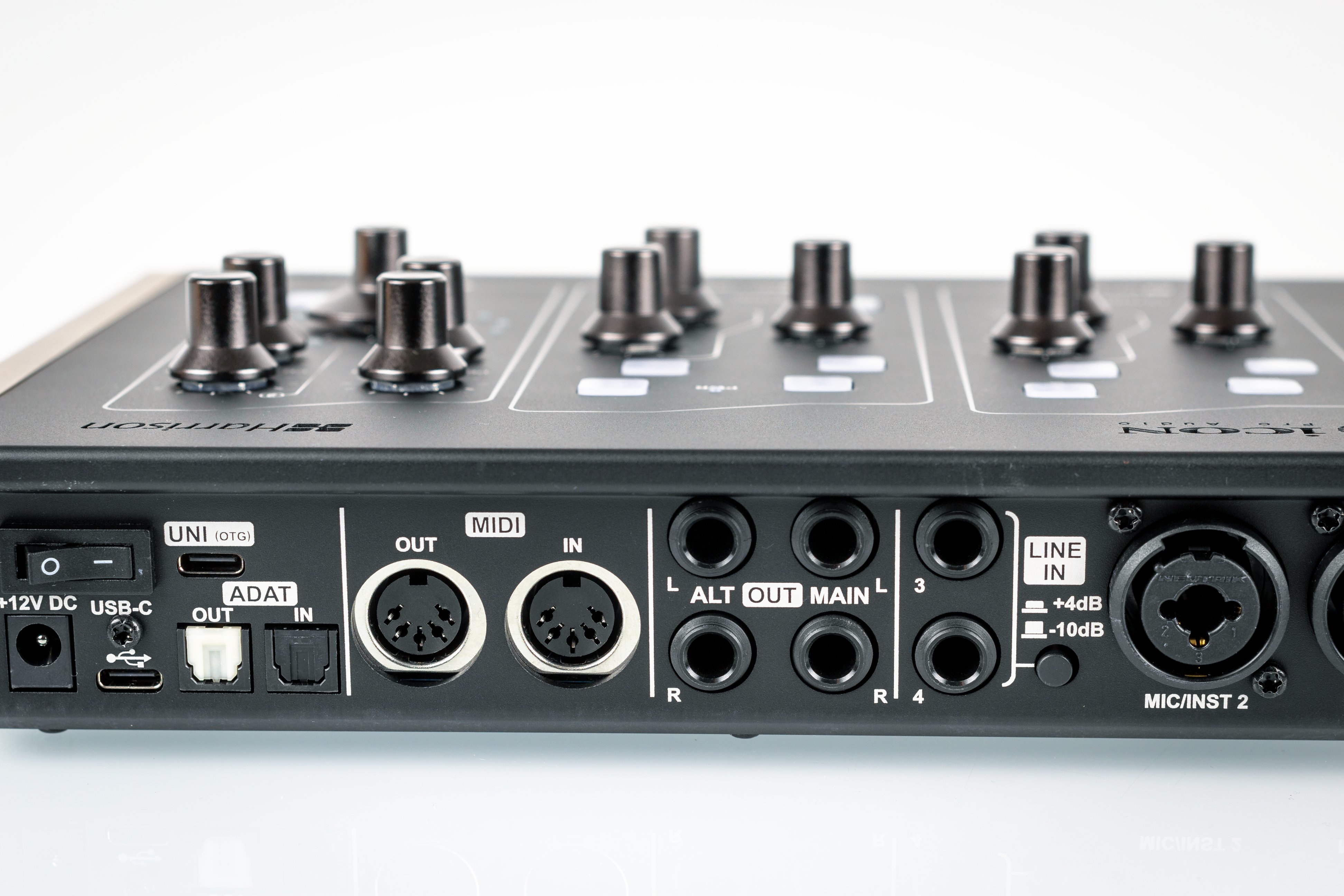
The rear carries a combo TRS/XLR microphone input, TRS line outputs and three USB ports. The central USB 2.0 port connects to a computer. UNI connects to a mobile device. A computer powers the interface over USB. Mobile operation without a PC requires an extra power adapter connected to +5V DC.
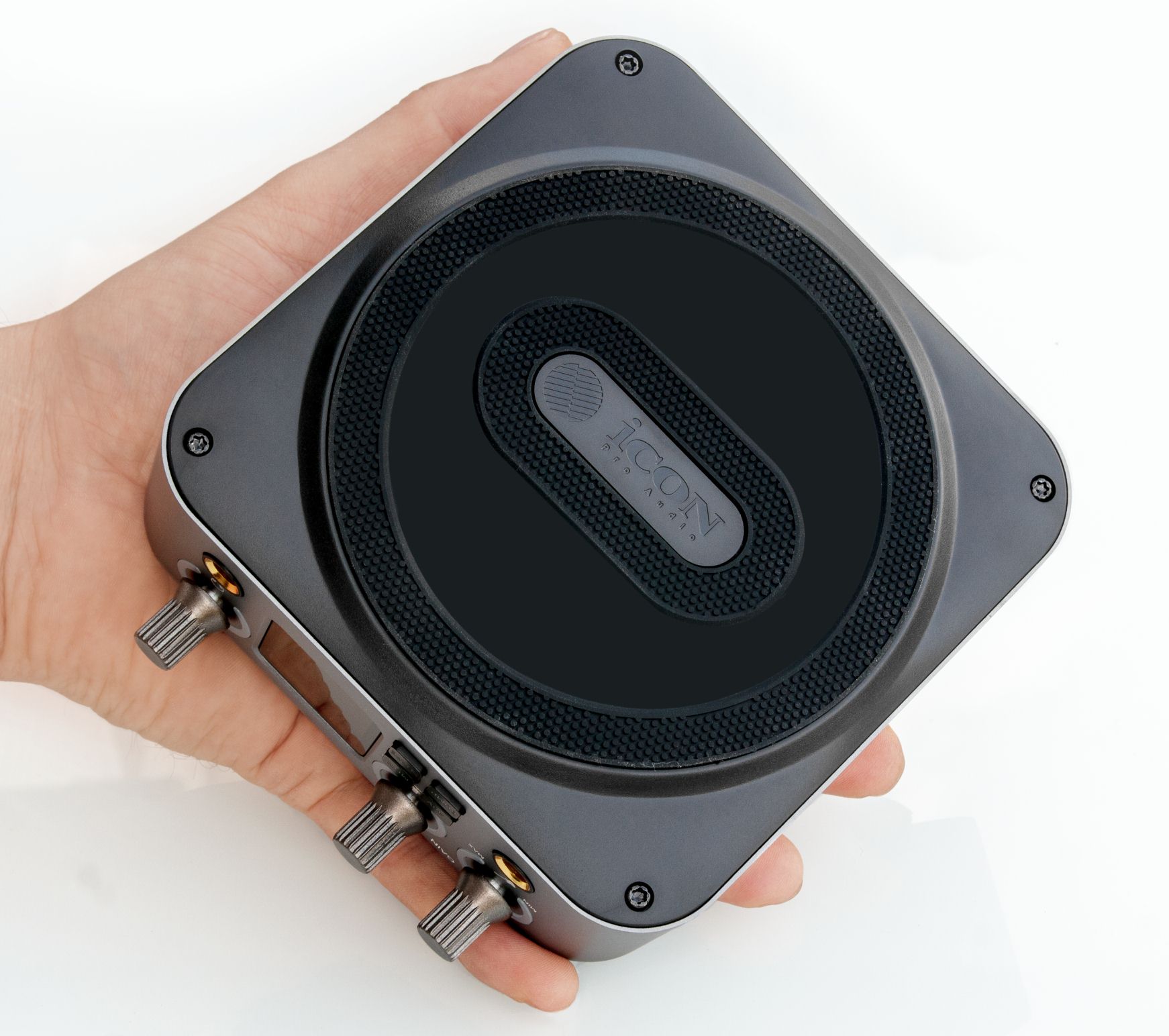
The metal case adds useful weight. Despite its small size, the interface sits firmly on a desk and does not slide when headphone cables move. A wide, textured rubber base provides good grip.
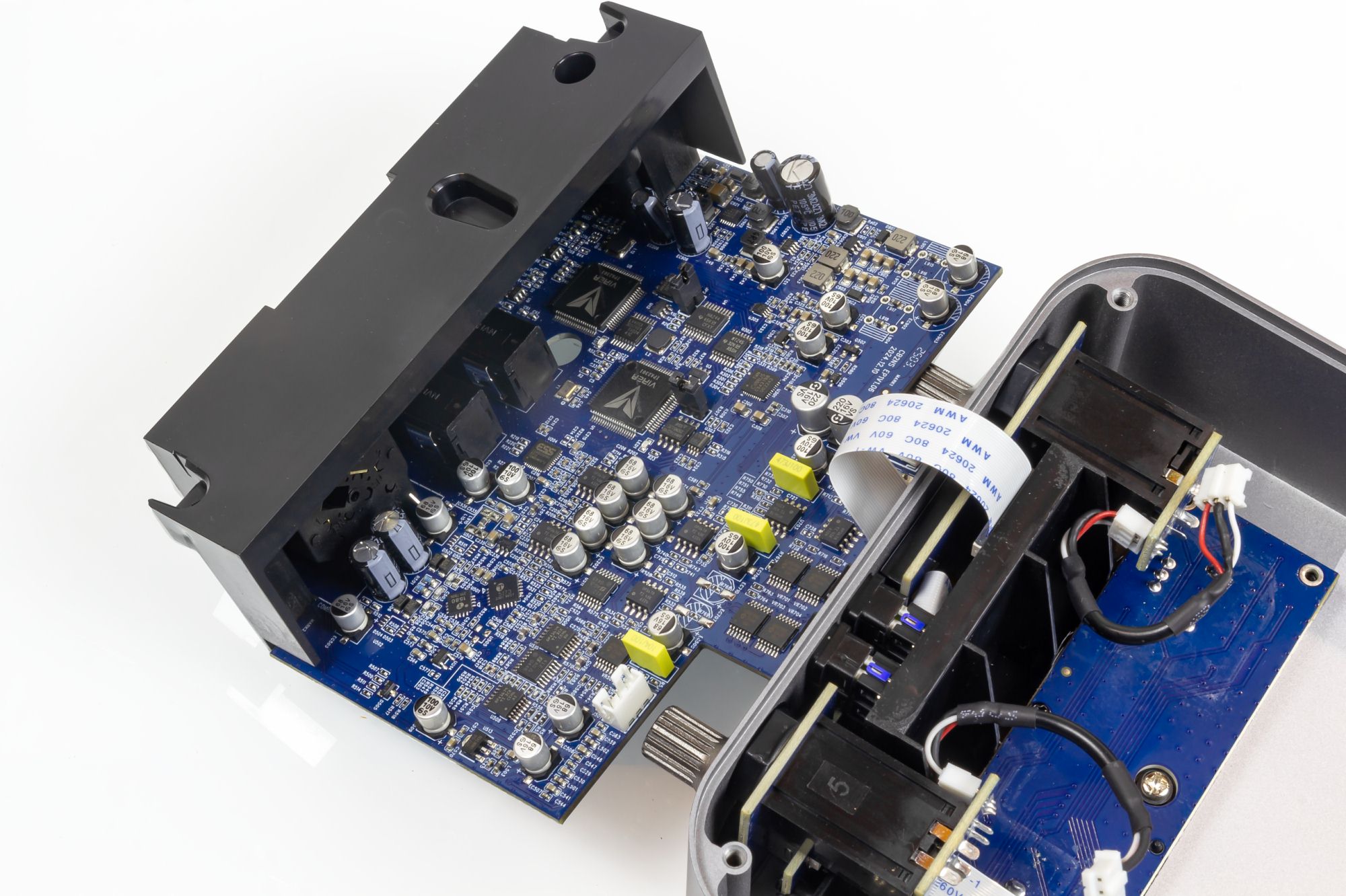
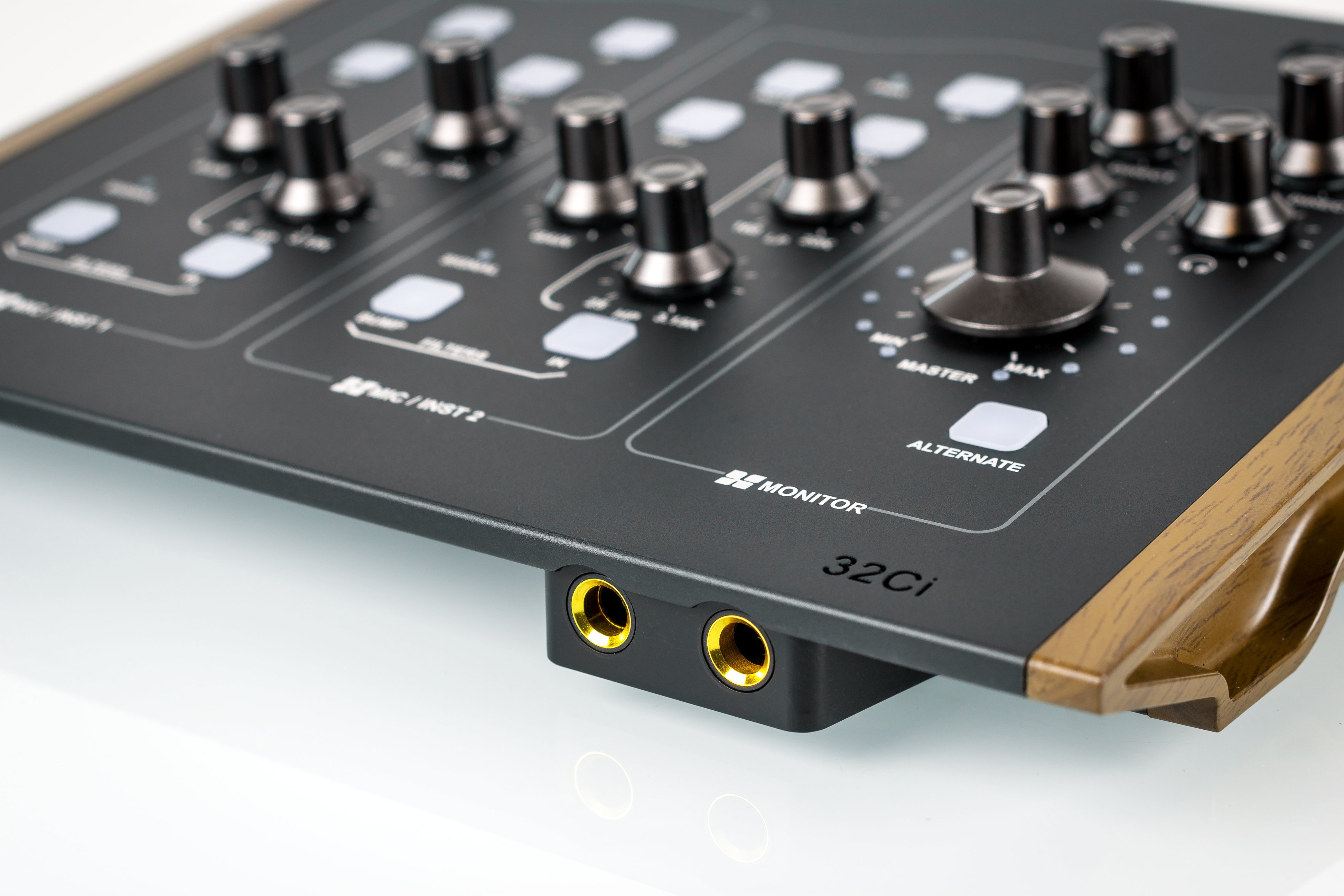
The electronics use modern, high-quality parts: an ES9822PRO ADC with 125 dBA dynamic range and a CS43198 DAC with 130 dBA. Such top-class converters were previously absent from mainstream products. The preamp uses well-known American THAT chips. A TI TPA6120A provides powerful headphone amplification. All operational amplifiers are high-quality TI OP1678 parts.
ASIO diagnostics
Features:
Input channels: 16
Output channels: 16
Input latency: 421
Output latency: 421
Min buffer size: 32
Max buffer size: 4096
Preferred buffer size: 256
Granularity: -1
ASIOOutputReady - not supported
Sample rate:
8000 Hz - not supported
11025 Hz - not supported
16000 Hz - not supported
22050 Hz - not supported
32000 Hz - not supported
44100 Hz - supported
48000 Hz - supported
88200 Hz - supported
96000 Hz - supported
176400 Hz - supported
192000 Hz - supported
352800 Hz - not supported
384000 Hz - not supported
Input channels:
channel: 0 (HW In 1) - Int32LSB
channel: 1 (HW In 2) - Int32LSB
channel: 2 (OTG In 3) - Int32LSB
channel: 3 (OTG In 4) - Int32LSB
channel: 4 (VC In 1) - Int32LSB
channel: 5 (VC In 2) - Int32LSB
channel: 6 (VC In 3) - Int32LSB
channel: 7 (VC In 4) - Int32LSB
channel: 8 (VC Music In 5) - Int32LSB
channel: 9 (VC Music In 6) - Int32LSB
channel: 10 (Loopback 1) - Int32LSB
channel: 11 (Loopback 2) - Int32LSB
channel: 12 (Loopback 3) - Int32LSB
channel: 13 (Loopback 4) - Int32LSB
channel: 14 (Loopback 5) - Int32LSB
channel: 15 (Loopback 6) - Int32LSB
Output channels:
channel: 0 (HW Out 1) - Int32LSB
channel: 1 (HW Out 2) - Int32LSB
channel: 2 (OTG Out 3) - Int32LSB
channel: 3 (OTG Out 4) - Int32LSB
channel: 4 (VC Out 1) - Int32LSB
channel: 5 (VC Out 2) - Int32LSB
channel: 6 (VC Out 3) - Int32LSB
channel: 7 (VC Out 4) - Int32LSB
channel: 8 (VC Music Out 5) - Int32LSB
channel: 9 (VC Music Out 6) - Int32LSB
channel: 10 (Loopback 1) - Int32LSB
channel: 11 (Loopback 2) - Int32LSB
channel: 12 (Loopback 3) - Int32LSB
channel: 13 (Loopback 4) - Int32LSB
channel: 14 (Loopback 5) - Int32LSB
channel: 15 (Loopback 6) - Int32LSB
The ASIO driver supports rates up to 192 kHz. Six virtual inputs and six virtual outputs help with online streaming.
RMAA PRO measurements
We measured the balanced line output separately. Its maximum level is exactly +4 dBu.
| Device under test | Icon Cube 2Nano S |
| Operating mode | 32-bit, 44 kHz |
| Audio interface | ASIO |
| Signal path | Line output |
| RMAA version | 6.4.5 PRO |
| 20 Hz–20 kHz filter | YES |
| Signal normalization | YES |
| Level change | -2.8 dB / -2.8 dB |
| MONO mode | NO |
| Calibration signal frequency, Hz | 1000 |
| Polarity | Correct/correct |
| Frequency response variation (40 Hz–15 kHz), dB | +0.03, -0.02 |
Excellent |
| Noise level, dB(A) | -118.9 |
Excellent |
| Dynamic range, dB(A) | 118.8 |
Excellent |
| Harmonic distortion, % | 0.00011 |
Excellent |
| Harmonic distortion + noise, dB(A) | -107.7 |
Excellent |
| Intermodulation distortion + noise, % | 0.00063 |
Excellent |
| Stereo crosstalk, dB | -116.8 |
Excellent |
| Intermodulation at 10 kHz, % | 0.00056 |
Excellent |
| Overall rating | Excellent |
24-bit/44 kHz measurements are on a separate page.
The measurement results are excellent. The spectrum is clean and distortion is very low. This is a major improvement over the manufacturer's previous interface generation. At its affordable price, it competes seriously with leading brands.
Installing iCON Pro Driver adds 5 Windows audio devices. Different applications can use separate devices, with independent volume and effects.
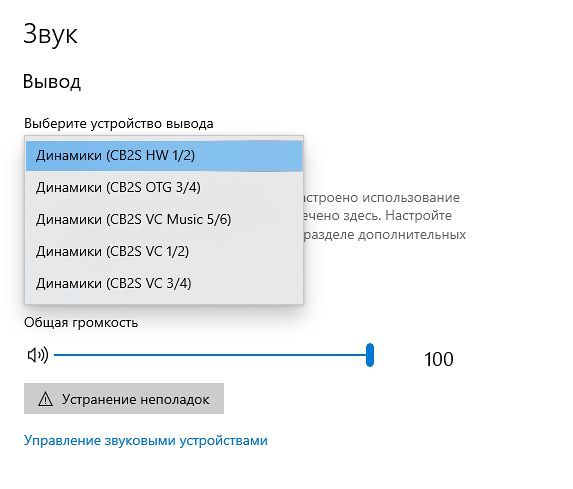
HW 1/2 sends audio to the physical analogue outputs. OTG 3/4 sends it to a mobile device. The other three are virtual devices for convenient use with multiple applications.
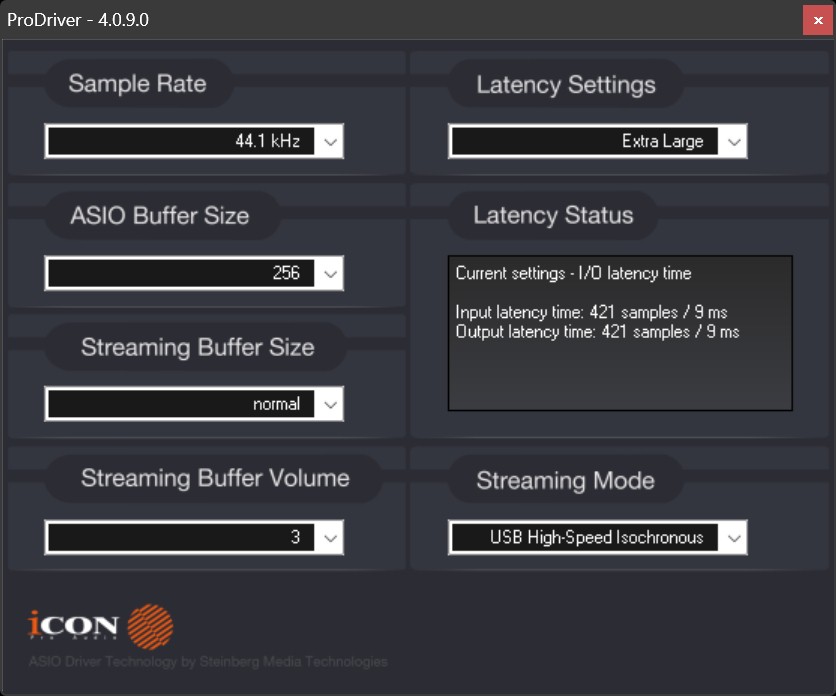
The control panel adjusts buffer size and displays latency in milliseconds.
Professional ASIO applications also have three stereo loopback channels. These route system and application audio for recording or streaming, with mixer processing available.
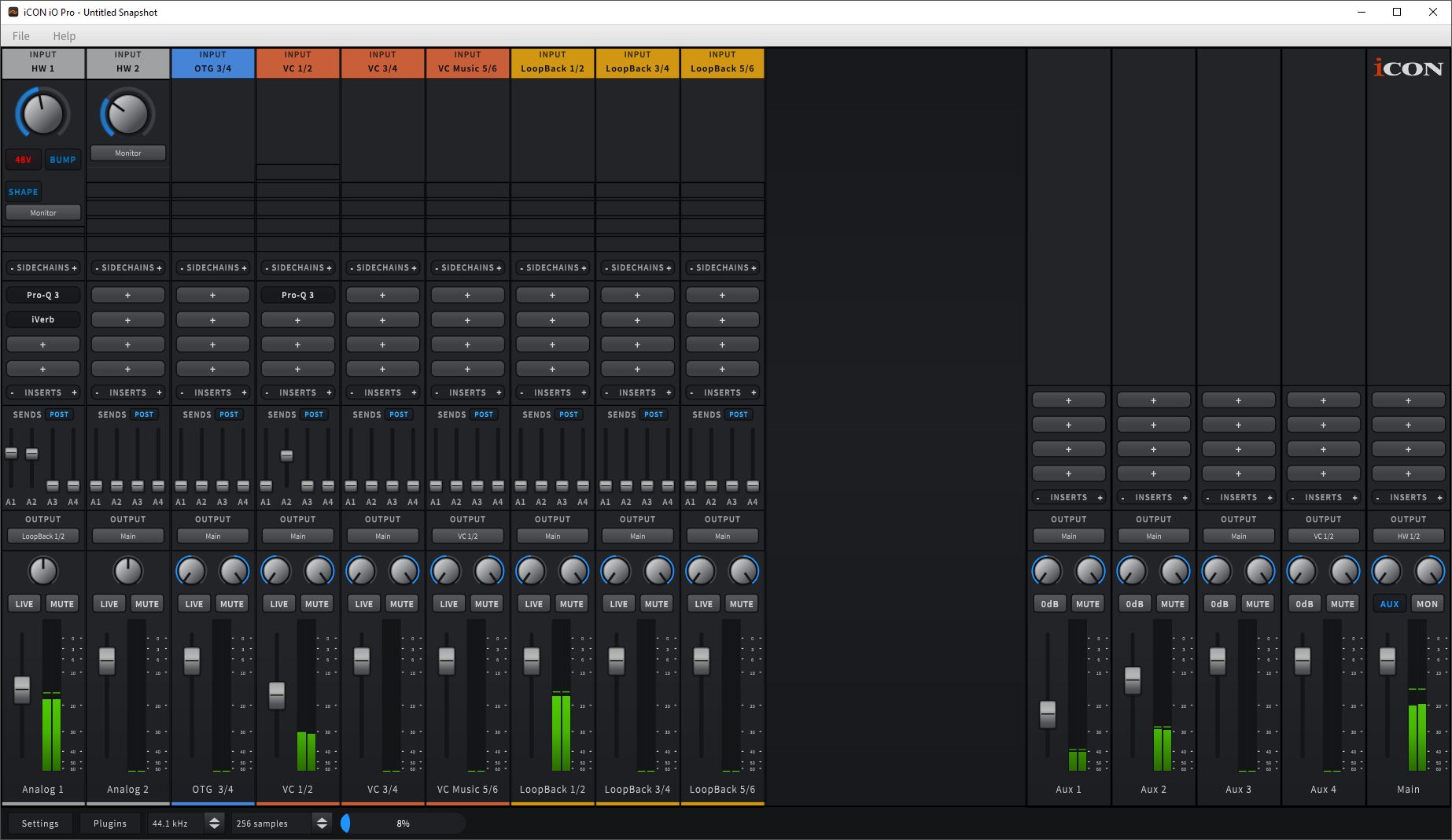
The iO Pro mixer goes well beyond the control panels of budget iCON interfaces. It provides familiar effect inserts, sends to four AUX buses for submixes and loopback channels for recording a mix or streaming. Presets save all mixer settings for quick recall. Scalable graphics fit different resolutions without reducing control quality. It is good to see the Cube range using advanced control functions from flagship iCON products.
The main question is how well the iCON Cube 2 Nano S realizes its high-quality converters' potential. We tested its microphone input with our usual Neumann TLM 102, recording male and female vocals and a wind instrument: a trumpet.
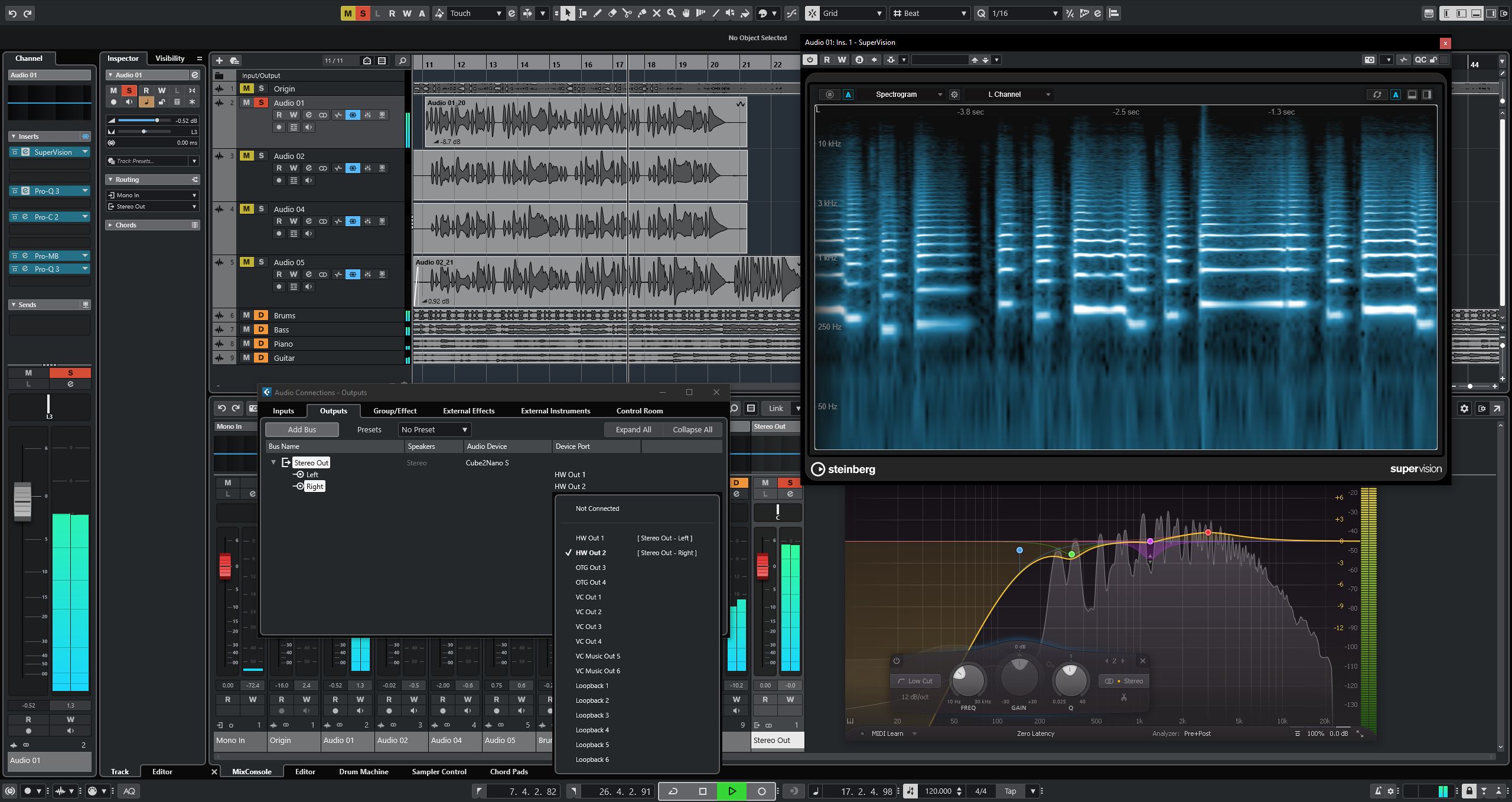
The microphone input is very successful. Despite the Cube 2 Nano S's low price, recording quality is high, with full sound, fine detail and accurate timbre.
The Cube 2 Nano S preamp is neutral rather than strongly coloured. Bump and Shape can change its tonal balance if desired. Both are optional, and users with many VST plug-ins may choose not to use them.
We concluded that the Cube 2 Nano S can fully reveal the potential of a high-quality studio microphone such as the Neumann TLM 102. Its likely owners may use simpler microphones, so the preamps have performance to spare. Recording quality will depend more on the microphone, recording technique and room acoustics than on the interface.
The Cube 2 Nano S headphone output also deserves mention for its high volume headroom. During recording, it comfortably reproduces both backing music and a quiet input signal recorded with headroom to avoid overload. Separate line and headphone level controls are convenient too. Affordable interfaces often combine them under one control.
The Cube 2 Nano S line output also sounds very good: modern and detailed. Its only unusual feature is a maximum level a few dB below the norm. This does not reduce sound quality and is not critical with active monitors, but is worth mentioning.
One small drawback is the lack of a power button. Lighting stays on even when the computer is off. Unplug USB to turn the LEDs off completely.
Conclusions
Our test shows that the iCON Cube 2 Nano S is an interesting, capable interface that can challenge competitors. Its measured output performance and sound approach the converter chips' specifications.
We welcome the growing number of affordable devices with modern high-quality electronics. The iCON Cube 2 Nano S should help move the market forward and give users on limited budgets access to more technically capable professional tools.
Note. This is an adapted machine translation into English. It follows the “In simple terms” approach. Read the original article at https://prosound.ixbt.com/interfaces/icon-cube2nano.shtml.