
ART Tube Mix — five-channel mixer with a tube and USB interface
Maxim Liadov
The ART Tube Mix is a small retro-style analogue mixer. The mixer has analogue VU level meters, a tube to warm the sound and decorative wooden side panels. The manufacturer also offers traditional compact mixers with 2, 4 and 6 channels, ordinary looks and standard functions. The ART Tube Mix stands out with unusual looks and functions. A basic two-channel 16-bit/44 kHz USB codec also handles computer audio digitization and playback.

The most common tube type is used: the 12AX7 dual triode. Invented in the USA, the model was popular from 1950 to 1980 and appeared in almost all audio equipment during that period, after which it ceased to exist. Production of 12AX7 tubes resumed in 1990 for guitar preamps.

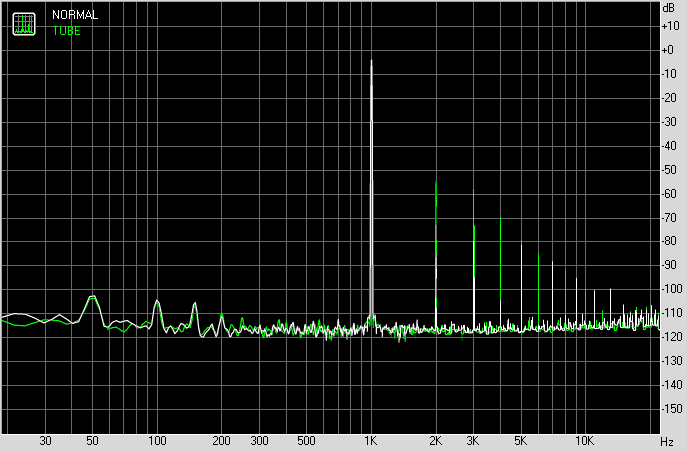
In the ART Tube Mix, the tube can be enabled or disabled and assigned to inputs 1/2 or Hi-Z guitar input 5. Listening and measurements show added harmonics, potentially enriching voice or guitar tone. Recording examples with the tube enabled can be found on Youtube.
ART Tube Mix specifications
| Input impedance | Microphone input: 3.5 kohms Line inputs (CH1, CH2, CH3/4), 10 kohms Instrument input CH5 (Inst.), 1 Mohm |
| Output impedance | Line outputs Main, Control Room (balanced/unbalanced), 150/100 ohms AUX output, 150 ohms Headphone output, 100 ohms |
| Frequency response | 20 Hz - 100 kHz +1 dB |
| Maximum input signal level | CH1, CH2 (microphone), +9 dBu CH1, CH2 (line), +20 dBu CH3/4 (EQ Flat), +20dBu CH5 (EQ Flat), +16dBu AUX Return, +24dBu |
| Maximum output signal level | Main, Control Room (balanced/unbalanced), +20 dBu/+17 dBu Aux Send, +20dBu Headphone output, 100 mW/channel @ 300 ohms, 50 mW/channel @ 32 ohms |
| Maximum gain | LINE IN - Main output (balanced), +63 dB CH 5 to Main output (balanced), 56 dB CH3/4 to Main output (balanced), +30 dB |
| Equivalent input noise, EIN | Microphone input (@ max gain), 127 dBu Line input (@ max gain), -105 dBu Guitar input (@ max gain), -112 dBu |
| USB | USB class compliant, Mac and PC |
| ADC, DAC | 16-bit, 44.1 kHz, 48 kHz |
| Phantom power | +48V |
| Power supply | 18 W, 1 A |
| Dimensions | 84 x 198 x 265 mm |
| Weight | 2.5 kg |
Specifications are typical for inexpensive mixing consoles. Headphone amplifier power into high-impedance loads is notably high. The 18 W power supply is also needed for signal levels up to +30 dB and tube operation.

The headphone output is on the front panel. Each channel has full 3-band EQ. The peak meter has 5 segments and an overload indicator. Two buses, AUX1 and AUX2, are available. There are two output paths, MAIN and CONTROL ROOM, with the latter shared with HEADPHONES.
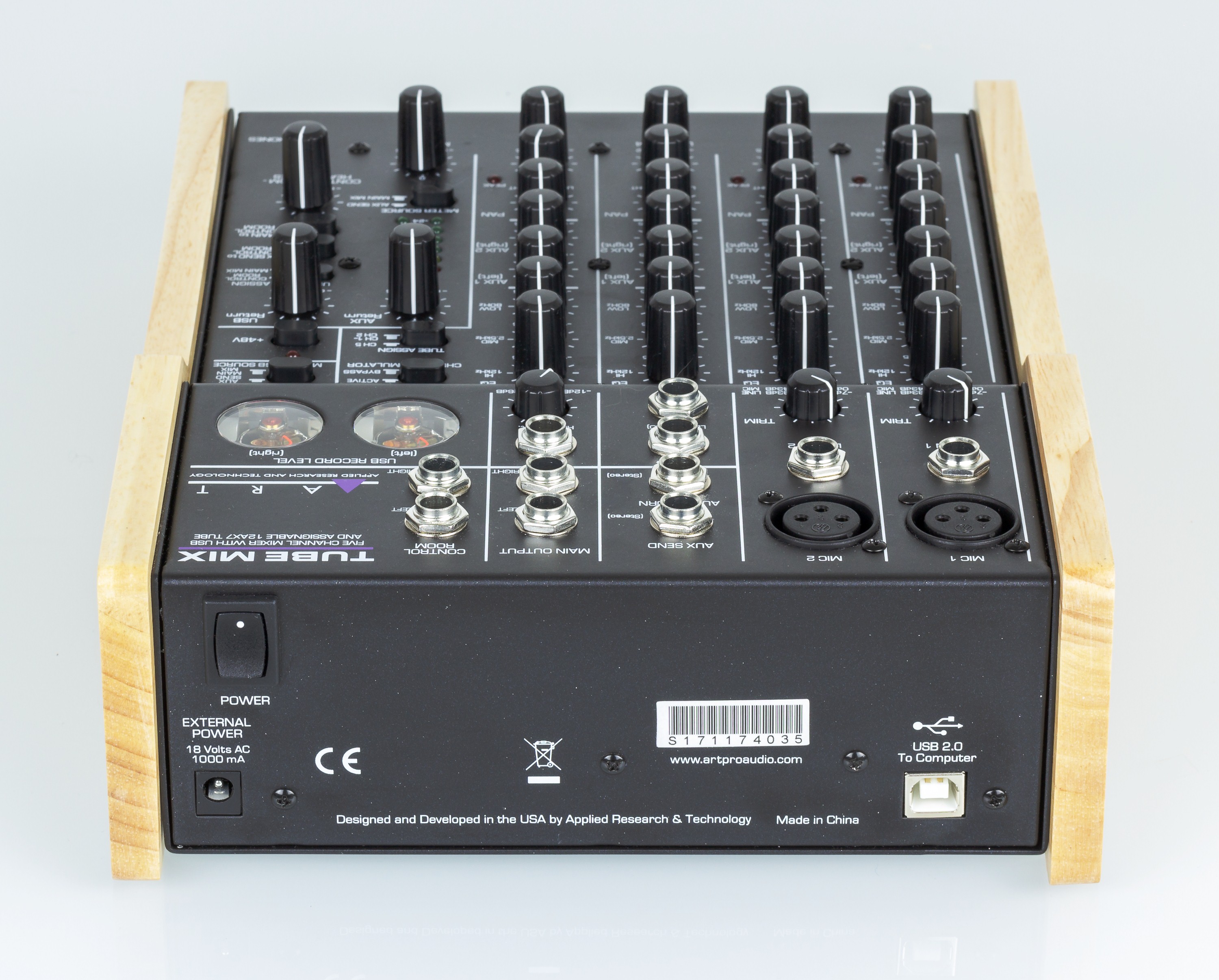
The mixer enclosure is entirely metal. White spots in the photos are special speckled paint, not dust. The wooden side panels have no functional role and can be removed without changing anything. 4 large rubber feet support the mixer, rather than the wooden sides. The panels are solid wood with a lacquer finish, not plastic imitation, MDF or veneer as the pictures might suggest.
Overall signal flow is a little confusing, but the manual diagram immediately explains where everything is.

After studying the diagram, we configured the mixer to record microphone inputs to the computer through USB while sending computer backing audio to the headphones.


The needle VU meters with a classic -20..+6 dB scale are mainly decorative. The zero recording level mark corresponds to roughly -6 dB signal. Because the needles are slow, the VU meters miss brief peaks and are not very reliable for this purpose. They show an average value. To monitor overload, it is better to watch the peak meter in the computer recording application. The VU meters have no lighting, reducing their visual effect slightly.

Audio digitization and playback use the popular inexpensive TI PCM2700 USB codec, rated at 89 dB signal-to-noise and 0.01% distortion. Our input-to-output measurements gave 80 dB signal-to-noise and 0.02% distortion.
Surprisingly, Windows ASIO drivers are even included.

The drivers are shared across several ART USB devices, from mixers to preamps.
Features:
Input channels: 2
Output channels: 2
Input latency: 45
Output latency: 1368
Min buffer size: 22
Max buffer size: 882
Preferred buffer size: 45
Granularity: 1
ASIOOutputReady - not supported
Sample rate:
8000 Hz - not supported
11025 Hz - not supported
16000 Hz - not supported
22050 Hz - not supported
32000 Hz - supported
44100 Hz - supported
48000 Hz - supported
88200 Hz - not supported
96000 Hz - not supported
176400 Hz - not supported
192000 Hz - not supported
352800 Hz - not supported
384000 Hz - not supported
Input channels:
channel: 0 (USB AUDIO CODEC In 01) - Int32LSB
channel: 1 (USB AUDIO CODEC In 02) - Int32LSB
Output channels:
channel: 0 (USB AUDIO CODEC Out 01) - Int32LSB
channel: 1 (USB AUDIO CODEC Out 02) - Int32LSB
Conclusions
The ART Tube Mix five-channel mixer with a tube and USB interface suits a wide range of common uses. The mixer can handle an event or record voice over a backing track on a computer. However, this model has no digital effects section, so voice reverb cannot be enabled. The signal can instead receive tube warmth, a function rarely found in mixers.
Note. This is an adapted machine translation into English. It follows the "In simple terms" approach. Read the original article at https://prosound.ixbt.com/interfaces/art-tube-mix.shtml.