
Arturia PolyBrute Noir Edition: Arturia's polyphonic analog synthesizer in black
Arturia continues to release products in the alternative Noir Edition finish. In early 2023, the French manufacturer made a limited run of the popular PolyBrute synthesizer in black with dark wood trim. We have not yet introduced readers to this excellent instrument. The Noir Edition is a good reason to do so.
PolyBrute is Arturia's flagship analog synthesizer, with its most advanced features. It combines the best qualities of earlier models with new functions and modern controls. Its key difference from other Arturia analog synthesizers is the polyphonic design. With 6 voices, it can play full chord progressions in a rich, authentic analog sound. Like MatrixBrute, it offers extensive modulation through an easy-to-use assignment matrix. The full-size keyboard has aftertouch. A touch strip and the unusual three-axis Morphée controller add performance control. An arpeggiator/sequencer and digital stereo effects are also included. We will look at these in turn.

Unlike Arturia's early monophonic analog synthesizers, PolyBrute has fully digital control. This makes polyphonic operation easier to implement and allows instant preset changes, as on a digital synthesizer. Digital control also enables morphing between sounds. The PolyBrute Connect software makes editing convenient and supports DAW use with automation of all adjustable parameters.
How do you adjust parameters after changing presets or morphing, when physical knobs and faders remain in their old positions? Several control response modes solve this, just as on controllers for virtual instruments. In Hook mode, a control takes effect only after reaching the stored value. In Jump mode, the parameter immediately jumps to the knob's current position when moved. Scaled mode also responds immediately, but changes the value smoothly by scaling the remaining range. Once the knob reaches an endpoint, it works in the normal way.

There are 8 banks of 96 presets, or 768 in total. The modulation section's buttons handle loading and navigation. The top row of round buttons selects banks; buttons below select preset slots. Presets are grouped by category. Selecting a sound type lights the appropriate buttons.

Each preset contains two separate sounds. PolyBrute can play either sound alone or both together. The most effective use, however, is a smooth transformation from one to the other. Morphing creates remarkable transitions between sounds that seem unrelated. It is not a simple crossfade. It changes the synthesis parameters, as though you were moving all the controls at once to turn one sound into another.

PolyBrute uses subtractive synthesis. Two oscillators generate sawtooth, triangle, and square waves, alongside a noise generator. Waveforms can change smoothly rather than remaining fixed. Besides waveform and frequency controls, oscillator one has Metalizer to add harmonics and Pulse Width to adjust pulse width. Oscillator two replaces Metalizer with a sine sub-oscillator one octave down. Oscillator sync is continuously adjustable. Oscillator two can also frequency-modulate oscillator one. The noise generator has a spectrum control and can modulate the filter.

There are two filters. The two-pole Steiner-Parker filter is familiar from monophonic Brute models, with its distinctive sound and Brute Factor saturation. Earlier versions selected one filter mode at a time. PolyBrute can move smoothly between modes. The second filter is a conventional ladder design with a 24 dB/octave slope.
Filters work in series, one after the other, or in parallel for separate left/right processing. Assigning oscillators to particular filters adds flexibility. Master Cutoff conveniently changes both filter cutoffs together.

There are three LFOs. LFO1 and LFO2 offer seven fixed waveforms with conventional phase, rate, and trigger settings. LFO3 is different: its sine-based shape changes continuously, with an adjustable rise/fall ratio. It also has a one-shot mode and can further modulate LFO1. All three modulation generators support unipolar and bipolar operation.
Three ADSR envelopes can be assigned to various parameters through the modulation matrix.

The modulation matrix follows the MatrixBrute design. It is a flexible and effective way to create modulation routes. Complex configurations are easy to build while keeping the whole routing visible. PolyBrute has 12 modulation sources, labeled A–L to the left of the buttons and arranged by row. Modulation destinations appear on the display and correspond to the matrix columns. To assign modulation, press the button at the required intersection and set the modulation amount.
Almost every onboard control can be a destination. The display shows 8 parameters at once, with four more pages of 8. Users can assign a chosen parameter directly rather than search the full list: press its column button and turn the desired knob. Modulation amounts can themselves be modulated by another source, creating complex, evolving chains.
Dedicated touch controls handle many parameters: a strip above the keyboard and the three-axis Morphée controller.

Factory presets assign the touch strip to parameters that strongly change the sound. This makes the strip effective for expressive and visually engaging performances.
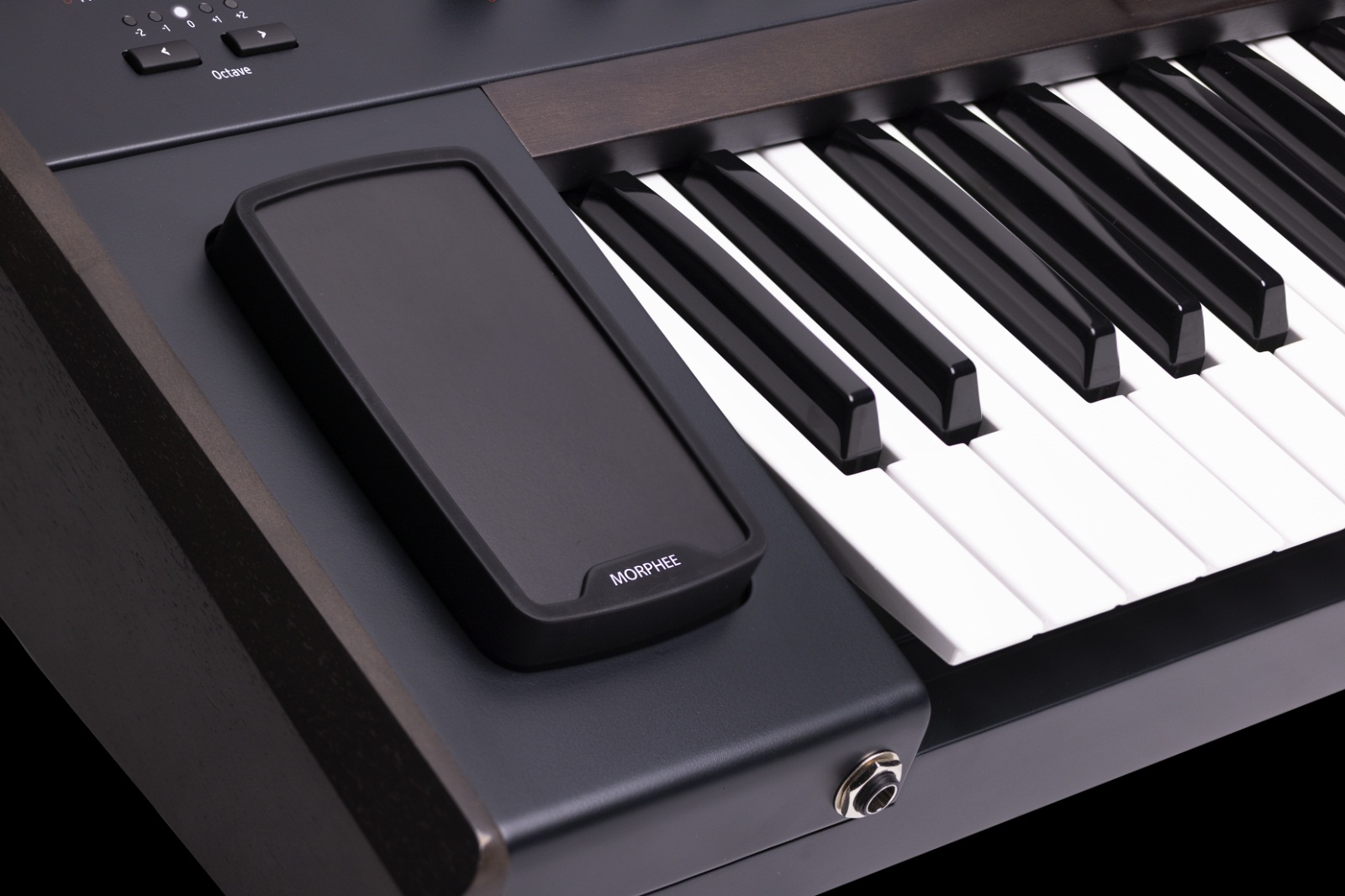
Morphée looks less dramatic in use, but it offers more control. Its touch-sensitive surface also moves down into the case when pressed. This provides three axes of information for creative modulation assignments. In particular, it allows more flexible and selective control of sound morphing.

The sequencer and arpeggiator follow the MatrixBrute approach, but are polyphonic and add several distinctive functions. We will not describe every feature here. The sequencer can create polyphonic patterns up to 64 beats long. The modulation matrix buttons act as a display showing active notes, making sequences and arpeggios easy to edit. The matrix arpeggiator is especially interesting. It combines arpeggiator and sequencer features for more complex rhythms. It is also polyphonic, with a clear view of all the arpeggio elements.

As noted earlier, PolyBrute has digital effects. Three high-quality processing sections can work together: modulation, delay, and reverb. Type buttons select the algorithms. Each has only three positions, but many more effects are available. To keep the panel simple, Arturia provides two fixed options and an Alt setting for a third effect chosen by the user. Modulation options are Flanger, Phaser 12p, RingMod, BitCrusher, Soft Flanger, Phase Flanger, DownSampler, and Ensemble. Delay options are Stereo Delay, Long Delay, BBD, PingPong, Karplus, Stereo Spread, Parallel, and BBD Spread. Reverb options are Bright Plate, Room, Dreamy, Springy, and Delayed Plate. A separate equalizer is available through the menu.
For users who prefer an unprocessed analog sound, a full effects-bypass mode sends the signal to the line outputs without digital processing.

The line outputs use TRS connectors. A headphone output on the front has its own level control, independent of the line outputs. PolyBrute accepts two expression pedals and a sustain pedal. Full-size MIDI DIN sockets connect external MIDI devices. Separate clock connections synchronize other equipment. USB connects the synthesizer to a computer running PolyBrute Connect.

PolyBrute Connect runs as a standalone application or a VST/AU/AAX plug-in. Two-way communication synchronizes synthesizer settings and controls in real time. It is not a virtual version of the synthesizer, but a graphical hardware editor. As a DAW plug-in, it offers the editing and automation benefits of a virtual instrument. As with other hardware synthesizers, audio must be recorded through an audio interface. A project can contain several plug-in instances with different settings, but only one can be active at a time.

Arturia PolyBrute sound examples are available on the manufacturer's website.
Conclusion
Adding a polyphonic instrument to Arturia's analog synthesizer range is an important step. The flagship PolyBrute is an exceptionally interesting result. It combines authentic analog synthesis with modern controls, making it an excellent and convenient instrument for detailed studio work, creative experiments, or live performance. Arturia's description, “made by musicians for musicians”, fits it well.
Note. This is an adapted machine translation into English. It follows the “In simple terms” approach. Read the original article at https://prosound.ixbt.com/keyboards/arturia-polybrute.shtml.