
Arturia AstroLab 37: compact version of the AstroLab stage synthesizer
Grigory Liadov
Arturia's flagship AstroLab keyboard range continues to grow. After the AstroLab 88, described in the original as a five-octave model, the French company has introduced a compact version for musicians who prioritize portability. The new AstroLab 37 has 37 mini keys and is significantly smaller than the full-size AstroLab 61 and AstroLab 88.
Importantly, the AstroLab 37 keeps the main functions and high sound quality of the flagship range while becoming more affordable and easier to carry. It also suits musicians who want an Arturia stage instrument without the larger investment required for the full-size models.
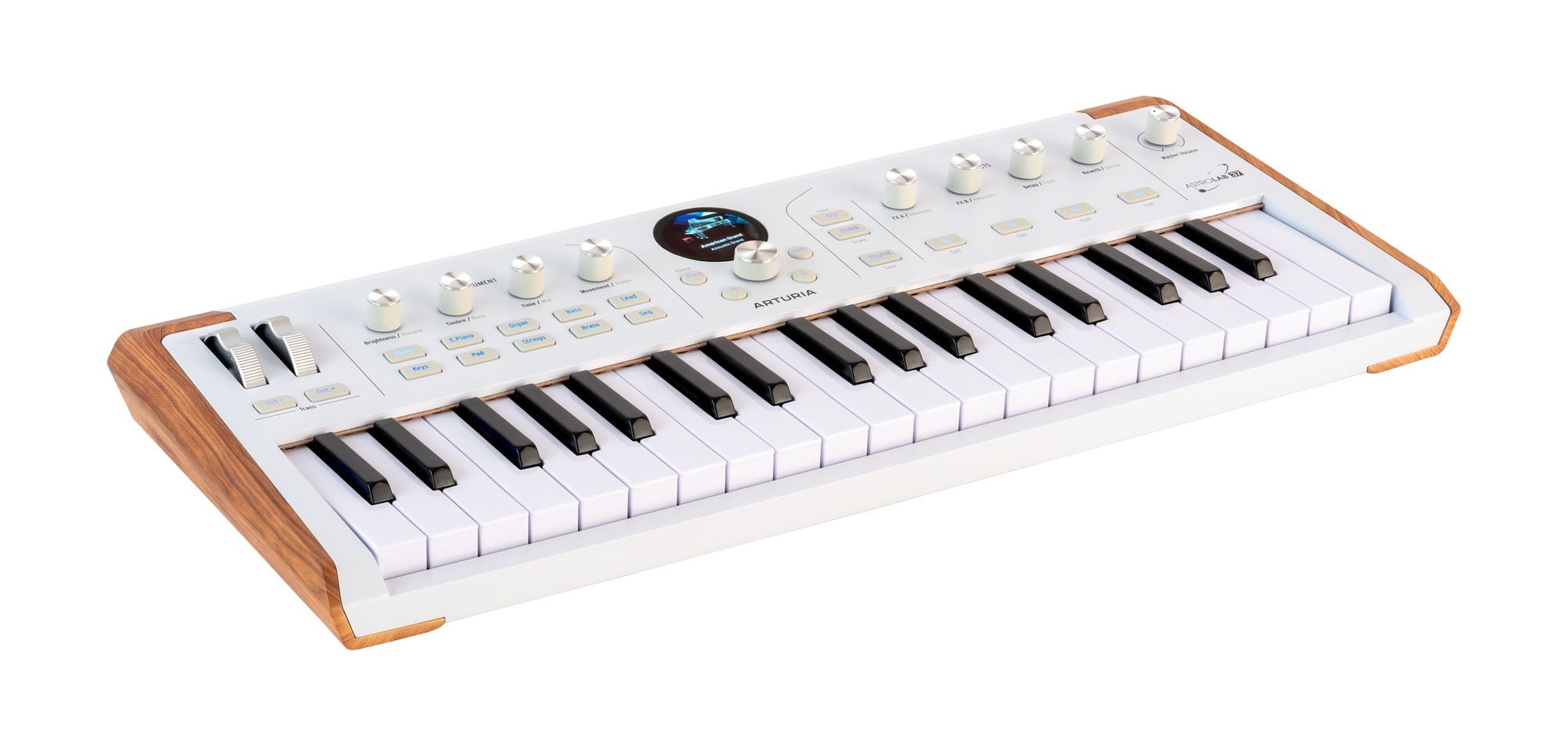
For readers unfamiliar with the range, AstroLab is not just a MIDI controller. It is a complete stage keyboard: a hardware version of Analog Lab. Powerful onboard DSP runs Arturia's high-quality algorithms in full.
Unlike a conventional digital piano that plays ready-made sounds, AstroLab is a synthesizer that models physical processes in real time. Its presets therefore retain the quality of the Analog Lab virtual instruments. This makes AstroLab useful in the studio as well as on stage.
Arturia AstroLab 37 main features
| Sounds | More than 1800 onboard sounds: acoustic and electric pianos, organs, synthesizers, samplers and more. Over 10000 free sounds available in Analog Lab Pro and Arturia Sound Store. |
| Keyboard | 37 mini keys with aftertouch |
| Displays and indicators | High-resolution colour display Buttons indicating active modes |
| Modes | Arpeggiator Scale and chord modes |
| Effects | 2 slots with 12 effect choices, plus 2 delay and reverb buses |
| Controls | Navigation and Shift buttons 10 instrument-category shortcut buttons 4 effects activation/edit buttons 4 continuous MACROS knobs 4 continuous FX knobs Master volume knob Transpose/octave buttons Pitch-bend and modulation wheels |
| Connections | Wi-Fi and Bluetooth USB-C for computers or mobile devices USB-A for storage and MIDI controllers MIDI DIN input and output Balanced TRS line outputs TRS headphone output 2 combo XLR/TRS microphone/line inputs 4 pedal connections: Expression, Sustain, Aux 1, Aux 2 |
| Dimensions | 59 × 515 × 214 mm |
| Weight | 1.95 kg |
| Package contents | USB cable Power adapter Printed manual AnalogLab Pro, AstroLab Connect |
The compact AstroLab 37 uses the same six-core 1.8 GHz ARM processor as the full-size AstroLab 61. Processing performance therefore matches that model. DSP power is sufficient for demanding instrument combinations. The most complex calculations are optimized for stable, uninterrupted operation, and we encountered no audio problems.
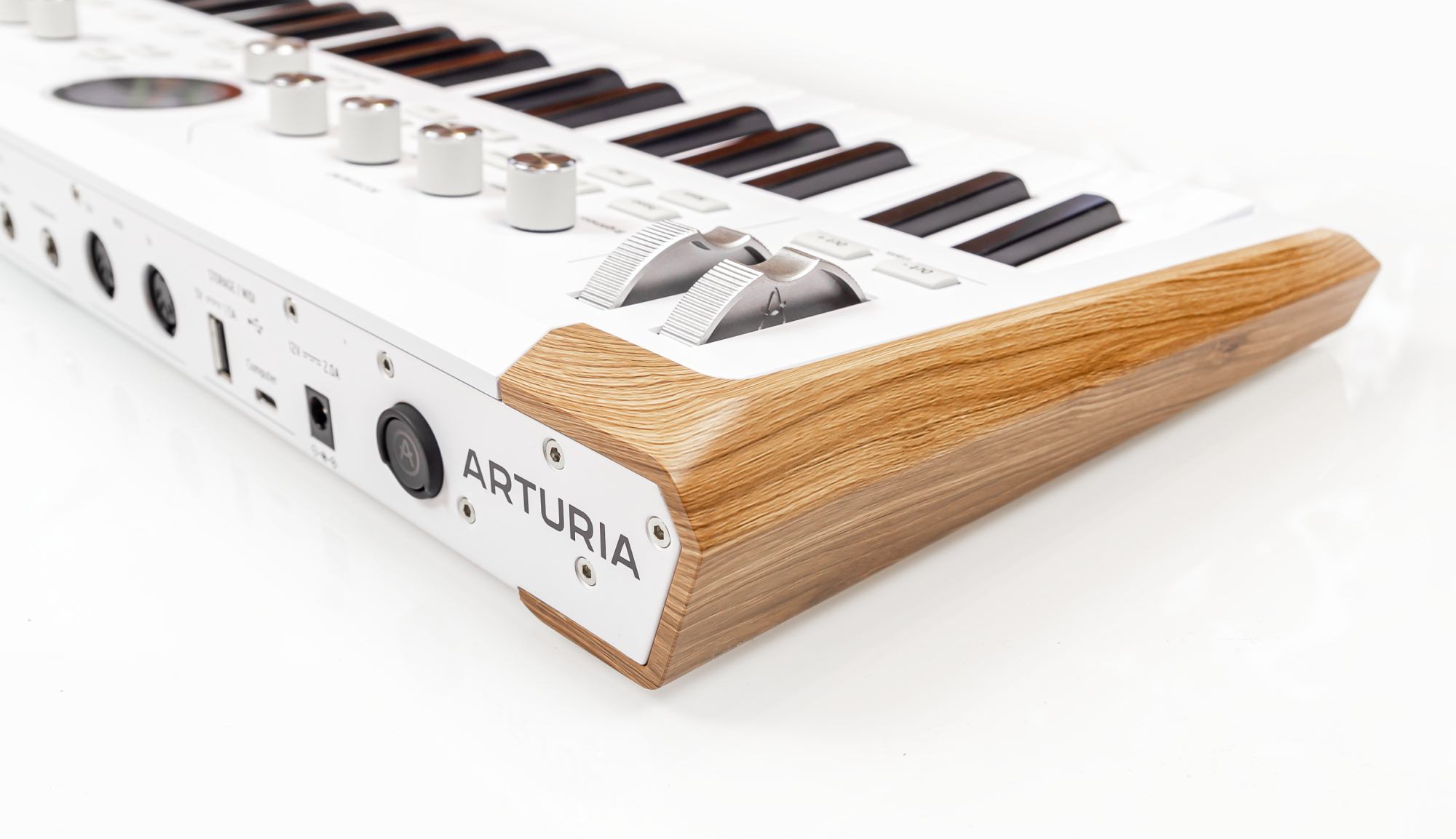
The AstroLab 37 follows the attractive design of earlier models, with a white case and wood-style sides. A metal frame supports the plastic case parts. Assembly quality is high: joints do not creak and parts fit firmly. Weight remains low, around 2 kg.
As expected, the AstroLab 37 has fewer controls. The essential buttons and knobs remain but are arranged differently. The display stays in the centre, with controls on both sides.

The display is not large by current standards, but its size suits the compact AstroLab 37 better than the full-size models. High resolution and good brightness make lists, menus and preset graphics clear and detailed.
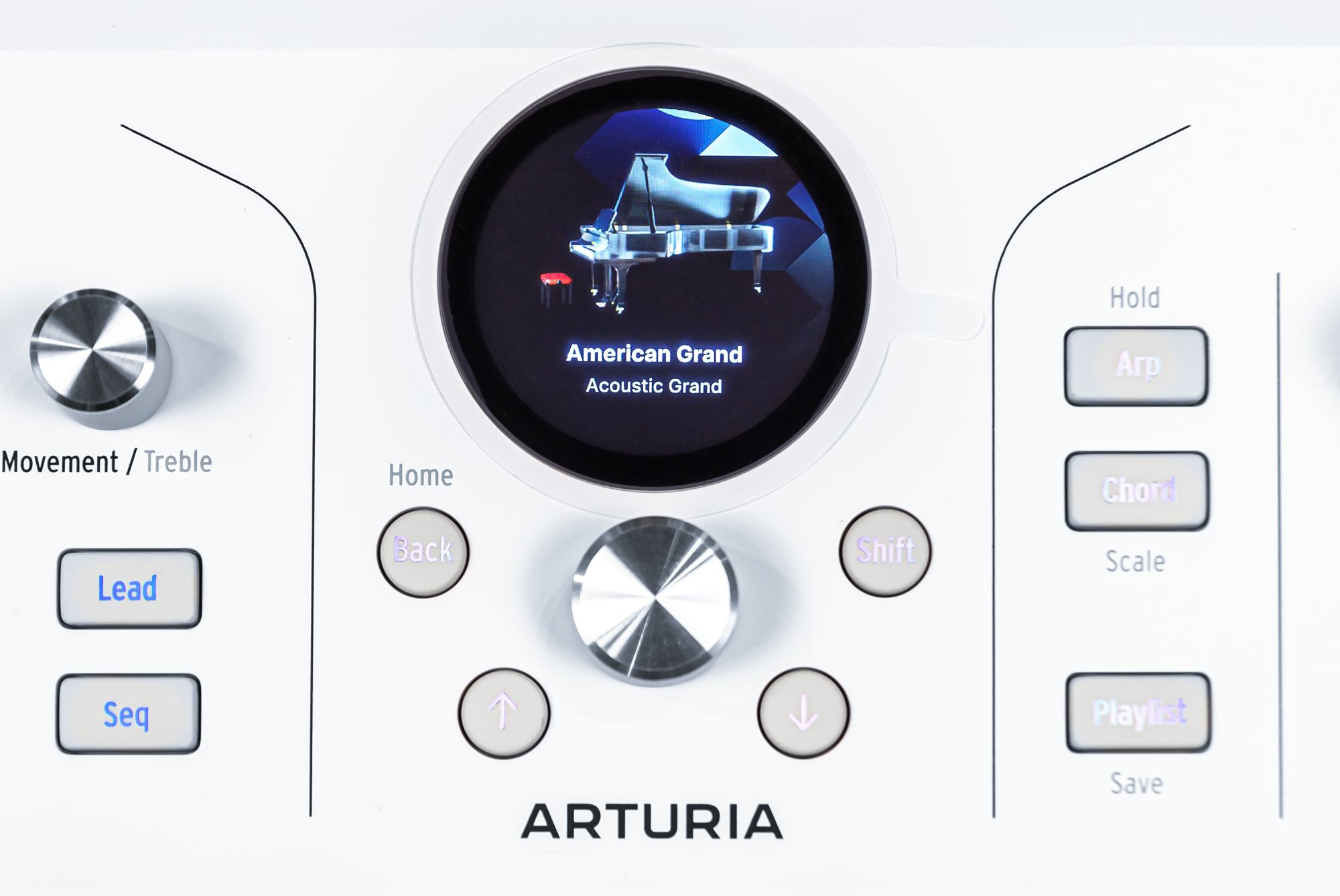


The larger models use a distinctive circular controller with a screen inside. On the AstroLab 37, the screen is fixed in the case. A rotary knob below performs the circular controller's function, navigating preset lists and settings and selecting items conveniently.
Buttons below the screen also step through presets. They may be preferable for moving sequentially through sounds or menus. Presets load almost instantly.
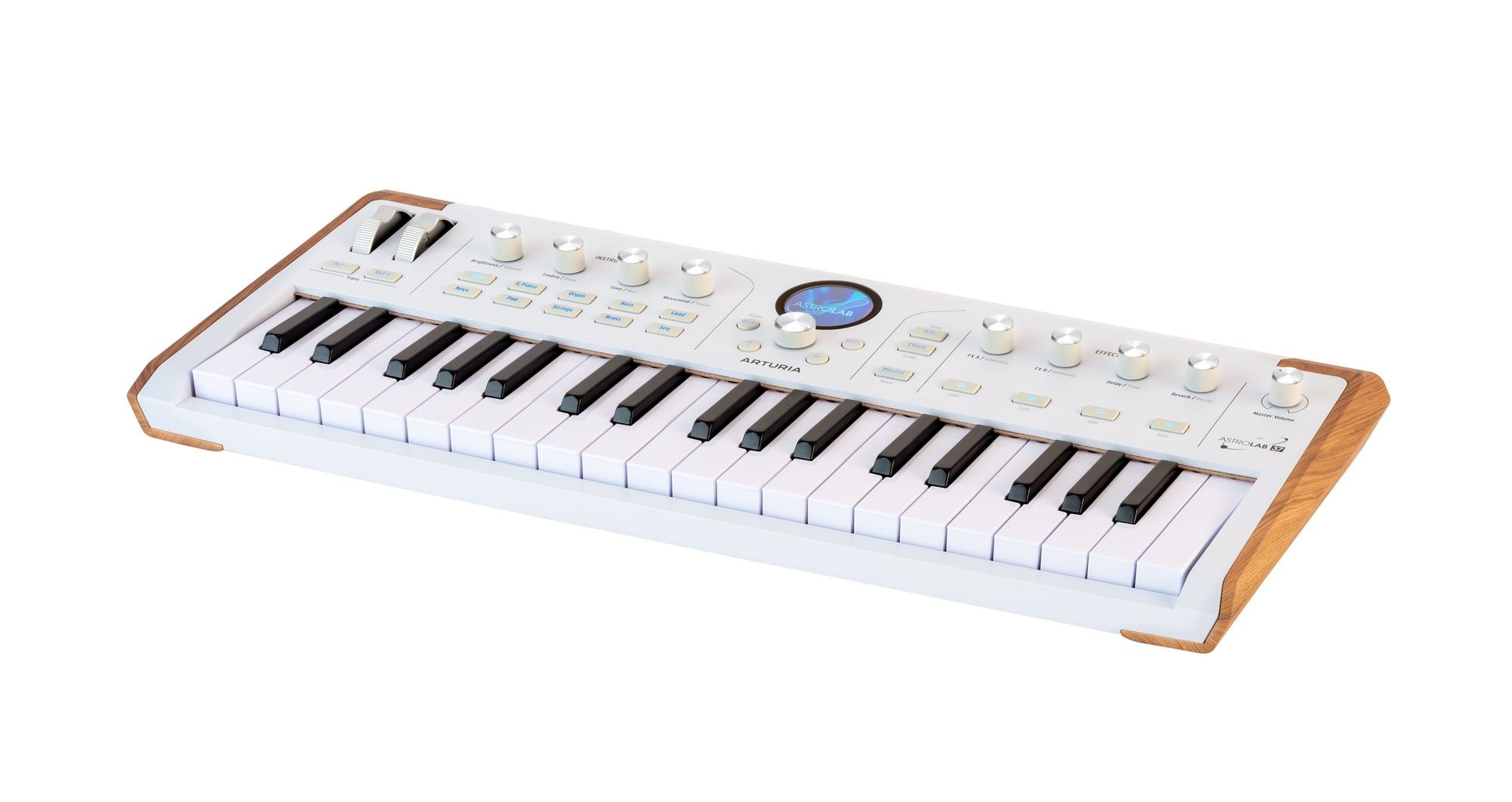
AstroLab uses the synthesizers and keyboards in Analog Lab Pro: 44 instruments and over 1800 presets from Arturia V Collection. The library is well organized. Tags quickly narrow searches by category, instrument, artist, liked presets, sound designer or playlist, including combinations of these tags.
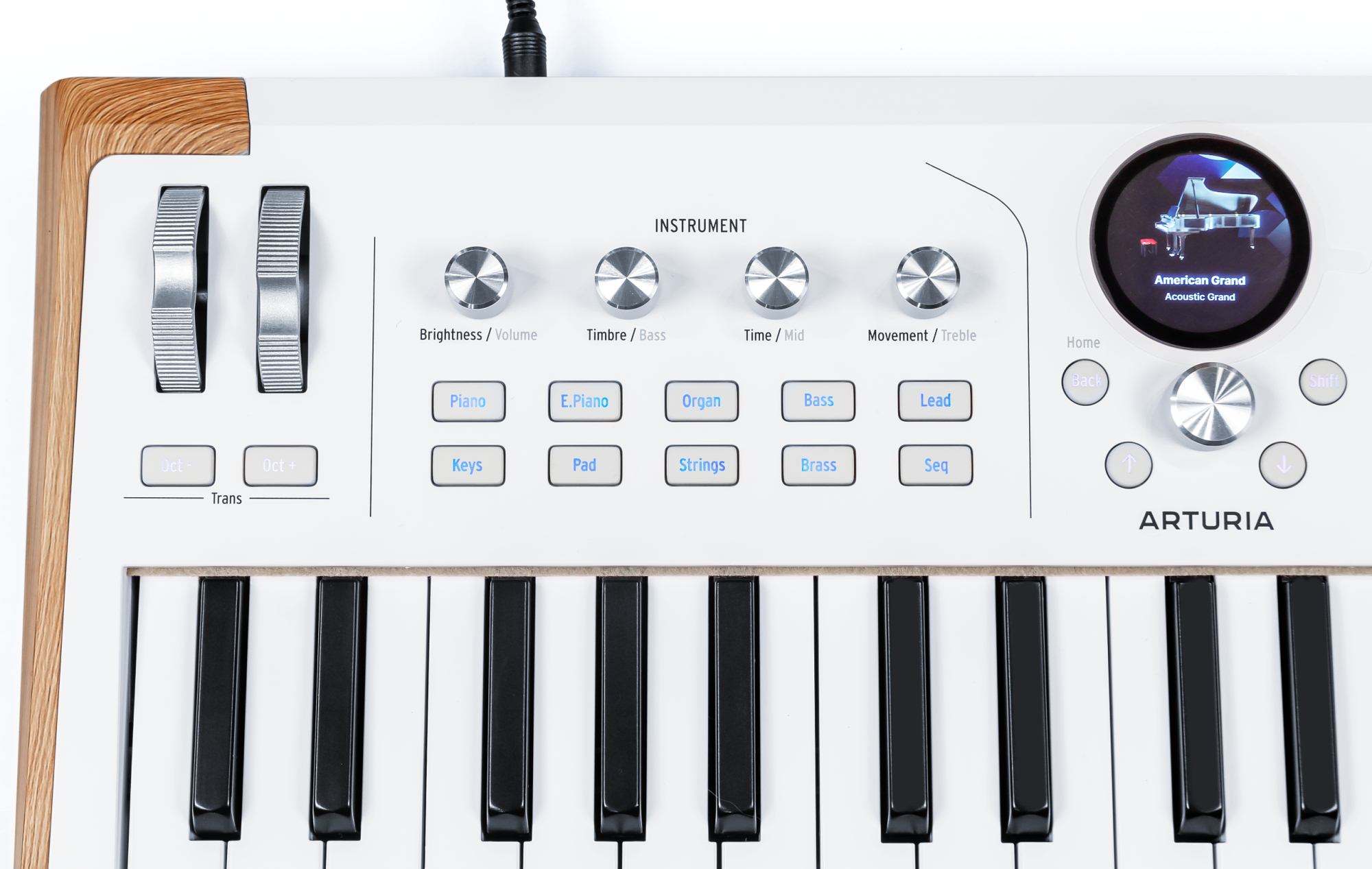
Dedicated category buttons quickly open instrument groups. Pressing one loads a representative preset and limits further browsing to that category.
Each preset has four macros on dedicated knobs. They usually control major sound parameters such as resonant filtering, envelopes and modulation. One macro often changes several synth parameters together. Simple labels are Brightness, Timbre, Time and Movement. These controls add movement and expression to a static sound. Analog Lab presets do not allow macro reassignment, but the full version of the corresponding virtual instrument does.
The circular knob-position indicators of the full-size models are absent. However, knobs remain touch-sensitive: touching one shows its current value on the display.
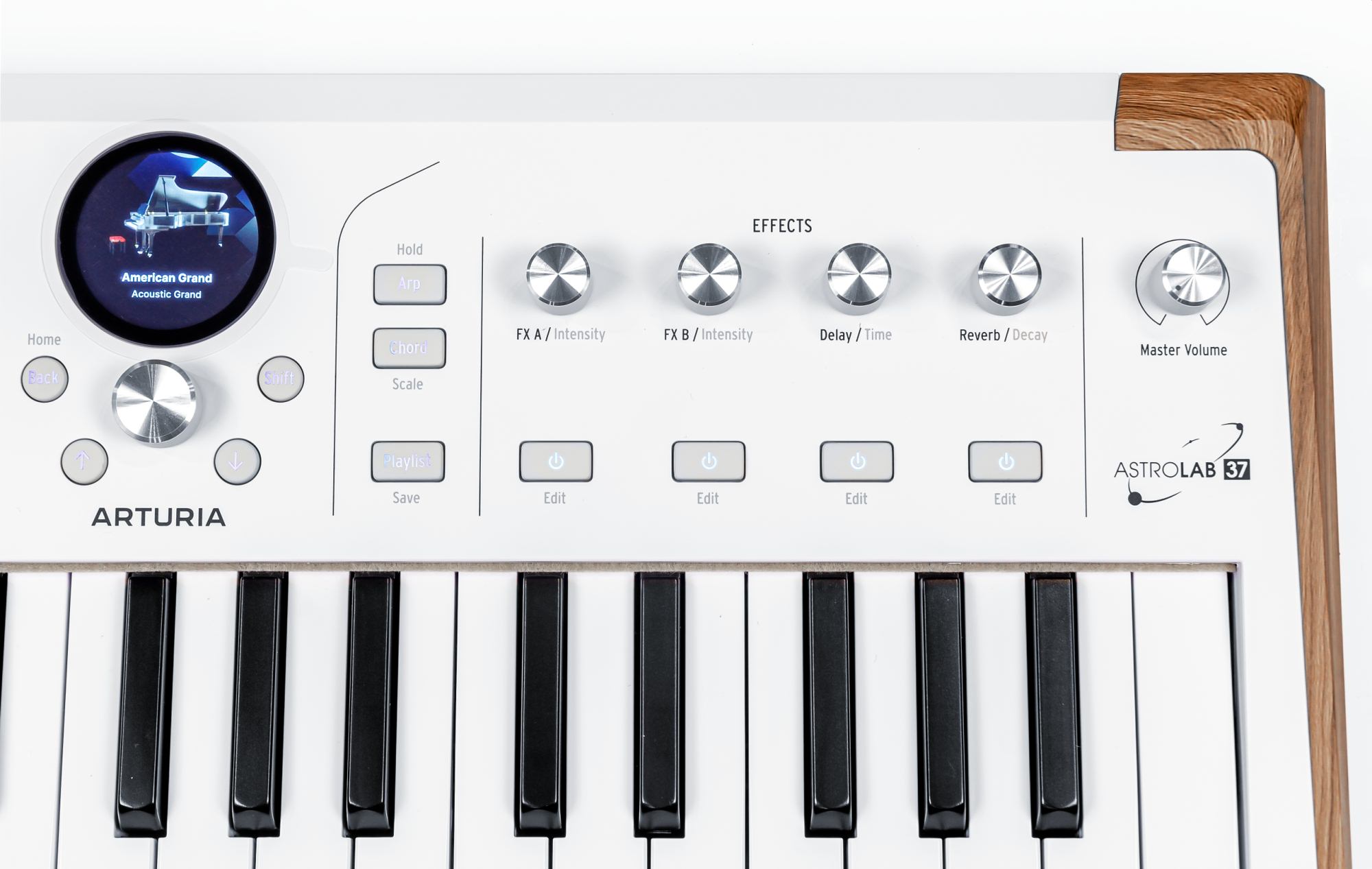
The effects section is right of the display. Each sound supports two insert effects and two send buses for delay and reverb. Knobs adjust insert intensity or send level. Buttons disable an effect or open detailed settings. The first two slots offer Multi Filter, Parametric EQ, Compressor, Distortion, Chorus, Flanger, Phaser, Stereo Pan, Analog Phaser, Wah, Twin Amp and Rotary Speaker. Delay and Reverb slots allow algorithm changes within their effect type. Preset effects vary with the sound and can easily be replaced. Effect presets complement detailed controls for quick setup.
Like Analog Lab software, AstroLab is multitimbral. Many ready-made two-layer presets sound interesting. Some layer two sounds, while others split them across keyboard zones. Splits may be less comfortable on a three-octave keyboard but remain useful in some situations.
Playlists give quick access to the large preset library. Users build individual Playlist lists, with Song groups inside each playlist for more specific organization. This is especially important in professional stage work and is implemented well.
Creating playlists and editing detailed settings on the hardware is not always convenient. Full integration with Analog Lab Pro and AstroLab Connect is therefore a major advantage.

Two-way communication allows flexible app control of keyboard settings. Analog Lab changes synchronize with AstroLab in real time. The software can therefore prepare playlists and also support live performance.

AstroLab Connect is available for iOS and Android. Devices connect by cable, Bluetooth or Wi-Fi. No extra wireless adapter is needed because the keyboard includes the wireless module.
Wi-Fi can use an existing network or a direct hotspot connection. AstroLab supports 2.4 GHz and 5 GHz networks. Wi-Fi synchronizes settings and manages presets and playlists. The wireless connection does not transmit MIDI messages between devices. Use reliable wired USB or MIDI, or at least Bluetooth.
The AstroLab 37 also has good wired connections, broadly comparable to the full-size models.
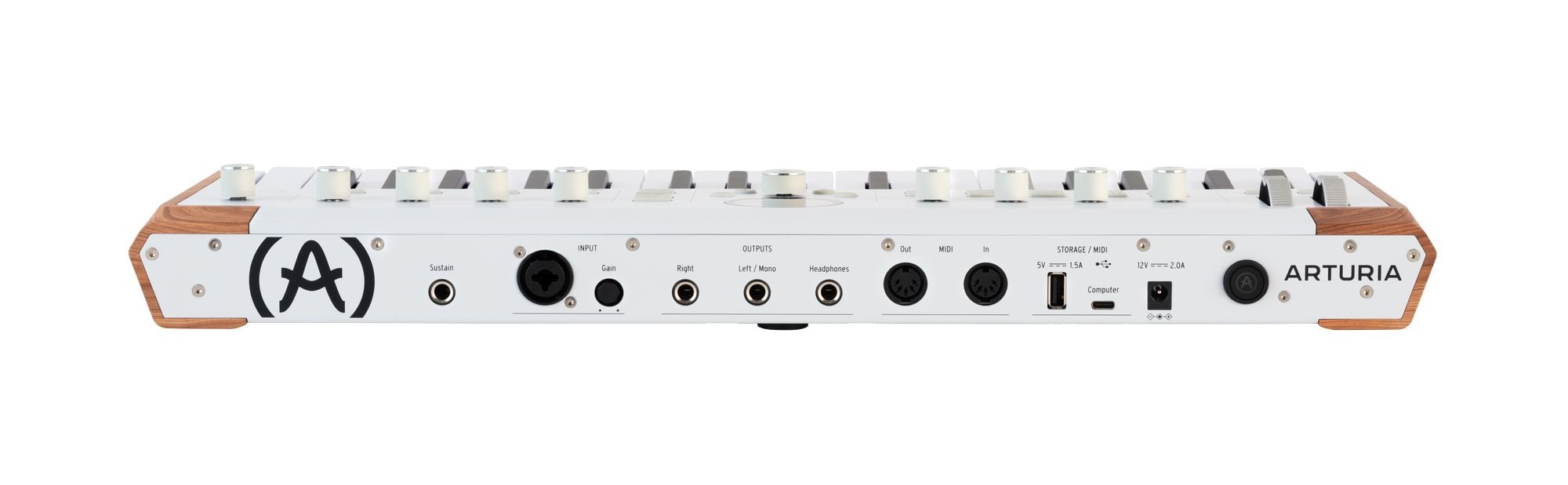
USB Type-C connects computers or mobile devices. AstroLab 37 also has Wi-Fi and Bluetooth. USB-A accepts storage and MIDI controllers, and full-size MIDI DIN input and output are provided. Line and headphone outputs use TRS. A combo XLR/TRS input accepts a microphone or another analogue source. The synth cannot apply its ordinary processing to incoming audio, but Vocoder V can use it. Pedal connection is limited to one TRS sustain socket.

A full Analog Lab Pro licence is included. It works standalone or as a VST, AU or AAX plug-in in a DAW. Both modes fully integrate with AstroLab and can be used alongside its hardware sounds.
This is useful in the studio and while arranging. Playing the AstroLab hardware gives zero computer-monitoring latency, regardless of computer power, buffer size or DAW project load. The performance can simultaneously be recorded to an Analog Lab Pro track with the matching preset.

The AstroLab 37 has a three-octave mini keyboard with velocity sensitivity and aftertouch. Its feel is good, similar to Arturia controllers but slightly firmer and quieter. Velocity curves are Light, Medium and Heavy. Aftertouch offers Linear, Logarithmic and Exponential response curves with different pressure responses.
AstroLab 37 line-output quality meets expectations for a modern stage keyboard. Comparing its presets with the same Analog Lab Pro sounds through a studio interface confirms a suitable level of sound quality.
Conclusions
As we noted before, AstroLab successfully combines software flexibility with hardware reliability. These instruments work on stage and in the studio. The full-size AstroLab 61, and especially 88, suit more permanent setups. AstroLab 37 is ideal for travel or as an additional stage instrument.
We especially liked that the compact AstroLab 37 retains the larger models' full functions. DSP power, controls, Analog Lab integration and AstroLab Connect support remain. Its price is accessible for a hardware synthesizer, making the Arturia system available to more musicians.
Note. This is an adapted machine translation into English. It follows the “In simple terms” approach. Read the original article at https://prosound.ixbt.com/keyboards/arturia-astrolab37.shtml.