
MOTU 828 review and test – new-generation USB 3.2 rackmount studio converter
The MOTU 828 is a long-awaited 2024 release and the latest interface generation from an American recording specialist. We welcome its continued development and introduction of new technology rather than simply relying on earlier success.
Take care when searching: the same name may return the 828 mk3 Hybrid, an old model from 12 years earlier. LED meters, a green matrix display and combined USB 2.0/FireWire identify it. The new MOTU 828 is much more advanced in appearance, specifications and sound.
MOTU 828 main features
- USB 3.2 Gen 1 Audio interface with new-generation hardware, backward compatible with USB 2.0
- 60 total channels over 5 Gbit/s USB3: 28 inputs and 32 outputs, including two combo XLR/TRS mic/line/guitar inputs with individual SEND and RETURN, 8 TRS analogue line inputs/outputs, separate XLR main outputs, two eight-channel optical I/O banks, stereo RCA S/PDIF I/O and two front headphone outputs
- New 3.9-inch display: bright high-resolution 24-bit RGB LCD with 480 × 128 pixels provides metering for all analogue and digital I/O, detailed status and menu access to hardware settings
- Studio sound quality and high-class converters: ESS Sabre32 DAC delivers 125 dB dynamic range, with all standard sample rates up to 192 kHz supported
- Ultra-low latency and reliable MOTU drivers: round-trip latency (RTL) is just 2 ms at 96 kHz with high-performance DAW hosts.
- High-quality firmware and drivers work with any audio application. Connect an iPad over USB-C or through a separately purchased Lightning adapter.
- Improved microphone preamps provide clear sound with -114 dB THD+N and 118 dB dynamic range, plus -129 dBu equivalent input noise (EIN). Each microphone channel has separate controls for gain up to +74 dBand a -20 dB pad
- When the front microphone inputs are unused, the rear returns become extra line inputs with the same performance as the other eight line inputs
- Hardware DSP mixing and processing: 24-input digital mixer with 8 stereo buses and effects including reverb, 4-band EQ, gate and compressor
- Wi-Fi control through CueMix 5 on mobile devices or other computers on the same network, including multiple simultaneous devices with password protection
- Analogue input/output level adjustment in 1 dB steps and polarity inversion
- Control-room features: Front-panel Talk button for speaking to the performer, plus A/B speaker selection for quick mix comparison on two studio monitor pairs
- Two independent headphone outputs: each can mirror the other, main outputs, another analogue output pair, a CueMix bus or USB playback channels
- Two optical I/O banks: 16 ADAT channels at 44.1/48 kHz, or 8 S/MUX channels at 88.2/96 kHz. Bank A can instead provide stereo TOSLink optical S/PDIF I/O up to 96 kHz
- Footswitch input for a separately purchased pedal to control a function hands-free while recording
- MIDI in/out/thru: connect MIDI devices without a separate interface
- Inputs and outputs for WordClock: supports sample rates up to 192 kHz
- Loopback for live streaming or podcasting
- Reamping: send an unprocessed recording through different amps, cabinets or modelling plug-ins to explore other sounds
- CueMix 5 app: mixer and settings control from Mac, PC or iOS
- Performer Lite: music workstation with more than 100 instruments, dozens of effects and 6 GB of loops; Ableton Live Lite is also included
The feature list covers professional commercial studio needs. If the budget allows, the MOTU 828 also suits personal and home studios.

The MOTU 828 box is about 50% larger than the interface itself. Inside are the interface, a good two-metre USB-C cable certified for USB 3.2 and a printed manual. For setup, it is easier to visit motu.com/828-start and watch the manufacturer's Windows and Mac software installation video.

The MOTU 828's strong aluminium case has a machined front and metal knobs. Rack ears fit a standard rack, but desk or shelf placement is also possible. There are no bottom vents, and the electronics stay cool. As usual for MOTU, combo sockets are from Amphenol. Gain, master and headphone controls are digital encoders with pleasant resistance. Paint and lettering quality are excellent. Front microphone/guitar sockets and two independent headphone outputs are convenient. Each headphone output can receive a separate source or submix through the control panel.

The rear connections are balanced and level-adjustable. MAIN OUT uses the large master knob; others are controlled in software. Any output signal or submix can also feed MAIN OUT. Expansion includes RCA SPDIF/Toslink and two ADAT banks adding 16 input and output channels. Word Clock integrates existing studio equipment. MIDI connects devices such as keyboards, and a pedal socket provides quick hands-free switching.
The table shows input and output performance and maximum signal levels:
| Connector | Dynamic range | THD+N | Signal level | |
|---|---|---|---|---|
| Line inputs | Balanced 1/4-inch TRS | 120 dBA | -114 dB | +16dBu |
| Line outputs | Balanced 1/4-inch TRS | 125 dBA | -114 dB | +18dBu |
| Microphone inputs | Balanced XLR | 118 dBA | -114 dB / -129 dBu EIN | +0 dBu without pad |
| Headphone output | 1/4-inch stereo TRS | 118 dBA | -110 dB | +14.4 dBu |
These are excellent figures with very low distortion, matching leading studio equipment. Our measurements below confirmed them. They are the best specifications among current MOTU products. The formal flagship, the Thunderbolt/AVB 828es introduced in 2017, specifies -108 dB input/output distortion, while this new model reaches -114 dB. Progress is clear.
The Thunderbolt MOTU 828es reaches 1.6 ms latency, while USB 3.2 on the new 828 is close at 2.0 ms. Other things being equal, we find the new model more interesting and much easier to connect to a computer.

A completely new digital section makes its first appearance. The large TI Sitara ARM Cortex-A15 processor supports USB 3.2 and includes a TI C66x hardware DSP with VLIW floating-point operations. This accelerates low-latency audio processing. Two nearby smaller chips provide DDR3 memory and power control. The digital section has its own circuit board, as it should.

Recording uses an eight-channel 32-bit/768 kHz ADC, the AKM AK5578, rated at 121 dBA dynamic range and -112 dB THD+N. Beside it is its two-channel version, the AKM AK5572 with identical specifications.. Together they provide 10 independent recording channels.

As usual for MOTU, playback uses the eight-channel ES9026PRO with 124 dBA dynamic range and -110 dB THD+N. MOTU achieves even better finished-device figures than the chip specification, showing serious engineering work.

Like larger MOTU AVB interfaces, it uses PGA2500 digitally controlled analogue microphone preamps. EIN is -128 dBu and THD+N at 30 dB gain is only 0.0004%. Maximum gain of +74 dB supports very low-sensitivity dynamic and ribbon microphones. An OPA1688A drives headphones, with output increased from the standard 3.3 V RMS to 4 V RMS, enough for mainstream models.

The MeanWell supply accepts 100–240 V AC at 50/60 Hz. A front power button is another benefit: there is no need to reach around the case to find a rear switch.
We normally measure RTL at 44 kHz with a 64-sample buffer.

Here we obtained an excellent 5.8 ms, among our best results. MOTU also claims 2.0 ms at 96 kHz.

That is indeed achieved at 96 kHz with a small 32-sample ASIO buffer. It is useful for real-time software processing or virtual instruments, such as MIDI keyboard playing or guitar effects. A fast modern computer is needed. For ordinary tasks, chasing minimum latency is unnecessary: the delay is inaudible and does not affect sound quality.
ASIO diagnostics
Features:
Input channels: 30
Output channels: 32
Input latency: 91
Output latency: 235
Min buffer size: 16
Max buffer size: 4096
Preferred buffer size: 64
Granularity: -1
ASIOOutputReady - not supported
Sample rate:
8000 Hz - not supported
11025 Hz - not supported
16000 Hz - not supported
22050 Hz - not supported
32000 Hz - not supported
44100 Hz - supported
48000 Hz - supported
88200 Hz - supported
96000 Hz - supported
176400 Hz - supported
192000 Hz - supported
352800 Hz - not supported
384000 Hz - not supported
Input channels:
channel: 0 (Mic/Line/Inst In 1) - Int32LSB
channel: 1 (Mic/Line/Inst In 2) - Int32LSB
channel: 2 (Line In 3) - Int32LSB
channel: 3 (Line In 4) - Int32LSB
channel: 4 (Line In 5) - Int32LSB
channel: 5 (Line In 6) - Int32LSB
channel: 6 (Line In 7) - Int32LSB
channel: 7 (Line In 8) - Int32LSB
channel: 8 (Line In 9) - Int32LSB
channel: 9 (Line In 10) - Int32LSB
channel: 10 (Loopback In 1) - Int32LSB
channel: 11 (Loopback In 2) - Int32LSB
channel: 12 (S/PDIF In 1) - Int32LSB
channel: 13 (S/PDIF In 2) - Int32LSB
channel: 14 (Optical In A 1) - Int32LSB
channel: 15 (Optical In A 2) - Int32LSB
channel: 16 (Optical In A 3) - Int32LSB
channel: 17 (Optical In A 4) - Int32LSB
channel: 18 (Optical In A 5) - Int32LSB
channel: 19 (Optical In A 6) - Int32LSB
channel: 20 (Optical In A 7) - Int32LSB
channel: 21 (Optical In A 8) - Int32LSB
channel: 22 (Optical In B 1) - Int32LSB
channel: 23 (Optical In B 2) - Int32LSB
channel: 24 (Optical In B 3) - Int32LSB
channel: 25 (Optical In B 4) - Int32LSB
channel: 26 (Optical In B 5) - Int32LSB
channel: 27 (Optical In B 6) - Int32LSB
channel: 28 (Optical In B 7) - Int32LSB
channel: 29 (Optical In B 8) - Int32LSB
Output channels:
channel: 0 (Main Out L) - Int32LSB
channel: 1 (Main Out R) - Int32LSB
channel: 2 (Line Out 3) - Int32LSB
channel: 3 (Line Out 4) - Int32LSB
channel: 4 (Line Out 5) - Int32LSB
channel: 5 (Line Out 6) - Int32LSB
channel: 6 (Line Out 7) - Int32LSB
channel: 7 (Line Out 8) - Int32LSB
channel: 8 (Line Out 9) - Int32LSB
channel: 9 (Line Out 10) - Int32LSB
channel: 10 (Phones 1L) - Int32LSB
channel: 11 (Phones 1R) - Int32LSB
channel: 12 (Phones 2L) - Int32LSB
channel: 13 (Phones 2R) - Int32LSB
channel: 14 (S/PDIF Out 1) - Int32LSB
channel: 15 (S/PDIF Out 2) - Int32LSB
channel: 16 (Optical A 1) - Int32LSB
channel: 17 (Optical A 2) - Int32LSB
channel: 18 (Optical A 3) - Int32LSB
channel: 19 (Optical A 4) - Int32LSB
channel: 20 (Optical A 5) - Int32LSB
channel: 21 (Optical A 6) - Int32LSB
channel: 22 (Optical A 7) - Int32LSB
channel: 23 (Optical A 8) - Int32LSB
channel: 24 (Optical B 1) - Int32LSB
channel: 25 (Optical B 2) - Int32LSB
channel: 26 (Optical B 3) - Int32LSB
channel: 27 (Optical B 4) - Int32LSB
channel: 28 (Optical B 5) - Int32LSB
channel: 29 (Optical B 6) - Int32LSB
channel: 30 (Optical B 7) - Int32LSB
channel: 31 (Optical B 8) - Int32LSB
Loopback In provides virtual channels for streaming input and output audio online.

Although any device on the local network can control the MOTU 828, CueMix 5 is a separate application with a scalable interface suited to modern HiDPI displays.

Despite extensive I/O, the MOTU 828 is simple to operate. Tabs group channel meters and controls, and the same meters appear on the front display.

MOTU releases firmware updates promptly. The current version worked reliably throughout our test.

Each channel has hardware 4-band parametric EQ. Adjustable Q and selectable filter types for the outer bands are particularly useful.

The gate and compressor have standard controls without analogue-device modelling. Specific external hardware processing can be inserted through SEND and RETURN on the first two channels.

Reverb uses a separate effects bus with shared settings. All effects sound good and are useful in practice.
RMAA PRO measurements
We measured with TRS outputs connected to interface inputs.
| Device under test | [ASIO] MOTU Gen 5 |
| Operating mode | 24-bit, 44 kHz |
| Audio interface | ASIO |
| Signal path | External loopback (line-out - line-in) |
| RMAA version | 6.4.5 PRO |
| 20 Hz–20 kHz filter | YES |
| Signal normalization | YES |
| Level change | -0.8 dB / -0.8 dB |
| MONO mode | NO |
| Calibration signal frequency, Hz | 1000 |
| Polarity | Correct/correct |
| Frequency response variation (40 Hz–15 kHz), dB | +0.03, -0.10 |
Excellent |
| Noise level, dB(A) | -121.1 |
Excellent |
| Dynamic range, dB(A) | 120.7 |
Excellent |
| Harmonic distortion, % | 0.00014 |
Excellent |
| Harmonic distortion + noise, dB(A) | -109.1 |
Excellent |
| Intermodulation distortion + noise, % | 0.00045 |
Excellent |
| Stereo crosstalk, dB | -120.4 |
Excellent |
| Intermodulation at 10 kHz, % | 0.00046 |
Excellent |
| Overall rating | Excellent |
24-bit/44 kHz measurements are on a separate page.
The excellent result confirms the high specifications.
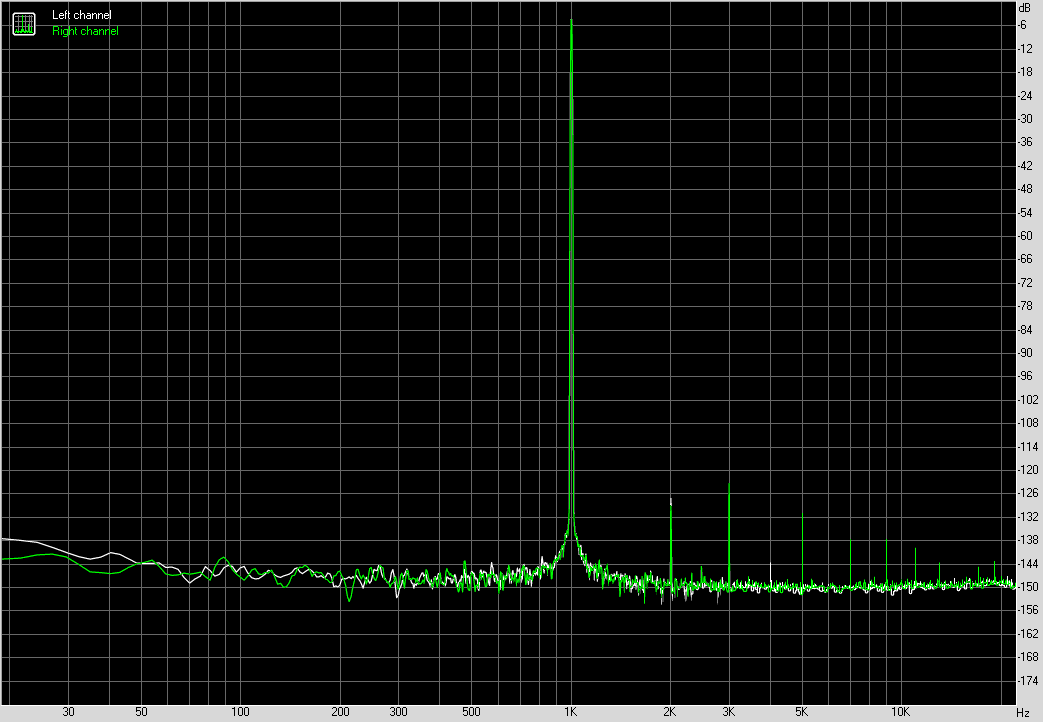
Distortion is very low, with a clean harmonic spectrum dominated by the 2nd and 3rd harmonics.
MOTU's digital controls use fixed 1 dB steps. This suits human loudness perception and is convenient. Encoders also last longer than potentiometers, which can have channel imbalance and develop noise with age.

We did not need USB 3.2's full capacity because our tasks did not require 30 simultaneous channels. Everyday operation was excellent, with precise dB values, calibrated meters and peak indication. The display is finally bright and high-quality, with high-resolution graphics.
Besides I/O meters, it can show main settings for standalone use over ADAT.


We compared the MOTU 828 with our regularly used M2, recording voice through a Neumann TLM 103. Both gave excellent professional results, with slightly greater clarity from the 828. To us, its AKM ADC adds a pleasant warmth compared with the ESS ADCs in recent MOTU models, but the difference is extremely small. We also prefer the 828's line and headphone playback.
Conclusions
We liked the MOTU 828 very much. Other MOTU interfaces also perform well, but the top model's converters and extremely low distortion make work especially pleasant. Operation is simple, and its appearance and high-quality display appealed to us. Hardware effects let it replace a live-event mixer, with remote Wi-Fi control from a laptop or iOS CueMix app. Ten analogue inputs and 14 analogue outputs handle demanding studio tasks, with two eight-channel ADAT banks for further recording expansion.
Note. This is an adapted machine translation into English. It follows the “In simple terms” approach. Read the original article at https://prosound.ixbt.com/interfaces/motu-828.shtml.